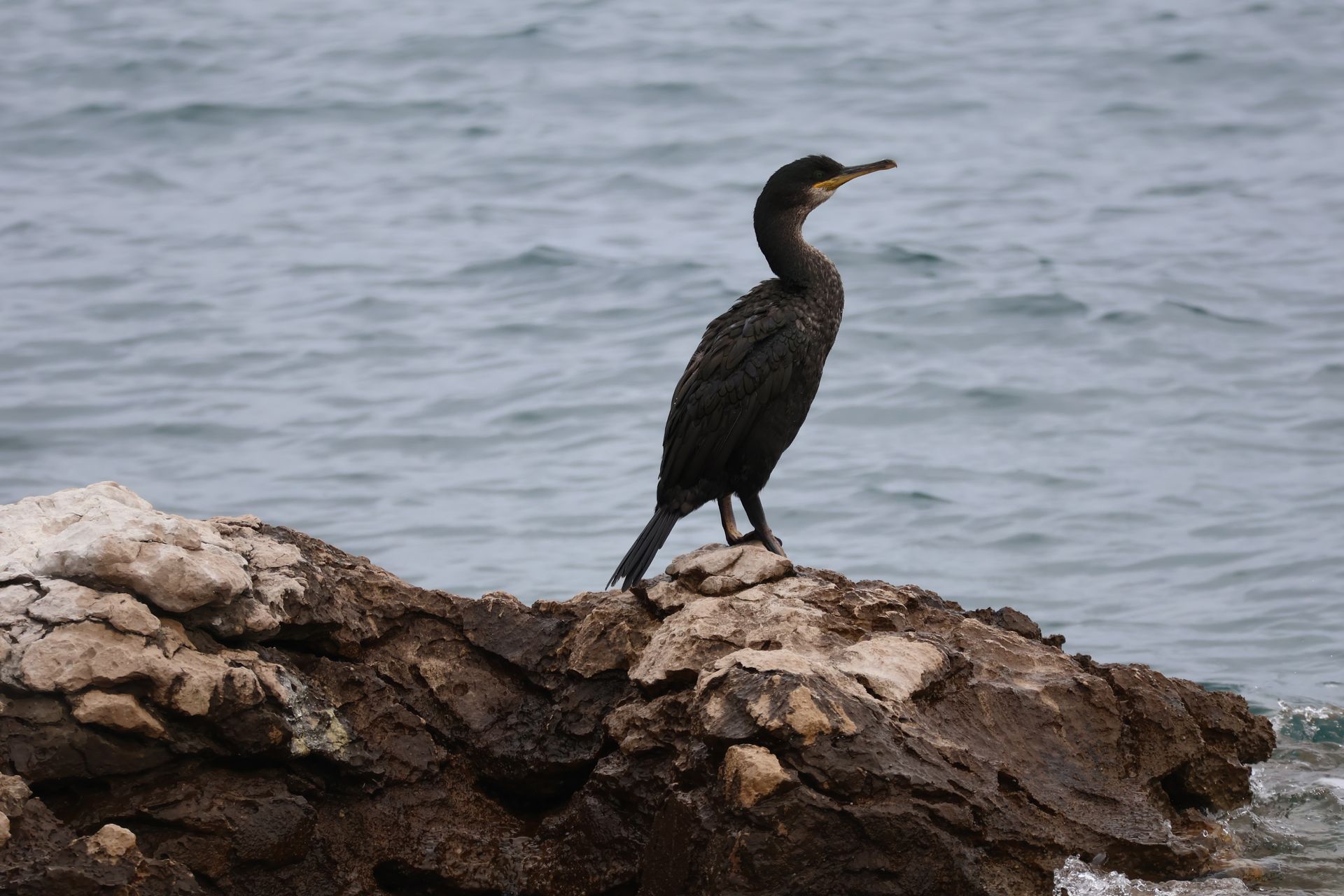
The Phalacrocorax penicillatus, also known as the Double-crested Cormorant, is a large waterbird with a distinctive appearance.
It has a black body, a white throat patch, and a distinctive double crest on its head.
The Double-crested Cormorant is found in coastal areas, including beaches, estuaries, and islands, where it can be seen perched on rocks or swimming in the water.
These birds are known for their impressive diving abilities, with some individuals reaching speeds of up to 50 km/h.
Habitat and Distribution
The Brandt's cormorant is closely tied to the California Current, which delivers cold water down the Pacific Coast from Alaska to the Baja Peninsula.
This upwelling of nutrients along the coast between central Oregon and southern California is a magnet for smaller fish like anchovies and sardines, which are the cormorant's preferred food.
Brandt's cormorants develop nesting colonies on rocky offshore islets, where they can safely raise their young.
They feed away from these nesting areas, floating in deeper coastal waters where spawning fish populations are more abundant.
Brandt's cormorants are frequent travelers, moving around to find the best places to fish and take advantage of the rich food sources along the California Current.
Behavior and Feeding
Brandt's cormorants are clumsy on land, but they're incredible divers, capable of reaching depths of 55 to 70 meters in search of food.
They prefer to stay low over the water when flying, avoiding land altogether, and can often be seen forming large rafts over open water.
These rafts are actually floating groups of birds, and they dive deep in flocks, circling fish into tighter schools for easier feeding.
In fact, Brandt's cormorants prefer deep water to hunt, unlike some other cormorant species that feed closer to shore or in bays.
By working together in these large flocks, they're able to corral their prey and make mealtime much more convenient.
Life Cycle
Reproduction begins with the arrival of males to build nests in early spring, often in the same location as the previous season.
Males spread their wings, point their beaks to the sky, and tilt their heads back to show off their bright blue gular pouch, which catches the female's eye.
Females choose males based on their display of plumage rather than nest-building skills, as both sexes share in the complex labor of nest construction.
About three eggs result from these encounters, and older birds show greater reproductive success, arriving earlier and producing more clutches of eggs if predators steal the first clutch.
A study of Brandt’s cormorant colonies in the Farallon Islands, California, estimated that 70% of males return to the same nest, versus just 32% of females.
Young birds leave the nest and may remain away a year or more before returning to breed, with females breeding at two to three years of age, a year earlier than males.
Nestlings are fully feathered by the time they fledge at 5 to 6 weeks old, and the oldest Brandt’s cormorants live up to 18 years.
Species Information
The phalacrocorax penicillatus, also known as the Brandt's cormorant, is a medium-sized cormorant found in the Pacific coast of North America.
They can grow up to 27-33 inches in length and weigh between 1.5-3.5 pounds, with a distinctive white patch on their forehead.
These birds are excellent divers, with the ability to dive to depths of up to 100 feet in search of fish and other aquatic prey.
Common Name
The species has several common names, but one of the most widely recognized is the "Red Fox" due to its distinctive reddish-orange fur. This name is often used interchangeably with its scientific name, but it's worth noting that not all foxes have this coloration.
In some parts of the world, the species is also known as the "Silver Fox" due to its thick, gray coat that turns white in the winter. This adaptation helps the fox blend in with its snowy surroundings.
The "Corsac Fox" is another common name for this species, particularly in Eastern Europe and Central Asia. This name is thought to be derived from the Turkic word for "fox".
Conservation Status
The conservation status of this species is a pressing concern. Unfortunately, it is listed as Critically Endangered due to habitat loss and fragmentation.
Habitat loss and fragmentation are major contributors to the decline of this species. The species' dependence on a specific type of habitat makes it highly vulnerable to changes in its environment.
The species' population has been declining steadily over the past few decades. In fact, the population has dropped by more than 50% in the past 10 years alone.
Conservation efforts are underway to protect the remaining habitats and reintroduce the species to suitable areas. However, more needs to be done to address the root causes of the decline.
Brandt's Cormorant in La Jolla
Brandt's Cormorants are a common sight in La Jolla, California, often seen perched on rocks or diving into the ocean.
These birds are known to form large colonies, with some colonies in La Jolla having thousands of individuals.
In La Jolla, Brandt's Cormorants are often seen alongside other bird species, such as the Western Gull.
Brandt's Cormorants in La Jolla can be identified by their distinctive black plumage and white throat patches.
They are also known to be skilled divers, capable of reaching depths of up to 60 feet in search of food.
Phalacrocorax Penicillatus
The Phalacrocorax penicillatus, also known as the Brandt's Cormorant, is a fascinating bird species. It's a marine bird that inhabits the Pacific coast of North America, from Alaska to the Gulf of California.
This bird is strictly a marine species, and its distribution is quite extensive, spanning from Alaska to the Gulf of California. During the summer, it can be found in these areas, but it migrates south during the winter, with the population north of Vancouver Island moving to warmer climates.
The name "penicillatus" is Latin for "painter's brush", which refers to the white feathers on the bird's neck and back during breeding season. This is a unique feature of the species, and it's quite striking to see.
The Brandt's Cormorant is an opportunistic feeder, feeding on small fish that it finds on the ocean floor. It uses its webbed feet to propel itself underwater, where it can reach depths of up to 12 meters in search of food. The most common prey species for this bird varies by location, but it tends to feed on species like the Sebastes and the Pacific herring.
Check this out: American White Ibis Bird
During breeding season, the adults have a distinctive blue patch on their neck feathers. This is a unique characteristic of the species, and it's a great way to identify them. The birds also nest on the ground or on rocky outcroppings, often in large colonies.
Here's a list of some of the key characteristics of the Phalacrocorax penicillatus:
- Found on the Pacific coast of North America, from Alaska to the Gulf of California
- Marine bird that feeds on small fish
- Can reach depths of up to 12 meters in search of food
- Has a distinctive blue patch on its neck feathers during breeding season
- Nests on the ground or on rocky outcroppings
Frequently Asked Questions
What are the predators of Brandt's cormorant?
Brandt's cormorant eggs and young are preyed upon by crows, ravens, and western gulls, while adults are often caught in fishing nets
Do Brandt's cormorants mate for life?
Yes, Brandt's Cormorants are known to form long-term monogamous relationships, with elaborate mating rituals helping them select a partner for life. This unique behavior is a key aspect of their breeding and social habits.
Which cormorant has a blue throat?
The Brandt's cormorant has a blue throat, specifically a blue gular pouch that appears during the breeding season. This distinctive feature is used in courtship displays.
Featured Images: pexels.com