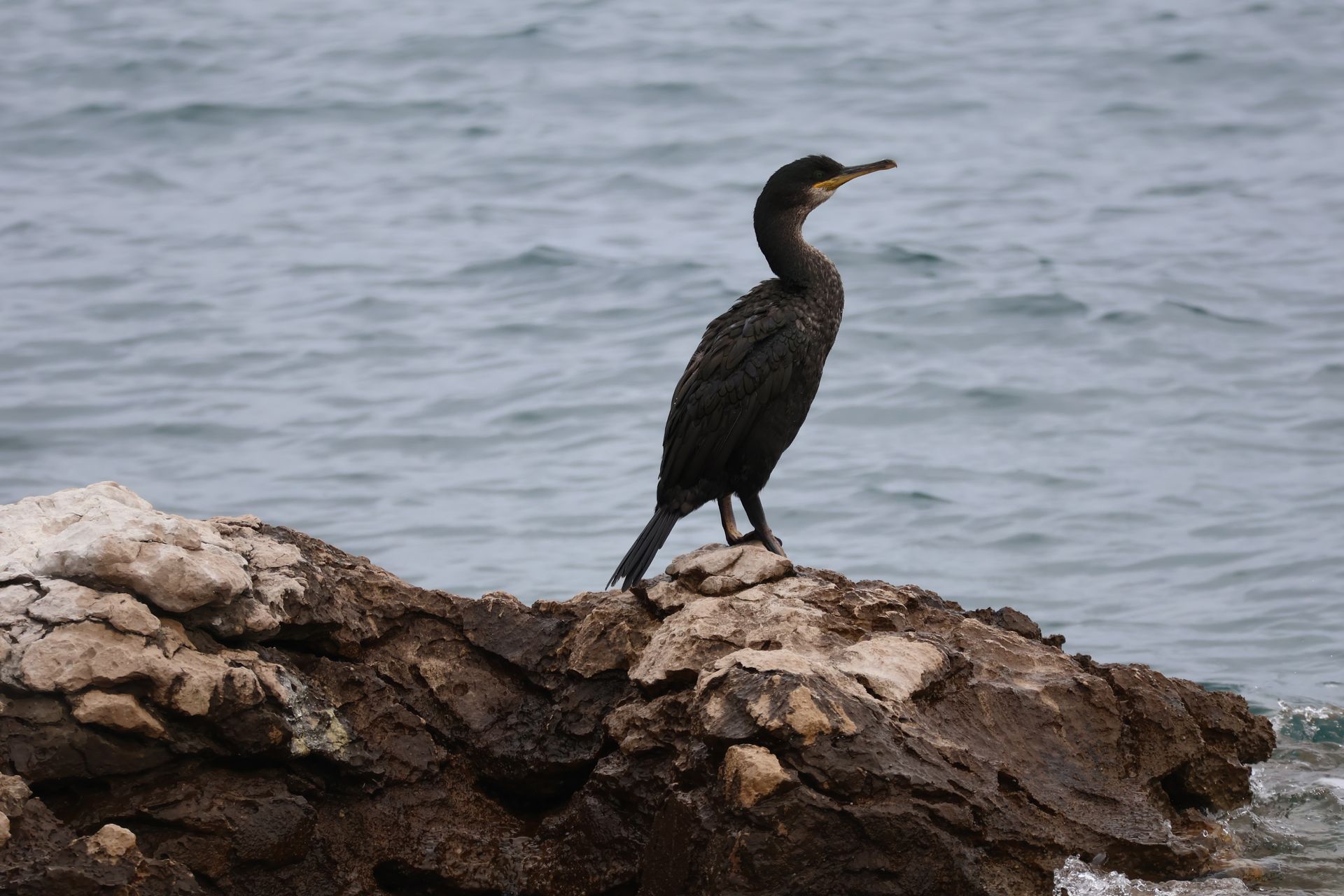
The Phalacrocorax varius varus bird species is a unique and fascinating creature.
They are a type of cormorant, a group of medium to large-sized seabirds.
Found in the coastal regions of Australia, these birds are well adapted to their marine environment.
Their distinctive black and white coloring serves as effective camouflage in their saltwater habitat.
Phalacrocorax varius varus birds are carnivores, feeding on a variety of fish and crustaceans.
Explore further: Phalacrocorax Penicillatus
Physical Characteristics
The pied cormorant is predominantly black on its back and upper surface of the wings and white on the underside. Males weigh approximately 2.2 kg and females 1.7 kg.
It stands between 65–85 cm tall, with a wingspan of 110–130 cm. The bird has large webbed feet which it utilises to pursue fish underwater.
A small yellow patch between the bill and the eye on each side of the head is likely to have been the reason for the historical common name. The eyes have a special nictitating membrane for underwater protection.
The bird has a large hooked bill, green eyes with a blue eye ring and black legs and feet. This lack of feather waterproofing may help the cormorant spend longer underwater due to decreased buoyancy effects.
The two subspecies have slight differences in physical characteristics.
Explore further: Black Legged Kittiwake
Habitat and Distribution
The pied cormorant, or phalacrocorax varius varius, can be found in a wide range of habitats, from coastal areas to inland wetlands and rivers.
In New Zealand, its range extends as far south as Christchurch, a recent extension that's likely due to recolonization of its former range. The population has grown significantly since the early 1900s, when it was heavily persecuted, and now estimates around 3,000 breeding pairs.
In Australia, the pied cormorant is moderately common in the eastern states, both on the coast and in inland wetlands, but abundant in the south-west, particularly along the coast. It's found in all states except Tasmania.
The pied cormorant is a adaptable species, able to thrive in various water conditions, including variable salinity, turbidity, and shoreline vegetation. As long as there are available perches, it seems unaffected by these factors.
In New Zealand, the pied cormorant prefers coastal areas close to its prey, while in Australia, it can be found at inland waterways. Adult birds are sedentary and can often be seen roosting in trees, on rocks, or logs in the water.
The pied cormorant's conservation status varies by region, with it listed as "least concern" globally, "Nationally Vulnerable" in New Zealand, and "secure" in Australia, except in Victoria, where it's considered "near threatened".
Behavior and Ecology
Pied shags are generally sedentary birds, but some juveniles disperse widely.
They can be found resting on undisturbed beaches, shoreline rocks, trees, and artificial structures during the day.
Adult pied shags return to nesting colonies or favoured roosts in trees near water for the night, often gathering in small groups where prey is readily available.
Pied shags use alternate feet when swimming slowly at the surface, but use both feet at the same time for propulsion when foraging underwater.
They typically forage in water less than 10 m deep.
As a solitary forager, pied shags are not often seen in large groups, but will gather where food is plentiful.
For another approach, see: Malayan Water Monitor Lizard
Life Cycle and Reproduction
Pied cormorants prefer to breed in small groups, typically with fewer than 30 pairs, in sheltered places like harbors, estuaries, and lakes.
Their nests are large platforms made of sticks and leaves, held together with droppings, and are usually about 80 centimeters wide.
Males collect most of the nest material, while both parents help build the nest, which is used twice a year by different pairs in autumn and spring.
Some younger or less experienced pairs might breed in summer and winter, and the nests can be built on the ground or in trees.
Pied cormorants are monogamous, staying with one partner, and start breeding from two years old, laying eggs once a year with an average breeding cycle of 6 months.
They usually lay 2–5 eggs, which hatch after 25–33 days, and both parents share the duties of caring for the eggs and young birds.
Raising the chicks takes 47–60 days, and they become independent just over 3 months old, with both parents feeding the chicks by partly throwing up food for them.
Classification and Similarity
The Australian pied cormorant, also known as Phalacrocorax varius, is a medium-sized bird of the cormorant family.
It's recognized by its distinctive black and white plumage, with a black back and upper wings, and a white underside. Males are larger than females, weighing around 2.2 kg compared to the females' 1.7 kg.
This species stands tall at 65–85 cm with a wingspan of 110–130 cm, making it a striking sight to behold.
For your interest: Black Faced Spoonbill
Phalacrocorax Varius
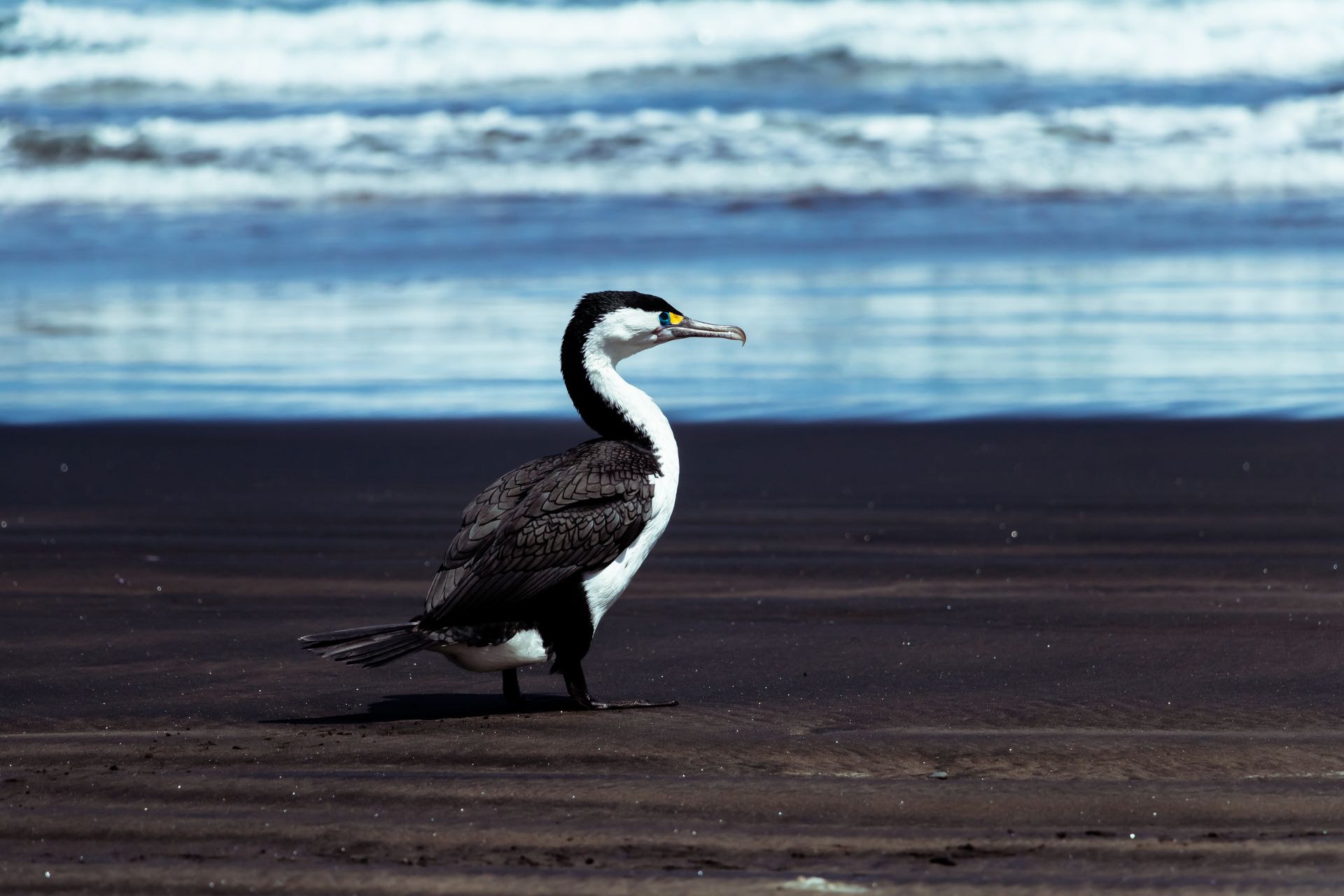
The Australian pied cormorant, also known as the pied cormorant, pied shag, or great pied cormorant, is a medium-sized bird of the cormorant family.
Males are larger than females, weighing around 2.2 kg compared to females' approximately 1.7 kg.
It stands tall at 65–85 cm with a wingspan of 110–130 cm.
A distinctive yellow patch between the bill and eye may have inspired the historical name "yellow-faced cormorant."
Related reading: Phalacrocorax Perspicillatus
Similar Species
The black-faced cormorant is slightly smaller than the great cormorant.
The little pied cormorant is substantially smaller than both the black-faced and great cormorants.
These differences in size are noticeable when comparing the three species side by side.
The black-faced cormorant is slightly smaller, while the little pied cormorant is substantially smaller.
Conservation Status
The pied cormorant, also known as phalacrocorax varius varius, is listed as Least Concern on the IUCN Red List due to its large range and stable population.
However, in New Zealand, the situation is a bit more complex, with the species listed as Nationally Vulnerable. Unfortunately, this means that conservation efforts are still needed to protect this bird.
Historically, the pied cormorant population in New Zealand had declined, but it's now showing signs of recovery.
Take a look at this: Eastern Gray Squirrel Population Distibution Pattern
Featured Images: pexels.com