
Pangshura species are a group of freshwater turtles that belong to the family Geoemydidae. They are native to the Indian subcontinent and parts of Southeast Asia.
Pangshura species are generally medium-sized, with most species reaching a carapace length of around 20-30 centimeters. Some species, like the Pangshura tecta, can grow larger, up to 35 centimeters.
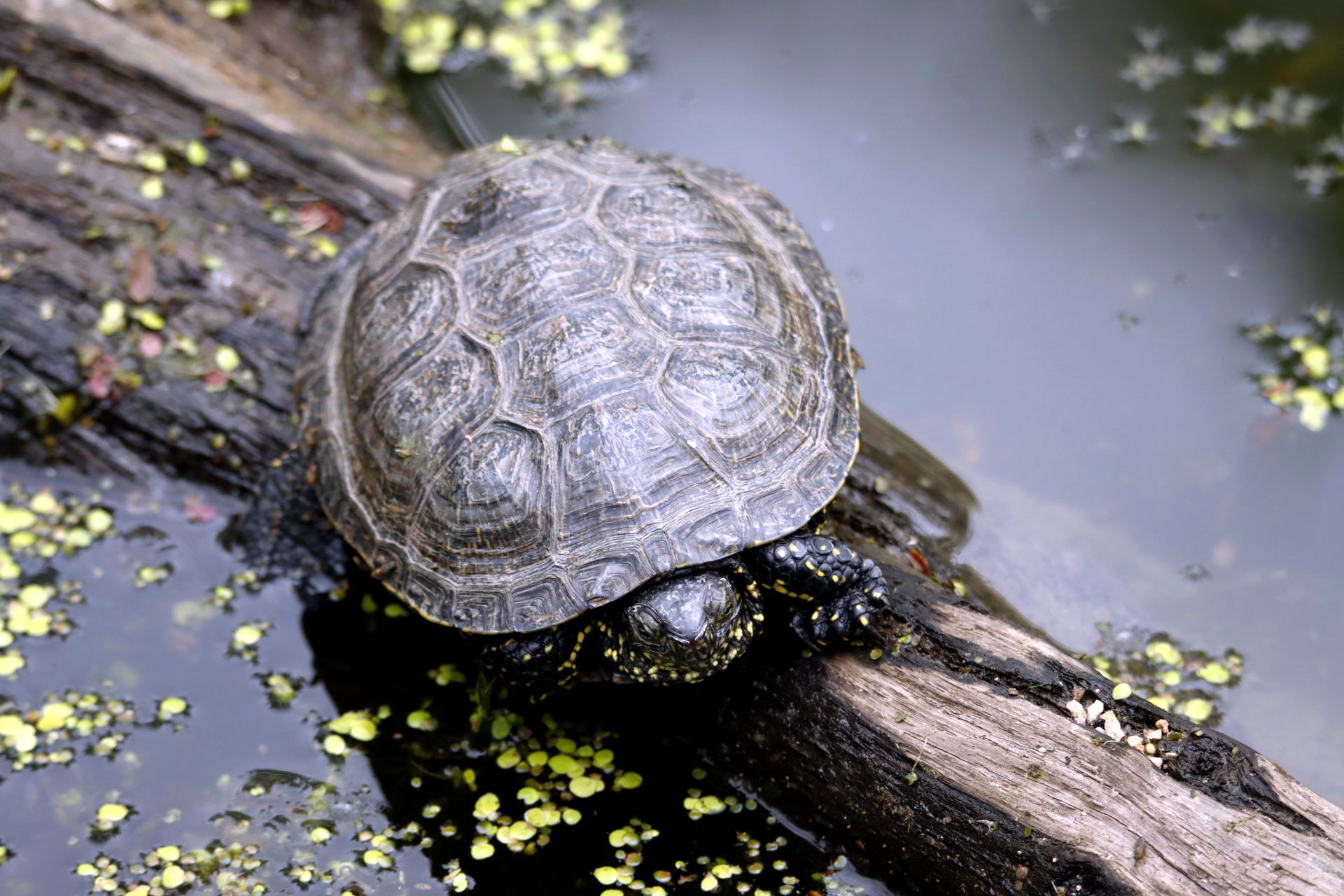
These turtles have a distinctive appearance, with a brown or yellowish-brown carapace and a yellow or orange belly. The Pangshura tecta, for example, has a brown carapace with yellow stripes.
Pangshura species are primarily herbivores, feeding on aquatic plants and algae.
Here's an interesting read: Box Turtles of North America
Species Information
The Indian Roofed Turtle, also known as Pangshura tecta, is a fascinating species that can be found in various parts of the Indian subcontinent.
This turtle belongs to the family Geoemydidae and is classified under the suborder Testudines.
Pangshura tecta is a freshwater turtle that inhabits rivers, swamps, and other aquatic environments.
Its carapace shape is quite distinctive, earning it the name "roofed" turtle, as mentioned in the species' etymology.
The type locality of this species is India, and it can be found in countries such as Pakistan, India, Bangladesh, Nepal, and possibly Bhutan.
Pangshura tecta is oviparous, meaning it lays eggs.
Here is a list of the countries where Pangshura tecta can be found:
- Pakistan
- India (Ganges, Brahmaputra, Indus drainages, Assam, Madhya Pradesh, Gujarat, Jammu and Kashmir, Punjab)
- Bangladesh
- Nepal
- Possibly Bhutan
Genome and Phylogeny
Phylogenetic relationships of Testudines mitogenomes were assessed using Bayesian analysis and maximum-likelihood methods.
The first dataset included 52 Testudines mitogenomes, including Pangshura sylhetensis, and treated Pleurodiran species as out-group taxa.
Most previous studies used limited taxa to infer the phylogenetic position of Testudines relative to other amniotes, so a second dataset was prepared with 52 Testudines and 11 other amniotes mitogenomes.
The sperm whale was used as out-group taxon in the second dataset.
Sequences of all PCGs were concatenated using SequenceMatrix v1.7.84537.
NADH dehydrogenase subunit 6 (nad6) is encoded on the light-strand, so its reverse complement was used for phylogenetic tree construction.
The suitable models for phylogenetic analyses were estimated by partitioning of each gene using PartitionFinder 2.
The evolutionary pathways within Testudines were inferred using TreeREx analysis to check the gene arrangement scenario.
TreeREx analysis can distinguish putative gene orders at internal nodes of a reference tree and works in a bottom-up manner through iterative analysis of triplets or quadruplets of gene orders.
The most consistent nodes in TreeREx analysis are considered to be most reliable and marked by green color.
Insertion, deletion, and duplication of genes were reviewed in the analysis of the gene arrangements dataset of 52 Testudines.
Gene Arrangements
The researchers used TreeREx analysis to infer the evolutionary pathways within the Testudines, leading to the observed diversity of gene orders.
This analysis allowed them to distinguish putative gene orders at internal nodes of a reference tree.
The most consistent nodes are considered to be most reliable and marked by green color, whereas nodes with the highest level of uncertainty are marked by red color.
The researchers used the default settings of TreeREx suggested on the website to analyze every node of the reference phylogenetic tree.
To finalize the gene arrangements dataset of 52 Testudines, the insertion, deletion, and duplication of genes were reviewed as discussed in previous studies.
The researchers used a reference phylogenetic tree to analyze the gene arrangements of the Testudines.
The TreeREx analysis was adopted to infer the evolutionary pathways within the Testudines, leading to the observed diversity of the gene orders.
Gene arrangements play a crucial role in understanding the evolutionary history of the Testudines.
By analyzing the gene arrangements, the researchers were able to identify the most consistent nodes and mark them with green color.
The researchers also reviewed the insertion, deletion, and duplication of genes to finalize the gene arrangements dataset.
The default settings of TreeREx were used to analyze the gene arrangements of the Testudines.
Pangshura Sylhetensis
The Assam roofed turtle, Pangshura sylhetensis, is a small freshwater turtle that can only grow up to 185 mm in length.
It's a member of the Geoemydidae family and is known for its strikingly spiked vertebral keel.
The species is strongly sexually dimorphic, with females growing up to 185 mm in length and males reaching a maximum of 97 mm.
Pangshura sylhetensis occurs primarily in running waters in the hills of northeastern India and northeastern and southeastern Bangladesh.
It's a rare and localized species, with little information available on its biology.
The species nests between late October and February, corresponding with the cool, dry season.
Pangshura sylhetensis produces clutches of around 6-12 eggs, with hatchlings appearing mainly between March and April.
This species is threatened by logging of primary forests, causing siltation, as well as capture for food and the pet trade.
Pangshura sylhetensis is listed as Endangered on the IUCN Red List and is protected under the Indian Wildlife (Protection) Act.
Habitat and Distribution
The Pangshura species can be found in a variety of habitats across India, including Arunachal Pradesh, Meghalaya, and Northern and Eastern India.
It has a wide distribution, covering several countries including Bangladesh, India, Nepal, Pakistan, and Bhutan.
The Pangshura species is widespread across India, with the exception of south India.
It can be found in various states in India, including Arunachal Pradesh, Assam, Bihar, Gujarat, Haryana, Madhya Pradesh, Meghalaya, Odisha, Punjab, Rajasthan, Uttar Pradesh, Uttarakhand, and West Bengal.
Frequently Asked Questions
How big are Indian roofed turtles?
Indian roofed turtles can grow up to 230 mm in size. They have a relatively compact shell, typical of hard shell turtles.
Featured Images: pexels.com