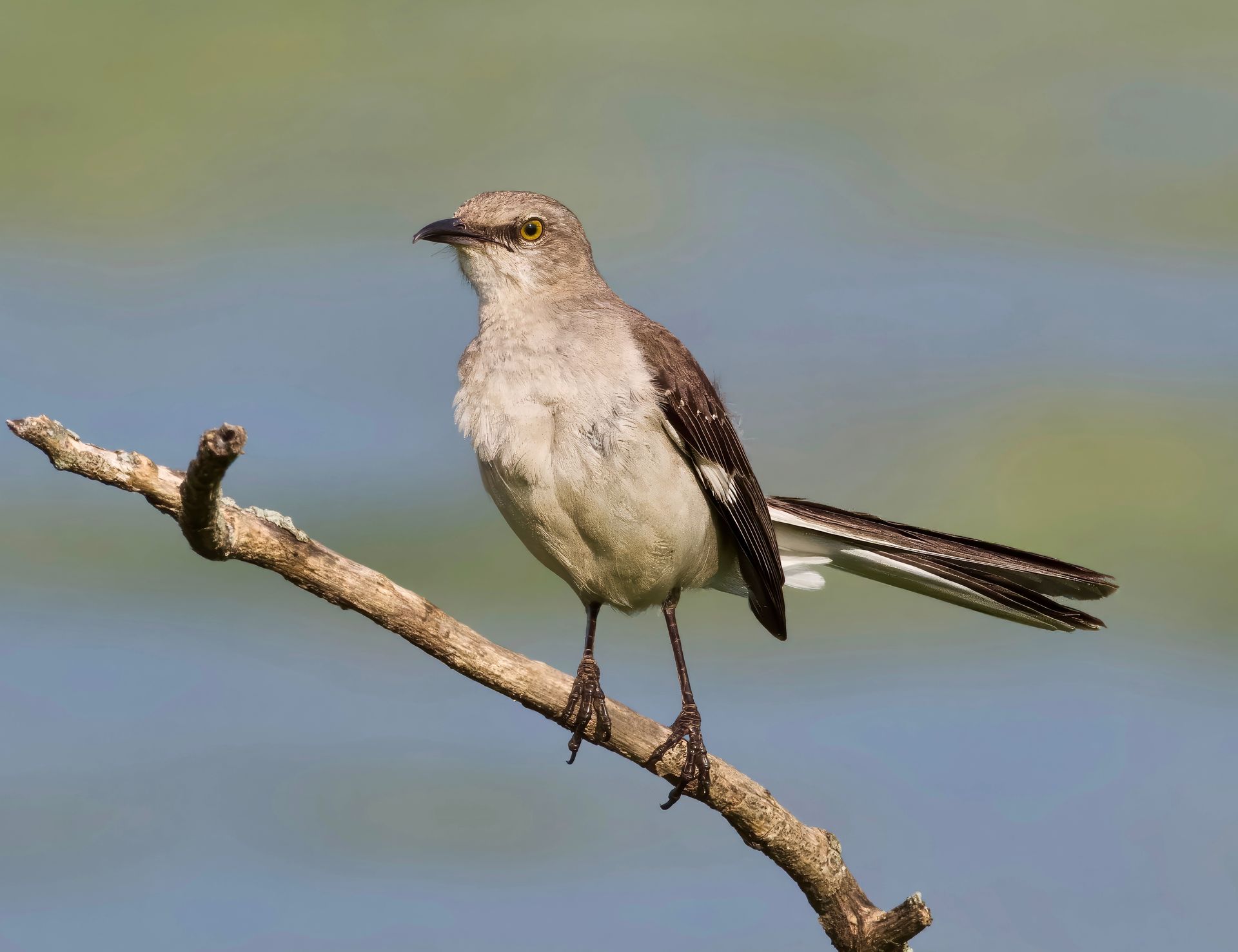
The Northern Mockingbird is a bird species that thrives in urban and suburban areas. They are known to inhabit backyards and parks with trees and shrubs.
One of the key factors in their habitat is the presence of dense vegetation, which provides them with shelter and protection. This is particularly important for their nesting sites.
Northern Mockingbirds are also known to be territorial birds, defending their territory from other birds and animals. They will fiercely defend their food and nesting sites.
In terms of food sources, Northern Mockingbirds are omnivores, eating a wide variety of insects, fruits, and berries. They are also known to eat small lizards and snakes on occasion.
Northern Mockingbird Habitat
Northern Mockingbirds live in a wide variety of habitats, including open areas with low shrubbery and sparse trees, thickets, scrub forests, grasslands, savannas, forest edges, and desert edges.
They also thrive in more urban areas, such as farms, pastures, suburbs, parks, and gardens. In these areas, they often forage in fruit trees, hedges, bushes, and more.
These birds prefer to nest in dense backyard shrubs, where they create cup nests. They also enjoy splashing about in birdbaths that are maintained year-round, especially if the water is moving.
Habitat Map
The Northern Mockingbird is a year-round resident in the contiguous United States, but it's a rare visitor to many areas in the northern U.S.
These birds can be found in open urban areas and shrublands, often hanging out at the edge of bushes close to eye level.
Their range has dramatically extended northward over the past 70 years, partially due to people planting bushes and trees that bear winter fruit.
Their nonmigratory nature allows them to thrive in various environments, making them a common sight in many parts of the country.
Mockingbird Habitat
Northern Mockingbirds live in a wide variety of habitats, including open areas with low shrubbery and sparse trees.
These birds prefer habitats like thickets, scrub forests, grasslands, savannas, forest edges, and desert edges. They're also found in more urban areas, such as farms, pastures, suburbs, parks, and gardens.
In these areas, they often forage in fruit trees, hedges, bushes, and more. They love to splash about in birdbaths that are maintained year-round, and moving water is even better.
Northern Mockingbirds are nonmigratory and can be seen throughout the contiguous United States. Their range has extended northward over the past 70 years, partially because of people planting bushes and trees that bear winter fruit.
They especially love to settle in gardens and orchards, and in areas where woods are relieved by fields. In these spots, they often find large clusters of trees, including swamp and white oaks, water tupelo, and elms.
In these clusters, they create cup nests in dense backyard shrubs and enjoy the fruits and insects that grow in the area. To attract them to your yard, try setting out raisins or grapes, and explore Audubon's Plants for Birds native plant database for more ideas.
Mockingbird Behavior
Northern mockingbirds are known for their complex social behavior, and one of the most fascinating aspects is their territorial defense. They will aggressively defend their territory from other mockingbirds and even other bird species.
Mockingbirds are also known to be fiercely loyal to their mates, with some pairs staying together for many breeding seasons. They will even go to great lengths to protect their young from predators.
In their natural habitat, northern mockingbirds can be seen singing from a high perch, often in the early morning or late evening. This is their way of establishing their territory and warning off potential intruders.
Flight and Food
The Northern Mockingbird's flight may not be the fastest, but it's surprisingly agile in its native haunts, flitting from tree to tree and thicket to thicket with ease.
In fact, it's completely at home among the branches of trees and shrubs, often descending to the ground to forage for insects and small fruits. The bird's diet consists of a variety of insects, including noxious species that it devours in immense numbers.
A Northern Mockingbird's favorite snack is the juicy poke-berries, which stain its plumage a deep purple. It's also particularly fond of the berries of the sparkle-berry bush, a favorite food source in Florida.
The bird's love of berries is matched only by its love of singing, with a single Mockingbird perched in a Magnolia grandiflora tree creating a truly unforgettable experience. The ringing notes of its song are a true delight, filling the air with music and beauty.
Consider reading: Bird Tracks in Snow Identification
Mockingbird Behavior
Mockingbirds are social birds that build their homes in shrubs, specifically in the fork of a shrub.
They lay a clutch of eggs, which can range from three to six in number, and these eggs are a beautiful blue or green color with brown splotches.
Juveniles look similar to adult birds, but they have a distinctive feature - specks on their chests.
It's fascinating to watch a mockingbird pair work together to build their nest, a cup-shaped structure that serves as a safe haven for their young.
For more insights, see: Northern Mockingbird Eggs
Mockingbird Distribution and Conservation
The Northern Mockingbird is a bird that's found in a wide range of habitats, from open areas with low shrubbery to more urban environments like farms, pastures, and parks.
They can be found from southeast Canada to southern Mexico and Central America, with some populations migrating south for the winter. In the northern parts of their range, they're seasonal breeders.
Mockingbirds have been expanding their territory northward, with records of them in New England dating back to the early 20th century. However, their population in New Hampshire peaked in the 1990s and has since stabilized at a lower level.
It's worth noting that mockingbirds are well-adapted to human environments, but their numbers may be affected by factors like increased development, forest succession, and changing agricultural practices.
Check this out: Sharp Tailed Grouse Range Map
Mockingbird Distribution
The Northern Mockingbird is a bird with a wide distribution, found from southeast Canada to southern Mexico and Central America. They can be found in various parts of the United States, including the Bahamas, Greater Antilles, and the Cayman Islands.
In the northern portions of their range, Mockingbirds migrate south for the winter. This is a crucial time for conservation efforts to protect their habitats and food sources.
From southeast Canada and Maine, Mockingbirds breed seasonally across to New Mexico and Arizona, and up to northern California and Oregon. They live year-round across the rest of the southern United States and Mexico.
In their various habitats, Mockingbirds can be found in open areas with low shrubbery and sparse trees, as well as in more urban areas like farms, pastures, suburbs, parks, and gardens.
Related reading: Southern Leopard Frog Habitat
Conservation Actions
The Northern Mockingbird's population in New Hampshire surged through the 1980s and became firmly established, but then fell just as quickly after peaking around 1990.
The current population is stable at low levels, with only a quarter as many birds as there were in the 1980s.
Mockingbirds occupy the same areas they did in the 1980s, but it's unclear why their numbers dropped in the Northeast.
It's likely that increased development, forest succession, and changing agricultural practices eliminated some of the shrubby thickets that mockingbirds prefer.
The Northern Mockingbird's singing prowess is a notable aspect of its behavior, with males capable of mimicking the songs of other birds, as well as sounds like barking dogs and car alarms.
A mockingbird in good form can cycle through a dozen or so copied bird songs over a few minutes, often flawlessly.
Males with higher song diversity are more likely to attract mates, and mockingbirds continue to add new elements to their repertoires as they age.
Mockingbird and Human Interaction
Humans and Mockingbirds usually coexist somewhat peacefully.
The Northern Mockingbird feeds on seeds and berries of ornamental plants, but the damage to the plant is usually minimal.
Bird watchers enjoy listening to the Mockingbird's song, and they often feed this species with birdfeeders.
Their populations are quite stable, and the IUCN lists the Northern Mockingbird as Least Concern.
Humans have not domesticated Mockingbirds in any way.
Frequently Asked Questions
How rare are northern mockingbirds?
Northern mockingbirds were once scarce in some areas due to overcollection for the pet trade, but their populations have since recovered and they are now common in many regions.
Are northern mockingbirds friendly?
Northern Mockingbirds are not typically friendly, as they can be aggressive when defending their territory or nest. They may attack people who approach too close, so it's best to keep a safe distance.
Featured Images: pexels.com