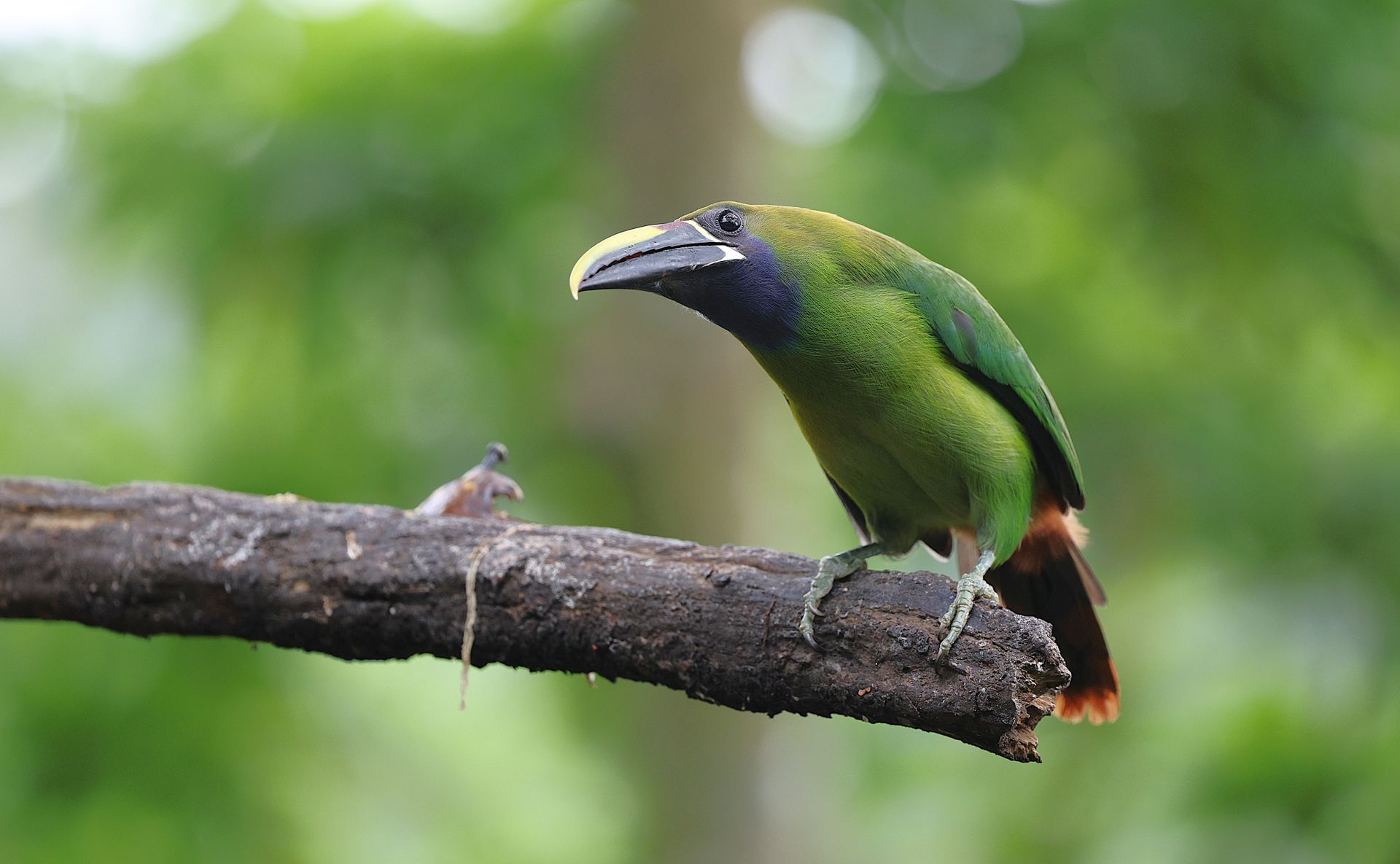
The northern emerald toucanet is a stunning bird species found in the tropical rainforests of Central America. They are relatively small, reaching a length of about 12 inches.
Their plumage is a vibrant mix of greens, blues, and yellows, with a distinctive red beak that's a key identifier. This striking coloration serves as a warning signal to potential predators.
In the wild, northern emerald toucanets are social birds that live in small groups, often foraging for fruit and insects together.
Physical Characteristics and Variations
The northern emerald toucanet's physical characteristics are quite striking, and they vary slightly depending on the subspecies. The extent of black on their bill is one notable difference.
The subspecies wagleri has a yellower front of head, olive crown, and pale breast with a blue tinge. The bill of wagleri has a black base on the upper mandible and an orange base on the lower mandible.
The prasinus group stands out with a more extensive yellow on the upper mandible, reaching the base of the upper mandible and forming a stripe at the base of the lower mandible. They also have black around their nares and a whitish or yellowish wash on their throat.
The caeruleogularis group has a distinctive blue chin, throat, and upper breast. Their mandibles are mostly black with a narrow yellow along the culmen on the outer 4/5th and a chestnut border.
The cognatus subspecies has a violet throat and differs from the others in having lasking chestnut on its bill and the black being slightly more extensive. Some sources describe throat color as violet-blue in both the cognatus and caeruleogularis groups.
Here's a summary of the variations in throat color:
- wagleri and prasinus group: no specific mention of throat color
- caeruleogularis group: blue chin, throat, upper breast
- cognatus: violet throat (some sources describe it as violet-blue)
Habitat and Distribution
The Northern Emerald-Toucanet is found in Central America and parts of eastern Mexico, making it the northernmost member of its family.
Its range is quite extensive, allowing it to adapt to various environments.
This bird is highly variable in appearance, with eight subspecies recognized that differ in throat color and bill pattern.
Some authorities consider two of these subspecies to be separate species.
The Northern Emerald-Toucanet is non-migratory, but it will range widely each day in search of food.
This behavior allows it to take advantage of available food sources.
Readers also liked: Red Shafted Northern Flicker Range
Conservation Status
The northern emerald toucanet is listed as Near Threatened on the IUCN Red List.
Habitat loss and fragmentation are major threats to the species.
The northern emerald toucanet's population is estimated to be declining due to these threats.
Its range spans across Mexico, Guatemala, and Honduras, where it inhabits humid forests and woodlands.
The species is also known to inhabit secondary forests and plantations.
However, the destruction of its habitat continues to threaten the species' survival.
See what others are reading: Northern Mockingbird Habitat
Scientific Classification
The northern emerald toucanet is a member of the Ramphastidae family, a group of near-passerine birds known for their distinctive beaks.
These birds are found in the tropical forests of Central and South America, where they inhabit the dense canopy layer.
Their diet consists mainly of fruits, berries, and seeds, which they forage for in the forest.
The northern emerald toucanet's beak is a vibrant green color, which helps it to blend in with its surroundings.
It has a length of approximately 23-25 centimeters, with a weight of around 120-150 grams.
This bird's plumage is a mix of green, yellow, and blue feathers, with a distinctive crest on its head.
The northern emerald toucanet's call is a loud, screeching sound that can be heard throughout its territory.
Suggestion: Giant Northern Green Anaconda
Frequently Asked Questions
Can you have a toucanet as a pet?
Yes, you can have a toucanet as a pet, but they require a lot of attention and specialized care. With proper socialization and a large, active environment, they can make charming and affectionate pets.
What are the interesting facts about the emerald toucanet?
The Northern Emerald-Toucanet is a social bird that forages in pairs or small groups, feeding on a variety of food sources including fruit, insects, and small animals. This omnivorous bird's diet is diverse and adaptable, reflecting its unique characteristics.
Featured Images: pexels.com