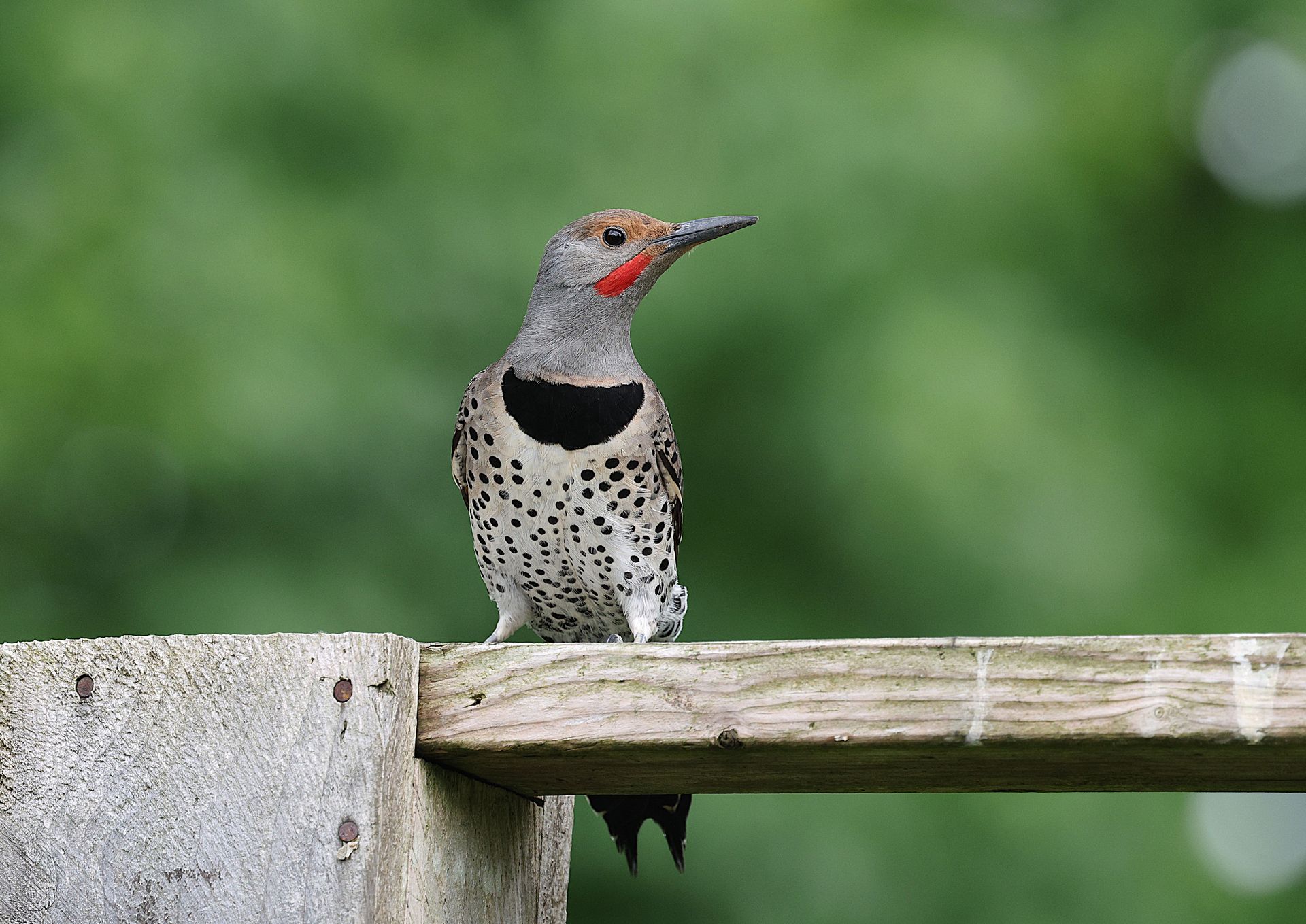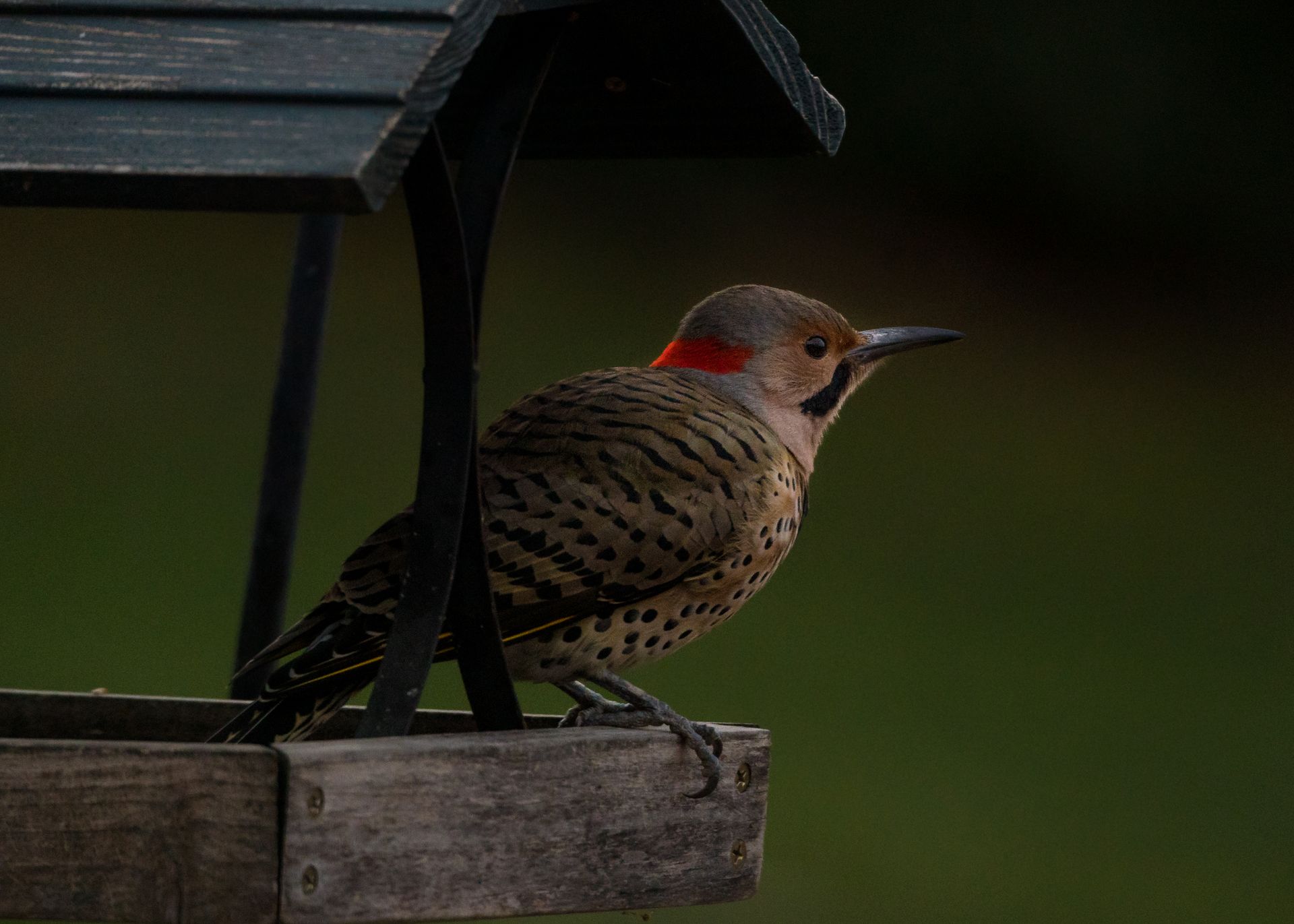
The Red Shafted Northern Flicker is a bird species that can be found in the western United States, specifically in the mountainous regions of Arizona, New Mexico, Colorado, and Utah.
These birds are known for their distinctive red shafts on their tail feathers, which give them their name. The Red Shafted Northern Flicker's range is characterized by its high elevation, often above 6,000 feet.
One of the most notable features of the Red Shafted Northern Flicker's range is its proximity to pine forests, which provide the birds with a reliable food source.
Related reading: Yellow Shafted Flicker Feather
Red-Shafted Northern Flicker Range
The Red-Shafted Northern Flicker Range spans across western North America, with the western red-shafted flicker residing in western North America, specifically red under the tail and underwings and with red shafts on its primaries.
The coastal red-shafted flicker has a range that closely overlaps with the western red-shafted flicker, extending along much of the West Coast of North America from the British Columbia Coast along the West Coast of the United States to northwestern Mexico.
Here's a breakdown of the range of the Red-Shafted Northern Flicker:
Habitat
The northern flicker's habitat is quite varied, ranging from open areas near trees to woodlands and even mountain forests in the Western United States.
They can be found in yards and parks, often nesting in holes in trees like other woodpeckers.
In some cases, they've been known to take over old, earthen burrows vacated by belted kingfishers or sand martins.
Both males and females help with nest excavation, creating an entrance hole about 8 cm in diameter and a cavity that's 33-41 cm deep.
The cavity widens at the bottom to accommodate eggs and the incubating adult, and is usually bare except for a bed of wood chips for the eggs and chicks to rest on.
Once the nestlings are about 17 days old, they start clinging to the cavity wall rather than lying on the floor.
You might like: Northern Mockingbird Eggs
North American Flickers: Life, Habitat, Photos
North American Flickers are relatively small birds, measuring 12.5 inches in length.
Their wingspan is quite impressive, reaching up to 20 inches.
These birds are part of the Picidae family, which includes woodpeckers and sapsuckers.
The Latin name for the Red-Shafted Northern Flicker is Colaptes auratus (cafer).
Here's a summary of their physical characteristics:
These physical attributes make the North American Flicker a unique and fascinating bird species.
Birds in North America
The Red-shafted Northern Flicker is a fascinating bird species. It's one of the two sub-species of the Northern Flicker, with the Yellow-shafted Flicker being the other.
These birds can be found from northern British Columbia through most of the Canadian prairies and south into Mexico. They're part of the woodpecker family.
What sets the Red-shafted Northern Flicker apart from other birds is the bright reddish-orange edging on their flight feathers. This distinctive feature helps identify them from other species.
Flickers are members of the woodpecker family, which includes other fascinating birds like the Yellow-shafted Flicker.
The Red-shafted Northern Flicker's range spans a significant portion of North America, making them a common sight in many areas.
A unique perspective: Yellow Collared Lovebird
Wintering and Migration
Northern flickers are partial migrants, meaning some populations don't migrate at all, while others travel to warmer areas during the winter. Those that do migrate tend to begin their spring migration in April and return between September and October.
Individuals breeding in northern areas travel farther than those breeding in southern areas, often converging at wintering sites. This difference in migration distance is likely due to the species' ground-foraging behavior, which requires snow-free locations.
Northern flickers are divided into eastern and western populations by the Rocky Mountains, with unique migratory pathways for each. They form flocks during migration and still roost in cavities, even in unfamiliar areas.
About 75% of individuals spend their nights in a cavity during migration. This is consistent with their habit of reusing nest cavities, rather than excavating new ones each year.
Breeding individuals exhibit intense site fidelity, returning to the same nest cavity year after year.
Behavior and Adaptations
The red-shafted northern flicker is a bird that's highly adaptable to its environment. They can be found in a variety of habitats, including urban areas, forests, and even backyards.
These birds are known for their bold and curious nature, often approaching humans in search of food. They're also quite social, often seen in large flocks.
One of the most distinctive features of the red-shafted northern flicker is its distinctive call, a loud, clear "wicka-wicka" sound that echoes through the trees.
A fresh viewpoint: Red Shafted Flicker
Physical Adaptations
Physical Adaptations play a crucial role in helping animals survive and thrive in their environments.
The desert-dwelling camel's ability to go without water for long periods is an excellent example of physical adaptation. It can survive on limited water resources.
Its large humps store fat, which is used for energy when food is scarce. This adaptation allows the camel to travel long distances without drinking water.
Some animals have adapted to extreme temperatures by developing thick layers of fur or feathers. The polar bear's white coat is a perfect example of this adaptation.
This coat helps the bear blend in with its snowy surroundings and stay warm in freezing temperatures. It's a vital adaptation for survival in the harsh Arctic environment.
The human eye has adapted to varying light conditions by changing its pupil size. In bright light, the pupil constricts, reducing the amount of light that enters the eye.
In low light conditions, the pupil dilates, allowing more light to enter and improving vision. This adaptation is essential for humans to navigate and function in different environments.
A unique perspective: Light Vented Bulbul
Behavioral Adaptations
Behavioral adaptations are crucial for survival in various environments. They can be seen in the way animals adjust their behavior to suit their surroundings.
In the desert, animals have adapted to conserve water by reducing their urine output. This is evident in the fact that camels can go without drinking for several days.
Animals in cold climates have adapted to stay warm by growing thick fur or feathers. This is seen in the example of polar bears, which have two layers of fur to keep them insulated.
In areas with high levels of predation, animals have adapted to be more vigilant and cautious. This is demonstrated by the fact that many prey animals have a keen sense of smell to detect predators.
Subspecies and Distribution
The Red-shafted Northern Flicker has a range that spans western North America, with the western red-shafted flicker (C. a. cafer) residing in this region.
There are several subspecies of the Red-shafted Northern Flicker, including the coastal red-shafted flicker (C. a. collaris), the dwarf red-shafted flicker (C. a. nanus), the Mexican red-shafted flicker (C. a. mexicanus), and the Guatemalan red-shafted flicker (C. a. mexicanoides).
The Red-shafted Northern Flicker can be identified by its distinctive red under the tail and underwings, as well as its red shafts on its primaries.
Here are the four base characteristics that distinguish the Red-shafted and Yellow-shafted Northern Flicker subspecies:
Note that intergrades can exhibit a range of characteristics, making identification more challenging.
Characteristics and Identification
To identify a Red-shafted Northern Flicker, look for a red malar stripe. Males in this group have a distinctive red malar stripe, while females do not have one.
The face color of a Red-shafted Northern Flicker can be gray for both males and females, or buffy to warm, light brown.
Check this out: Flicker Bird Identification
The Nape Pattern is a key field mark to look out for. Males in the Red-shafted Group typically don't have any nape pattern, while females can have a red crescent.
Flight feathers, including the wings and tail, are a crucial characteristic to note. For Red-shafted Group males, these feathers are typically pinkish to reddish to red. In contrast, females have pinkish to reddish to red feathers as well.
Here's a breakdown of the characteristics for the Red-shafted Group:
Birding and Conservation
Birding and Conservation is a vital aspect of appreciating these beautiful creatures. Bird Songs and Calls are a great way to identify the Red-Shafted Northern Flicker, as its distinctive calls can be heard in various regions of North America.
If you're new to birding, it's essential to learn about Bird Range Maps to understand where to spot the Red-Shafted Northern Flicker. These maps can be found online or in birding guides and can help you plan your next birding adventure.
Here's an interesting read: Black Capped Chickadee Images
Learning about Birding and Conservation can also help you contribute to the protection of the Red-Shafted Northern Flicker's habitat. By supporting conservation efforts, you can make a positive impact on the environment and help preserve these amazing birds for future generations.
To get started with birding and conservation, here are some key resources to explore:
- Bird Songs and Calls: Listen to recordings of the Red-Shafted Northern Flicker's calls to improve your identification skills.
- Bird Range Maps: Use online maps or guides to plan your birding trips and spot the Red-Shafted Northern Flicker in its natural habitat.
Frequently Asked Questions
Are Northern Flickers illegal to shoot?
No, it is illegal to harm Northern Flickers, including shooting them, due to their protected status under the Federal Migratory Bird Treaty Act.
Featured Images: pexels.com