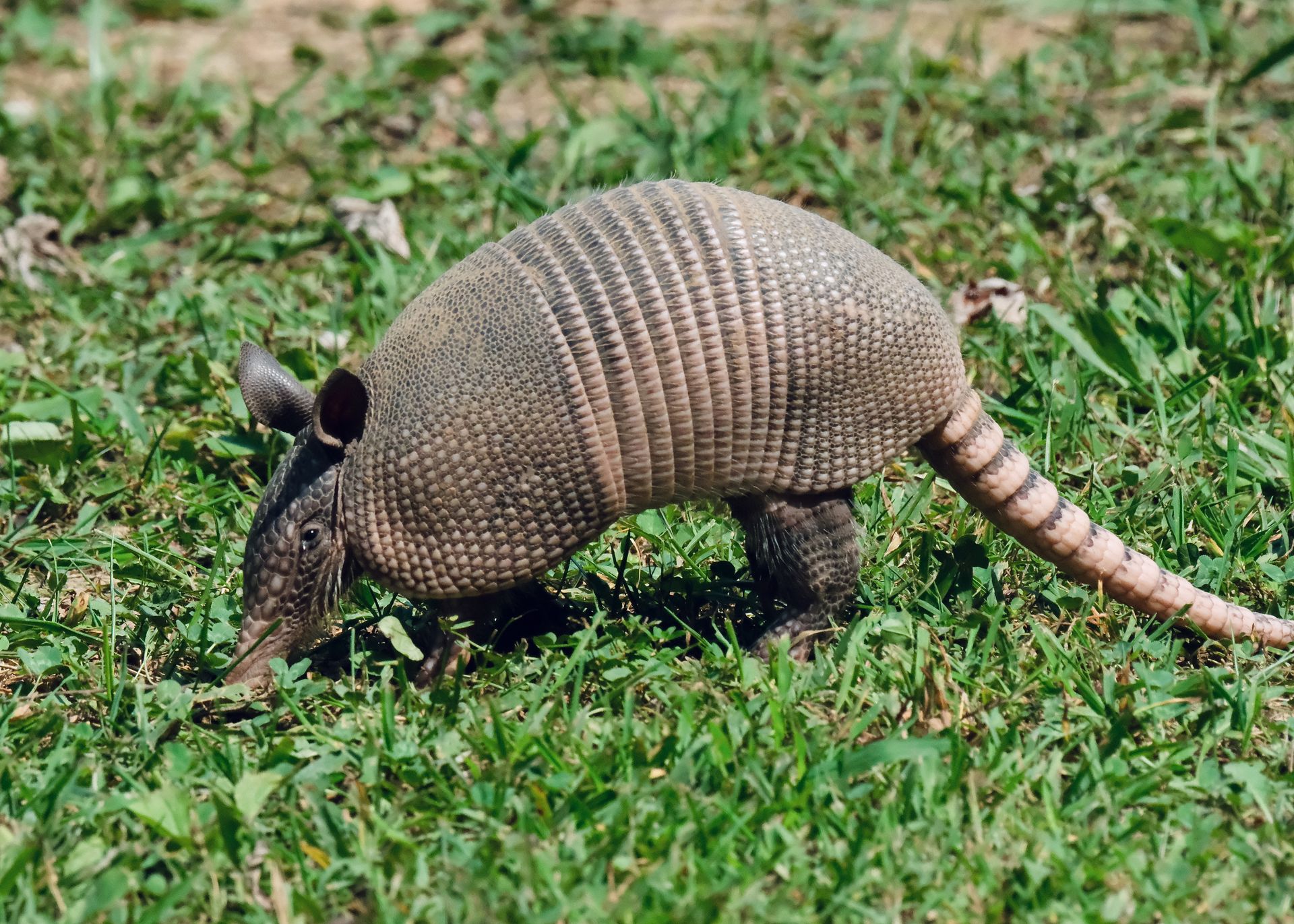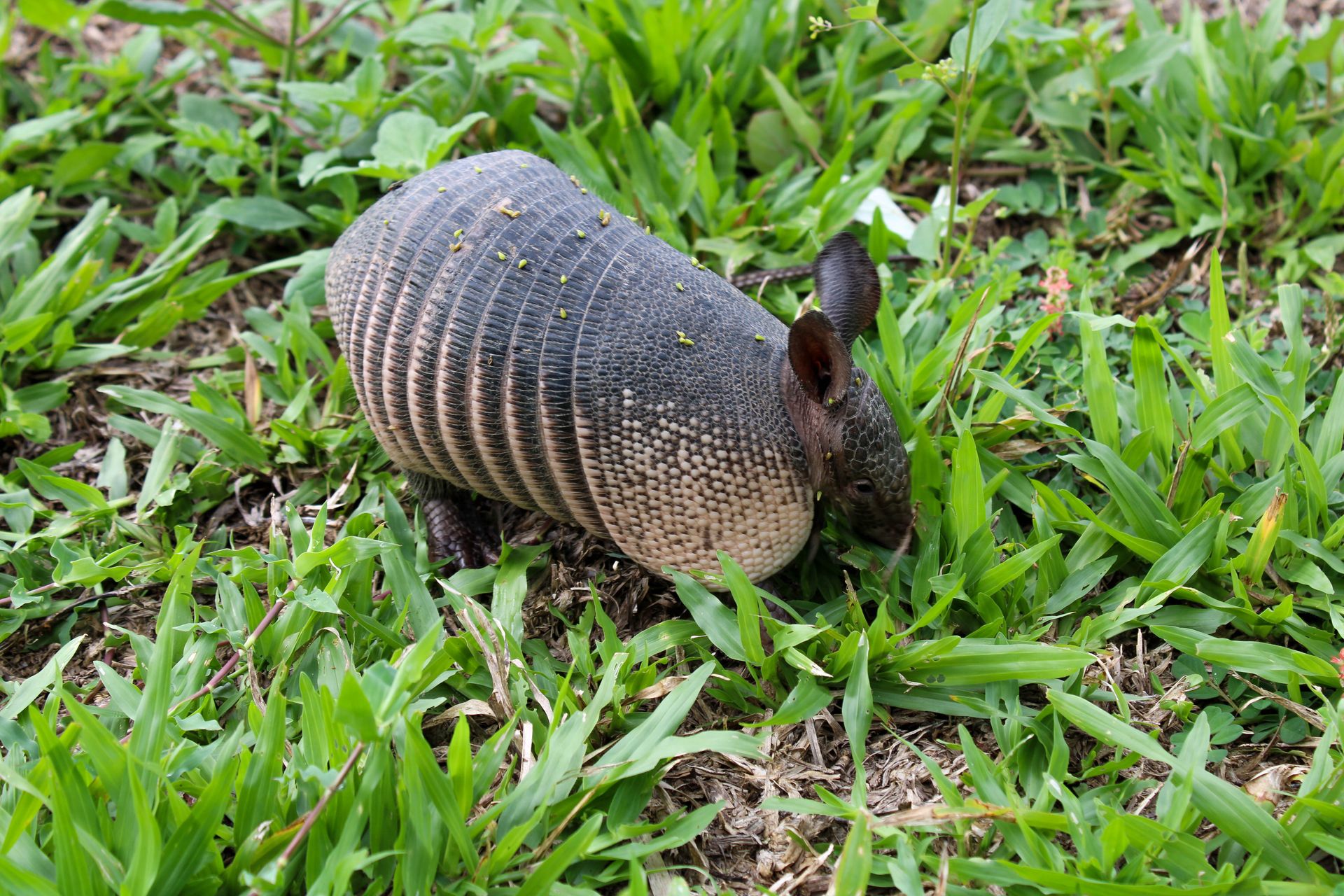
The nine-banded armadillo is a fascinating creature that calls North America home. They are found throughout the southern and central regions of the continent, stretching from the eastern parts of Texas and Mexico to the southeastern United States.
Their range spans across a vast area, including the Gulf Coast and the southeastern states, such as Florida, Georgia, and Alabama. They are also found in parts of the Midwest, including Illinois, Indiana, and Ohio.
These armadillos have adapted to living in a variety of habitats, from forests to grasslands, and even urban areas. They are excellent diggers and can be found in burrows and dens throughout their range.
Armadillo Habitats
Armadillos are highly adaptable creatures that can thrive in a variety of habitats. They most often inhabit forest and scrub-brush areas in tropical and temperate regions. In fact, they are found in grasslands and savanna regions around woody areas, but they prefer forests over grasslands because they forage in forest litter for small invertebrates.
Nine-banded armadillos are not often found in arid regions, and they thrive especially in riparian habitats or areas with a sufficient amount of water and/or at least 38 cm of rain annually. This association with water could be due to the increased number of available food sources in wetter areas or to the softer soil conditions, making digging and burrowing easier.
They have been observed near swampy or marshy regions as well, but they do not commonly inhabit them. Nine-banded armadillos are very adaptable to different habitats as long as sufficient food and water supplies are available.
Here are some of the key habitat regions where nine-banded armadillos are found:
- Temperate regions
- Tropical regions
- Terrestrial habitats
Within these habitats, nine-banded armadillos make their homes in underground burrows, which can be up to 5 m long and 2 m deep. They may bring some grasses and leaves inside their burrow and try to hide the entrance by placing plant debris around it.
Conservation Status
Nine-banded armadillos are not considered to be in any danger due to their high reproduction rate and expanding distribution.
Their population size is actually increasing in most of their distribution area. This is likely due to their adaptability to different environments.
They are found in a variety of biomes, including grasslands, savannas, and even residential areas on the outskirts of large cities.
Here is a summary of their conservation status:
- IUCN Red List: Least Concern
- US Federal List: No special status
- CITES: No special status
- State of Michigan List: No special status
Why We Should Care
Armadillos have arrived in Illinois, and it's crucial we keep tabs on them. This new species has a lot of unknowns, and understanding their role in the environment is beneficial.
Land managers, private landowners, researchers, and state and federal agencies can all benefit from learning about armadillos' influence on local ecosystems. By documenting and investigating their impact, we can track how they affect the environment and other species that already live there.
Armadillos may act as vectors for disease, posing a threat to public health. This makes it essential to monitor their presence and potential effects on local ecosystems.
Nathan Proudman, a Postdoctoral Research Associate at the Illinois Natural History Survey, is working on a statewide monitoring program for mammals in Illinois, including armadillos. His research focuses on the ecology of mammals, providing valuable insights into the species' behavior and habitat.
Explore further: Do Armadillos Attack Dogs
Conservation Status
The nine-banded armadillo is not considered to be in any danger due to its high reproduction rate and expanding distribution.
According to the IUCN Red List, the nine-banded armadillo is listed as Least Concern, indicating that it is not considered to be threatened with extinction.
The US Federal List, CITES, and the State of Michigan List do not have any special status for the nine-banded armadillo.
This indicates that the species is not considered to be threatened or protected at the federal, international, or state level.
Here's a summary of the conservation status of the nine-banded armadillo:
- IUCN Red List: Least Concern
- US Federal List: No special status
- CITES: No special status
- State of Michigan List: No special status
Geographic Information
Nine-banded armadillos have the largest range of any extant species of armadillo, spanning from Argentina and Uruguay, through Central America, and into the southern United States.
They can be found in South, Central, and North America, with a gradual expansion of their range to the northeast, particularly in the late 19th century. They have been spotted as far east as Florida and are common as far north as Missouri.
Their migration and establishment of populations northward are likely limited by the severity of cold, winter weather, for which the species does not have a strong tolerance. However, if winter seasons become milder, nine-banded armadillos may continue their migration northward.
They can survive short periods of severe cold by remaining in a burrow for days at a time. Another factor that has limited their migration westward is dependence on rainfall or other sources of water.
Nine-banded armadillos are able swimmers due to their ability to hold air in their digestive tract, increasing buoyancy; they are also able to walk along river bottoms as a result of their ability to maintain a large oxygen debt.
Here are the biogeographic regions where nine-banded armadillos can be found:
- nearctic
- neotropical
In Illinois, nine-banded armadillos are expected to occur up to the 40th parallel, though they are at their greatest densities in the heavily forested southwest.
Armadillo Home
Armadillos are adaptable creatures, and their home range size varies greatly depending on the physical conditions of their surroundings. Home ranges can be as small as 0.63 hectares or as large as 20.1 hectares.
Soil type and water availability play a significant role in determining home range size. Armadillos are able to thrive in areas with suitable soil and water conditions.
Home range size also increases with age, suggesting that older armadillos require larger territories to sustain themselves. Adult males tend to tolerate less overlap in home ranges, while females and males have similar-sized home ranges.
Adults of both sexes may share home ranges with juveniles and members of the opposite sex, highlighting the social aspect of armadillo behavior. A small number of individuals are transient, moving through different areas in search of resources or suitable habitats.
Take a look at this: Diamondback Water Snake Range Map
Featured Images: pexels.com