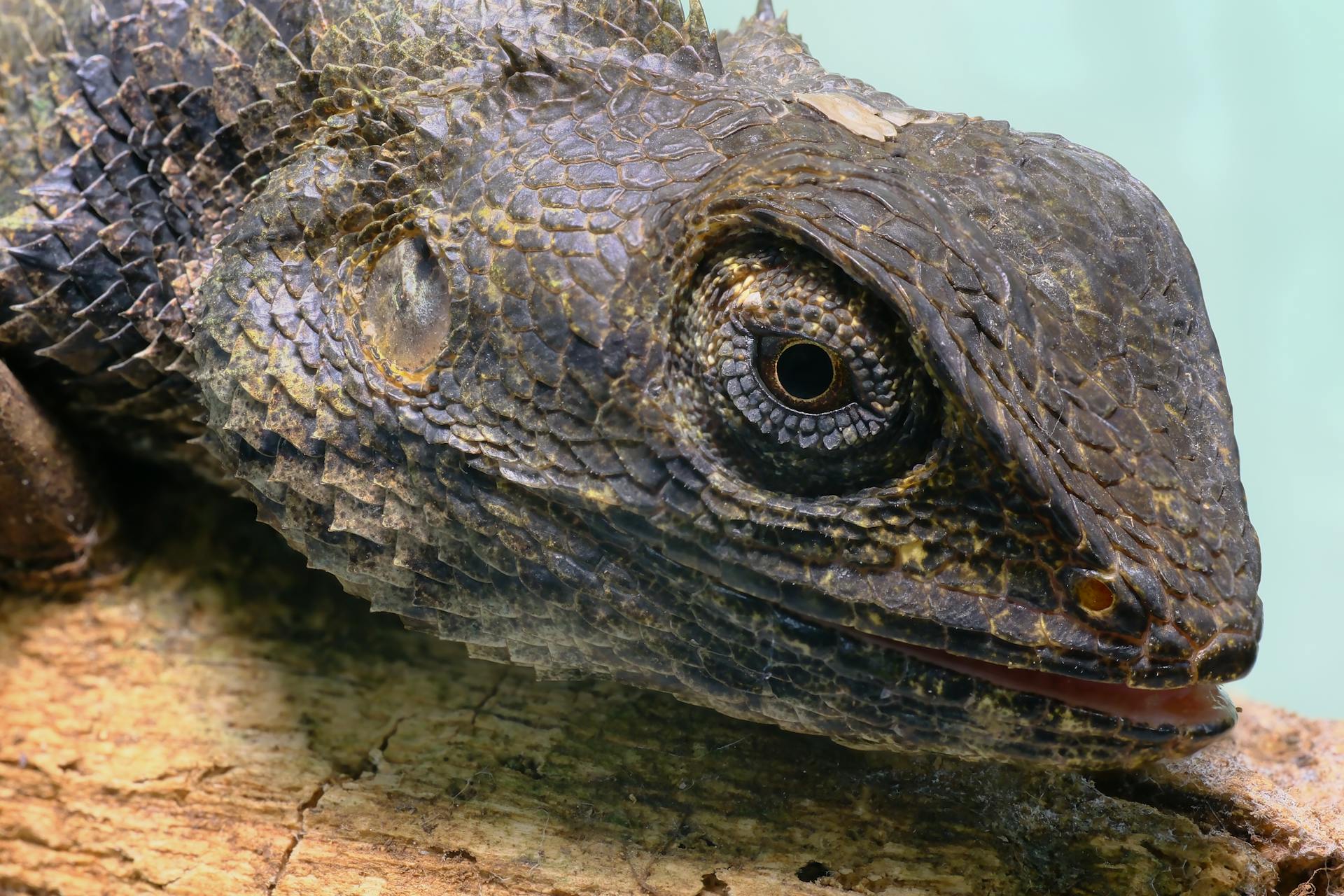
The girdled armadillo lizard is a fascinating creature that's native to South Africa. They have a unique appearance, with a distinctive girdle around their midsection.
These lizards are primarily insectivores, which means they feed on insects and other small invertebrates. They have a specialized diet that includes ants, beetles, and other small insects.
In the wild, girdled armadillo lizards can be found in rocky outcrops and scrublands. They thrive in areas with plenty of hiding spots and food sources.
Their conservation status is currently listed as Least Concern, but habitat destruction and fragmentation pose a threat to their populations.
Physical Description
The girdled armadillo lizard is a small, yet impressive creature. Its body color can range from light brown to dark brown, with a distinctive yellow underbelly and blackish pattern under the chin.
They are quite tiny, typically growing to be around 7.5 to 9 centimeters (3 to 3.5 inches) long, not counting their tail. The longest they might get is around 8 inches (20 centimeters) from their snout to the base of their tail.
These lizards have a unique ability to drop their tail (autotomy) when in danger, and can grow it back slowly. However, unlike many other lizards, they tend to keep their tail intact as it's a necessary part of their defensive position.
Here are some key physical features of the girdled armadillo lizard:
- Snout-vent length: 7.5 to 9 cm (3.0 to 3.5 in)
- Maximum size: 8 in (20 cm) STL
- Ability: Autotomy (dropping their tail) and regrowth
Males tend to be larger than females, and have more prominent femoral pores.
Distribution and Habitat
The girdled armadillo lizard is found in the Succulent Karoo biome in South Africa. This is a unique and fascinating region that's home to a variety of interesting plants and animals.
The Succulent Karoo biome spans across the Northern and Western Cape provinces. You can find girdled armadillo lizards from the southern Richtersveld to the Piketberg Mountains and the southern Tankwa Karoo.
They inhabit rock outcrops and mountain slopes, with a preference for sandstone substrate. This type of rock provides a suitable environment for the lizards to live and thrive.
Here are some key facts about the habitat of the girdled armadillo lizard:
- Habitat Regions: temperate, terrestrial
- Terrestrial Biomes: desert or dune, chaparral
Behavior and Communication
The girdled armadillo lizard is a social creature that lives in groups of 2 to 60 individuals, averaging 2 to 6. This is unique because permanent group living is not common among lizards.
These groups are not necessarily composed exclusively of family units, and inter-group movement is high. Males, females, and juveniles all leave and join different groups, often during and outside of the mating season.
Males are extremely territorial, defending territories that include more than one female. Females and juveniles do not have established territories, and they move between different territories, mating with multiple males.
The girdled armadillo lizard uses various forms of communication, including head bobbing, tail wagging, and tongue flicking. These signals can aid in reproduction or warn unfamiliar lizards to leave.
Here are some key behaviors of the girdled armadillo lizard:
- Territorial
- Social
- Diurnal
- Sedentary
- Aestivation
The girdled armadillo lizard communicates through various channels, including visual, tactile, and chemical signals. It also perceives its environment through visual, tactile, vibrations, and chemical cues.
Reproduction and Lifespan
The girdled armadillo lizard's reproductive habits are quite fascinating. These lizards give birth to one or two live young, which is unusual for a lizard, and the female may even feed her young.
The female armadillo girdled lizard typically gives birth once a year at most, with some taking a year off between births. This species is one of the few lizards that does not lay eggs.
In terms of mating, armadillo lizards are polygynandrous, meaning they have multiple mates, and the males do not defend their mates but rather their territory. The males actively pursue females during the mating season, which occurs in the spring.
Here are some key reproductive features of the girdled armadillo lizard:
- Iteroparous: offspring are produced in more than one group and across multiple seasons.
- Seasonal breeding: mating takes place in the spring, and births occur in the fall.
- Ovoviviparous: females give birth to live young.
In captivity, armadillo lizards can live up to 20 to 25 years, which is a relatively long lifespan for a lizard. This species has a low resting metabolic rate and low activity levels during the dry summer season, which helps them conserve energy and quickly regain fat reserves in the winter and spring.
Reproduction
Armadillo girdled lizards give birth to one or two live young, which is unusual for a lizard. They don't lay eggs like most other lizards do.
The female armadillo girdled lizard may even feed her young, which is a rare behavior for a lizard. This unique behavior is just one of the many fascinating aspects of armadillo girdled lizard reproduction.
In a study of 106 individuals from 27 groups, researchers found that the group with higher fidelity had a greater neighboring distance, while the group with lower fidelity had a shorter neighboring distance. This correlation suggests that armadillo girdled lizards that live in close-knit groups are more likely to be faithful to each other.
Here are some key reproductive features of armadillo lizards:
- iteroparous (giving birth to multiple offspring in a lifetime)
- seasonal breeding (breeding occurs at specific times of the year)
- sexual (reproduction involves males and females)
- ovoviviparous (giving birth to live young, rather than laying eggs)
Armadillo lizards typically breed once a year in the spring, with mating occurring in September to October and births occurring in March or April. Females give birth to one rather large young each year, which is a remarkable feat considering the harsh climate of the karroo veld.
Lifespan/Longevity
Cordylus cataphractus can live up to 25 years in captivity, which is a remarkable lifespan for a species of its kind.
The average lifespan of this species in captivity is around 20 years, which is still a significant amount of time.
In the wild, however, the average and maximum lifespan of Cordylus cataphractus is unknown, making it difficult to compare their lifespan in captivity.
This species is considered to be potentially long-lived, as they can survive for many years in their natural habitat.
Here's a breakdown of the lifespan of Cordylus cataphractus in captivity:
- Range lifespan: 25 years (high)
- Average lifespan: 20 years
This species is an example of an iteroparous animal, meaning they can produce offspring in multiple groups and across multiple seasons, which is a key factor in their ability to live long lives.
Diet and Predation
The girdled armadillo lizard's diet mainly consists of small invertebrates, including insects and spiders. They also occasionally nibble on plants.
Their favorite food in the wild is termites, specifically Microhodotermes viator and Hodotermes mossambicus termites. Lizards living in bigger groups tend to eat more termites.
In captivity, they often eat crickets, which is a common food source for pet lizards. Armadillo lizards move relatively slowly, making them easily catchable by hand if they're out in the open.
Known predators of the girdled armadillo lizard include birds of prey and humans, who collect them illegally for the pet trade. Humans are likely the biggest threat to their survival.
What Does It Eat
The armadillo girdled lizard is primarily a small invertebrate eater. They munch on insects and spiders as their main course.
In the wild, termites are a favorite snack, with Microhodotermes viator and Hodotermes mossambicus being particular favorites.
Lizards in larger groups tend to have a bigger appetite for termites, indicating that social interaction may influence their eating habits.
They also occasionally nibble on plants, but this is not a significant part of their diet.
Predation
Armadillo lizards are undoubtedly preyed on by a number of vertebrate predators. Their spiny defenses may discourage many potential enemies, but they're not foolproof.
Their social behavior actually helps protect them from predators. A large number of alert associates watching for danger can decrease the chance that a predator will approach unseen.
As a result, armadillo lizards are relatively safe in their groups. But they're not invincible - they're still vulnerable to predators that can sneak up on them.
Birds of prey are a major threat to armadillo lizards. Their slow movement and tendency to stay close to crevices make them easy targets.
Humans are also a significant threat, as these lizards are often collected illegally for the pet trade. Armadillo lizards move relatively slowly, making them easily caught by hand if they're out in the open.
- Known Predators:
- Birds of prey
- Humans
Conservation and Status
The girdled armadillo lizard is classified as near threatened by the IUCN Red List, a status that's a significant improvement from the past due to the cessation of collection for the pet trade.
This change in classification is largely attributed to the fact that collecting these lizards for the pet trade is now illegal, which has helped stabilize their populations.
The armadillo girdled lizard is somewhat susceptible to fluctuations in its primary food source, which is termites.
Changes in rainfall patterns, as well as the impact of invasive alien plant species and poor fire management, can affect the availability of termites, making it a vulnerable species.
Here are some key facts about the conservation status of the girdled armadillo lizard:
- Classified as near threatened by the IUCN Red List
- Formerly collected for the pet trade, which is now illegal
- Susceptible to fluctuations in its primary food source (termites)
- Impacted by climatic events and habitat changes
Featured Images: pexels.com