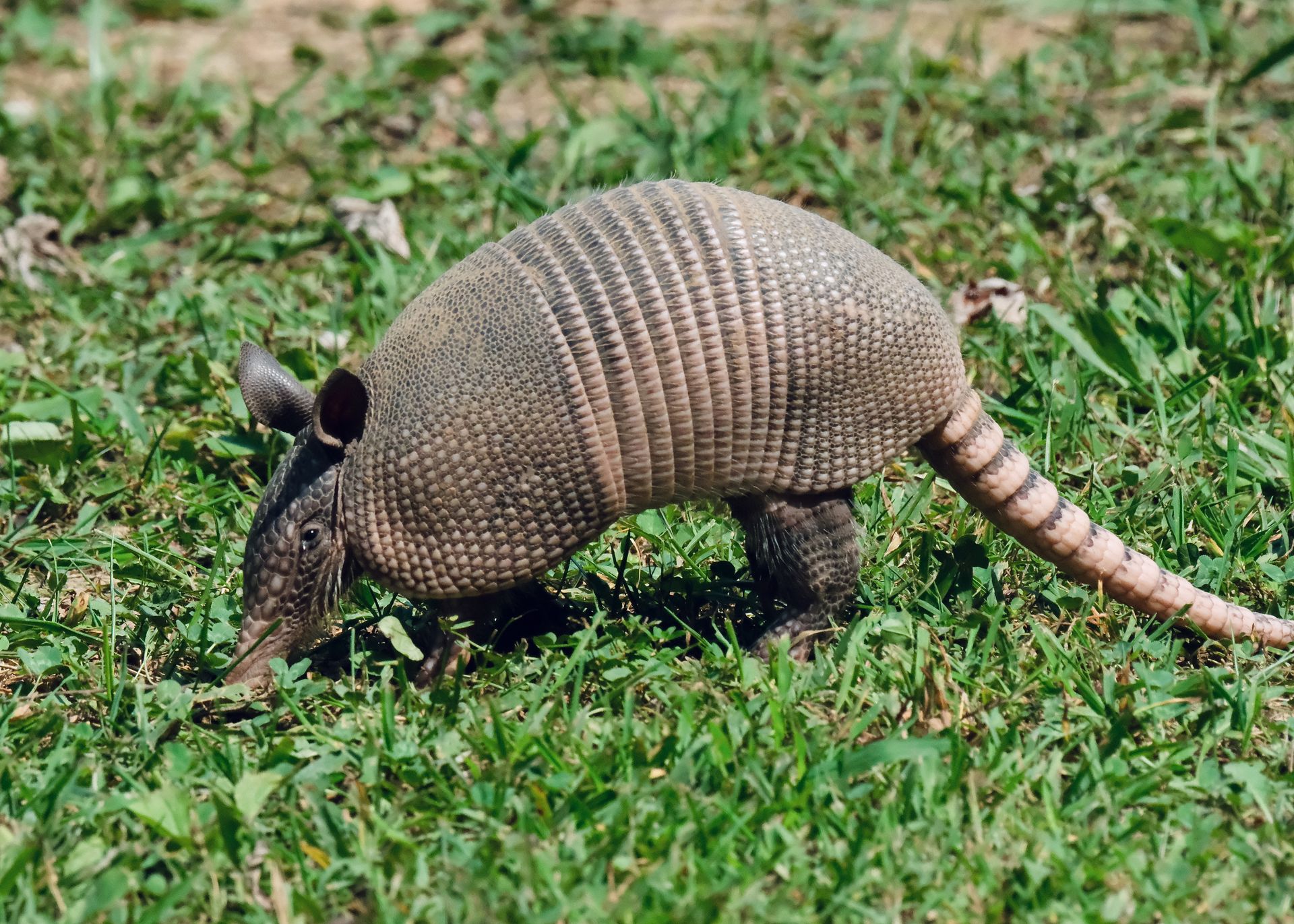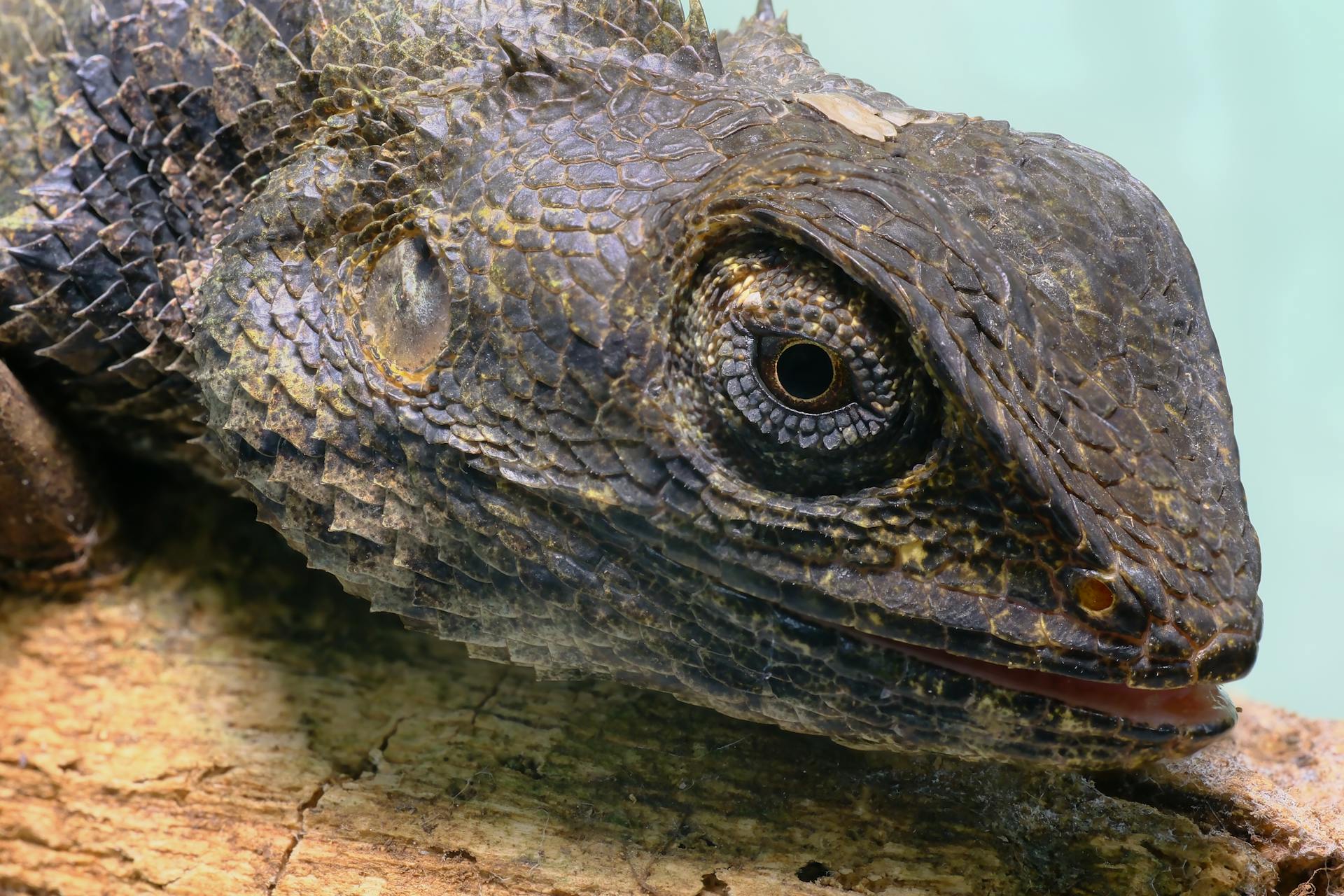
The armadillo girdled lizard is a unique and fascinating creature. They are found in South Africa, specifically in the provinces of Northern Cape, Western Cape, and Eastern Cape.
These lizards are known to be solitary animals, only coming together for mating. They have a complex communication system that involves visual and acoustic signals.
One interesting aspect of their behavior is their ability to change color, which helps them to regulate their body temperature and communicate with other lizards.
Physical Characteristics
The armadillo girdled lizard is a unique and fascinating creature. Its physical characteristics are quite remarkable, and I'm excited to share some of them with you.
The armadillo girdled lizard has a distinctive appearance when threatened, curling up into a tight, armored ball that resembles an armadillo. This defensive position protects its soft underside.
Males grow to be larger than females, with more prominent femoral pores. The average snout-vent length is between 75 and 90 mm, with a maximum snout-vent length of 105 mm.
The tail is equal to or slightly shorter than the body length, and the body color is a dirty yellowish brown to straw color. Dark brown infusions on the back are not uncommon.
The upper lip is dark brown, and the head and tail are flattened, allowing it to squeeze into rock crevices. Armadillo lizards have the ability to drop their own tail (autotomy) when in danger, and can grow it back slowly.
Here are some key physical characteristics of the armadillo girdled lizard:
Distribution and Habitat
The armadillo girdled lizard is found in the Succulent Karoo biome in South Africa, specifically in the Northern and Western Cape provinces. This region spans from the southern Richtersveld to the Piketberg Mountains and the southern Tankwa Karoo National Park.
Its preferred habitat is on rock outcrops and mountain slopes, with a sandstone substrate. This unique environment provides the perfect conditions for the armadillo girdled lizard to thrive.
Additional reading: Southern Alligator Lizard
Armadillo lizards inhabit large cracks in rocky outcrops, which is a common feature in their karroid veld habitat. This vegetation type is characterized by sparse, dwarf shrubs.
They can be found in a variety of terrestrial biomes, including desert or dune and chaparral. Their geographic range extends along the west coast of South Africa, from the Orange River in the north to the Piketberg Mountains in the south.
On a similar theme: Lizards of South America
Behavior and Reproduction
The armadillo girdled lizard is a unique creature that's full of interesting behaviors. They are diurnal, meaning they're active during the day, and they love to hide in rock cracks and crevices.
These lizards live in social groups, which can range from a few individuals to up to 30 to 60 of all ages. Males are territorial and will protect their territory, where they'll mate with the females living there.
One of the most fascinating things about the armadillo girdled lizard is its anti-predator adaptation. When it feels threatened, it rolls into a ball and takes its tail in its mouth, using its thick scales and spines for protection.
Here are some key reproductive features of the armadillo girdled lizard:
- iteroparous
- seasonal breeding
- sexual
- ovoviviparous
Females typically give birth to one rather large young each year, which is a remarkable feat considering the harsh climate of the karroo veld.
Cordylus Cataphractus
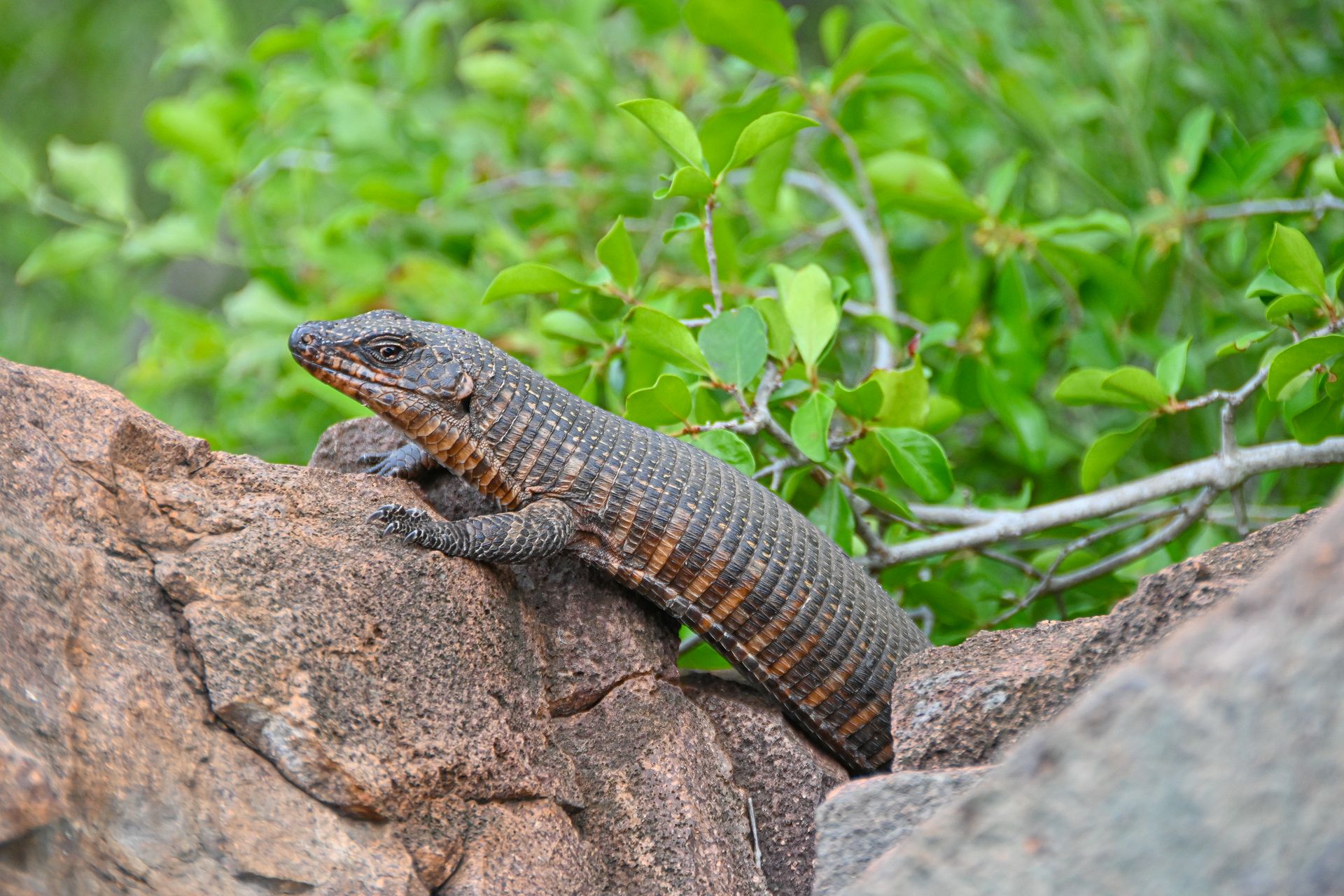
The Cordylus cataphractus, a fascinating creature.
This species of lizard is known to be diurnal, meaning it's active during the day.
In the wild, they can be found in a variety of habitats, including rocky outcrops and scrublands.
Cordylus cataphractus is a solitary animal, only coming together with others of its kind for mating.
Males engage in a unique form of courtship, where they perform a series of head bobs and push-ups to attract a female.
After mating, females lay their eggs in a burrow, which can be up to 1 meter deep.
Behaviour
The armadillo girdled lizard is a social creature that lives in groups of up to 30 to 60 individuals of all ages. These groups are usually smaller than that, but it's fascinating to think about the potential size of a group.
Males are territorial, protecting a specific area and mating with the females living there. This territorial behavior is a key part of their social dynamics.
One of the most unique features of the armadillo girdled lizard is its ability to roll into a ball when frightened. This defense mechanism is made possible by the thick, squarish scales on its back and the spines on its tail.
Reproduction
Armadillo girdled lizards are one of the few lizards that give birth to live young instead of laying eggs. Females typically have one or two young per year, and some may even take a year off between births.
The species is polygynandrous, meaning males and females mate with multiple partners. Males defend their territory and have multiple females within it, but females are known to cross boundaries to mate with other males.
Armadillo lizards mature at a snout-vent length of around 95mm and reach reproductive maturity when sperm production peaks in spring. Courtship and mating take place at this time, and females give birth to one or two young in late summer to early fall.
In a captive group, mating took place between January and March, and females gave birth to a single large young between September and December. The newborns averaged about 63.5mm in body length.
Armadillo lizards are unique in their reproductive habits, with females giving birth to one rather large young each year. This is likely due to the harsh climate of the karroo veld, where food is scarce during the hot, dry season.
Here are some key reproductive features of armadillo lizards:
- Breeding interval: once yearly in the spring
- Breeding season: matings occur in September to October; births occur in March or April
- Range number of offspring: 1 to 2
- Average number of offspring: 1
- Range gestation period: 6 to 8 months
Conservation and Breeding
The armadillo girdled lizard is a vulnerable species, listed as such on the IUCN Red List. Conservation efforts are necessary to protect it from illegal collection for the pet trade and habitat degradation.
Local community involvement is crucial in conserving this species, as seen in the example of the Rare Pride Campaign in rural Namaqualand. This campaign resulted in a 45% increase in local residents' knowledge and identification of the armadillo girdled lizard.
The species is protected by law, but more conservation attempts are needed to ensure its continued survival. The armadillo girdled lizard is an iteroparous animal, producing offspring in multiple groups and across multiple seasons.
Here are some conservation statuses of the armadillo girdled lizard:
- IUCN Red List: Vulnerable
- US Federal List: No special status
- CITES: Appendix II
- State of Michigan List: No special status
Conservation Status
The armadillo lizard, a unique species found in the deserts of South Africa and Namibia, is listed as "vulnerable" in the Red Data Book.
Conservation efforts are underway to protect this species, but it's facing threats from illegal collection for the pet trade and habitat degradation.
A different take: Common Snapping Turtle Species
In rural Namaqualand, a biodiversity hotspot, community involvement is crucial for conservation.
Local residents are being educated about the threats to the armadillo lizard through awareness campaigns, which have shown promising results.
A campaign led by Morne Farmer resulted in a 45% increase in local residents' knowledge and identification of Cordylus cataphractus.
Here are the conservation statuses of the armadillo lizard:
- IUCN Red List: Vulnerable
- US Federal List: No special status
- CITES: Appendix II
- State of Michigan List: No special status
Captive Breeding of the
Captive breeding programs are carefully managed to mimic the natural habitats and behaviors of the species being bred. This includes replicating the temperature, humidity, and lighting conditions found in the wild.
Some species are more adaptable to captivity than others. The California condor, for example, has been successfully bred in captivity for over 30 years.
Captive breeding programs often involve a team of experts, including veterinarians, biologists, and conservationists. They work together to develop breeding plans and monitor the health of the animals.
The goal of captive breeding is to increase the population size of the species and eventually release the offspring back into the wild. This can help to reestablish populations that have been depleted due to habitat loss, poaching, or other human activities.
Predation and Ecosystem
Armadillo girdled lizards have a unique relationship with predators. They're preyed on by various vertebrate predators, but their spiny defenses may deter some potential enemies.
Their sluggish nature makes them vulnerable to predators, but living in groups gives them a chance to escape. They spend most of their time near crevices where they can hide.
Birds of prey are likely a significant threat to armadillo girdled lizards. Humans also pose a threat, particularly due to the illegal pet trade.
Predation
Armadillo lizards are preyed on by a number of vertebrate predators, despite their spiny defenses.
Their social behavior and cooperative group dynamics actually help to decrease the chance that a predator will approach unseen.
These lizards are relatively sluggish and slow-moving, making them more vulnerable to predators.
Living close to crevices where they can hide gives them a better chance of escape.
Birds of prey are a significant threat to armadillo lizards.
Humans are also a major threat, particularly due to the illegal collection of these lizards for the pet trade.
Armadillo lizards are easily caught by hand if they're out in the open, making them vulnerable to mass-collection.
Ecosystem Roles
Armadillo lizards play a modest role in controlling insect populations by eating termites and other insects.
Their diet mainly consists of insects, which helps keep their numbers in check.
Armadillo lizards are probably not eaten in sufficient numbers by other animals to make a significant impact as a source of food.
This means they don't have a substantial effect on the food chain as prey.
Intriguing read: Western Fence Lizard Food
Frequently Asked Questions
Are armadillo girdled lizards legal to own?
Armadillo girdled lizards are no longer collected for the pet trade, but their status as a pet is still subject to local laws and regulations. Check with your local authorities for specific information on owning an Ouroborus cataphractus.
What do armadillo girdled lizards eat?
Armadillo girdled lizards primarily feed on small invertebrates like insects and spiders, with occasional plant material. In captivity, they thrive on a diet of crickets.
Featured Images: pexels.com