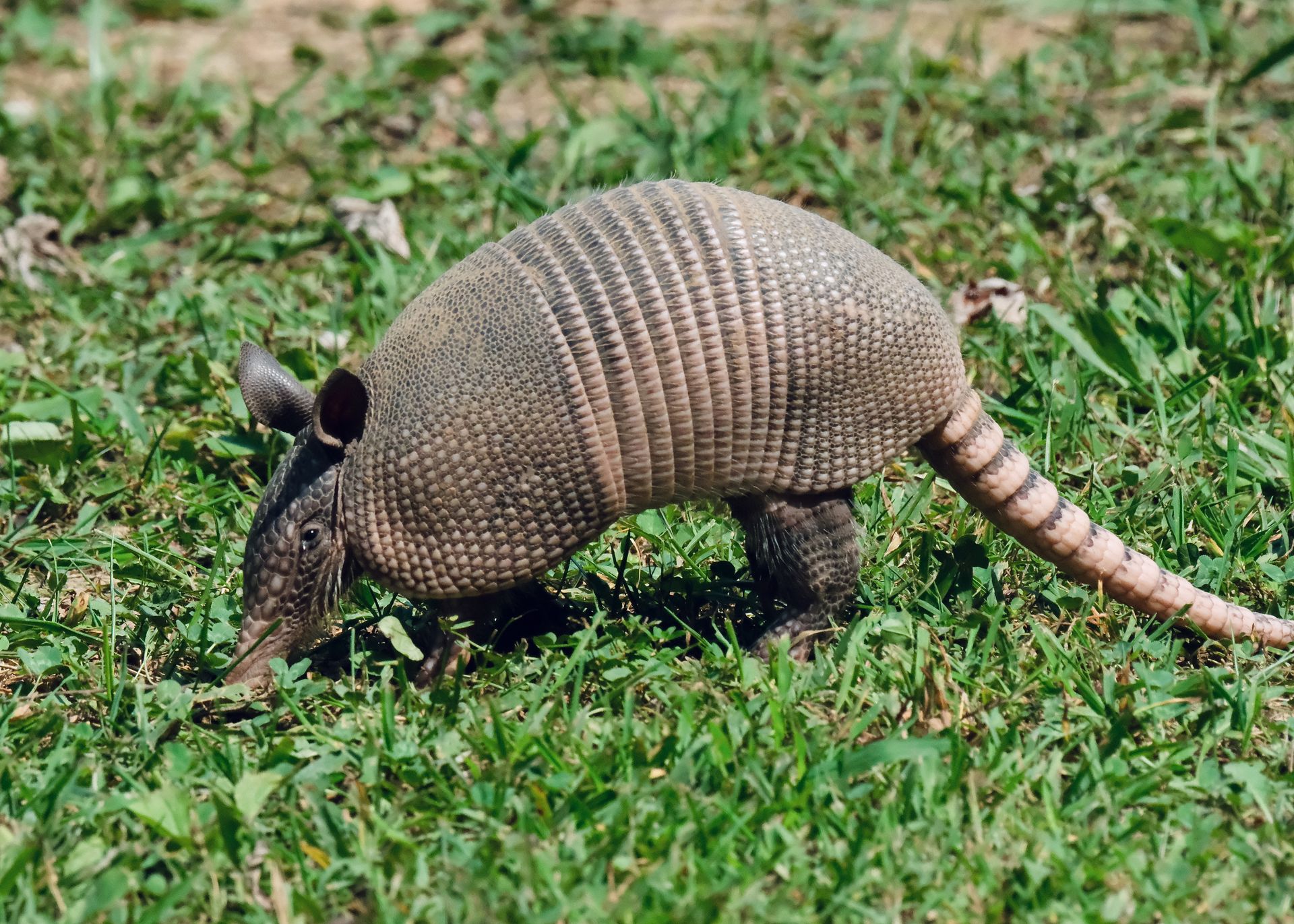
The nine-banded armadillo is a fascinating creature. They have a unique, armored shell that protects them from predators.
Their shell is made up of bony plates called "scutes" that are connected by flexible tissue. These scutes can be removed and replaced if damaged.
Armadillos are excellent diggers, using their powerful claws and strong shoulders to excavate burrows. They can dig complex networks of tunnels and dens.
In the wild, armadillos are solitary animals, only coming together to mate.
A unique perspective: Do Armadillos Attack Dogs
Physical Description
The nine-banded armadillo's physical description is quite distinctive.
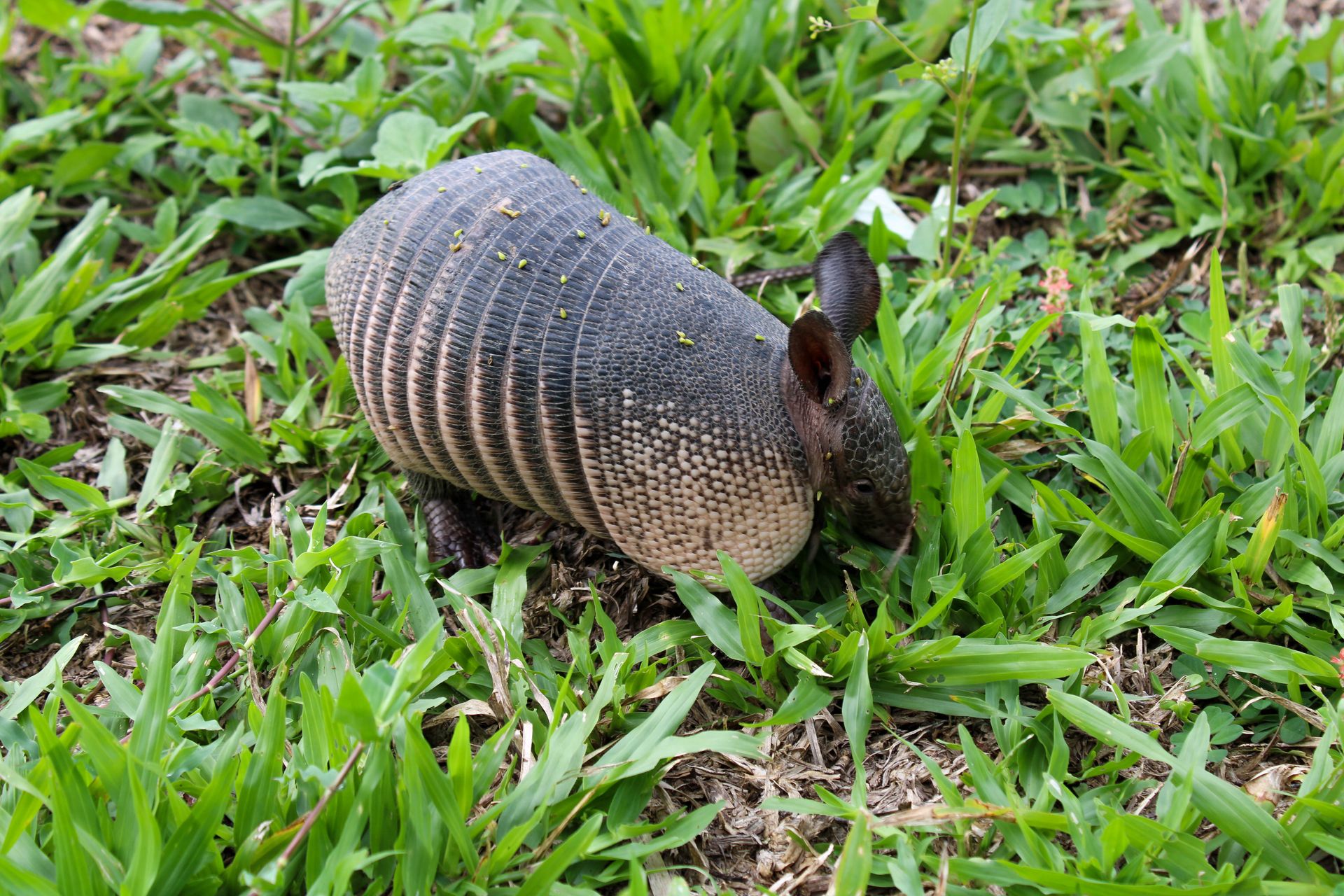
Their outer body is covered by a hard but flexible armor made up of bony plates called osteoderms. These scales are typically rectangular or pentagonal in shape and are developed later than the rest of the skeleton. The armor comprises about 16% of body weight and is divided into three main areas of coverage on the body: a pelvic shield, a shield on the shoulder region, and the characteristic bands of the back.
The number of visible bands can vary, but they typically have 9. Each band is separated by a thin epidermal layer and hairs. Scales grow continuously and wear, but are never fully shed.
The average body length is .752 m, with the tail averaging about 0.3 m long and covered by 12 to 15 rings of scales.
The head is partially covered in these bony/keratinous scales, but the ears lack them. Instead, ears are hairless and covered in a rough, bumpy skin.
Here's a breakdown of the armadillo's physical features:
- Body length: .752 m (2.47 ft)
- Tail length: 0.3 m (1 ft)
- Number of bands: 7-11
- Skull shape: dorso-ventrally flattened
- Teeth: simple, small, and cylindrical (peg-like)
The underside lacks any armored protection and is of a paler color, generally appearing slightly yellow. The long snout is much softer and pinkish in color, appearing almost pig-like with its narrow, tapered shape. The face, neck, and underside are covered in small clusters of hair.
Habitat and Distribution
Nine-banded armadillos are found in a variety of habitats, including forest and scrub-brush areas in tropical and temperate regions. They thrive in areas with sufficient food and water supplies, and can adapt to different habitats as long as these necessities are met.
Nine-banded armadillos are not often found in arid regions, but can be found in riparian habitats or areas with at least 38 cm of rain annually. This is likely due to the increased number of available food sources in wetter areas or the softer soil conditions, making digging and burrowing easier.
Their burrows can be up to 5 m long and 2 m deep, and they may bring some grasses and leaves inside to line their homes. Nine-banded armadillos often try to hide the entrance to their burrows by placing plant debris around it.
Nine-banded armadillos are found in a range of terrestrial biomes, including savanna or grassland, forest, rainforest, and scrub forest. They are also found in suburban and agricultural areas.
Here are some of the key habitat features associated with nine-banded armadillos:
- Habitat Regions: temperate, tropical, terrestrial
- Terrestrial Biomes: savanna or grassland, forest, rainforest, scrub forest
- Other Habitat Features: suburban, agricultural, riparian
They are able to survive in areas with mild winters, but are not common in regions with more than 24 freeze-over days annually or average January temperatures below -2°C. Nine-banded armadillos are also more populous in low-lying lands, often around sea-level.
Behavior and Life Cycle
Nine-banded armadillos are primarily nocturnal or crepuscular, but they can forage earlier in the day during cold or cloudy periods. They don't hibernate, but in the northern part of their distribution, they're more active during summer months.
Armadillos are skilled diggers, using their noses and forelimbs to loosen soil and then kicking it away with their hind limbs. They can create burrows with multiple entrances, and may have separate burrows for nesting and food storage.
A nine-banded armadillo can hold its breath for up to 6 minutes and accumulate a large oxygen debt. This allows them to swim or walk across the bottom of streams or rivers, but they tire quickly and can't cross wide bodies of water.
Armadillos are generally solitary animals and only share burrows with their young or a mate during mating season. However, in cold weather, non-related adults may share a nest to thermoregulate.
Behavior
Armadillos are fascinating creatures with some unique behaviors. They are primarily nocturnal or crepuscular, but can forage earlier in the day during cold or cloudy periods.
One of the most impressive things about armadillos is their ability to hold their breath for up to 6 minutes, allowing them to cross streams or rivers by swimming or simply walking across the bottom.
Armadillos are also skilled diggers, using their noses and forelimbs to loosen soil and their hind limbs to kick it away. A single burrow can have several entrances, but there is usually a main entrance that the animal prefers.
Armadillos may have multiple burrows, including one for nesting and several shallower ones used as food traps. They also use naturally occurring above-ground crevices as nesting sites.
In cold weather, armadillos may share a nest with non-related adults, possibly to thermoregulate at the northern limits of their distribution.
Armadillos are generally not aggressive towards each other, but a pregnant or nursing mother may be unusually aggressive, even towards her own older offspring.
During the mating season, older males may exhibit aggressive behavior towards younger males, but this usually does not result in serious injury.
If an armadillo feels threatened, it will often freeze or jump up straight in the air and sprint over short distances.
Armadillos are also capable of regulating their buoyancy by swallowing air, which helps them cross wide bodies of water.
Here are some key behaviors associated with armadillos:
- Terriculous
- Fossorial
- Nocturnal
- Crepuscular
- Motile
- Solitary
- Territorial
Armadillos typically do not share burrows, but they may have a range territory size of 0.0063 to 0.21 km^2.
Home Range

Nine-banded armadillos have a surprisingly large home range, which can vary greatly depending on the physical conditions of their surroundings.
The size of their home range can range from 0.63 to 20.1 hectares, which is a significant variation.
Home range size is also believed to increase with age, indicating that older armadillos require more space.
Female and male home ranges tend to be of similar size, but adult males tolerate much less overlap.
Adults of both sexes may share home ranges with juveniles and members of the opposite sex.
A small number of individuals are transient, indicating that some armadillos may be wandering through the area without a fixed home range.
Here are some approximate home range sizes for nine-banded armadillos in different regions:
Lifespan/Longevity
Nine-banded armadillos can live up to 20+ years in the wild, although their lifespan is influenced by various factors.
Juveniles have a higher mortality rate than adults, likely due to their weaker physical state and softer armor.
Climate plays a significant role in determining their longevity, with cold temperatures being particularly challenging for these animals.
A large adult male can survive no longer than 10 days at 0° C without starving.
Other environmental conditions, such as drought, can also impact nine-banded armadillo mortality.
In one area that experienced a severe drought, the nine-banded armadillo population completely disappeared due to death or migration.
Predation and death by humans, both purposeful and accidental, are also causes of mortality.
A juvenile is more likely to be killed by a predator in the wild than is an adult due to its weaker physical state and softer armor.
Disease can be an important contributor to nine-banded armadillo mortality, with leprosy having an impact on some populations.
In one population of nine-banded armadillos, 30% of adults were found to have the bacterium associated with the disease, while 17% had the antibodies, indicating previous exposure.
- Range lifespan: 23+ years (in captivity)
- Typical lifespan: 7 to 20+ years (in the wild)
Predation
Nine-banded armadillos have many natural predators, including pumas, maned wolves, coyotes, black bears, red wolves, jaguars, alligators, bobcats, and raptors, which prey on baby nine-banded armadillos.
For another approach, see: Wolves in Great Britain
Young nine-banded armadillos tend to forage earlier in the day and are more wary of human approach than are adults.
Their softer carapace makes juveniles more susceptible to predation than are adults.
To avoid predators, nine-banded armadillos can jump straight in the air and sprint over short distances.
They often flee to the cover of dense, thorny underbrush or nearby burrows for safety.
Here are some of the known predators of nine-banded armadillos:
- Pumas
- Maned wolves
- Coyotes
- Black bears
- Red wolves
- Jaguars
- Alligators
- Bobcats
- Raptors
Conservation and Impact
Nine-banded armadillos are not considered to be in any danger, thanks to their high reproduction rate and expanding distribution.
Their population size is actually increasing in most areas where they live. This is a testament to their adaptability and resilience.
The IUCN Red List classifies nine-banded armadillos as Least Concern, indicating that they are not currently threatened with extinction.
Here's a rundown of their conservation status:
- IUCN Red List: Least Concern
- US Federal List: No special status
- CITES: No special status
- State of Michigan List: No special status
Conservation Status
The nine-banded armadillo's conservation status is a positive one, thanks to their high reproduction rate and expanding distribution.
Their population size is increasing throughout most of their distribution, which is a testament to their adaptability and resilience.
According to the IUCN Red List, the nine-banded armadillo is listed as Least Concern, indicating that it is not considered to be threatened with extinction.
Here's a breakdown of their conservation status:
- IUCN Red List: Least Concern
- IUCN Red List: Least Concern
- US Federal List: No special status
- CITES: No special status
- State of Michigan List: No special status
This lack of special status indicates that the nine-banded armadillo is not considered to be in danger, and conservation efforts are not currently focused on this species.
Economic Importance: Positive
Armadillos play a crucial role in medical research, hosting pathogens responsible for human diseases like leprosy and a widespread mycosis in Brazil.
These pathogens, such as Mycobacterium leprae and Paracoccidiodies brasiliensis, are extensively studied, providing valuable insights into human disease.
Nine-banded armadillos are also important predators of common insect agricultural pests, helping to control pest populations.
In addition to their ecological importance, armadillos are hunted for their meat and skin, which is used to make various trinkets.
Their body parts are a source of valuable material, highlighting their economic importance beyond their ecological role.
Here is a list of the positive impacts of armadillos:
- Food
- Body parts are a source of valuable material
- Research and education
- Controls pest population
Armadillo Behavior and Problems
Armadillos are fascinating creatures, and understanding their behavior can help us appreciate them better. They are nocturnal or crepuscular, but can forage earlier in the day during cold or cloudy periods.
Armadillos are excellent swimmers and can hold their breath for up to 6 minutes. They can also regulate their buoyancy by swallowing air, which allows them to cross streams or rivers.
Their digging skills are impressive, and they can create burrows with multiple entrances and exits. A single armadillo can have several different burrows, and they may even use naturally occurring above-ground crevices as nesting sites.
Armadillos are generally solitary animals and only share burrows with their young or in extreme weather conditions. However, they can be quite aggressive during mating season, especially pregnant or nursing females.
If you're dealing with armadillo problems, such as damage to your lawn or garden, it's essential to understand their behavior. They are attracted to moist soil and lush vegetation, which brings earthworms and insect larvae to the surface.
Here are some key behaviors associated with armadillos:
- terricolous
- fossorial
- diurnal
- nocturnal
- crepuscular
- motile
- sedentary
- solitary
- territorial
Armadillos can cause significant damage to property, and their burrowing can uproot ornamental plants. To discourage them from digging, you can create barriers around smaller areas, such as flower beds and gardens.
Classification
The nine-banded armadillo's classification is a fascinating topic. It belongs to the kingdom Animalia, which includes all animals.
The nine-banded armadillo is a mammal, specifically classified in the order Cingulata, which includes armadillos. Within this order, it's further classified into the family Dasypodidae, which consists of armadillos.
Here's a breakdown of the nine-banded armadillo's classification:
The nine-banded armadillo is a unique species within its classification, with its own distinct characteristics. It's the only species of armadillo that lives in the southeast US.
Frequently Asked Questions
Do nine-banded armadillos carry diseases?
Yes, nine-banded armadillos naturally carry Mycobacterium leprae, the bacteria that causes leprosy, and can transmit it to humans in the United States.
Can you have a nine-banded armadillo as a pet?
Armadillos can be unpredictable pets and may not be suitable for most people, despite their seemingly calm nature. If you're considering having an armadillo as a pet, it's essential to learn more about their specific needs and potential challenges.
Featured Images: pexels.com