To care for a full-grown Nile monitor lizard, you'll need a spacious enclosure that's at least 8 feet long, 4 feet wide, and 4 feet tall. This will provide them with enough room to move around and exercise.
Nile monitors are carnivores and require a diet rich in protein, including meaty foods like mice, rats, and quail. They also need a calcium supplement to prevent metabolic bone disease.
Their enclosure should have a temperature gradient, with a basking spot around 95°F (35°C) and a cooler area around 75°F (24°C). This will allow them to regulate their body temperature.
Discover more: Nile Monitor Lizard Care
Physical Characteristics
The Nile monitor lizard is a remarkable creature, and one of its most striking features is its size. Adult Nile monitors can grow up to 7 feet 3 inches in length, with the largest recorded specimens reaching 8 feet.
Their weight is also quite impressive, with the largest recorded specimen weighing a whopping 44 pounds. This is likely due to their muscular bodies and strong legs.
If this caught your attention, see: Nile Monitor Lizard
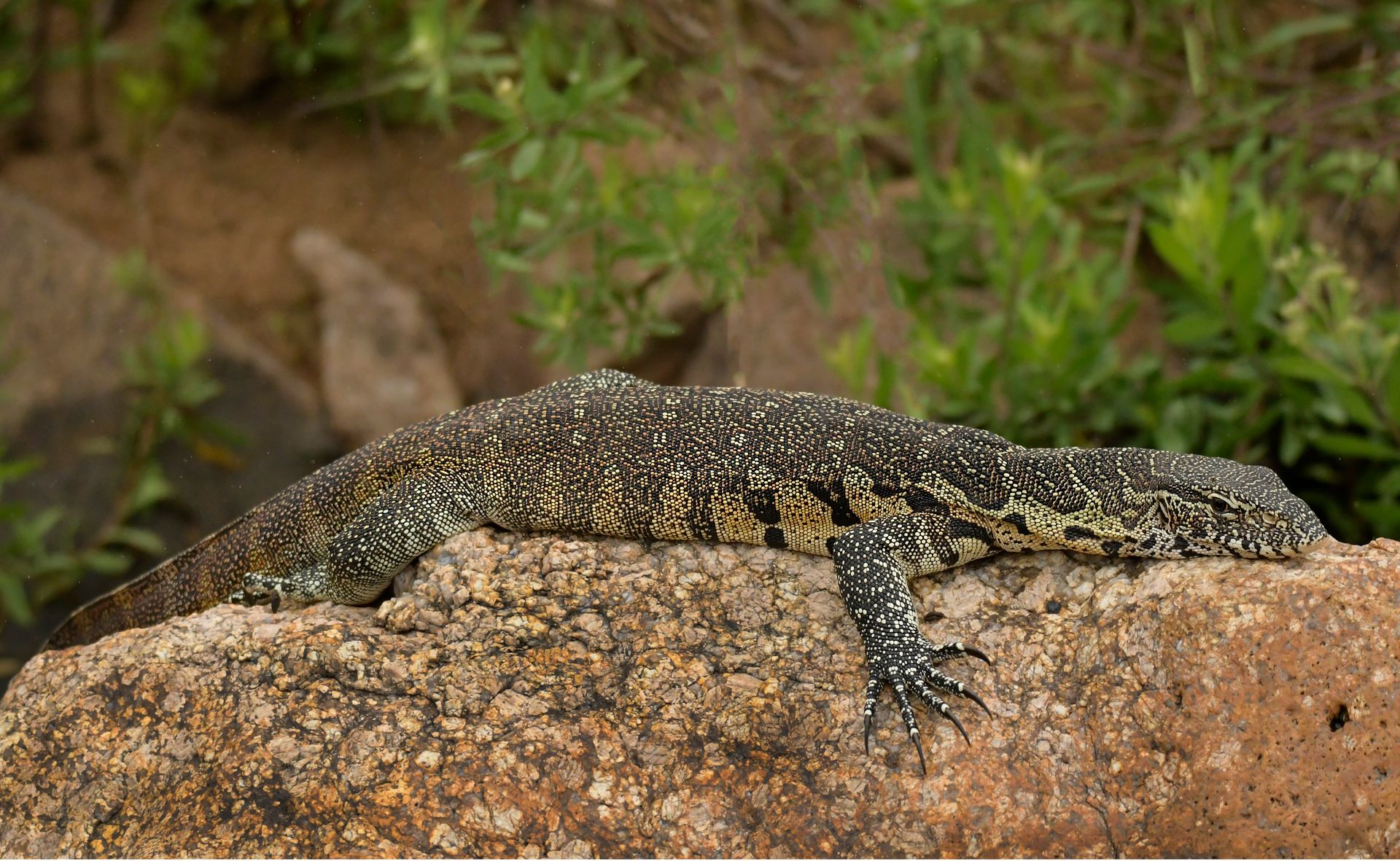
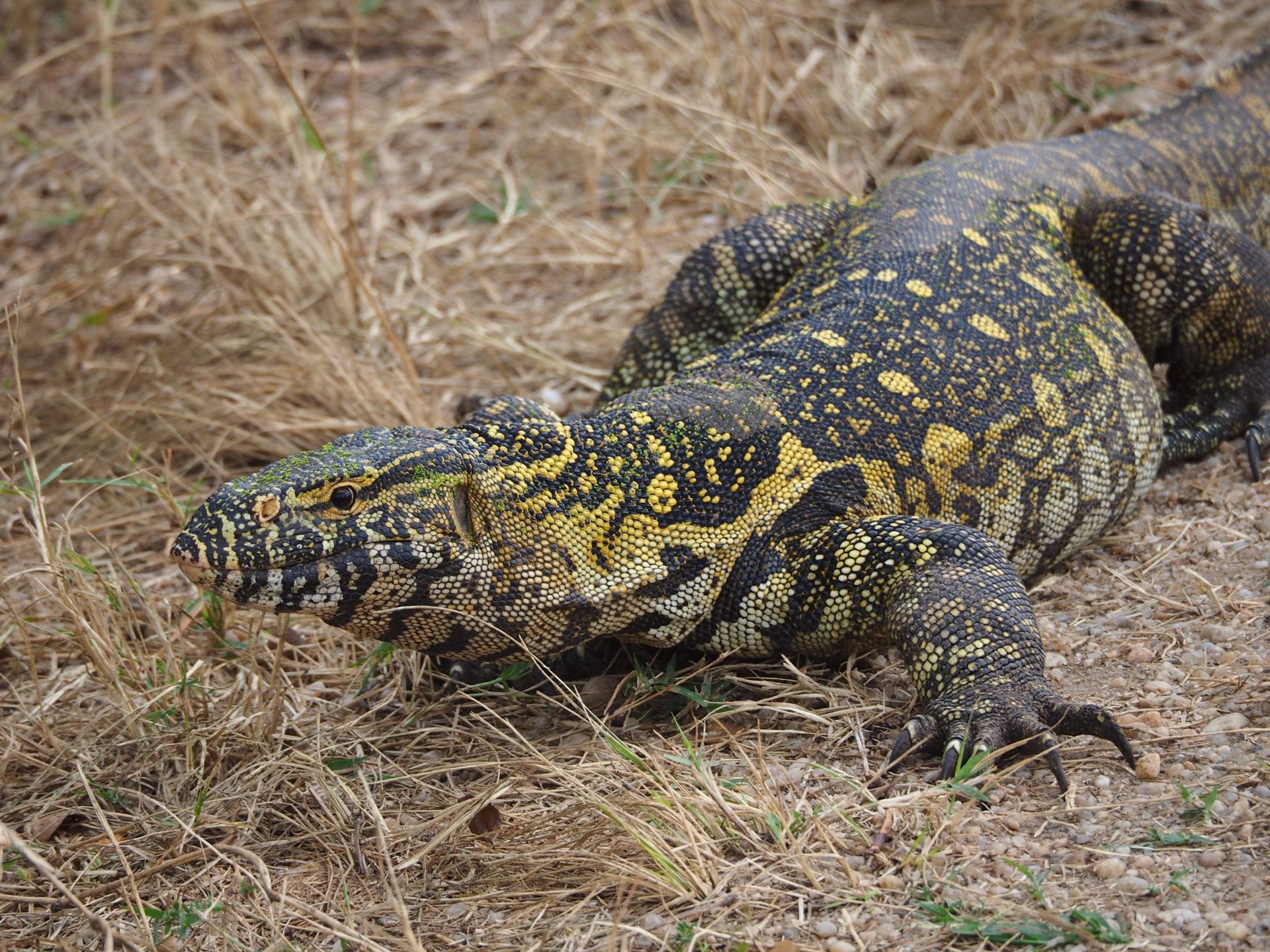
One of the most distinctive features of the Nile monitor lizard is its head, which is elongated and snake-like, with a wide mouth and tiny nose/nostrils. Their eyes are small and black.
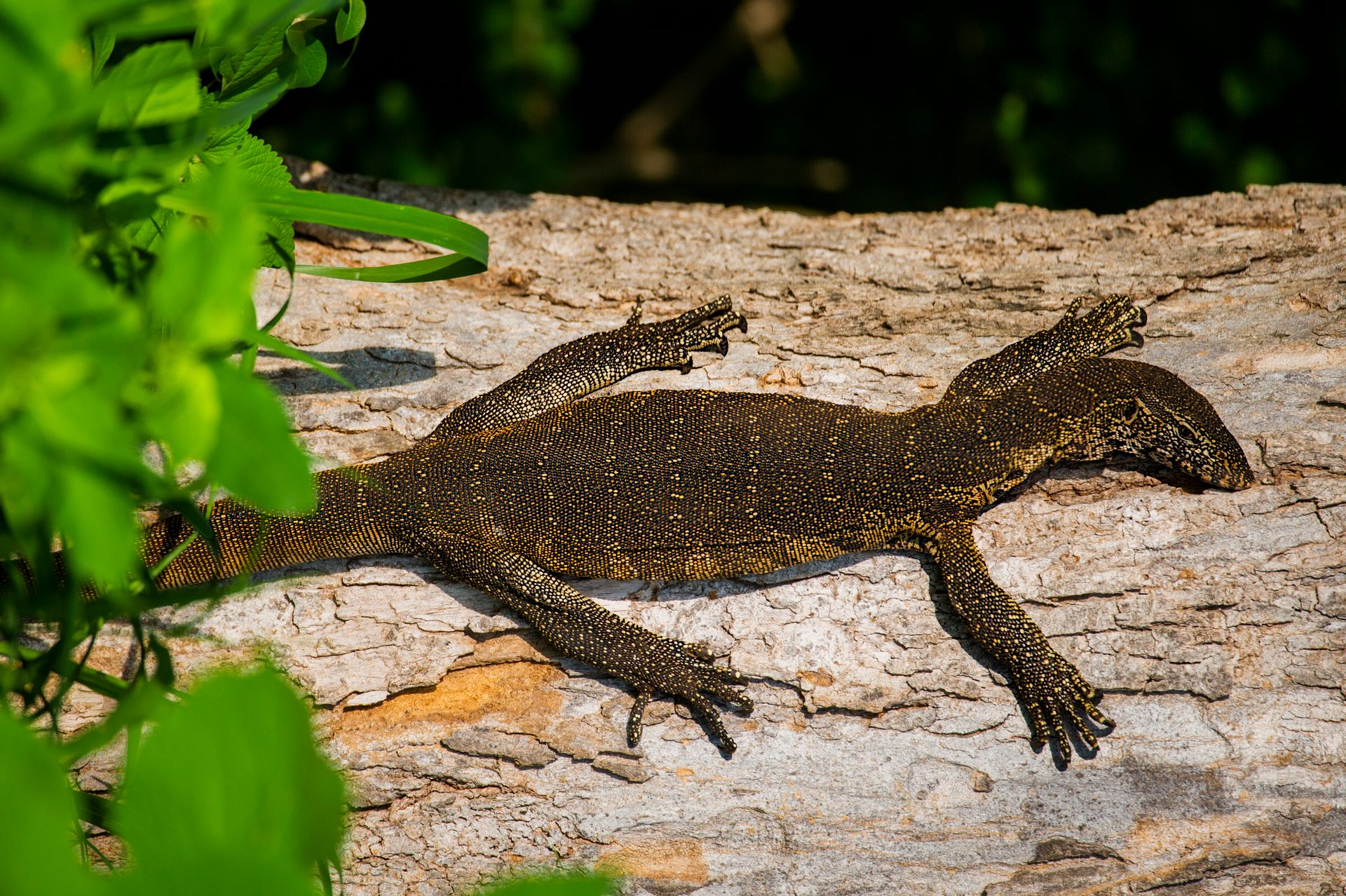
Their skin is tough and beady, with a beautiful pattern of greyish-brown and greenish-yellow spots on the dorsal side of their head, body, and tail. The underside and throat are a lovely ochre- to creamy-yellow color.
Their feet are strong and well-muscled, with sharp claws for climbing, digging, defense, and tearing prey. These claws are a vital tool for the Nile monitor's survival.
Their teeth are strong and pointed in immature specimens, but become blunt and peg-like in adults. This is likely due to their diet and the need for a different type of bite.
Their forked tongue is a unique feature of the Nile monitor lizard, and is used to "smell" the air. This is a common trait among monitor lizards, and is essential for their hunting and survival.
Readers also liked: Yellow Spotted Monitor
Distribution and Habitat
Nile monitors are native to Sub-Saharan Africa and along the Nile. They are not found in any of the desert regions of Africa, such as the Sahara, Kalahari, and much of the Horn of Africa.
These large African monitors are scattered through much of sub-Saharan Africa, from Senegal to Somalia, down to northeastern parts of South Africa. They can be found in a wide variety of habitats, typically close to permanent water bodies.
Nile monitors thrive around rivers, including the Nile River, and can also be found in and around other water bodies like lakes, swamps, and mangroves. They are absent from the rest of North Africa and the Sahara.
Their habitats include grassland, scrub, forests, and wetland areas, always near water. They range as far north as Egypt, but avoid desert regions.
Suggestion: Nile Monitor Lizard Florida
Behavior and Diet
Nile monitor lizards are opportunistic feeders, preying on a wide variety of animals including mammals, amphibians, fish, and birds.
Their diet consists of almost all kinds of mammals, amphibians, fish, birds, reptiles, and eggs found in or around their habitat.
Diet
Nile monitors are opportunistic feeders, taking advantage of whatever food sources are available in their habitat. They will eat almost anything they can catch, from small mammals to birds and reptiles.
Their diet consists of a wide variety of prey, including mammals, amphibians, fish, birds, reptiles, and eggs.
How Fast is a Nile Monitor?
The Nile monitor is a speedy reptile, both in and out of the water.
Online sources estimate that they can swim at incredible speeds, but figures vary from 18 mph to 30 mph.
The perentie, an Australian monitor lizard of similar size, has been clocked at 25 mph and is thought to be the fastest lizard in the world.
The truth about the Nile monitor's speed might be somewhere in between these estimates.
Lifespan and Growth
Nile monitors in the wild typically live for 10 to 20 years, with an average lifespan of 10.6 years in captivity.
Their growth rate is quite impressive, but specific details about their growth are not mentioned in the article.
In captivity, Nile monitors can live for an average of 10.6 years, which is a significant portion of their lifespan.
If you're considering owning a Nile monitor as a pet, keep in mind that their lifespan is relatively long compared to other lizards.
Conservation and Impact
The Nile monitor lizard's presence in Florida has significant conservation implications.
Invasive species like the Nile monitor can negatively impact indigenous crocodilians, such as American alligators and American crocodiles.
Established breeding populations of Nile monitors in Florida, particularly in Lee County, pose a substantial threat to native wildlife.
The Nile monitor's tendency to raid crocodile nests, eat eggs, and prey on small crocodiles is a major concern, given its West African origins.
Anecdotal evidence suggests a high rate of disappearance of domestic pets and feral cats in areas with established Nile monitor populations, such as Cape Coral.
The potential impact of Nile monitors on Florida's ecosystem is enormous, with far-reaching consequences for native species and ecosystems.
In areas with established Nile monitor populations, it's essential to take steps to mitigate the risks to native wildlife.
The presence of Nile monitors in Florida highlights the importance of effective conservation efforts to protect native species.
A fresh viewpoint: Florida Burmese Python Bounty
Care and Management
Nile monitors require a large cage, as they grow quickly when fed a varied diet.
Juvenile monitors will tail whip as a defensive measure, and adults are capable of inflicting moderate to serious wounds from biting and scratching.
Their care presents particular problems due to their enormous size and lively dispositions.
It's essential to be aware that a Nile monitor can turn into a ferocious carnivore within a couple of years, capable of breaking the family cat's neck with a single snap and swallowing it whole.
Nile Monitors as Pets
Nile monitors don't make good pets, especially for beginners.
Their attractive patterning might catch your eye, but they're not content to sit in a small tank.
They need space and are highly active, which makes them a challenge to care for.
These lizards are aggressive and can bite or scratch when stressed.
Their powerful tails, claws, and teeth make them a potential threat to their owners.
In the wild, Nile monitors eat a varied diet and consume a lot of food, leading to expensive bills.
Their diet doesn't change much as they age, so the food costs will continue to add up.
Baby Nile monitors may look cute, but they can quickly outgrow their enclosures.
This often leads to owners abandoning adult animals, which is a sad outcome.
Nile monitors are only suitable for experienced and dedicated reptile owners who can provide the necessary care and attention.
In Captivity
Nile monitors in captivity require a lot of space, as they can grow quite large. In fact, they need a large cage to accommodate their size, especially as juveniles.
Juvenile monitors are prone to tail whipping as a defensive measure. This behavior is a warning sign that they're feeling threatened.
As adults, Nile monitors can inflict serious wounds from biting and scratching. It's not uncommon for them to fight back when they feel threatened.
Their care presents particular problems due to their enormous size and lively dispositions. Few people are prepared for the challenges that come with owning a Nile monitor.
A Nile monitor's diet is a key factor in their growth, and they can quickly outgrow a small enclosure. A varied diet will help them thrive, but it also means they'll need more space to move around.
With proper care, Nile monitors can live for many years, but their aggressive nature and size make them a formidable pet.
Classification and Taxonomy
The Nile monitor lizard is a fascinating creature, and understanding its classification and taxonomy can be a great way to appreciate its unique characteristics. The Nile monitor is classified under the kingdom Animalia, phylum Chordata, class Reptilia, order Squamata, family Varanidae, genus Varanus, and species V. niloticus.
The Nile monitor is a member of the Varanidae family, which also includes other monitor lizards. This family is part of the larger clade Varanoidea, which also includes the Helodermatidae and Lanthanotus families. The Nile monitor's scientific name, Varanus niloticus, is a combination of its genus and species names.
Here's a breakdown of the Nile monitor's classification:
Scientific Classification
Scientific classification is a way to group living things based on their characteristics and evolutionary relationships. It's a system used by biologists to organize and identify species.
The classification system starts with the kingdom, which is the broadest category. In the case of the Nile monitor, it belongs to the kingdom Animalia.
Here's a breakdown of the classification levels:
The scientific name of the Nile monitor is Varanus niloticus, which is a combination of its genus and species names.
Species Complex
A species complex is a group of species that are closely related and can be difficult to distinguish from one another. This is exactly what we see in the Nile monitor, a species complex that has been debated among taxonomists for a long time.
The Nile monitor was traditionally considered a single species, but in 1997, a taxonomic review suggested that the ornate monitor was a separate species from the West and Central African rainforests. This was based on differences in color and morphology.
However, a 2016 review based on genetics found that the West African Nile monitor is actually a separate species from the others in the Nile monitor complex. This species is estimated to have split from the others about 7.7 million years ago.
Here's a breakdown of the different clades within the Nile monitor complex:
- A widespread clade found throughout much of Southern, Central and East Africa, as well as more locally in coastal West Africa.
- A clade that includes the monitors of the Sahel (Mali to Ethiopia) and Nile regions.
It's worth noting that the Reptile Database still considers the ornate monitor and West African Nile monitor as synonyms of the Nile monitor, but acknowledges that this broad species definition includes distinctive subpopulations.
Interesting Facts
The Nile monitor lizard is an incredible creature, and here are some interesting facts about it.
The skin of the Nile monitor lizard has been used for various purposes, including as dietary protein, in ceremonies, and for medicine, as well as for leather goods, for many centuries.
At almost 60 eggs per clutch, these big size monitor lizards have the largest clutch size of any lizard.
One million whole skins of the Nile monitor are required each year in the leather trade, especially in Indonesia.
Nile monitor lizards are the second largest reptile in the Nile River, next only to the Nile crocodile.
The skin of the medium-sized specimens is valued in the leather trade, since the skins of the larger Nile monitors are too tough and difficult to shape.
More Information
If you're looking for more information on the Nile monitor lizard, there are several resources available. The University of Florida has a wealth of information on the topic, including a guide to nonnative reptiles in South Florida and a quick reference guide to large lizards in Florida.
The University of Florida's guide to nonnative reptiles in South Florida is a great place to start. This comprehensive guide helps you identify nonnative reptiles, including the Nile monitor lizard, and provides information on how to report sightings.
The University of Florida's quick reference guide to large lizards in Florida is another valuable resource. This guide provides detailed information on the Nile monitor lizard, including its size, behavior, and habitat.
A fresh viewpoint: Burmese Python Florida Deer
If you're interested in learning more about the Nile monitor lizard's invasion of Florida, the University of Florida has a guide that provides a detailed overview. This guide explores the impact of exotic reptiles and amphibians on Florida's ecosystem.
For more up-to-date information on the Nile monitor lizard, you can check out the FWC species information page or the EDDMapS species information page. Both of these resources provide the latest information on the species, including its distribution, behavior, and management status.
Here are some key resources to get you started:
- Nile Monitor Lizard (University of Florida)
- Nonnative Reptiles in South Florida: Identification Guide (University of Florida)
- Quick Reference Guide: Large Lizards in Florida (University of Florida)
- The Invasion of Exotic Reptiles and Amphibians in Florida (University of Florida)
- FWC species information page for Nile monitor
- EDDMapS species information page for Nile monitor
Featured Images: pexels.com