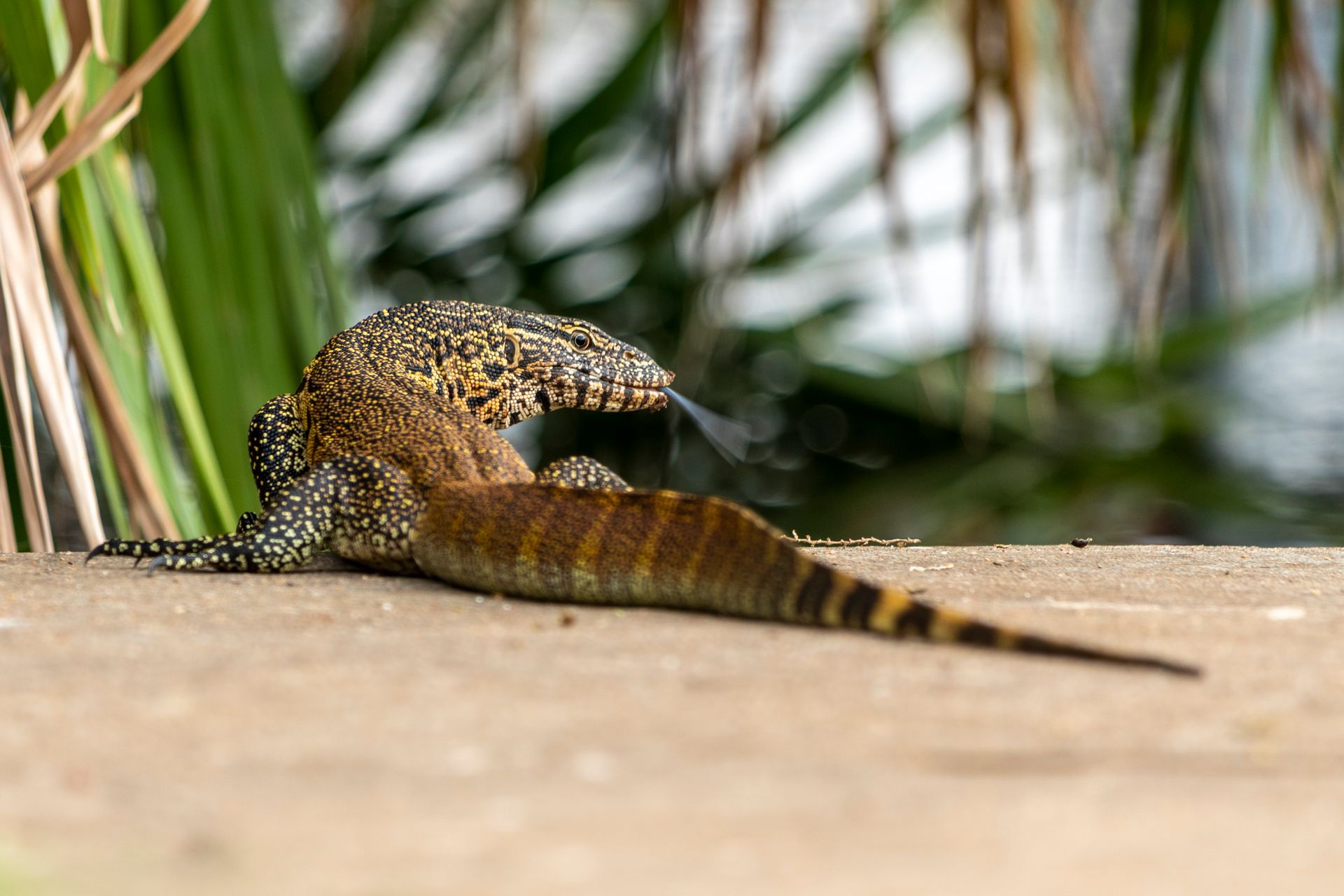
The Nile monitor lizard is a species that holds a special place in the hearts of many cultures. It's considered a sacred animal in some African cultures, revered for its strength and agility.
In fact, the Nile monitor lizard is a keystone species in its ecosystem, playing a vital role in maintaining the balance of nature.
Its unique appearance and fascinating behavior have made it a popular subject in art and literature throughout history.
People in some African communities have been known to keep Nile monitor lizards as pets, but this practice can be challenging due to their specific dietary needs.
Take a look at this: African Helmeted Turtle
Geographic Information
The Nile monitor lizard is found throughout most of sub-Saharan Africa.
This means you can spot them in many different countries, from the savannas to the grasslands.
They are absent from the arid regions of the north and the southwest, which makes sense given their love of water and humid environments.
Interestingly, they do reach Egypt along the Nile River, showing just how adaptable these lizards can be.
Their geographic range is quite extensive, covering a vast area of Africa.
Habitat and Distribution
The Nile monitor lizard is a highly adaptable species, found in a wide range of habitats across sub-Saharan Africa.
They inhabit various environments, including woodland, dry savanna, scrub, evergreen thickets, swamps, and mangroves. This adaptability is made possible by their ability to thrive both on land and in water, making them superb climbers and swimmers.
Exposed, open areas are crucial for Nile monitors, as they require sufficient basking locations. They've even been known to bask on open rooftops and streets.
Young Nile monitors often lie on branches overhanging rivers or pools, and if disturbed, will drop into the water. They're also skilled climbers, able to ascend trees up to 5 to 6 meters in height.
In addition to their climbing abilities, Nile monitors can flee down a hole or rocky crevice, or into a termite nest when alarmed and water is not available. They also live in burrows, which they excavate themselves or expand an existing one.
For your interest: Malayan Water Monitor Lizard
Here are the various habitats and biomes where Nile monitors can be found:
- Habitat Regions: temperate, tropical, terrestrial, freshwater
- Terrestrial Biomes: savanna or grassland, scrub forest
- Aquatic Biomes: lakes and ponds, rivers and streams, temporary pools
- Wetlands: swamp
Nile monitors are found throughout most of sub-Saharan Africa, with the exception of the arid regions of the north and the southwest. They can even be found in Egypt along the Nile River.
In the United States, they have adapted to both terrestrial and aquatic habitats, and prefer to be near permanent bodies of water. Florida's mangrove swamps have become an ideal habitat for them.
Physical Characteristics
The Nile monitor lizard is a sight to behold, with its long, muscular body and coloring of the skin in tough, scalelike patches that vary in color from dark brown to olive green.
Adult Nile monitors can grow up to 2.4 meters in length and weigh a significant amount, making them Africa's largest lizards. They have a deep, stoutly constructed skull and blunt crushing posterior teeth that allow them to eat hard-shelled prey.
Their skin is covered by bead-like scales, and they have rounded nostrils that are located slightly nearer to the eye than to the snout. The toes are strong and moderately long, perfect for climbing trees.
The tail of Nile monitors is compressed laterally with a dorsal keel and a very low double-toothed crest. They have a muscular physique, sharp claws, and strong legs that make it easy for them to climb trees and move around.
Juveniles, on the other hand, are black with yellow cross-lines on the head and black and yellow vertical bars on the lips. They have yellow lines on the neck and a transverse series of yellow spots on the back.
Adult Nile monitors are brownish or greenish-gray, with darker reticulation and yellowish spots or stripes on the back and limbs.
You might enjoy: Yellow Monitor Lizard
Behavior and Biology
The Nile monitor lizard is a remarkable creature, and understanding its behavior and biology is essential to appreciating its unique characteristics.
Females are sexually mature in two years and breed every other year, with only 50% of females breeding and laying eggs in any given year. This means that the breeding process is quite specific and not a continuous process.
In the wild, Nile monitors can live more than 10 years, which is impressive given their size and habitat. They are great swimmers, using their powerful tails to glide through rivers and lakes with ease.
Monitor Lizard Behaviour
Nile monitors are active foragers with a fairly large home range.
Their home range is likely in sub-Saharan Africa and Madagascar, where they spend most of their time in or near water.
These lizards are great swimmers, using their powerful tails to glide through rivers and lakes with ease.
Primarily diurnal, Nile monitors remain active during the day, allowing them to hunt for food in a wide range of environments.
They are not choosy eaters, consuming a variety of prey including fish, frogs, small mammals, birds, and even carrion.
Nile monitors are skilled climbers, often seen scaling trees or digging into sandy riverbanks.
Biology
Females are sexually mature in two years and they breed every other year, which means only 50% of females are breeding and laying eggs in any given year.
They lay eggs in the winter dry season in active termite mounds after feeding and accumulating fat during the summer.
Egg clutches are about 35 eggs, and smaller female Nile monitors will lay fewer eggs than larger females.
Hatchlings emerge 6-10 months later, near the beginning of the wet season, and are 6-12 inches in length.
Varanus niloticus can live more than 10 years in the wild.
For your interest: Raphus Cucullatus
Predation
Nile monitors have few predators, but pythons prey on these lizards most often. Young Nile monitors make easy prey for a large python.
A 4.5 m long African rock python has been reported to seize a 1.4 m long Nile monitor, and within half an hour had swallowed it head first.
Crocodiles also take monitors on occasion. As a last resort, a cornered Nile monitor will bite savagely and eject foul-smelling matter from the cloaca to deter attack or throw off a pursuer.
Explore further: Florida Burmese Python Bounty
Ecological Threat
Nile monitors are potentially the most destructive lizard introduced to Florida, with negative effects on the American alligator and American crocodile due to their similar diets.
Their aggressive behavior makes them a threat to native fauna, and they have a tendency to occupy burrows that displace endangered animals like the Burrowing Owl and the gopher tortoise.
In Florida, Nile monitors are major predators of crocodilian eggs and hatchlings, and their generalist and ravenous appetite makes them a significant threat to native species.
If the Nile monitor were to make its way to the Florida Keys, it could potentially make four species of rodents extinct.
Nile monitors are also known to eat the native animals' eggs, further threatening the native ecosystem.
Their ability to occupy burrows and displace other animals makes them a significant ecological threat in Florida.
Suggestion: American Yellow Warbler
Conservation and Threats
Nile monitors are protected by law in some African countries, including being listed under the Endangered Species Decree of 1985, which prohibits international trade of the species.
Additional reading: Common Snapping Turtle Species
The Nile monitor is listed under CITES, Appendix II, which means that there are regulations in place to ensure the species is not over-exploited.
Habitat loss is a significant threat to Nile monitors, as expanding agriculture, pollution, and infrastructure development can reduce their natural habitats.
Nile monitors are also hunted for food or skin, and their eggs are collected for local consumption in some areas.
The national parks and protected areas of Uganda, such as Queen Elizabeth National Park, Murchison Falls National Park, and Lake Mburo National Park, provide a safe habitat for Nile monitors.
Here are some conservation statuses for the Nile monitor:
- IUCN Red List: No special status
- US Federal List: No special status
- CITES: Appendix II
Classification and History
The Nile monitor lizard is a fascinating creature, and understanding its classification and history can provide valuable insights into its behavior and habitat.
The Nile monitor lizard belongs to the kingdom Animalia, which includes all animals. More specifically, it falls under the phylum Chordata, which includes animals with a backbone, and the subphylum Vertebrata, which includes animals with a backbone and a central nervous system.
Here is a breakdown of its classification:
- Kingdom: Animalia
- Phylum: Chordata
- Subphylum: Vertebrata
- Class: Reptilia
- Order: Squamata
- Family: Varanidae
- Genus: Varanus
- Species: Varanus niloticus
The Nile monitor lizard has a long history of being introduced to new habitats, with free-living individuals first spotted in Florida in 1990. By 2002, they had established themselves along the Atlantic coast of Florida and the southern part of the peninsula.
Classification
Classification is a way to group living things based on their shared characteristics. It's like organizing a big library of animals, where each book (or animal) has its own unique shelf (or classification).
The kingdom Animalia is the broadest category, and it includes all animals, with over 22861 pictures and 7109 specimens to prove it.
Phylum Chordata is a more specific group, containing animals with backbones, like humans and other vertebrates. Chordata has 15213 pictures and 6829 specimens.
Vertebrata is a subphylum within Chordata, and it's home to animals with backbones, including turtles, snakes, and lizards. There are 15168 pictures and 6827 specimens of vertebrates.
Reptilia is a class within Vertebrata, and it includes animals like turtles, snakes, lizards, and their relatives. Reptilia has 8809 pictures and 170 specimens.
The order Squamata is a group within Reptilia, and it's home to animals with scales, like snakes and lizards. Squamata has 985 pictures and 7 specimens.
The family Varanidae is a group within Squamata, and it includes animals like monitor lizards. Varanidae has 17 pictures.
The genus Varanus is a group within Varanidae, and it includes animals like the Nile Monitor. Varanus has 17 pictures.
The species Varanus niloticus is a specific type of animal, and it's also known as the Nile Monitor or Water Leguaan.
On a similar theme: Varanus Bengalensis
History
The Nile monitor has a fascinating history. Free-living Nile monitors were first spotted at Cape Coral in 1990.
This sighting is believed to be a result of the pet trade, which is how they were introduced to the area. By 2002, Varanus niloticus was found all along the Atlantic coast of Florida and the southern part of the peninsula.
The Nile monitor thrives in temperate parts of Africa, which suggests that it could establish itself as far north as the Carolinas.
Cultural and Economic Significance
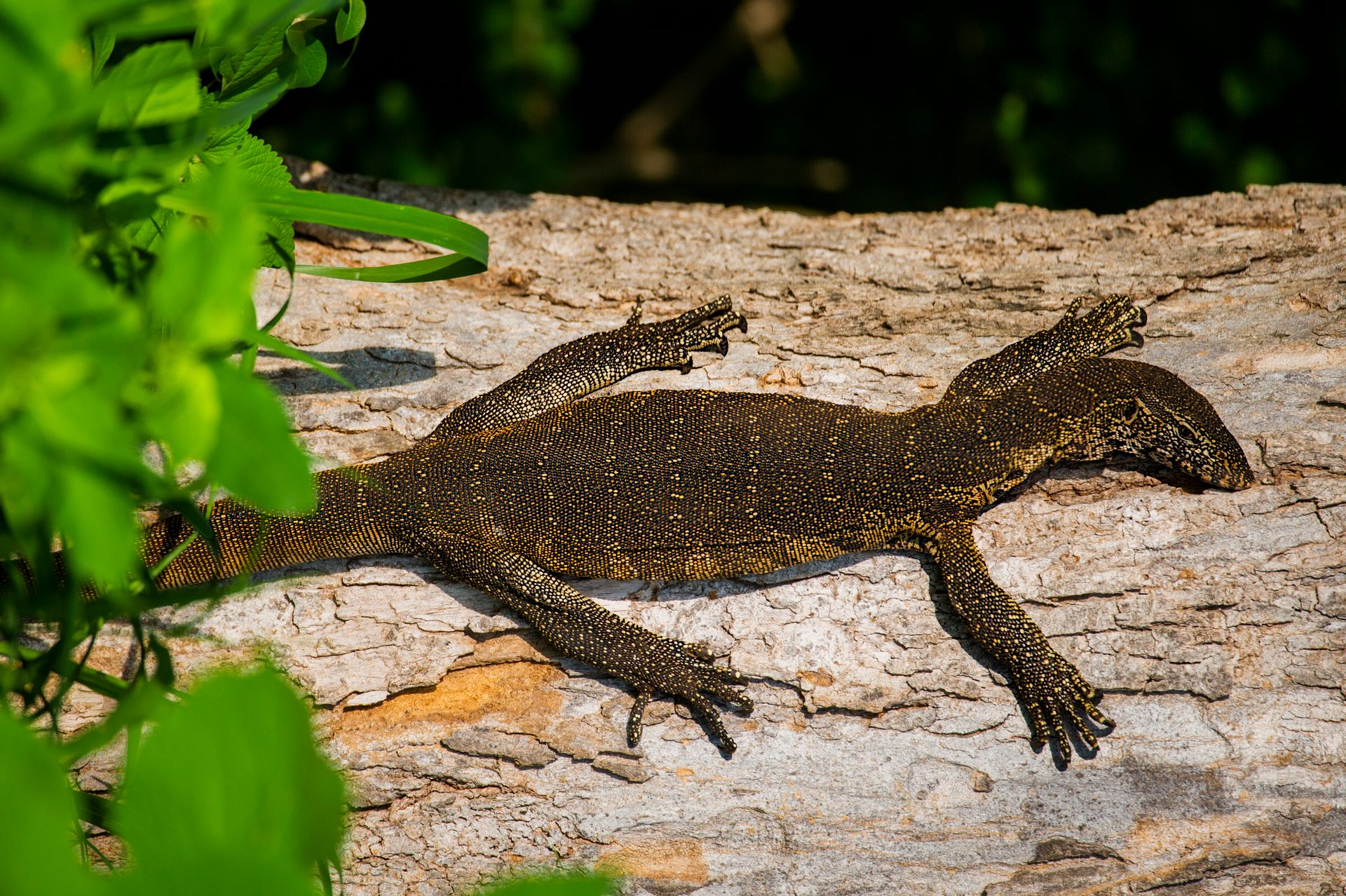
In many Ugandan communities, the Nile monitor lizard is more than just a wild animal. It's a symbol of strength and resilience.
To some people, the Nile monitor carries mystical knowledge of the rivers and wetlands it calls home. This is a big part of its cultural significance.
People used to hunt Nile monitors for their meat and skin, which artisans used in traditional drum-making and other cultural products.
Cultural Significance
The Nile monitor lizard holds a special place in many Ugandan communities. In these communities, it's often seen as a symbol of strength and resilience.
In traditional beliefs, the Nile monitor is thought to possess mystical knowledge of the rivers and wetlands it calls home. This unique perspective is deeply rooted in the cultural heritage of these communities.
People used to hunt Nile monitors for their meat and skin, which was then used by artisans to create traditional drum-making and other cultural products.
Negative Economic Importance
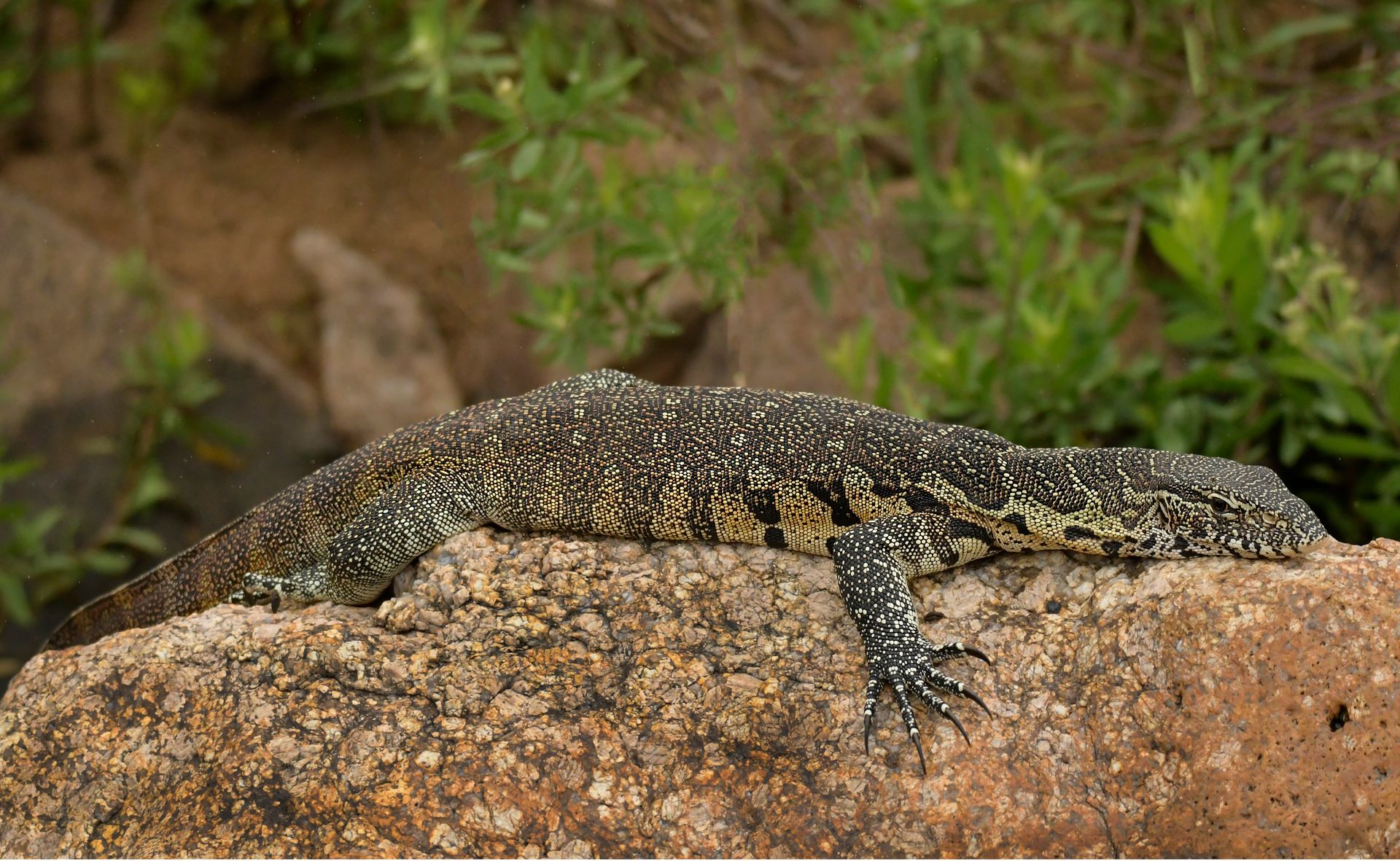
Nile monitors have been known to cause problems for humans by attacking livestock in towns, farms, and homesteads. This can be a significant issue for farmers and homesteaders who rely on their animals for food and income.
In some cases, Nile monitors have been known to acclimate to human environments and become a nuisance. They may even attack chickens, which can be a major concern for backyard farmers.
Their ability to adapt to human environments can lead to conflicts with humans, particularly in areas where their natural habitats overlap with human settlements.
Uganda Tourist Attractions
If you're planning a trip to Uganda, you'll want to know about the top tourist attractions where you can spot the Nile monitor lizard. Murchison Falls National Park is a must-visit, as it offers prime viewing spots for these reptiles basking on riverside banks or swimming through the waters.
The park's unique location, where the Nile River cuts through, creates a perfect habitat for Nile monitors. Take a guided tour or explore the park on your own to increase your chances of spotting one.
Queen Elizabeth National Park is another excellent destination for Nile monitor sightings. The Kazinga Channel, which connects Lake Edward and Lake George, is home to a large number of wild animals, including Nile monitors. A boat cruise along the channel is a great way to see these reptiles up close.
Lake Mburo National Park is also a great spot for Nile monitor sightings, thanks to its wetlands and lake systems. With numerous water bodies ideal for the survival of these large reptiles, you're likely to see them basking in the sun or swimming in the waters.
Frequently Asked Questions
Are Nile monitor lizards good pets?
No, Nile monitor lizards are not suitable pets for the average person due to their specialized care requirements. They are best suited for experienced owners who can provide the proper environment and attention.
Featured Images: pexels.com