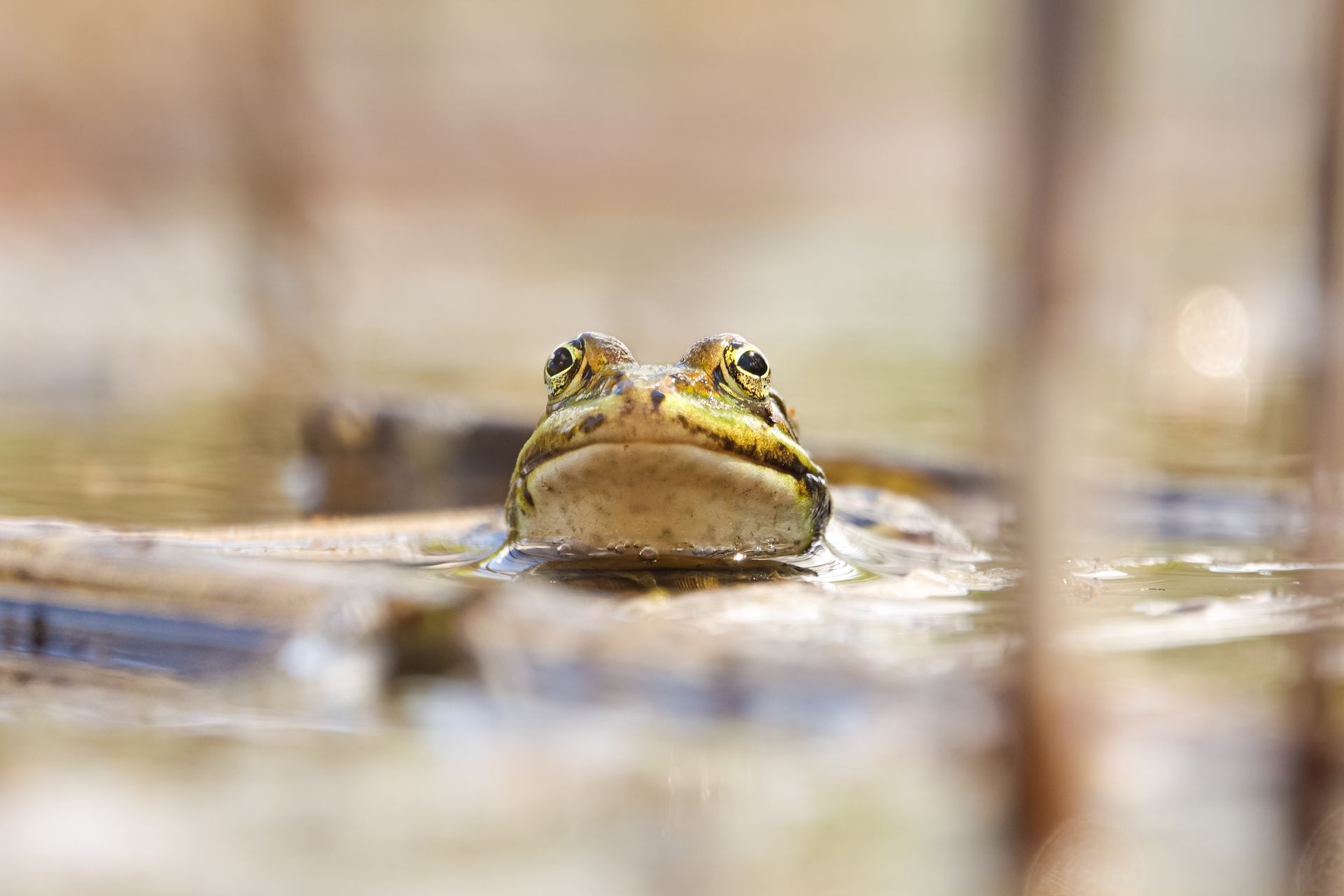
The Microhylidae family is a fascinating group of frogs, and understanding their characteristics and species can help us appreciate these tiny creatures even more.
The Microhylidae family is a group of small to medium-sized frogs, ranging in size from about 1 to 4 centimeters in length.
Some species of Microhylidae, like the Microhyla ornata, have a distinctive appearance with a brown or grayish-brown color and distinctive white or yellow markings on their backs.
These frogs are known for their burrowing behavior, often digging complex networks of tunnels and burrows in soil and leaf litter.
Classification
The Microhylidae family is closely related to other ranoid frog families, such as the Ranidae, Rhacophoridae, and Hyperoliidae.
Characterizing the family proves elusive, as some species lack the unique character of serrated, transverse folds of skin on the palate, or have them in reduced numbers and sizes.
The family Microhylidae has a moderately long history, dating back to the Miocene of Florida, around 24 million years ago.
Direct embryonic development, skipping a free-living larval stage, is a common trait among microhylids, with almost 30% of the genera and nearly half the species undergoing this process.
Free-swimming, feeding larvae of microhylids typically lack cornified denticles and have a median, ventral spiracle.
The fossil record of the Microhylidae is meager, but it suggests a Gondwanan origin, with the presence of microhylids in South America, Africa, Madagascar, India, and Australia.
Nine subfamilies are recognized in the Microhylidae family, although relationships among them are not well worked out.
The Asterophryinae subfamily received attention from Zweifel in 1972 and Burton in 1986, but relationships among the microhylid subfamilies and their genera remain unclear.
The Malagasy frogs in the Dyscophinae and Cophylinae subfamilies are considered primitive, with characteristics such as maxillary and vomerine teeth, and the retention of clavicles and procoracoid cartilages.
Taxonomic Groups
The Microhylidae family is divided into several subfamilies, which is a way of grouping similar species together. These subfamilies are a crucial part of understanding the taxonomy of Microhylidae.
Here are some of the subfamilies listed in the taxonomy section:
- Adelastinae
- Asterophryinae
- Chaperininae
- Cophylinae
- Dyscophinae
- Gastrophryninae
- Hoplophryninae
- Kalophryninae
- Melanobatrachinae
- Microhylinae
- Otophryninae
- Phrynomerinae
- Scaphiophryninae
Some of the subfamilies, like Microhylinae and Asterophryinae, were first described by notable herpetologists such as Albert Günther in 1858, who is also credited with naming the family Microhylidae.
Taxonomy
Taxonomy is the science of classifying living things into groups based on their characteristics and evolutionary relationships. The Microhylidae family, a group of frogs, has several subfamilies.
The subfamily Adelastinae was established by Peloso et al. in 2015, and it's one of the many subfamilies within the Microhylidae family. Another subfamily, Asterophryinae, was described by Günther in 1858, making it one of the earliest recorded subfamilies.
Here are some of the subfamilies within the Microhylidae family:
- Adelastinae (Peloso et al., 2015)
- Asterophryinae (Günther, 1858)
- Chaperininae (Peloso et al., 2015)
- Cophylinae (Cope, 1889)
- Dyscophinae (Boulenger, 1882)
- Gastrophryninae (Fitzinger, 1843)
- Hoplophryninae (Noble, 1931)
- Kalophryninae (Mivart, 1869)
- Melanobatrachinae (Noble, 1931)
- Microhylinae (Günther, 1858)
- Otophryninae (Wassersug & Pyburn, 1987)
- Phrynomerinae (Noble, 1931)
- Scaphiophryninae (Laurent, 1946)
Fry's Whistling Frog
Fry's Whistling Frog is a small species that can be found in northeast Queensland, Australia. It's a relatively small frog, with females reaching a body length of 1.3 in (35 mm).
The species has some distinctive physical features, including a slightly rotund body, relatively large eyes, and a rounded snout. The body is brown above, with a reddish tint, and the facial region is black.
One way to distinguish Fry's Whistling Frog from another similar species, Austrochaperina robusta, is by listening to their calls. Fry's Whistling Frog gives a series of brief whistles, while Austrochaperina robusta produces whistles in couplets.
Curious to learn more? Check out: Paedophryne Amauensis Frog
These frogs can be found in the leaf litter on the forest floor, where they hide by day amid the leaves or under other cover. They range in elevation from virtually sea level to 3,600 ft (1,100 m).
At night, males call from superficial cover on the forest floor, not from deep within the leaf litter.
Horned Land Frog
The horned land frog is a species that can be found in most of New Guinea at low to moderate elevations, usually below 4,100 ft (1,250 m).
Its body length is relatively small, maxing out at about 1.6 in (41 mm).
Females are slightly larger than males.
The species has a slender body with long legs and a pointed snout.
Enlarged terminal disks on the fingers and toes give the horned land frog the aspect of a tree frog.
The color of the horned land frog varies from dark to light brown above and gray laterally, with largely gray, orange, or red undersides.
Males call at night from shrubs or other low vegetation.
The presumed advertisement call is a rattling sound lasting up to three seconds.
The horned land frog is not threatened, as it is widely distributed and less likely to be exterminated by destruction of rainforest.
On a similar theme: Desert Horned Lizard
Eastern Narrow-Mouthed Toad
The Eastern Narrow-Mouthed Toad is a small species, with males growing to about 0.8 in (23 mm) and females to 1 in (25 mm) in body length.
They have a rather rotund body that tapers to a narrow head and bluntly pointed snout.
Finger and toe tips are pointed, and the toes have only scant webbing.
The dorsal ground color is light olive brown and sometimes grayish or reddish, with a prominent dorsal pattern of black bands.
Their typical habitats are grassy areas near flooded rice paddies, ditches, and pools up to the lower slopes of mountains at about 3,000 ft (900 m).
They are nocturnal, taking daytime shelter in grass or the crevices in drying soil or under surface litter.
They are said to be poor swimmers but very active jumpers.
Breeding takes place after heavy rain, when males call from the water in flooded rice fields and similar habitats.
The female deposits several hundred eggs that float in a film at the surface of the water.
Malaysian Painted Frog
The Malaysian painted frog is quite a unique creature, reaching lengths of up to 3 inches.
It's remarkable to note that this frog's body is rotund, with a blunt, rounded snout, and short, stout legs.
The Malaysian painted frog's hind feet have a projecting "spade" on the sole just anterior to the heel, which it uses to burrow backward into the soil.
This frog is secretive and terrestrial, often taking shelter in burrows, rubbish heaps, and other human-made structures.
Its diet consists mainly of ants and other small insects.
The Malaysian painted frog breeds in temporary water sources, such as ditches, only after heavy rains fill them up.
During breeding, males give loud, honking calls while floating high in the water, and their rounded shape is exaggerated when they inflate.
In these ephemeral habitats, larval growth is typically rapid, but may not be fast enough to reach completion before the water dries up.
This frog's association with people may explain its spotty occurrences outside of its apparent natural range.
Pyburn's Pancake Frog
Pyburn's pancake frog is a species of microhylid frog found in South America, with a range from southeastern Colombia eastward through southern Venezuela and Guyana to French Guiana.
This frog lives on the forest floor in sandy soils of the rainforest, and individuals probably stay underground much of the time.
It has a rather broad body, with short legs, and tapers to a sharp-pointed, projecting snout. The tympanum is distinct and slightly greater in diameter than the eye.
The dorsal surfaces are reddish brown to grayish yellow, uniform or with darker markings, including a mid-dorsal stripe, and separated by a pale stripe from the darker side of the body. The general impression is that of a dead leaf.
Males call during the day from sheltered sites, such as beneath leaf litter or under root tangles beside streams.
Physical and Behavioral Characteristics
Microhylids are a diverse group of frogs, and their physical characteristics can be quite varied. They can have a teardrop shape with a chunky body and narrow head, or be true treefrogs with large eyes and expanded terminal disks on their fingers and toes.
Most microhylids are drab-colored, with shades of brown and dull yellow dominating their dorsal sides. However, some species, like the rubber frogs in southern Africa, have bright-red dorsal markings on a black or brown background.
Some microhylids have unique features, such as two or three serrated folds across their palate, which is a feature unique to this family. They also often lack teeth and have a firmisternal condition, where the coracoid bones meet on the midline.
In terms of size, most microhylids are relatively small, with about 83% of species reaching a length of less than 2 inches. However, some species can grow up to 2.5 inches in length, like the broad-headed frog of New Guinea.
Microhylids have adapted to a wide range of habitats, and as a result, they exhibit diverse body forms. They can be found in forests, near water, or even in burrows, and their physical characteristics reflect their specific environments.
Physical Characteristics
Most microhylids are small frogs, with many species reaching lengths of less than 1.5 cm (0.59 in). Some species, however, can grow as large as 9 cm (3.5 in).
Their body shapes vary greatly, with some having a teardrop shape and others having a wide, flat body. Some species have a pointed snout, while others have a broad head and a wide gape.
Many microhylids have a drab coloration, with shades of brown and dull yellow dominating their dorsal sides. Some species, however, have bright-red dorsal markings on a black or brown background, which may serve as a warning coloration.
Their limbs and sides of the body can be warty, and some species have fleshy spines on their eyelids. Clavicles may be small or absent, and the procoracoid cartilage may be absent or cartilaginous rather than bony.
Some microhylids have two or three serrated folds across their palate, a feature unique to this family. They typically lack teeth, but some primitive forms in Madagascar have teeth.
Behavior
Microhylids are a diverse group of frogs, and their behavior reflects this diversity. Some species have adapted to life underground by developing specialized burrowing structures.
Terrestrial microhylids often use a "leap and hide" defense mechanism, diving underwater or burrowing into surface litter to evade predators. This behavior is characteristic of frogs in general.
The Madagascar tomato frog (Dyscophus antongilii) takes a different approach, producing slime that's nearly five times stronger than rubber cement to deter predators. This sticky slime can even trap a small predator's eyelids and lips together.
In some parts of the world, microhylids have formed unlikely alliances with other animals. For example, in the United States and South America, certain species have been known to live with tarantulas in their burrows without being attacked.
Seasonal activity varies depending on climate, with tropical microhylids often relying on rainfall to determine when to be active. In areas with a pronounced dry season, these frogs will remain in burrows until heavy rains return.
Most microhylids are nocturnal, but some species at high elevations will call during the day. This is a notable exception to the general rule of nighttime activity.
Ecology and Diet
Microhylids show a diverse feeding behavior, with some species specializing in taking ants as their primary prey. This is especially true for pointy-nosed species with a narrow gape.
In addition to ants, larger microhylid species can eat a wide range of tiny invertebrates, including lizards, frogs, and earthworms.
Some microhylids have a sit-and-wait behavior, where they remain stationary and ambush prey rather than actively foraging for food.
Habitat
Microhylids are incredibly adaptable, with a wide range of habitats to call home. They can be found from sea level to over 13,000 ft (4,000 m) in elevation.
Many species live in tropical rainforests, where they occupy various ecological niches. Some even burrow into the soil, emerging only to feed or find mates.
Others stay low to the ground, hiding in leaf litter on the forest floor. Climbing species may venture up low shrubbery at night, but some are arboreal, spending their entire lives high in the trees.
Some species, like those in the genera Oreophryne and Oxydactyla, inhabit alpine grasslands at elevations above 12,000 ft (3,700 m) in New Guinea. Temperate regions, however, seem to lack arboreal microhylids.
Rain frogs in southern Africa even burrow into sand dunes, showing just how varied their habitats can be.
Readers also liked: Arboreal Salamander
Feeding Ecology and Diet
Microhylid frogs have a diverse diet that includes ants, which are a common prey. Some species with a narrow gape, such as pointy-nosed frogs, specialize in eating ants.
These frogs don't just stick to ants, though - they also eat other tiny invertebrates. Even species that primarily feed on ants will still eat other insects.
Larger microhylid species with a broad gape can eat bigger prey, including lizards, frogs, and earthworms.
Reproduction and Conservation
The microhylids of New Guinea and Australia have a unique reproductive strategy, completely bypassing the tadpole stage and developing directly from egg to frog.
This means they can lay eggs within the trees and never need to venture to the ground, giving them a distinct advantage over other frog species.
In fact, most microhylids live in tropical rainforests, which are being destroyed at an alarming rate, making conservation efforts crucial to protect these species.
Many countries and jurisdictions have laws to protect wildlife, including frogs, but these laws often serve to inhibit scientific research without doing much else.
It's a sad reality that many microhylid species will become extinct before their plight is even recognized, and many others will disappear without achieving scientific recognition.
Broaden your view: Eastern Grey Squirrel Scientific Name
Reproduction
The reproductive habits of certain species are quite fascinating, and some have adapted to their environments in remarkable ways. Direct embryonic development is a characteristic of some species, but unfortunately, we don't know much about their reproductive habits.
Some species, like those found in New Guinea and Australia, have a unique reproductive strategy. They completely bypass the tadpole stage, with direct development from egg to frog, allowing them to lay eggs in trees and never venture to the ground.
The tadpoles of these species are quite different from those of other families, lacking teeth or horny beaks. This adaptation is likely a result of their arboreal lifestyle.
Conservation Status
The conservation status of microhylid frogs is a pressing concern. As of 2002, only two species are classified as Endangered.
The Camiguin narrow-mouthed frog (Oreophryne nana) is one of them, found only on a small island in the southern Philippines. It's a stark reminder of the importance of habitat preservation.
Six species are classified as Vulnerable, including the Cape rain frog (Breviceps gibbosus) and the desert rain frog (Breviceps macrops) in South Africa. Their small ranges make them even more susceptible to extinction.
The Negros truncate-toed chorus frog (Kaloula conjuncta negrosensis) on Negros Island in the Philippines is another example. Laws protecting wildlife exist in many countries, but they often hinder scientific research without providing meaningful protection.
Most microhylid frogs live in tropical rainforests, which are being destroyed at an alarming rate. This has devastating consequences for the species that depend on them.
Significance and Examples
Microhylidae, also known as the narrow-mouthed frogs, are a diverse group of frogs with over 1,000 species.
Their unique appearance is characterized by a narrow, pointed snout and a relatively small mouth, which is often hidden by their skin.
Some species, like the Pacific Chorus Frog, are known for their distinctive calls that can be heard during the breeding season.
These calls serve as a form of communication and help attract mates.
In terms of habitat, Microhylidae can be found in a wide range of environments, including forests, grasslands, and even urban areas.
Significance to Humans
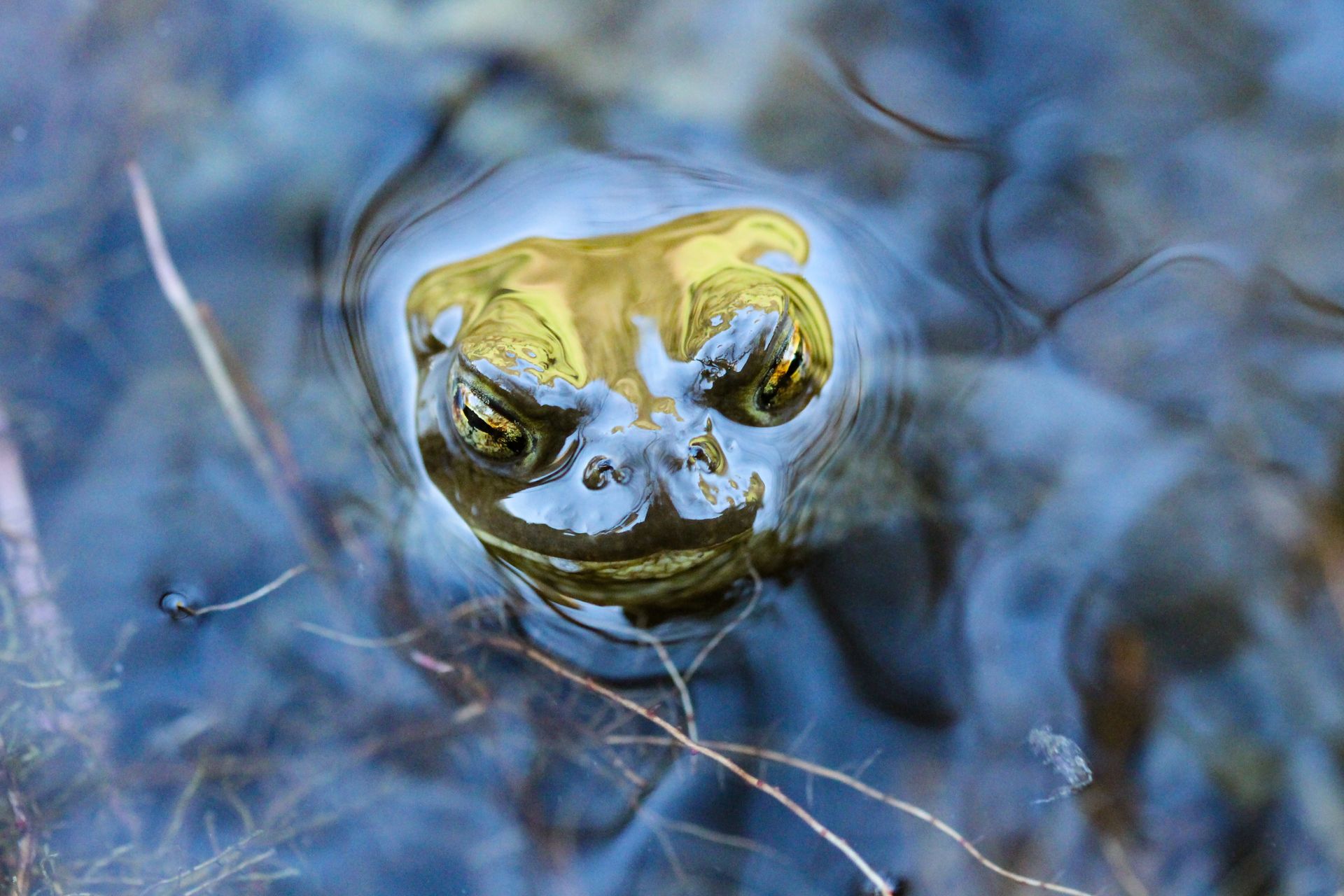
In many parts of the world, microhylid frogs are a food source for indigenous communities.
Some species are small enough to be considered a minor contribution to human nutrition.
In New Guinea, South America, and possibly other regions, microhylid frogs are a part of the traditional diet.
The danger of overutilizing these frogs is likely to be low due to their small size.
Timbo Disc Frog
The Timbo disc frog is a small frog with a stout body that tapers to a narrow head with a blunt, overhanging snout.
It's only about 1.1 inches long, or 28 mm, and has a gray-brown back with small spots that can range from cream to orange.
These frogs live on the floor of rainforest and are secretive, hiding in burrows beneath the forest floor under layers of fallen leaves and root tangles.
They emerge rarely, if ever, into the open, and when they do, it's only during heavy rainfall when they give a brief whistle from the mouth of their burrow.
The eggs are large and few, typically four to six, and are deposited in the burrow with the male frog accompanying them.
The hatched tadpoles don't feed and live on the stored yolk until they metamorphose.
Subfamilies and Species
The Microhylidae family has two notable subfamilies: Genyophryninae and Otophryninae.
The Genyophryninae subfamily has a procelous vertebral column and lacks clavicles and procoracoids in some species.
This subfamily is found in New Guinea, with fringe species in surrounding areas, and contains 11 genera and 118 species.
The Otophryninae subfamily, on the other hand, has a diplasiocelous vertebral column and includes clavicles and procoracoids.
Its larvae have distinctive dagger-like teeth and are found in northern South America.
There is only one genus in the Otophryninae subfamily, with three species, although some researchers question its distinction from the Microhylinae subfamily.
Cophylinae
The Cophylinae subfamily is quite unique in its physical characteristics.
The vertebral column is procelous, meaning it's a bit unusual in its structure.
This subfamily has maxillary or vomerine teeth, or sometimes both, which is a notable feature.
Four of the genera lack the transverse palatal folds found in almost all other micro-hylids.
The distribution of Cophylinae is restricted to Madagascar.
There are seven genera with 35 species within this subfamily.
Microhylinae
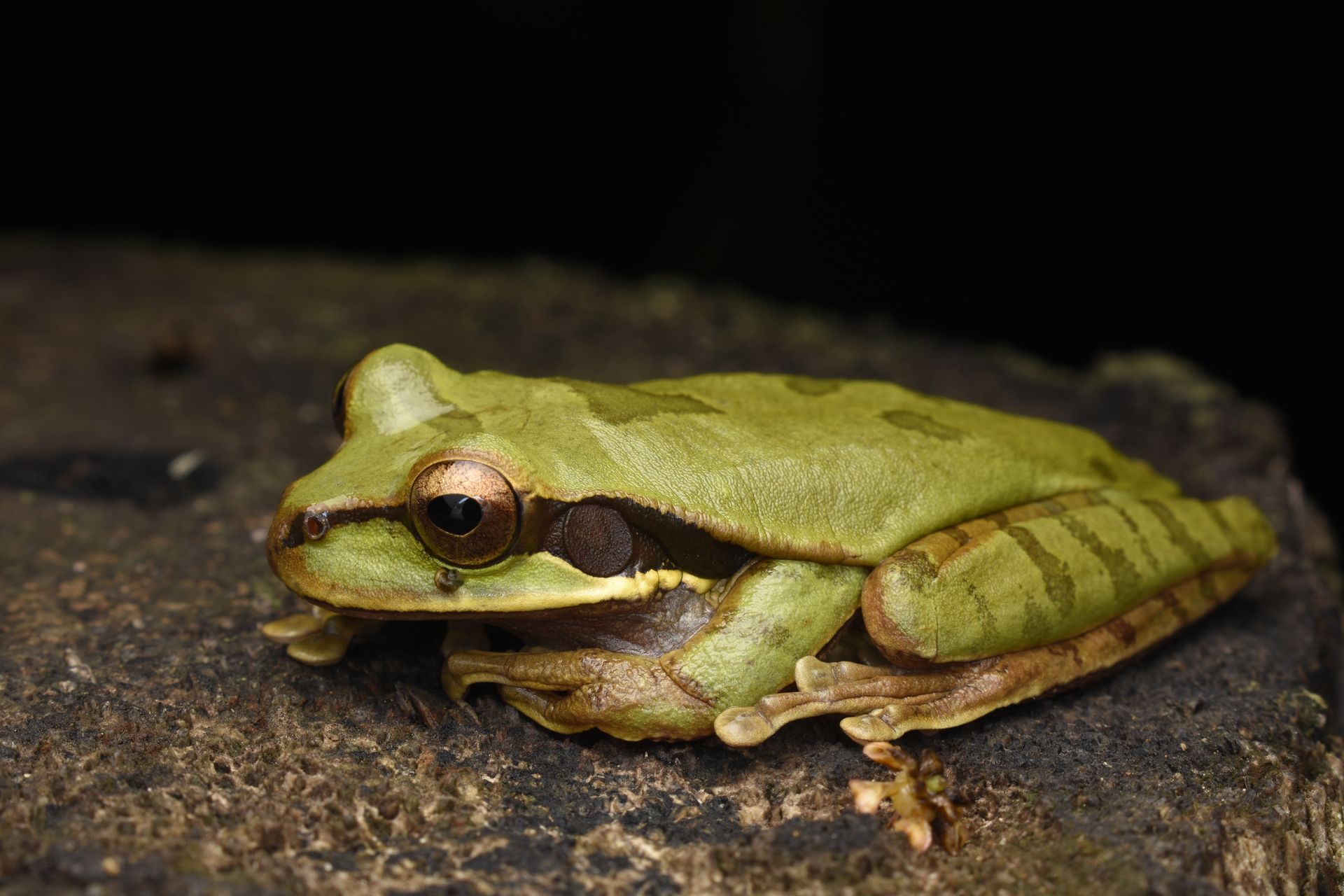
The Microhylinae subfamily is quite fascinating. It's the only microhylid family in the New World apart from the Otophryninae.
The vertebral column in Microhylinae is diplasiocelous, although it can be procelous in rare cases.
Teeth are completely absent in Microhylinae, but some species may have vestiges present on the maxilla.
In most species, the larva is a free-swimming microhylid type lacking cornified denticles and a beak.
Vomers are typically present in separate anterior and posterior locations, but they may be absent posteriorly.
Boulenger's Climbing Frog
Boulenger's Climbing Frog is a small species, measuring only 0.85 in (22 mm) in body length.
It has a distinctive appearance with a bluntly pointed snout, and teeth in the upper jaw, a feature lacking in most microhylids.
The frog's fingers and toes have enlarged terminal disks, with the fingers being much broader.
It lacks webbing between its toes.
Males have a sharp, projecting spine on the first finger that may help them grip the female during amplexus.
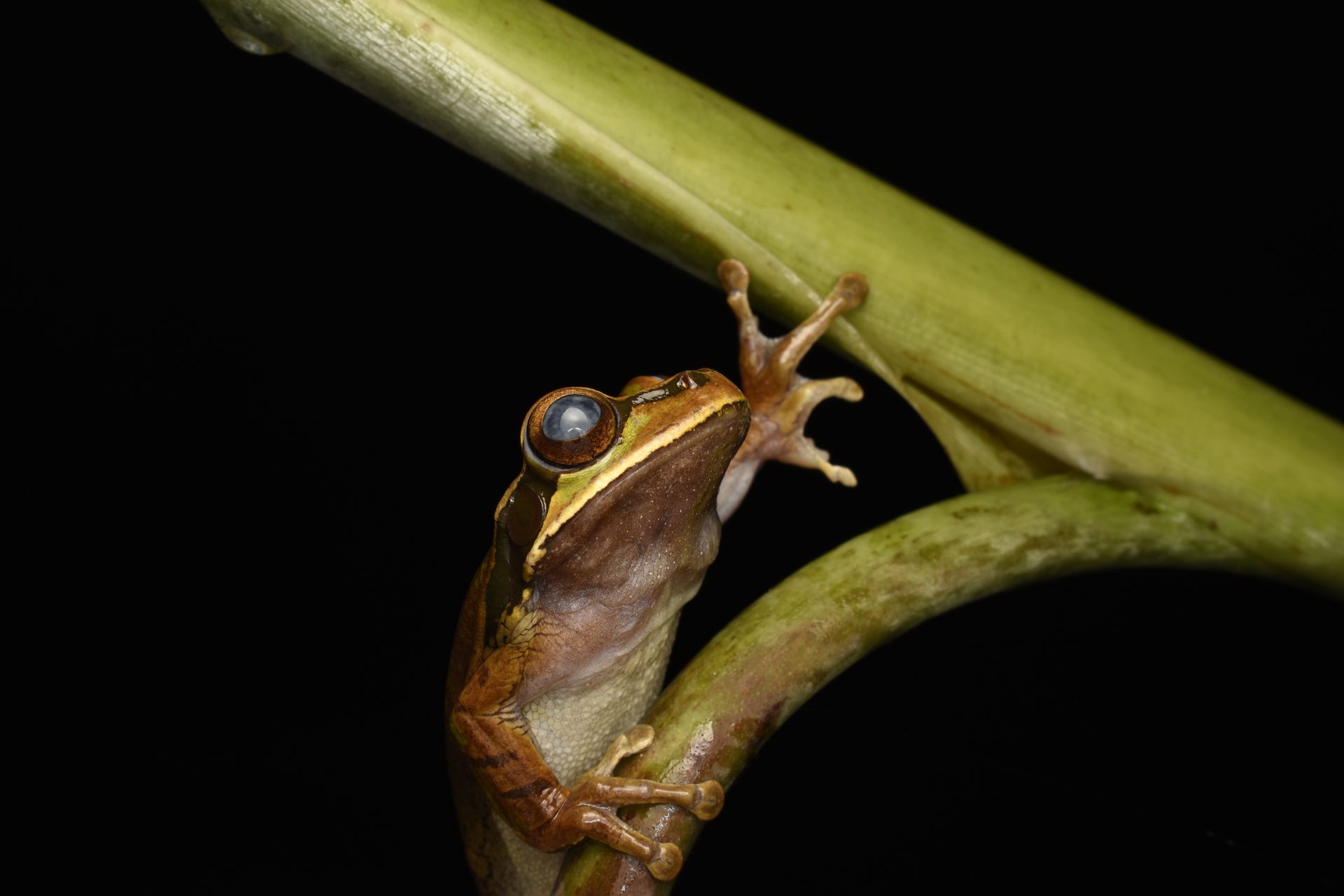
Boulenger's Climbing Frog is found in eastern Madagascar.
It's an arboreal species, but can sometimes be found under the forest floor litter.
The species' reproductive behavior is not well understood.
Males are known to call from the trunks of trees and ferns, as well as other vegetation.
The eggs are small, measuring less than 0.1 in (2 mm) in diameter, and are laid in water held in tree cavities or leaf axils.
The male remains with the eggs as they develop and through the period of larval growth, which lasts less than a month.
The tadpoles survive and grow through metamorphosis on energy supplied by the yolk.
Ornate Narrow-Mouthed Frog
The Ornate Narrow-Mouthed Frog is a small species that grows to about 0.8 in (23 mm) in body length in males and 1 in (25 mm) in females.
These frogs have a rather rotund body that tapers to a narrow head and bluntly pointed snout.
Their dorsal ground color is light olive brown and sometimes grayish or reddish, with a prominent dorsal pattern of black bands that originate behind the head and diverge as they pass posteriorly.
The Ornate Narrow-Mouthed Frog is widely distributed, ranging from eastern and southern China to Taiwan and the Ryukyu Islands, and west to Pakistan, Nepal, India, and Sri Lanka.
They typically inhabit grassy areas near flooded rice paddies, ditches, and pools up to the lower slopes of mountains at about 3,000 ft (900 m).
These frogs are nocturnal, taking daytime shelter in grass or the crevices in drying soil or under surface litter.
They are poor swimmers but very active jumpers.
The breeding habits of the Ornate Narrow-Mouthed Frog involve heavy rain, when males call from the water in flooded rice fields and similar habitats.
Females deposit several hundred eggs that float in a film at the surface of the water, and the tadpoles exhibit unusually rapid growth.
Featured Images: pexels.com