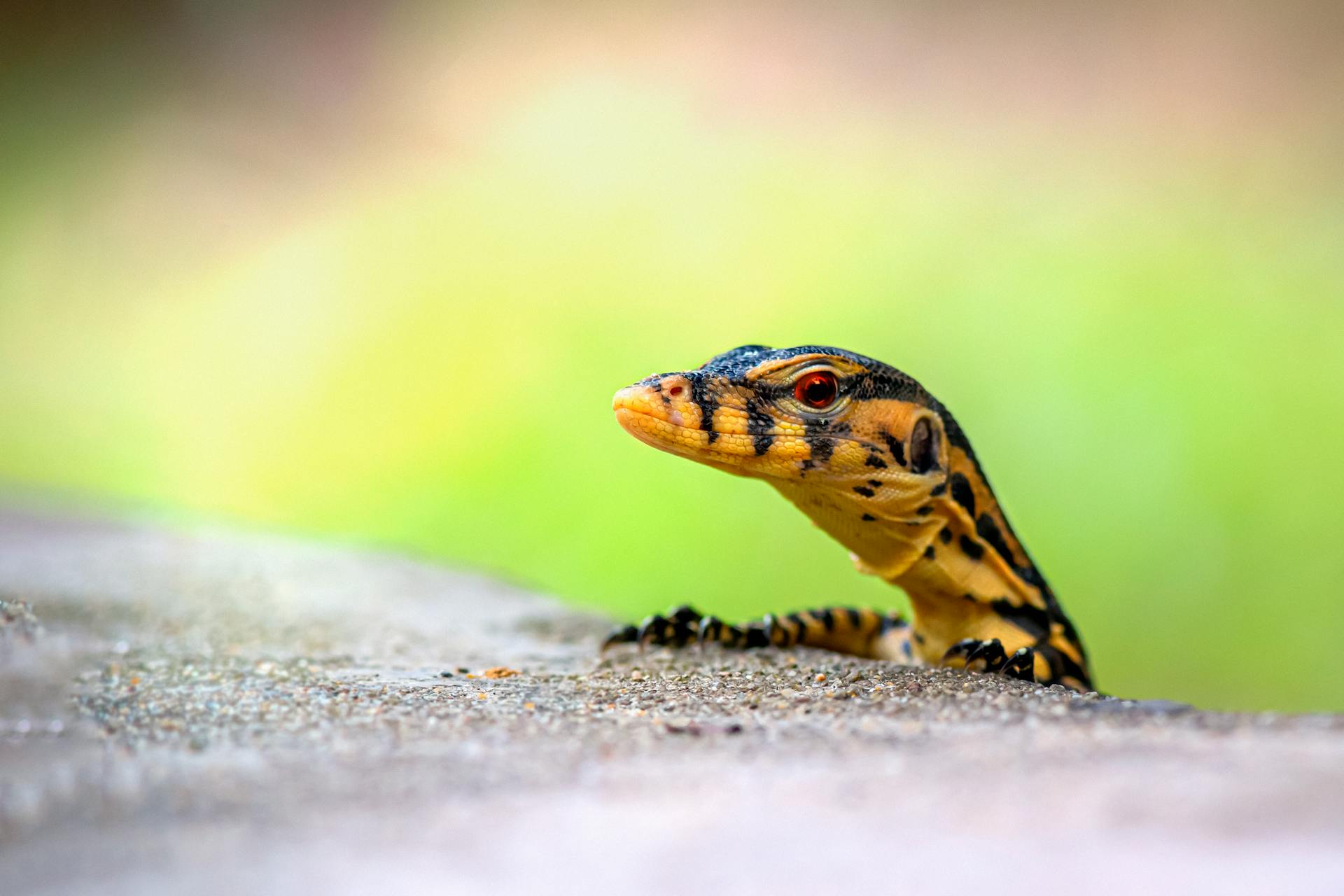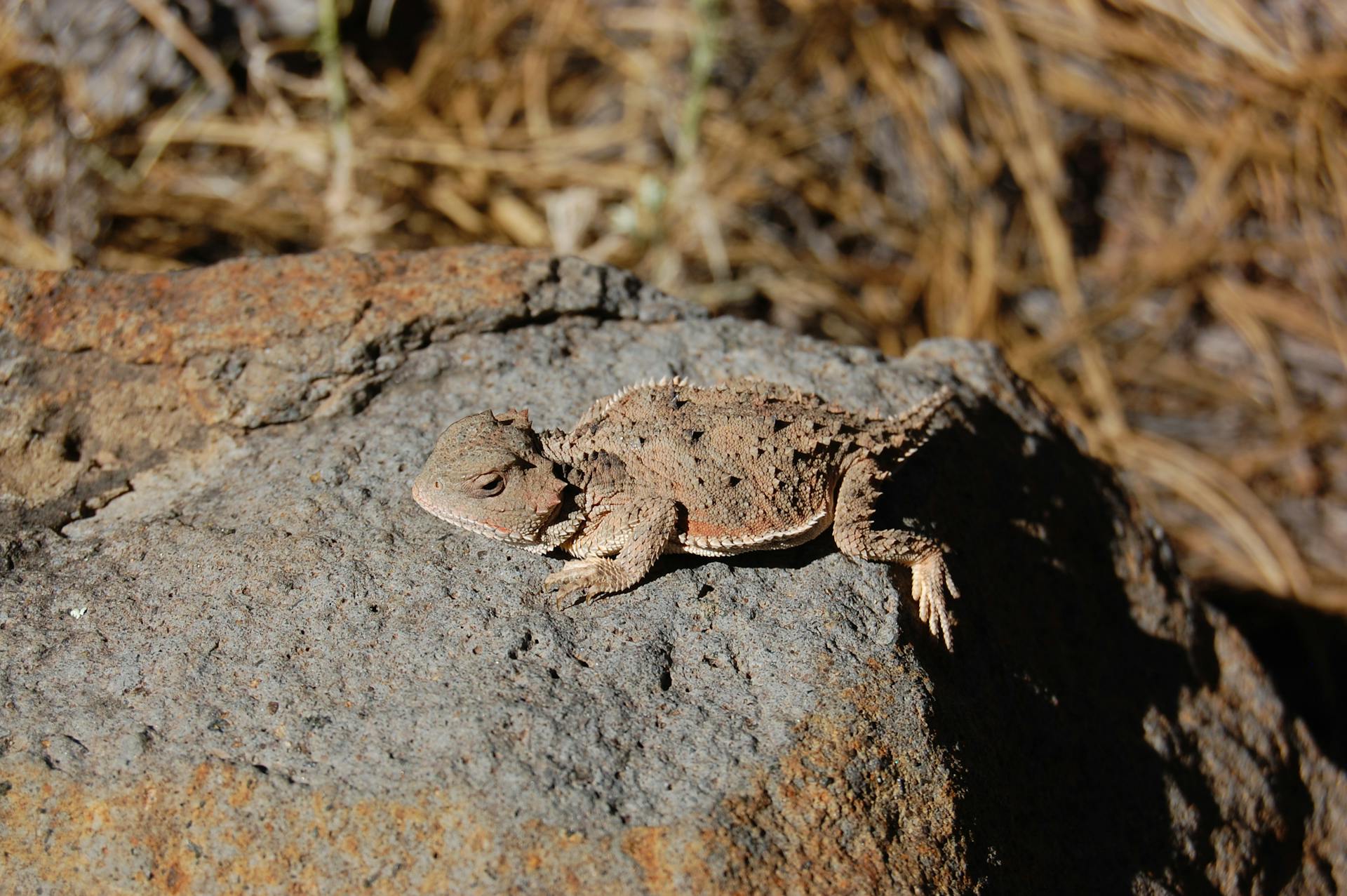
The desert horned lizard is a fascinating creature that's perfectly adapted to its harsh desert environment. They can be found in the southwestern United States and northern Mexico.
These lizards are relatively small, growing to about 5-6 inches in length. They have a distinctive horn-like protrusion on their head, which is actually a bump on their snout.
Physical Characteristics
Desert horned lizards have a distinctive flat body shape, which helps them blend in with their surroundings.
They can grow up to approximately 3.75 inches (95mm) in size, making them a medium-sized lizard.
Their bodies have one row of fringe scales down the sides, which is a characteristic that sets them apart from other horned lizards.
Adult desert horned lizards typically have a beige, tan, or reddish dorsum with contrasting, wavy blotches of darker color.
Juveniles are similar to adults, but have shorter and less-pronounced cranial spines, which are the pointed scales on the back of their heads.
Their horns are wide at the base and do not come into contact with one another at the base, unlike some other horned lizards.
Desert horned lizards usually have a dorsal stripe that appears faintly or is entirely absent, depending on the individual.
Lifestyle and Behavior
Desert horned lizards are generally gentle, but they can get feisty when excited, puffing themselves up with air to look bigger.
They have a unique way of trying to find cover from threats by dashing into nearby bushes. If they're really startled, they might even run for a short distance before stopping.
These lizards are also known to exhibit rain-harvesting behavior, adopting specific postures to get their mouths closer to the ground. This includes using their tails in creative ways, like curling them between their legs or holding them up in a three-legged stance.
Diet
Desert horned lizards are primarily insectivores, with a diet that consists mainly of ants and other invertebrates like crickets, grasshoppers, and beetles. They have a unique way of hunting, sitting and waiting for ants to pass by near ant hills.
Their love for ants is quite fascinating, as they contain a large amount of chitin, an indigestible compound that makes them less nutrient-rich. To compensate, desert horned lizards have developed larger stomachs to consume larger amounts of ants.
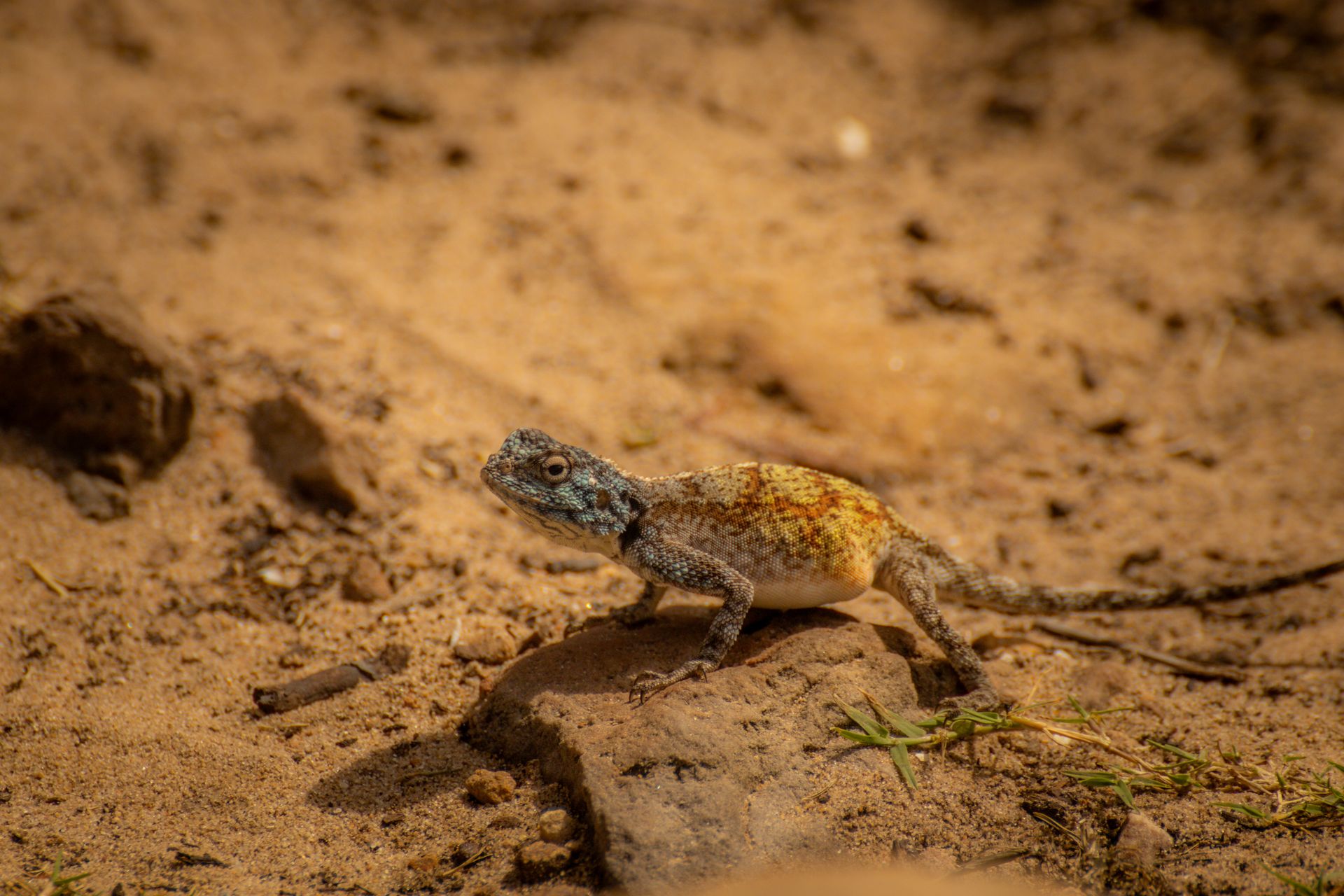
In fact, they're often found near areas with soft sand, where they shake themselves vigorously to throw sand over their backs and hide from predators. Only their head remains exposed, waiting for unsuspecting prey to pass by.
Their diet isn't limited to just ants, however. They also eat other insects and invertebrates, and occasionally small plant matter and berries.
Behavior
Desert horned lizards are generally gentle, but they can try to push their cranial spines into your hand when held.
These lizards puff themselves up with air to appear bigger when excited, similar to a Chuckwalla.
They will dash into a nearby bush to find cover from any threat, and unlike most other horned lizard species, they tend to run when startled, though only for a short period.
Rain-harvesting behavior has been observed in desert horned lizards, where they adopt specific postures to get their mouth closer to the ground.
They use various tail positions, such as curled, between the legs, or arched down with scratching behaviors, push ups, and a three-legged stance to achieve this.
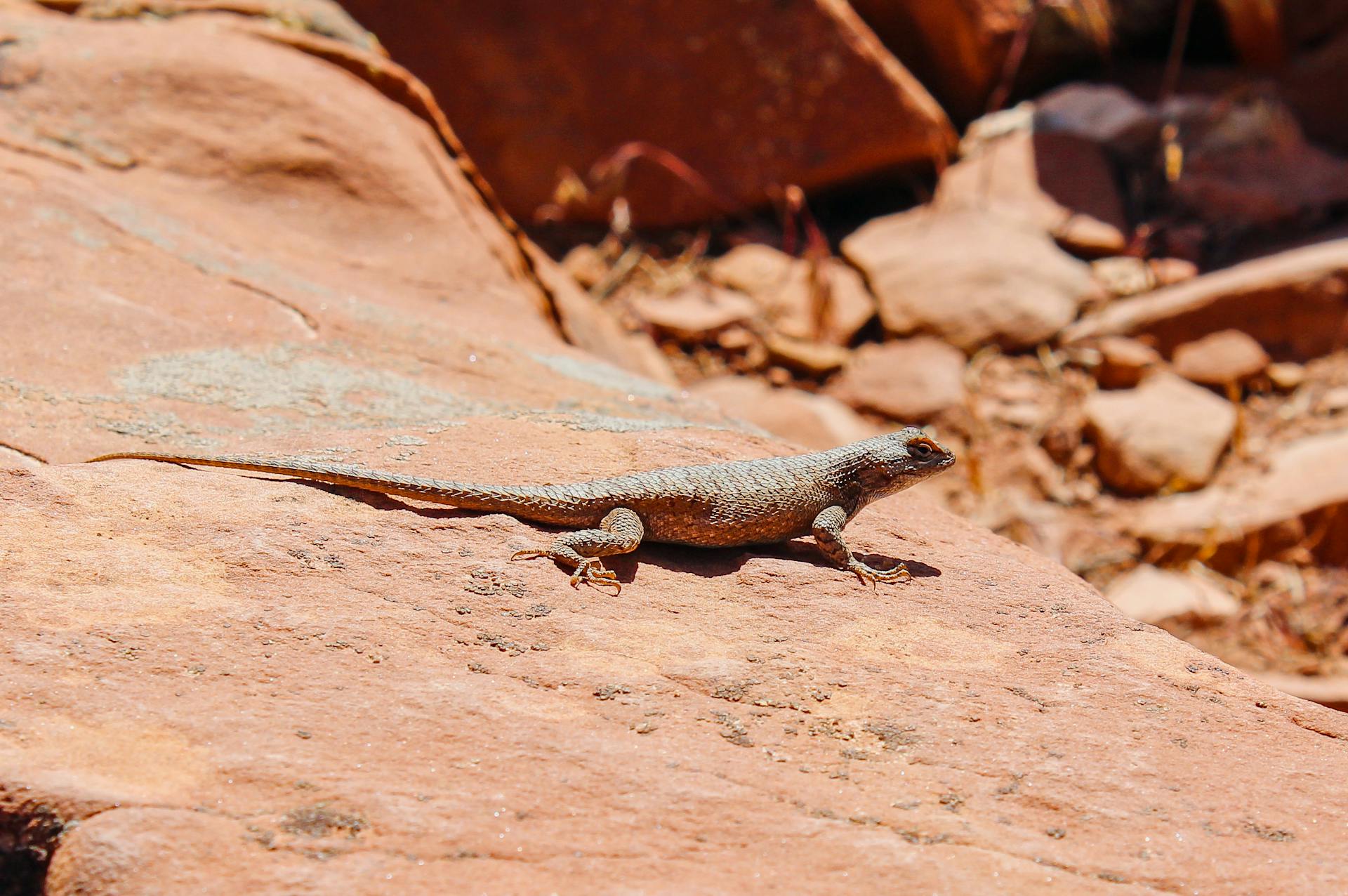
Desert horned lizards often bask in the sun during the morning and evening.
If threatened, they can shoot blood out of the corners of their eyes, but this is usually a last resort.
They will try to run to the nearest bush, dive into a rodent's burrow, or bury/shuffle into the sand to escape danger.
If grabbed, they will swell, hiss, stab with their horns, and try to bite.
It's worth noting that desert horned lizards almost never squirt blood from their eyes, unlike some other horned lizard species.
Additional reading: Texas Horned Lizard Shooting Blood
Habitat and Distribution
The desert horned lizard can be found in a variety of habitats, including fine sand, rocky or gravelly areas, and even spruce-fir forests. They tend to prefer areas with shrub covering and an understory.
These lizards are highly adaptable and can be found in different parts of North America, including the Great Basin Desert area, where they occur primarily in Nevada. Their range also extends into parts of Idaho, Utah, and Oregon.
Here are some specific locations where the desert horned lizard has been found:
- Nevada, where their range covers most of the state
- Parts of Idaho, Utah, and Oregon
- Western Arizona, Utah, Idaho, and Nevada
- Northwestern Sonora and northeastern Baja California
Habitat
The flat-tailed horned lizard thrives in diverse habitats, including areas of fine sand.
They can be found in shortgrass prairie, all the way up into spruce-fir forest, as seen in the case of the short-horned lizard (P. douglasii).
The regal horned lizard (P. solare) frequents rocky or gravelly habitats of arid to semiarid plains, hills, and lower mountain slopes.
The desert horned lizard (P. platyrhinos) prefers places with shrub covering and an understory, and can be found in the Sonoran and Mojave deserts.
They often bury themselves in sand soil, if possible, or live in burrows constructed by other animals.
Geographic Distribution
The desert horned lizard, Phrynosoma platyrhinos, has a vast geographic range that spans across western North America.
They can be found in areas with desert climates, primarily in Nevada, where their range covers most of the state, but also extends into parts of Idaho, Utah, and Oregon.
Their territory also includes southern Idaho in the north and northern Mexico in the south.
Phrynosoma platyrhinos has adapted to various desert environments, with two subspecies found in different geographic ranges: the northern desert horned lizard and the southern desert horned lizard.
Here's a breakdown of their subspecies and geographic ranges:
- The northern desert horned lizard (Phrynosoma platyrhinos platyrhinos) ranges in Idaho, Wyoming, Utah, Nevada, the Colorado front range, and parts of southeastern Oregon.
- The southern desert horned lizard (Phrynosoma platyrhinos calidiarum) ranges in southern Utah and Nevada to southeast California, western Arizona, and northern Baja California.
Stock Images
You can find a vast collection of stock images of desert horned lizards online, with over 121,600 photos available.
These images showcase the unique features of horned lizards, such as their distinctive bone horns, which come in various shapes and sizes depending on the species.
If you're looking for a specific type of image, you can search for line-art illustrations of horned lizards, like the one suitable for coloring.
The Regal Horned Lizard, found in the Sonoran Desert, has a full set of full-length horns, making for a striking image.
In Mexico, you can find photos of the Lagarto cornudo mexicano, or Mexican horned lizard, which has a distinctive red scaly appearance.
Expand your knowledge: Full Grown California Kingsnake
Frequently Asked Questions
What size tank does a Desert Horned Lizard need?
A minimum tank size of 90 x 30 x 30 cm (36 x 12 x 12 inches) is recommended, but a larger enclosure will provide a better environment for your Desert Horned Lizard
Featured Images: pexels.com