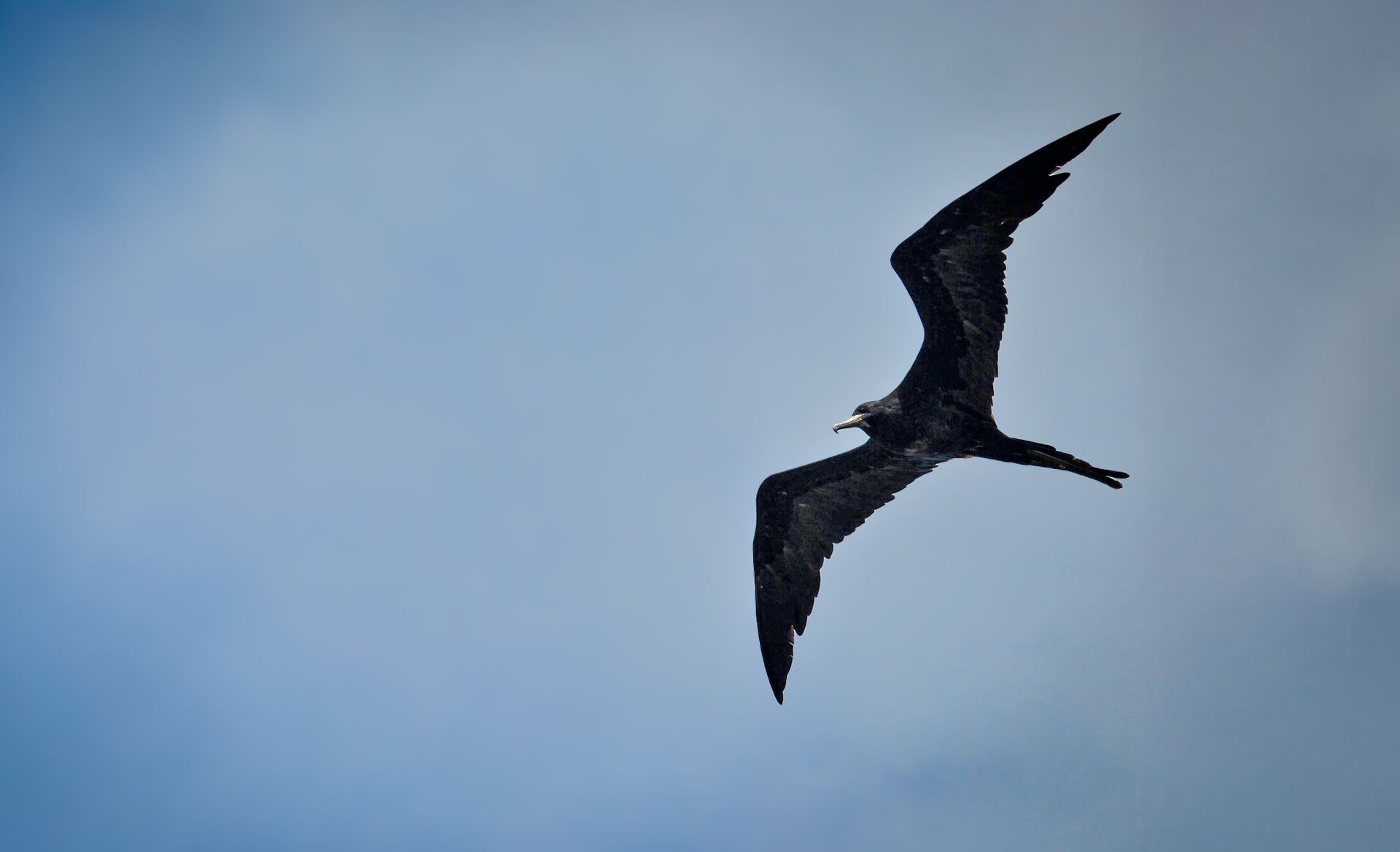
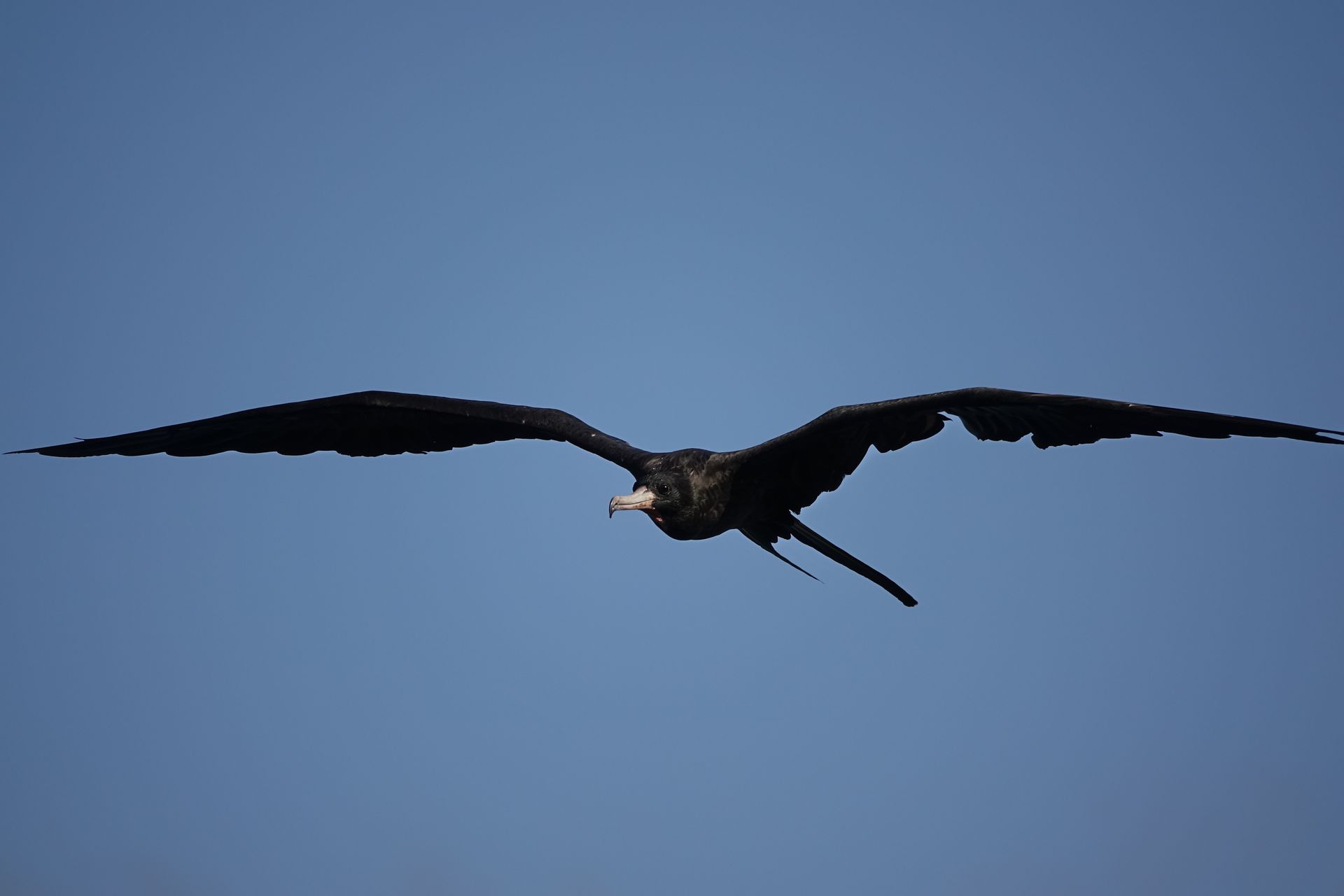
The Magnificent Frigatebird is an impressive sight to behold, with its massive wingspan and sleek, dark gray body gliding effortlessly over the tropical waters. Its wings can stretch up to 7.5 feet (2.3 meters) in length, making it one of the largest birds in the world.
These birds are expert gliders, able to stay aloft for hours without flapping their wings, thanks to the unique shape of their wings and the warm tropical air. They can cover long distances, sometimes traveling over 1,000 miles (1,600 kilometers) without touching land.
The Magnificent Frigatebird is a bird of the tropics, found in warm coastal regions around the world, from Australia to Africa and the Americas. They are highly social birds, often seen in large flocks, and are known to be fiercely protective of their territory.
You might enjoy: World Wildlife Foundation Charity Rating
Taxonomy and Classification
The magnificent frigatebird has a complex taxonomic history. Its original classification as Fregata aquila was later revised by Australian ornithologist Gregory Mathews in 1914 to Fregata magnificens.
This species is part of the genus Fregata, which includes four other species. Genetic analysis has shown that the magnificent frigatebird is most closely related to the Ascension frigatebird (Fregata aquila).
There are two subspecies of the magnificent frigatebird: F. m. magnificens and F. m. rothschildi. The International Ornithological Congress split these subspecies in 2022 based on a 2011 study that examined genetic and morphological variation.
The study found that the magnificent frigatebird on the Galápagos Islands is genetically and morphologically distinct from its mainland counterparts, with no gene flow between the two populations for several hundred thousand years.
The magnificent frigatebird belongs to the order Suliformes, which also includes cormorants and darters. Its family is Fregatidae, and its genus is Fregata.
Here's a breakdown of the magnificent frigatebird's classification:
The magnificent frigatebird is considered a least concern species by the IUCN Red List.
History and Etymology
Christopher Columbus encountered magnificent frigatebirds on his first voyage across the Atlantic in 1492, specifically on the Cape Verde Islands.
The bird was described in Columbus's journal, written in the 1530s by Bartolomé de las Casas, where it's mentioned that the frigatebird makes boobies throw up their food so she can eat it.
The modern Spanish word for a frigatebird is "rabihorcado" or "forked tail", derived from the 15th century text where the name was written as "rabiforçado".
The word "frigatebird" comes from the French mariners' name for the bird, "La Frégate", which refers to a fast warship.
English mariners called frigatebirds "Man-of-War birds", a name used by explorer William Dampier in his book An Account of a New Voyage Around the World in 1697.
In 1738, the English naturalist and illustrator Eleazar Albin used the modern name "Frigate Bird" in his book A Natural History of the Birds.
The genus name, Fregata, and the English term "Frigate Bird" both come from the French mariners' name for the bird.
The species name "magnificens" is Latin for "splendidly", from the word "magnificus", meaning "grand".
Physical and Reproductive Characteristics
The magnificent frigatebird is a stunning bird species with some remarkable physical and reproductive characteristics. They have a large size range, with males weighing between 1360 to 1815 grams and females weighing up to 15% more.
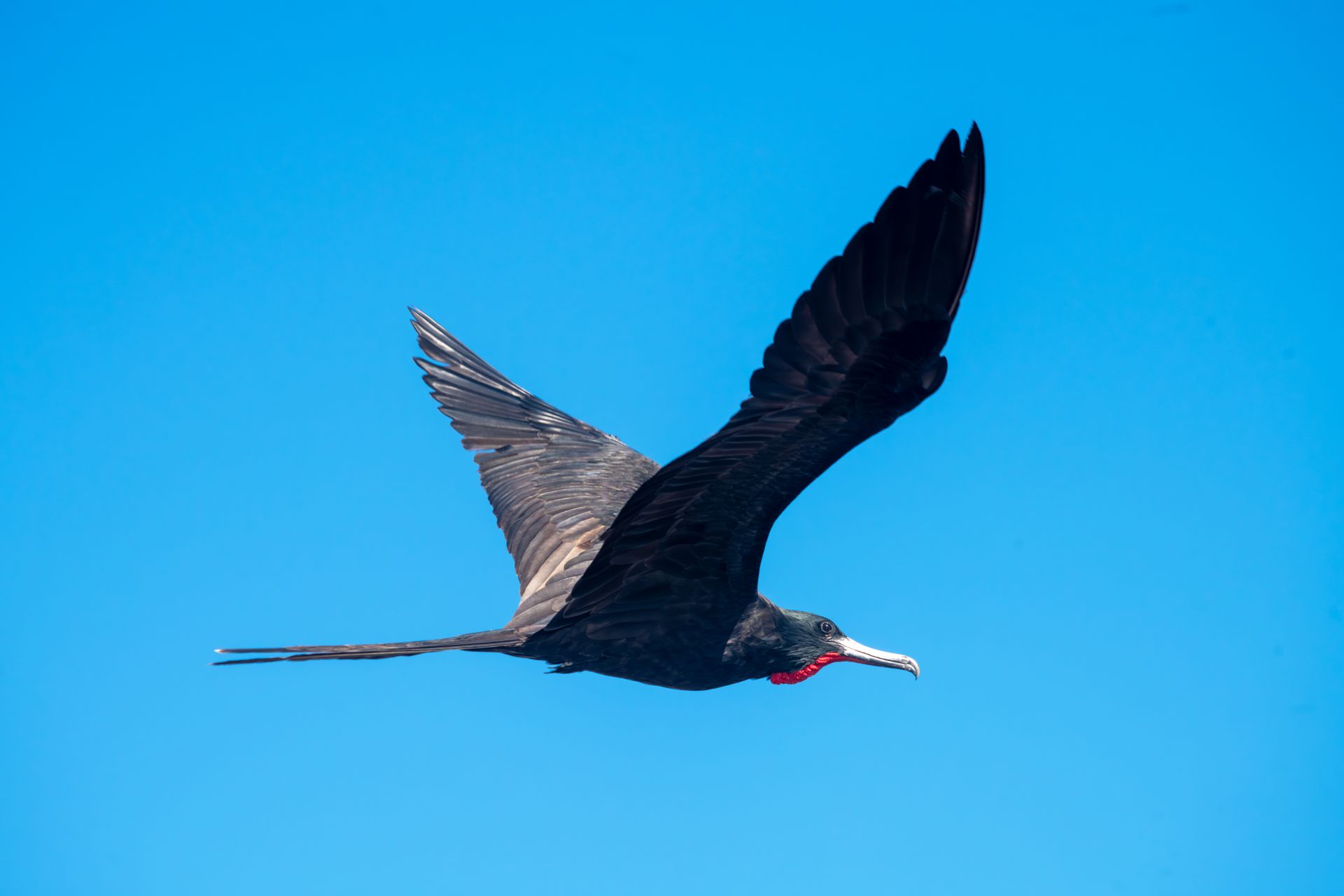
Their physical features include a glossy black plumage, a bright red throat pouch called a gular sac, and a deeply forked tail that aids in their agility in the air. Females have a distinctive white breast and a more muted appearance.
Here are some key physical features of the magnificent frigatebird:
- Endothermic and homoiothermic
- Bilateral symmetry
- Large heads, long, pointed, narrow wings, and forked tails
- Short legs and small feet not well-suited to walking or swimming
In terms of reproduction, magnificent frigatebirds are monogamous, with males inflating their gular sacs to attract females. Females lay a single egg three to four weeks after the breeding season begins, and the incubation period is estimated to be around 50 days.
Physical Description
The magnificent frigatebird is a striking bird with a range of physical characteristics that set it apart from other species.
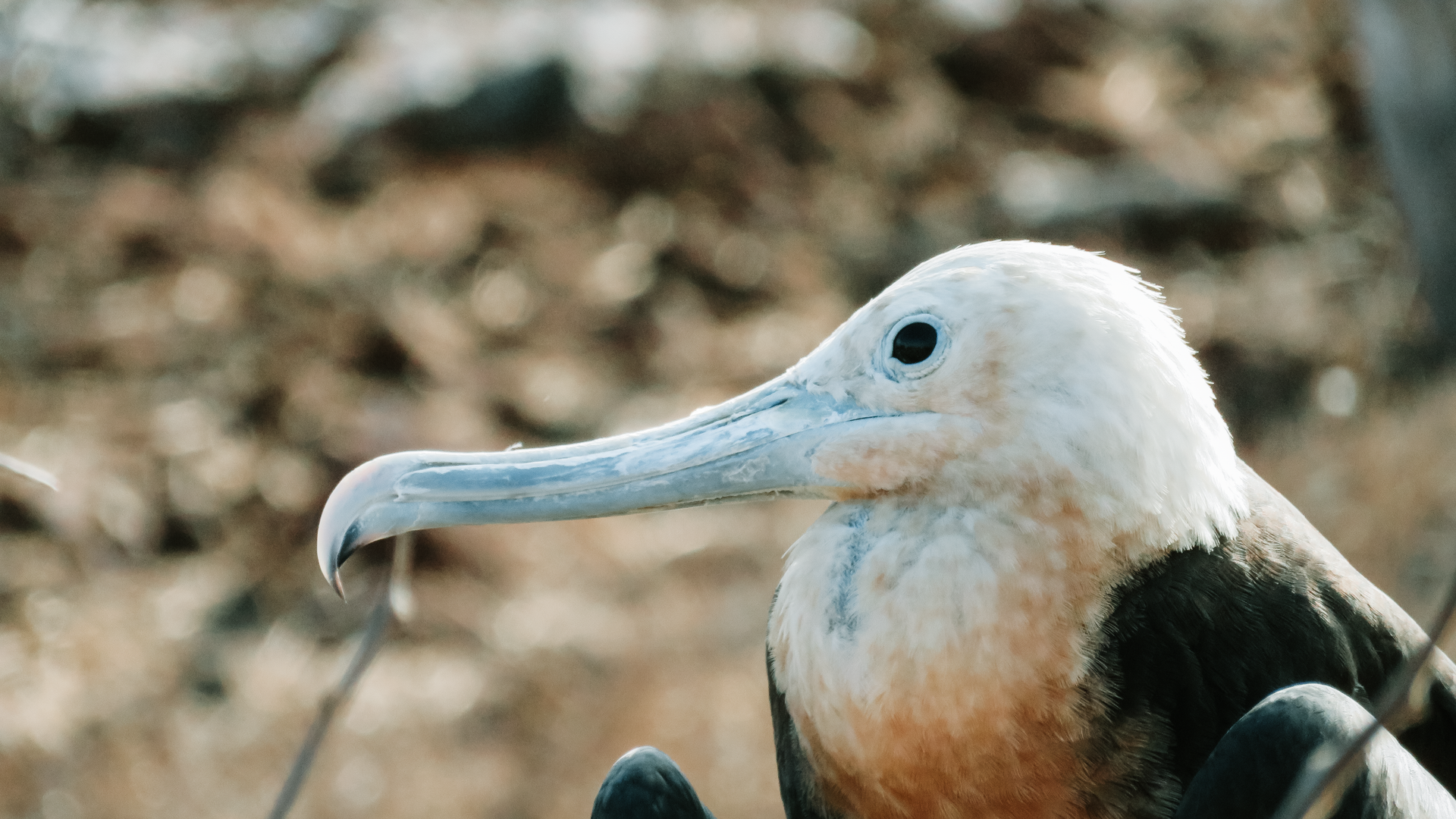
Males are entirely black, except for a red inflatable throat pouch called a gular sac, which they use to attract mates. Females, on the other hand, are also black but have a white chest and white and tan markings on the wings.
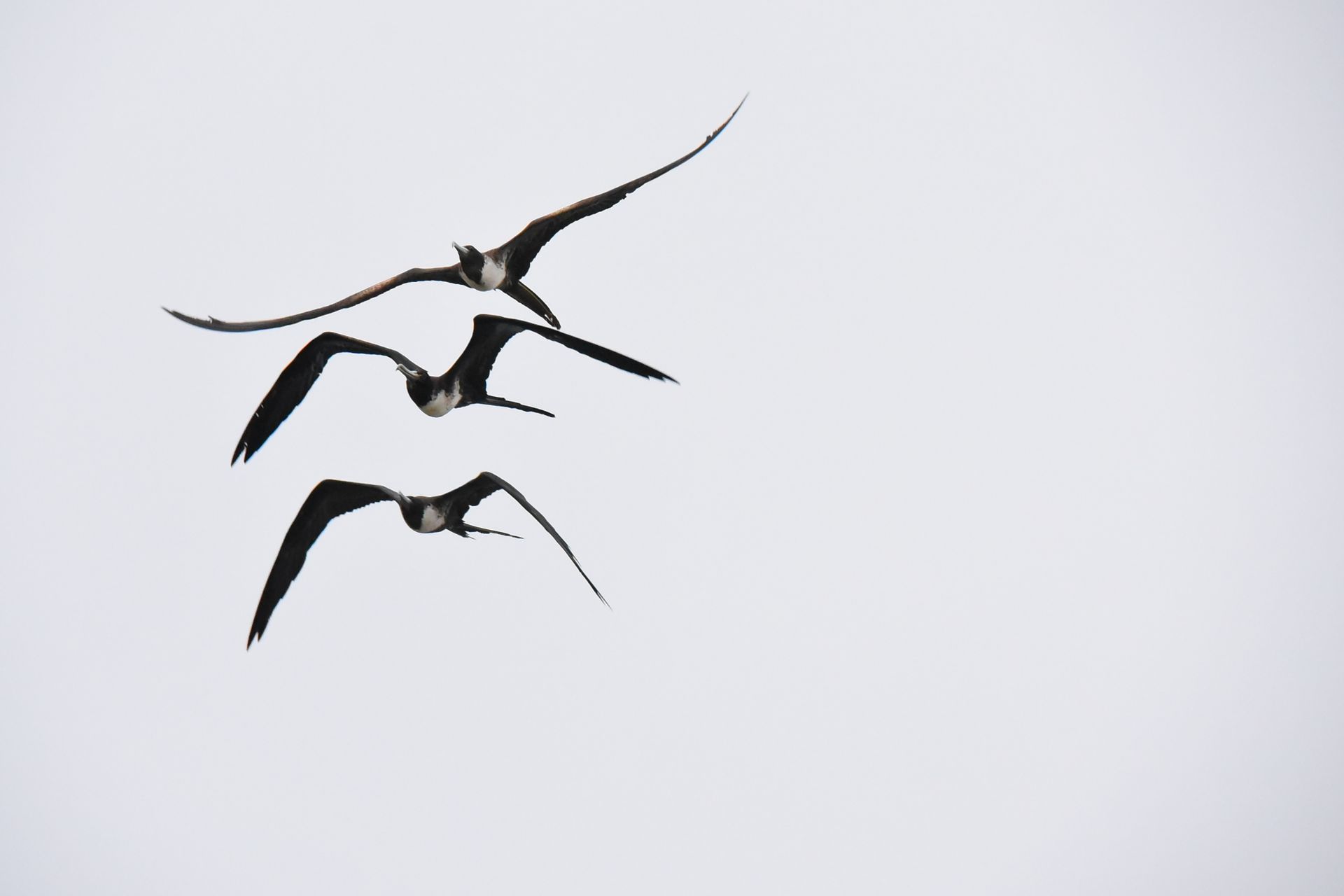
Their large heads, long, pointed, narrow wings, and forked tails make them easy to spot even from a distance. Immature birds have a white head and chest, with the rest of the body being black.
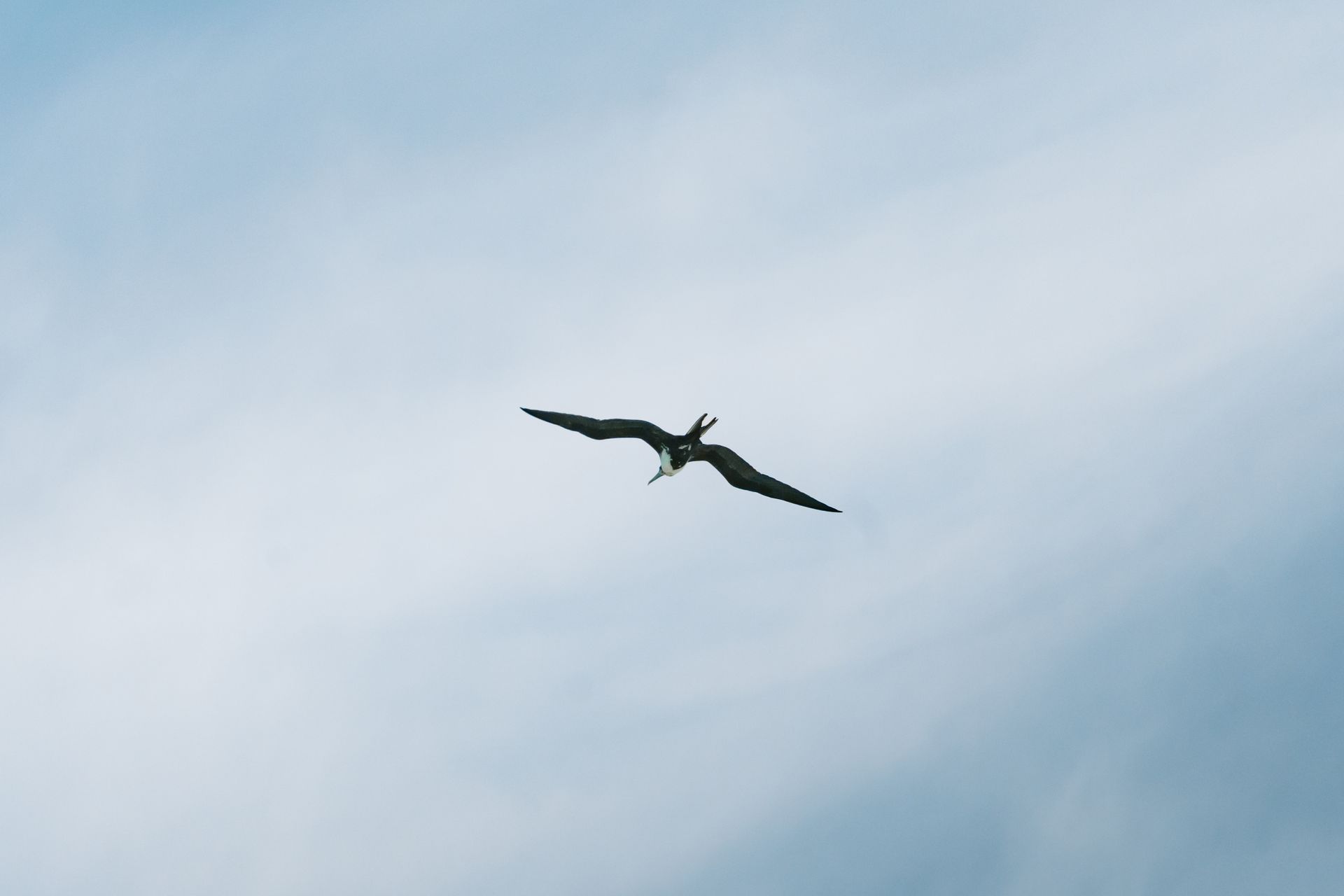
Frigatebirds have short legs and small feet that are not well-suited for walking or swimming. They are most often seen soaring along coastlines at higher altitudes, and their silhouette is readily recognizable.
Here are some key physical features of the magnificent frigatebird:
- Endothermic and homoiothermic
- Bilateral symmetry
- Exceptionally large size, with a range of length from 100 to 230 cm (39.37 to 90.55 in)
- Wingspan of up to 230 cm (90.55 in)
- Weight range of 1360 to 1815 g (47.93 to 63.96 oz)
Reproduction
During the breeding season, male magnificent frigatebirds congregate at male display sites, where they inflate their large, red, gular sacs that can obscure their head.
Males rapidly vibrate their wings and sit back on their tails, stretching their wings out and throwing their heads back for maximum display of the gular sac. They also make a loud, drumming noise during this display.
Females inspect the males, and as they attempt to find a preferred mate, males twist and bend to make their gular sac look as large as possible.
Intriguing read: Were the Tsavo Lions Male or Female
Magnificent frigatebirds form monogamous pairs each breeding season, but they rarely maintain the same partner from season to season.
Female magnificent frigatebirds lay a single egg three to four weeks after the beginning of breeding season.
The incubation period for this species is not recorded, but has been estimated at 50 days.
Here is a summary of the reproductive features of magnificent frigatebirds:
- Key Reproductive Features: iteroparous, seasonal breeding, gonochoric/gonochoristic/dioecious (sexes separate), sexual, and oviparous.
- Breeding interval: Female magnificent frigatebirds breed biannually, males attempt to breed annually.
- Breeding season: Magnificent frigatebirds lay their eggs between mid-December and early April.
- Average time to hatching: 50 days.
- Range fledging age: 120 to 200 days.
- Range time to independence: 21 to 24 months.
A magnificent frigatebird's egg is almost never exposed, being nearly continuously monitored by a parent.
Geographic and Habitat Information
Magnificent frigatebirds live along American, tropical coastlines, with breeding grounds as far north as 25 degrees north latitude in Mexico and Florida, and as far south as 27 degrees south latitude in Brazil.
These birds are especially common in southern Florida, the Gulf Coast, the Caribbean islands, and the west coast of Mexico.
They can be found in tropical and terrestrial habitats, often near saltwater or marine environments, including estuaries.
Frigatebirds prefer nesting in large colonies on remote islands, where they can raise their chicks away from predators.
Suggestion: Rodents of New Mexico
A colony of magnificent frigatebirds can occupy about 500 m of shoreline with a total area of about 22,500 m squared.
Here's a breakdown of their habitat regions:
- Tropical
- Terrestrial
- Saltwater or marine
And other habitat features include estuaries.
Nests are usually built out of twigs on or around low-lying vegetation, with males gathering twigs and other materials while females build the nest.
Nests are primarily constructed at ground level, but sometimes in trees as well, and are usually flat or slightly hollow with a diameter of 25-35 cm.
Behavior and Interactions
Magnificent frigatebirds are masters of the open ocean, spending most of their time in flight. They can fly long distances over open water, using updrafts and gliding for long periods without flapping their wings.
These birds are known to be extremely aggressive when feeding, and will often harass other animals to steal their catch. They're also capable hunters, snatching fish and squid from the ocean's surface with their hooked beaks.
Take a look at this: How Long Can Galapagos Tortoises Live
In contrast, they're surprisingly docile on land, often allowing humans to come very close and even touch them. They're also generally non-territorial, only defending their small nest areas.
Here are some key facts about the behavior of magnificent frigatebirds:
Fledglings often interact in playful ways, and the birds are generally quiet, only vocalizing when approaching a colony, begging for food, or during mating displays.
Behavior
Magnificent frigatebirds are birds of the open ocean, spending most of their time in flight. They have large wings that allow them to glide for long distances without flapping.
Their wingspans can grow up to seven feet in length, giving them the largest wingspan/body-weight ratio of any bird on Earth.
Frigatebirds are known to ride out strong winds, including those of hurricanes. They use their forked tails for maneuvering and can perch on branches using their strong, webbed toes.
While on land, frigatebirds are generally docile and will often allow humans to come close. However, they can be aggressive when competing for food or perches, usually in the form of bill snapping and jabbing.
In the air, frigatebirds are skilled hunters, snatching fish and squid from the ocean's surface with their hooked beaks. They also engage in kleptoparasitism, stealing food from other seabirds.
Frigatebirds are usually silent, but they do vocalize when approaching a colony, begging for food, or during mating displays.
Related reading: American Bald Eagle Food Chain
Predation
Predation is a major concern for magnificent frigatebirds, but surprisingly, there are no known birds that prey on them. They have no natural predators in the wild.
Mammals may occasionally take eggs and nestlings, but the birds are vigilant and closely monitor their young until they're able to defend themselves.
Conservation Status
The magnificent frigatebird has a complex conservation status, with some populations facing significant threats. The Galápagos population is particularly vulnerable, with a small population of genetically unique birds numbering approximately 2,000 individuals.
Human disturbances to nesting areas are a major concern for magnificent frigatebirds. In fact, their numbers are declining due to these disturbances, which can be caused by coastal development and other human activities.
Research and protection plans are needed to ensure the stability of magnificent frigatebird populations. This includes protecting their breeding sites, which is crucial for the species' recovery.
Regulations have been proposed to protect the magnificent frigatebird, but currently, there is no legal protection for this species in some areas. For example, in Antigua and Barbuda, regulations have been proposed, but no current legal protection exists.
Related reading: Eastern Gray Squirrel Population Distribution Pattern
Conservation efforts focused on protecting breeding grounds are vital to maintaining healthy populations of magnificent frigatebirds. Protected areas, such as Isla Contoy and Isla Mujeres, play a crucial role in preserving the natural habitats of frigatebirds.
Here are some of the conservation statuses of magnificent frigatebirds in different regions:
- IUCN Red List: Least Concern (although the Galápagos population may warrant a separate conservation status)
- US Migratory Bird Act: Protected
- US Federal List: No special status
- CITES: No special status
- State of Michigan List: No special status
Appearance and Characteristics
The Magnificent Frigatebird is a bird of impressive size and appearance. Adult males have glossy black plumage.
Their bright red throat pouch, known as a gular sac, is a distinctive feature that they inflate like a balloon during mating displays.
Females, on the other hand, have a white breast and a more muted appearance.
Frigatebirds have exceptionally long wingspans, which can reach up to 7.5 feet.
Their deeply forked tail aids in their agility in the air, making them a joy to watch.
Despite their large wingspan, these birds are incredibly lightweight, allowing them to soar effortlessly for hours or even days without flapping their wings.
Frigatebirds in Specific Locations
If you're looking to spot Magnificent Frigatebirds in their natural habitat, Quintana Roo is a prime location. Isla Contoy is one of the best places to observe these birds, especially during the breeding season.
On Isla Mujeres, frigatebirds can often be seen soaring above the cliffs and beaches, particularly around Punta Sur. This is because they catch the updrafts of wind to effortlessly glide through the sky.
The Galapagos National Park protects the Magnificent Frigatebird, even though it's labelled as Least Concern by the IUCN Red List.
Check this out: Great Frigatebird vs Magnificent Frigatebird
Frigatebirds in Galapagos
Frigatebirds in Galapagos are protected by the Galapagos National Park, despite being labelled as Least Concern by the IUCN Red List.
This means that conservation efforts are in place to safeguard their habitat and prevent harm to the species, even if they're not considered to be at risk.
The Galapagos National Park plays a crucial role in protecting the magnificent frigatebird and its habitat, ensuring the species' continued presence in the area.
On a similar theme: Malheur National Wildlife Refuge
Spotting Frigatebirds in Quintana Roo
If you're planning a birdwatching trip to Quintana Roo, you're in luck because this region offers several prime locations to spot Magnificent Frigatebirds in their natural habitat.
One of the best places to observe these birds is Isla Contoy, a small island north of Isla Mujeres, especially during the breeding season.
The island's status as a protected area ensures a safe haven for frigatebirds and other seabirds, making it a must-visit for bird enthusiasts.
Frigatebirds can often be seen soaring above the cliffs and beaches on Isla Mujeres, particularly around Punta Sur, where they catch the updrafts of wind to effortlessly glide through the sky.
Their distinctive silhouettes against the blue Caribbean sky are a common and mesmerizing sight.
General Information
The magnificent frigatebird is found across the tropics.
They have a unique body shape that gives them exceptional aerial manoeuvrability and allows them to glide on thermals for days at a time.
Their diet includes fish, small crustaceans, and newly-hatched green turtles.
The male frigatebird has a large red gular (throat pouch) that is inflated during the breeding season, whereas the female has a white breast and shoulder.
Lifespan/Longevity
The lifespan of a magnificent frigatebird is estimated to be around 30 years.
This is a remarkable feat, considering the harsh environments they inhabit.
Mortality in magnificent frigatebirds can be caused by natural events like destructive hurricanes.
Human activities, such as interfering with colonies, can also lead to mortality.
Overview
The magnificent frigatebird is a bird that's truly one of a kind. It has several nicknames, including the 'condor of the oceans' due to its impressive ability to stay on the wing for days at a time.
Their exceptional aerial manoeuvrability is made possible by their unique body shape, which allows them to glide on thermals for extended periods.
The male frigatebird is all black with a purplish sheen on its upper body feathers and a large red gular (throat pouch) that's inflated during the breeding season.
The female is slightly larger and has a distinctive white breast and shoulder, as well as a blue eye-ring.
The frigatebird's diet consists of fish, small crustaceans, and even newly-hatched green turtles. They're also known to steal food from other birds, which is why they're sometimes called 'pirate birds' or 'Man-o'-Wars'.
Their feathers have no waterproofing, so they become waterlogged if they stay on the water for more than a minute or two.
Breeding occurs throughout the year, and during courting, a female will be surrounded by several males inflating their throat pouches and emitting a shrill trill before an acrobatic aerial display between the pair.
Featured Images: pexels.com