The Komodo dragon is a monitor lizard that's often misunderstood. It's not a dinosaur, despite its prehistoric appearance.
Komodo dragons are found in the wild only on a few islands in Indonesia. They inhabit tropical forests and grasslands, where they can grow up to 10 feet long.
These massive reptiles are carnivores, feeding on deer, pigs, and even water buffalo. They're skilled hunters, using their sharp teeth and powerful bite to take down their prey.
Komodo dragons are also known for their deadly saliva, which contains over 50 different bacteria that can kill their victims.
For another approach, see: Akron Zoo Komodo Dragon Attack
Physical Characteristics
Komodo dragons can grow up to 10 feet long and weigh over 150 pounds.
Their powerful, muscular bodies are covered in tough, armored scales, which are reinforced with tiny bones called osteoderms.
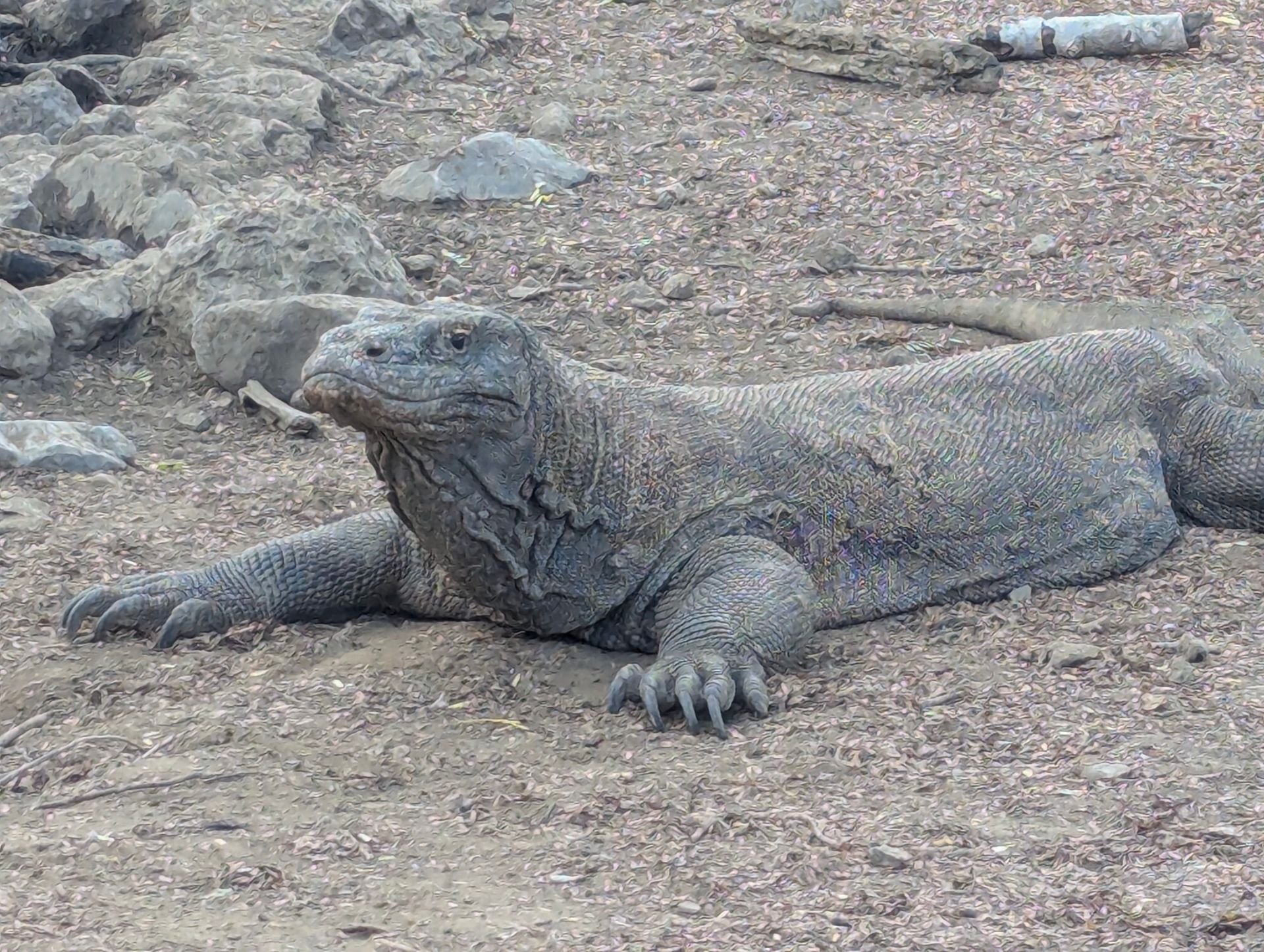
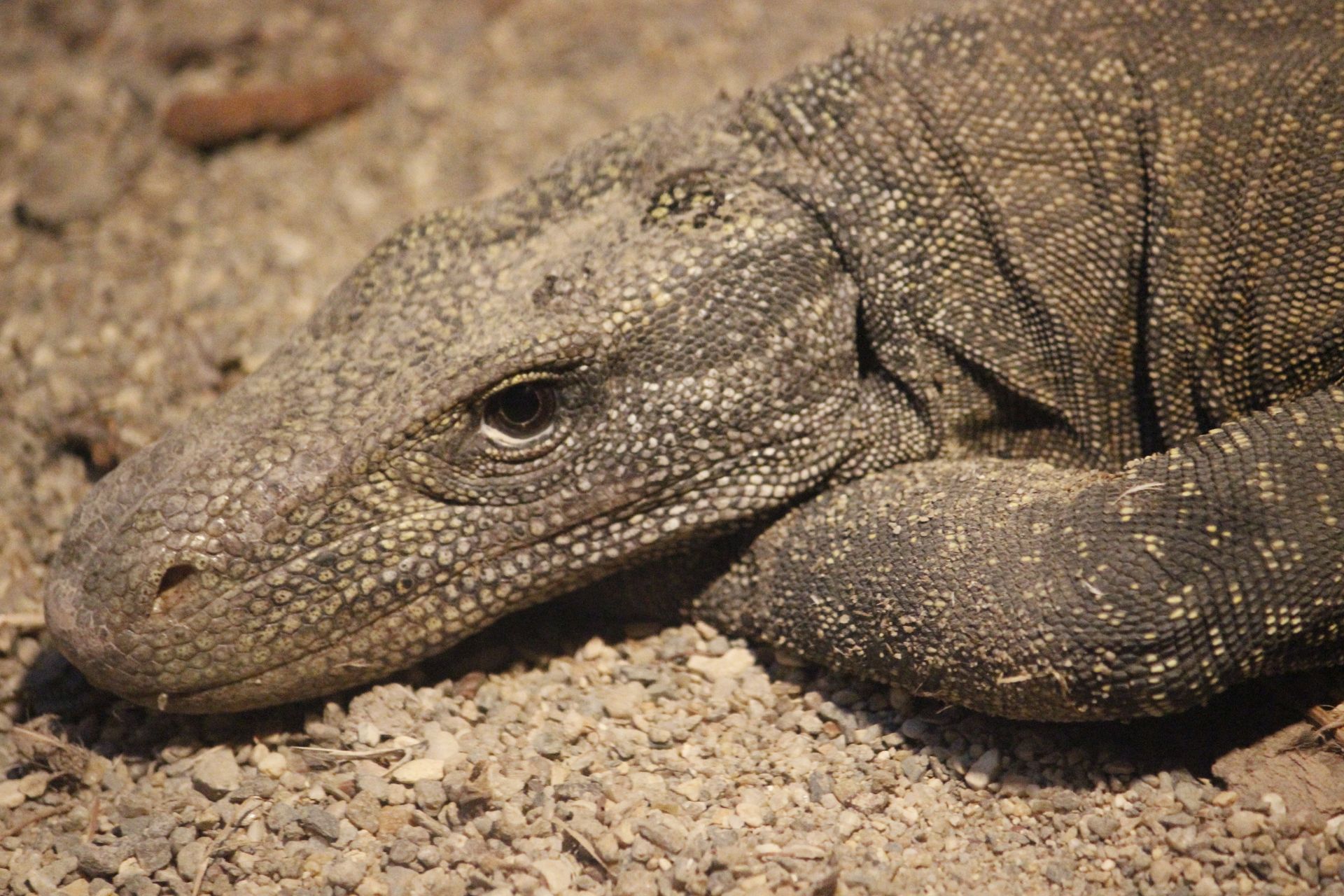
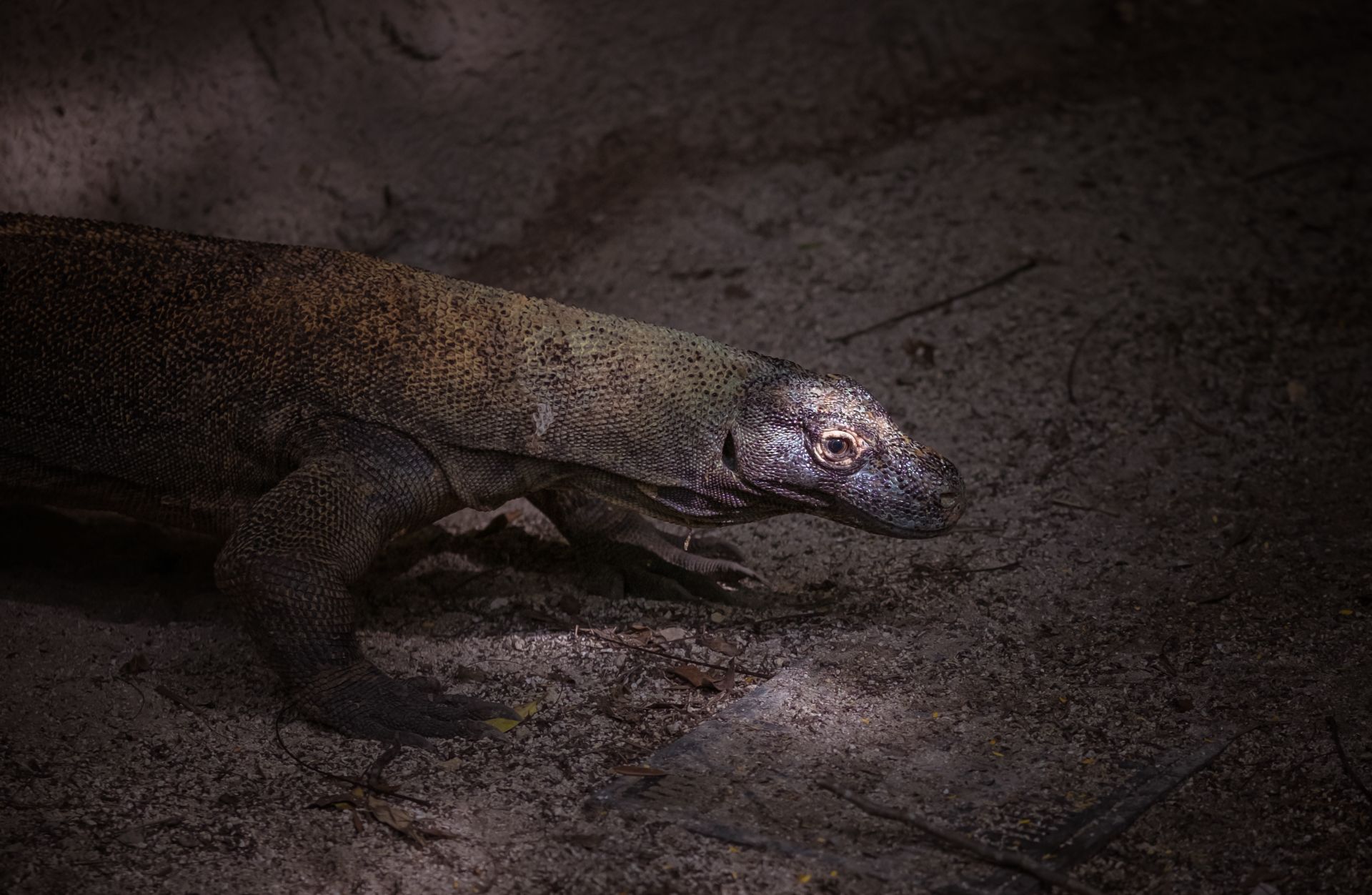
These scales provide excellent protection from their harsh environment, similar to the rugged, scaly skin of the Komodo dragon, which is often grayish-brown with a rough texture.
Adult Komodo dragons usually weigh around 154 pounds and can reach lengths of up to 10.3 feet, with the largest verified specimen weighing 366 pounds.
Check this out: Difference between Komodo Dragon and Monitor Lizard
Dentition

Komodo dragons have a unique type of dentition called ziphodont teeth, which are laterally flattened and recurved with serrated tooth crowns.
Their teeth are designed for slicing flesh, and the serrations have a dentine core and a very thin enamel outer layer.
In fact, the teeth of Komodo dragons are so specialized that they're similar to those of extinct theropod dinosaurs.
As they grow, the teeth of Komodo dragons change, becoming more recurved and serrated, especially in adults.
The teeth of insectivorous juveniles, on the other hand, are barely recurved and have fewer serrations that lack dentine cores.
A 2024 study found that Komodo dragons have orange, iron-enriched coatings on their tooth serrations and tips, which helps maintain their sharp cutting edges.
This adaptation is also seen in a few other Australasian to Asian monitor species, but not in others from the same range.
Their teeth are replaced quickly, every 40 days, and they can have up to 5 replacement teeth for each tooth position at any given time.
This high rate of replacement is similar to that of the crocodile monitor, and it's a key feature of Komodo dragon dentition.
Consider reading: Animals Similar to Prairie Dogs
Just How Big Are They?

Komodo dragons can grow up to 10 feet long, which is impressive, to say the least. The largest verified specimen reached a length of 10.3 feet, which is almost a foot longer than that.
They can weigh over 150 pounds, and the largest one on record weighed a whopping 366 pounds, which is roughly the same as a refrigerator.
Their scaly skin is quite tough and provides excellent protection from their harsh environment. It's often grayish-brown in color with a rough texture.
Intriguing read: Largest Lizards in Australia
Variations
Variations in Komodo dragons are quite fascinating.
Komodo dragons on Komodo Island tend to grow larger than those on neighboring islands like Rinca or Flores.
These differences might be linked to environmental factors, prey availability, or genetic diversity.
All Komodo dragons, regardless of size or location, share the same fierce survival strategies.
Environment
Komodo dragons inhabit harsh, rugged environments, from dry savannas to tropical forests. These environments are teeming with prey, providing the perfect hunting grounds for these stealthy giants.
Their habitats offer a mix of grassy plains, volcanic hills, and coastal mangroves, which is ideal for a predator with sharp senses and powerful limbs. Komodo National Park, their primary stronghold, showcases this diverse landscape.
Seasonal changes in temperature and food availability pose challenges to Komodo dragons in the wild, requiring them to adapt to survive. Fortunately, their resilience and adaptability have allowed them to thrive for millions of years.
Komodo dragons are native to several Indonesian islands, primarily Komodo, Rinca, Flores, Gili Motang, and Padar, which comprise the unique ecosystem of Komodo National Park.
A different take: Malheur National Wildlife Refuge
Conservation Status
Komodo dragons are an endangered species due to habitat loss, climate change, and human encroachment.
They face significant threats in the modern world, with scientists estimating there are less than 1,400 individuals in the wild.
Habitat loss is a major concern, with parts of their native sea islands expected to submerge in the next century due to climate change.
Related reading: Giant Panda Habitat Destruction
Human encroachment and overhunting of deer and other prey animals are making it harder for Komodo dragons to thrive in their habitat.
Conservation efforts are underway to safeguard habitats, reduce human-wildlife conflict, and raise awareness about the importance of preserving the Komodo dragon legacy.
Komodo National Park plays a vital role in protecting wild Komodo dragons and their environment, but challenges remain in the fight to preserve these iconic reptiles.
Consider reading: Examples of Human Wildlife Conflict
The Komodo Dragon
The Komodo Dragon is one of the largest lizards in the world, growing up to 10 feet long and weighing up to 200 pounds. They are native to a few small Indonesian islands, including Komodo, Rinca, and Flores.
Their size alone is intimidating, but it's their deadly bite that truly sets them apart. The Komodo dragon's venomous bite contains toxins that cause massive blood loss and shock in their prey. This makes them one of the most formidable predators in the animal kingdom.
Take a look at this: Eastern Massasauga Rattlesnake Bite
Komodo dragons have a limited range and can only be found in a small part of Indonesia, whereas monitor lizards are widespread and can be found across continents. Here's a comparison of the two species:
The Lizard
The Komodo dragon is a massive lizard, but it's not the only big player in the lizard world. Monitor lizards, part of the Varanus genus, can grow up to 10 feet long, similar in size to the Komodo dragon.
One thing that sets Komodo dragons apart from other lizards is their deadly bite. Komodo dragons have venomous bites that contain toxins causing massive blood loss and shock in their prey.
There are over 80 species of monitor lizards, ranging from small species that fit in your hand to giants like the Komodo dragon. However, Komodo dragons are the largest lizards in the world, weighing up to 200 pounds.
Monitor lizards are not traditionally venomous like snakes, but many do possess venom glands. Their venom is generally mild to humans and primarily used to weaken their prey.
For another approach, see: What Is Birds in Madagascar Prey
Komodo dragons are carnivorous and preys on large animals like deer, while monitor lizards eat insects, birds, and small mammals. This difference in diet highlights the unique adaptations of each species.
Here's a comparison of Komodo dragons and monitor lizards:
Komodo dragons are found in limited areas, specifically on Indonesian islands, while monitor lizards are found across Africa, Asia, and Australia.
Meet Our Murphy
Meet Murphy, our beloved Komodo dragon who's celebrating a major milestone - he's turned 25 years old! This laid-back lizard is a calm companion who's been a part of our family for a quarter of a century.
Murphy's age is a significant achievement, considering Komodo dragons can live up to 30 years in captivity.
Behavior and Ecology
The Komodo dragon prefers hot and dry places and typically lives in dry, open grassland, savanna, and tropical forest at low elevations.
It's most active during the day, although it does exhibit some nocturnal activity, and is capable of running rapidly in brief sprints up to 20 km/h.
Komodo dragons are solitary creatures, coming together only to breed and eat, and have some "personality" differences among the species, where some present as more "shy", particularly females.
They are also skilled climbers, using their strong claws to climb trees proficiently when young, and may stand on their hind legs and use their tail as a support to catch out-of-reach prey.
For shelter, the Komodo dragon digs holes that can measure from 1 to 3 m wide with its powerful forelimbs and claws, allowing it to conserve body heat throughout the night and minimise its basking period the morning after.
Senses
The Komodo dragon's senses are quite unique. They have only a single ear bone, the stapes, which restricts their hearing to sounds between 400 and 2,000 hertz.
This means they can't hear whispers, raised voices, or shouts, a fact that was once disputed when a London Zoo employee trained a captive Komodo dragon to respond to her voice. The dragon's poor hearing is likely a result of this limited range.
Komodo dragons can see objects as far away as 300 meters, but their night vision is poor due to the lack of rods in their retinas. They can, however, distinguish colors.
Their sense of smell is impressive, with the help of a favorable wind and their habit of swinging their head from side to side, they can detect carrion from 4-9.5 kilometers away. This is made possible by their tongue-flicking behavior, similar to that of snakes.
The Komodo dragon's tongue is also used for tasting and smelling stimuli, with the vomeronasal sense using the Jacobson's organ.
Recommended read: Blue Tongue Lizards Australia
Behaviour and Ecology
The Komodo dragon is a fascinating creature that thrives in hot and dry environments, typically living in dry grasslands, savannas, and tropical forests at low elevations.
As an ectotherm, Komodo dragons are most active during the day, although they do exhibit some nocturnal activity. They are solitary animals, only coming together to breed and eat.
Komodo dragons are surprisingly agile, capable of running rapidly in brief sprints up to 20 km/h (12 mph), diving up to 4.5 m (15 ft), and climbing trees proficiently when young.
To catch out-of-reach prey, the Komodo dragon may stand on its hind legs and use its tail as a support. Its strong claws are used primarily as weapons as it matures, making climbing impractical.
The Komodo dragon digs holes for shelter, which can measure from 1 to 3 m (3.3 to 9.8 ft) wide, using its powerful forelimbs and claws.
These burrows help the Komodo dragon conserve body heat throughout the night and minimize its basking period the morning after.
Feeding Behavior
Komodo dragons are carnivores, and a big part of their diet is carrion, or decaying flesh from dead animals.
They are fully capable of hunting live prey, and there are recorded instances of fully-grown Komodo dragons taking down animals as large as horses and water buffaloes.
Young individuals feed primarily on small lizards and insects, as well as snakes and birds.
As they grow older and bigger, they move onto larger prey, such as rodents, monkeys, goats, wild boars, and deer, which is their preferred meal.
Komodo dragons are renowned for their venomous bite, a trait uncommon in other lizards, and their saliva contains a mix of bacteria that aids in the digestion of their prey.
In contrast, Monitor Lizards use their sharp teeth and powerful jaws to consume a varied diet, including insects, birds, and small mammals.
Komodo dragons are able to drink by sucking water into their mouth via buccal pumping, a process also used for respiration.
A unique perspective: Prey Drive
What Eats a Dragon?
As a young Komodo dragon, you're at risk for cannibalistic attacks from adult members of your species. This is because you weigh less than 3.5 ounces and are only about 16 inches long when you first hatch.
You spend your first few years living in trees, where larger Komodo dragons can't reach you. This is a good thing, because it gives you a safe place to grow and develop.
At around 5 years of age, you're finally large enough to fend for yourself and live a more terrestrial lifestyle. This is a big milestone, and it's a sign that you're becoming a strong and independent dragon.
Reproduction and Development
Komodo dragons are known to form "pair bonds", a rare behavior among lizards, and may be monogamous. These pair bonds help prevent inbreeding, as females actively select distantly related male sperm.
Males engage in intense fighting over females and territory, often vomiting or defecating before the fight. This behavior helps establish dominance and secure mating opportunities.
Females are antagonistic during the early stages of courtship, resisting with their claws and teeth, and males must fully restrain them to avoid injury. Copulation occurs when the male inserts one of his hemipenes into the female's cloaca.
Consider reading: North American Raccoon Male vs Female
Komodo dragons may lay their eggs in various localities, including the nests of orange-footed scrubfowl, on ground level, or in hilly areas. In one study, 60% of females laid their eggs in scrubfowl nests.
Female Komodo dragons make camouflage nests to protect their eggs from other dragons, and clutches typically contain an average of 20 eggs. The incubation period is 7-8 months, and hatchlings break out of their eggshells with an egg tooth that falls off soon after.
Young Komodo dragons spend their first few years in trees, where they're relatively safe from predators, including cannibalistic adults. This habit of cannibalism helps sustain the large size of adults, as medium-sized prey on the islands is rare.
Komodo dragons take approximately 8-9 years to mature, and may live for up to 30 years.
Intriguing read: Great Pyrenees Kills 8 Coyotes
Encounters with Humans
Encounters with humans are rare, but Komodo dragons have been responsible for several human fatalities, both in the wild and in captivity.
Most reported attacks on humans occur in the Komodo National Park, where local villagers living around the national park are at higher risk of encountering these massive lizards.
According to data from Komodo National Park, spanning a 38-year period between 1974 and 2012, there were 24 reported attacks on humans, five of them fatal.
Explore further: Do African Wild Dogs Attack Humans
How Can I Help?
You can make a real difference in the lives of Komodo dragons and other threatened animals by getting involved with local zoos and organizations that research their care. These organizations need volunteers and supporters to help them protect and conserve these incredible creatures.
Consider donating to wildlife conservation organizations that protect Komodo dragons and their habitats. Your contribution can help fund vital conservation efforts and make a tangible impact on the environment.
To be a responsible traveler, practice ecotourism by being an advocate for the environment when you're on vacation. This means respecting local wildlife and their habitats, and choosing tour operators that prioritize sustainability.
By shopping smart and avoiding products made from animals, you can help remove the incentive for poachers and illegal wildlife traders to harm endangered species. This simple action can have a significant impact on the lives of Komodo dragons and other threatened animals.
For another approach, see: Animal Conservation Organizations
Encounters with Humans
Encounters with humans are rare, but Komodo dragons are capable of being deadly.
Attacks on humans have been documented in both the wild and in captivity.
In Komodo National Park, there were 24 reported attacks on humans over a 38-year period.
Most of the victims were local villagers living around the national park.
Five of the 24 reported attacks were fatal, highlighting the serious nature of Komodo dragon encounters.
Broaden your view: Bangladesh National Bird
Zoo Mourns Loss
It's not uncommon for zoos to experience the loss of beloved animals, like the Reptile Discovery Center's 26-year-old male Komodo dragon Murphy, who passed away on December 23, 2024.
The keepers at the Reptile Discovery Center were deeply affected by Murphy's death, showing the strong bond that can form between humans and animals in a zoo setting.
Komodo dragons like Murphy can live up to 26 years in captivity, which is impressive considering their average lifespan in the wild is around 30 years, but can vary greatly.
Murphy's death serves as a reminder of the importance of conservation efforts to protect these incredible creatures and their habitats.
Consider reading: Alaskan Wildlife Center
Taxonomy and Evolution
The Komodo dragon monitor lizard has a rich history, and understanding its taxonomy and evolution is fascinating.
The first documentation of the Komodo dragon by Europeans was in 1910, when Lieutenant van Steyn van Hensbroek of the Dutch colonial administration heard rumors of a "land crocodile".
The common name "Komodo dragon" was coined by W. Douglas Burden, who led an expedition to Komodo Island in 1926 and brought back 12 preserved specimens and two live ones.
Taxonomically, the Komodo dragon is also known as Varanus komodoensis, and it's sometimes referred to as the Komodo monitor or Komodo Island monitor in scientific literature.
Research from the Auffenberg family's 11-month expedition to Komodo Island in 1969 proved influential in raising Komodo dragons in captivity, and their work has continued to shed light on the nature of the Komodo dragon.
Genetic analysis shows that the Komodo dragon is the closest relative of the Australian lace monitor (V. varius), with their common ancestor diverging from a lineage that gave rise to the crocodile monitor (Varanus salvadorii) of New Guinea.
Take a look at this: Varanus Bengalensis
Here's a brief summary of the Komodo dragon's evolutionary history:
The Komodo dragon's ancestors had hybridized with the common ancestor of Australian sand monitors (V. spenceri, V. gouldii, V. rosenbergi, and V. panoptes) during the late Miocene.
Comparison and Differences
Monitor lizards and Komodo dragons are often confused with each other due to their similarities, but they have some key differences.
Monitor lizards come in a range of sizes, typically between 3-7 feet in length, depending on the species. In comparison, Komodo dragons can grow up to 10 feet long and weigh between 150-200 pounds.
The appearance of monitor lizards is quite varied, with different species displaying unique colors and patterns. In contrast, Komodo dragons have a stocky build, thick scales, and a rough texture, often with a brown-gray color.
Monitor lizards are carnivores and feed on insects, birds, and small mammals. Komodo dragons, on the other hand, are also carnivores but prey on larger animals like deer.
Here's an interesting read: Common Snapping Turtle Species
The lifespan of monitor lizards varies by species, typically ranging from 8-20 years. Komodo dragons, however, can live up to 30 years in the wild.
Monitor lizards are found in a wide range of habitats, including forests, deserts, and grasslands. Komodo dragons, by contrast, are limited to the Indonesian islands.
Monitor lizards tend to be solitary and opportunistic hunters, while Komodo dragons are aggressive, territorial, and have a deadly bite.
Here's a side-by-side comparison of the two species:
Health and Immune System
Komodo dragons have a remarkable immune system that's worth learning about. Their blood plasma contains a powerful antibacterial peptide called VK25, which has been isolated and studied by researchers.
This peptide has been synthesized into a short peptide called DRGN-1, which shows great promise in killing drug-resistant bacterial strains and even some fungi. Preliminary results are very encouraging.
DRGN-1 has an added benefit of significantly promoting wound healing in both uninfected and mixed biofilm infected wounds. This is a game-changer for people with compromised immune systems or those struggling with chronic wounds.
Broaden your view: Pack of Animals Called
Antibacterial Immune Factor
Researchers have isolated a powerful antibacterial peptide, VK25, from the blood plasma of Komodo dragons.
This peptide has been synthesized into a short peptide called DRGN-1, which has shown remarkable effectiveness in killing drug-resistant bacterial strains and even some fungi.
In tests, DRGN-1 has demonstrated its ability to significantly promote wound healing in both uninfected and mixed biofilm infected wounds.
The potential applications of DRGN-1 are vast, and scientists are eager to explore its full potential in treating various infections and promoting overall health.
DRGN-1's unique properties make it a promising candidate for developing new treatments for multidrug-resistant pathogens.
Treating Arthritis
Treating arthritis in animals can be a challenging task, but it's not impossible. Our team's experience with treating Murphy, a Komodo dragon with arthritis, shows that innovative treatments can make a big difference.
Blocking inflammation is key to easing discomfort. Our team used an innovative treatment to block the inflammation and ease Murphy's discomfort.
Some animals, like Komodo dragons, may require specialized care to manage their arthritis.
Disputed Claims
Some scientists have questioned the idea that Komodo dragons are venomous, suggesting that the effects of their bites are not due to venom, but rather to shock and blood loss.
The presence of venom glands in Komodo dragons has been confirmed, but it's unclear whether the venom has any serious effect on prey.
Researchers at the University of Melbourne initially speculated that perentie, monitors, and agamids may be somewhat venomous, but this theory has been disputed.
Bites from these lizards, including Komodo dragons, lace monitors, and spotted tree monitors, can cause rapid swelling, localized disruption of blood clotting, and shooting pain.
Other scientists argue that the discovery of venom glands has led to a narrow view of oral secretions in reptiles and may have misinterpreted reptilian evolution.
As of 2023, no clear evidence has been presented to show that Komodo dragon bites have serious venom effects.
You might enjoy: Duck Billed Platypus Venom
Frequently Asked Questions
What happens if monitor lizard bites?
Monitor lizard bites can cause severe bleeding and hypotension due to their strong fibrinogenolytic venom. If bitten, it's essential to seek medical attention immediately to prevent serious complications
Featured Images: pexels.com