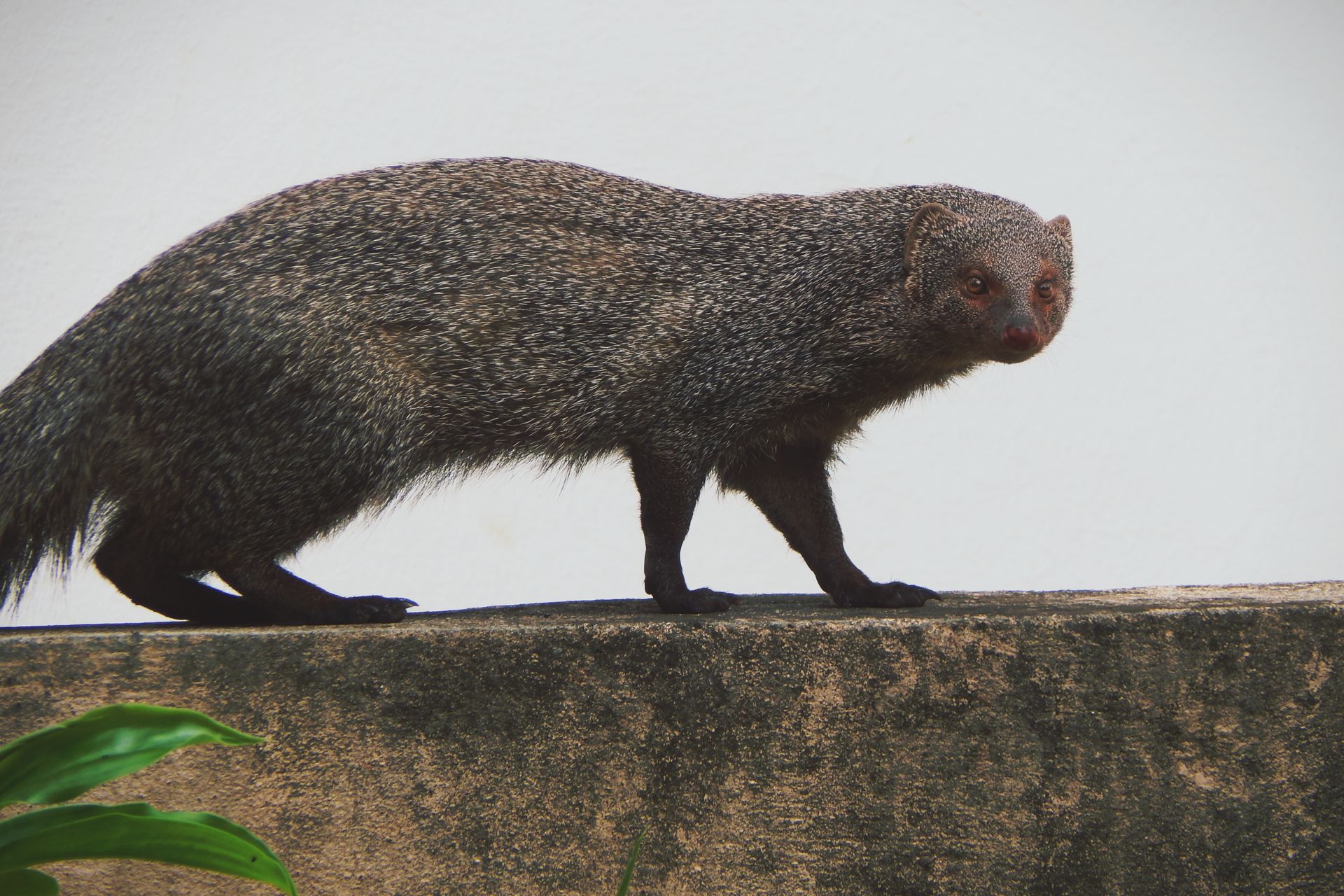
The Indian Gray Mongoose is a remarkable creature, and getting to know it can be a fascinating experience. They are found in a variety of habitats, including forests, grasslands, and deserts.
One of their most distinctive features is their thick, gray fur, which helps them blend in with their surroundings. They have a stocky build and a long, bushy tail that they use for balance.
In the wild, Indian Gray Mongooses are primarily carnivorous, feeding on small mammals, birds, and reptiles. They are also known to scavenge for food, eating carrion and other small animals.
Their intelligence and adaptability make them well-suited to their diverse habitats, and they are often seen as a welcome sight in rural areas where they help control pest populations.
Take a look at this: Small Indian Dog Breeds
Classification
The Indian gray mongoose is a fascinating creature, and understanding its classification can help us appreciate its unique characteristics. It belongs to the kingdom Animalia, which includes all animals.
The Indian gray mongoose is a vertebrate, meaning it has a backbone. This is a key characteristic that sets it apart from other animals. Vertebrates make up a large group of animals, and the Indian gray mongoose is just one of many species within this group.
The Indian gray mongoose is a member of the class Mammalia, which includes all mammals. This means it gives birth to live young and produces milk to feed them. Mammals are a diverse group, and the Indian gray mongoose is just one of many species within this class.
Here is a breakdown of the Indian gray mongoose's classification:
The Indian gray mongoose is a carnivore, which means it primarily eats meat. This is reflected in its classification within the order Carnivora.
Physical Characteristics
The Indian gray mongoose has a distinctive physical appearance. Their coats are typically gray or brown in color, with a long, slender body and a pointed snout. They have short legs and sharp claws, which they use for digging and climbing.
Their length varies depending on the sex, with males measuring around 48-60 cm and females measuring around 35-47 cm. The tail length is equal to the body length, and they weigh between 0.4-1.7 kg. Males are significantly larger than females.
One of the most distinctive features of the Indian gray mongoose is their ability to move quickly and agilely. They can jump up to six feet in the air and easily climb trees and walls. They also have excellent senses of hearing and smell, which they use to detect prey and avoid predators.
Here are some key physical characteristics of the Indian gray mongoose:
- Length: 35-60 cm (14-24 in)
- Weight: 0.4-1.7 kg (0.9-3.7 lbs)
- Coat color: Gray or brown
- Tail length: Equal to body length
Distribution and Habitat
The Indian gray mongoose is a widely distributed species, found in a variety of habitats across the Indian subcontinent and Southeast Asia.
They can be found in open forests, grasslands, rocky patches, scrublands, cultivated fields, and forest edges, showcasing their adaptability in different environments.
Their natural habitat preference includes areas with ample cover, such as vegetation and rocks, to provide shelter and protection.
Indian gray mongooses have been observed in areas of thickets, in cultivated fields or in broken, bushy vegetation, and they occupy open areas, grasslands, and scrub.
They sleep in holes in the ground or hollow trees to escape the mid-day sun.
In fact, they are often seen near human settlements, particularly in heavily forested areas where they scavenge on waste, highlighting their ability to exploit resources and adapt to changing circumstances.
Their ability to climb trees allows them to further expand their habitat range, providing opportunities to find prey and evade potential threats.
Here are some of the specific regions where Indian gray mongooses can be found:
- India, Pakistan, Nepal, Bangladesh, and Sri Lanka
- Parts of Southeast Asia, including Thailand, Cambodia, and Vietnam
- West Asia, including Saudi Arabia, Kuwait, Bahrain, Iran, Afghanistan, and parts of the United Arab Emirates
They have even been introduced to other regions, such as the West Indies, Hawaii, Jamaica, Cuba, and Puerto Rico, to control poisonous snakes and rats.
Behavior and Ecology
The Indian gray mongoose is a highly social animal that lives in pairs or small family groups in the wild. They are known to be very vocal, using a variety of sounds to communicate with each other.
In their natural habitat, Indian gray mongooses are primarily diurnal, meaning they are active during the day. They are also skilled hunters, using their sharp claws and agility to catch a wide range of prey, including snakes, lizards, and small mammals.
Indian gray mongooses have a highly developed sense of smell, which they use to detect their prey. They are also known to be excellent diggers, using their powerful claws and strong bodies to excavate burrows and dens.
These mongooses are found in a variety of habitats, including forests, grasslands, and rocky outcrops.
Curious to learn more? Check out: Prey Drive
Conservation and Protection
The Indian gray mongoose is found in many national parks and wildlife reserves in India, which offer protected habitats for the species and other wildlife.
Conservation efforts are actively underway to safeguard the Indian grey mongoose and its natural habitats, primarily focusing on raising awareness about the species' ecological significance and its vital role in maintaining India's diverse ecosystems.
A unique perspective: Snakes in India
The Indian gray mongoose is not considered to be vulnerable as a species in India, and its population is generally stable, with no precise estimate of the population due to its widespread occurrence in many different habitats.
Efforts are being made to strengthen legal frameworks and regulations to combat illegal trade and poaching activities that pose a threat to the Indian mongoose population, with stricter laws being enforced to deter these practices.
Grey mongooses are very common across the country and can be found in urban areas as well as in patches of green and parks, making them a familiar sight for many Indians.
Collaborative endeavors between various conservation organizations and wildlife authorities are ensuring the sustainable conservation of the Indian grey mongoose and its habitats, which is imperative for preserving India's rich wildlife heritage.
A unique perspective: Eastern Gray Kangaroo Habitat
General Information
The Indian gray mongoose is a fascinating creature.
These mammals are found in a variety of habitats, including forests, grasslands, and deserts, across the Indian subcontinent. They are adaptable and can thrive in different environments.
Their diet consists mainly of small snakes, lizards, and rodents, which they hunt using their keen sense of smell and agility.
Indian gray mongooses are known to be solitary animals, only coming together for mating.
Frequently Asked Questions
What are the predators of the Indian grey mongoose?
The main predators of the Indian grey mongoose are leopards and humans, who hunt them for meat and their valuable hair.
Featured Images: pexels.com