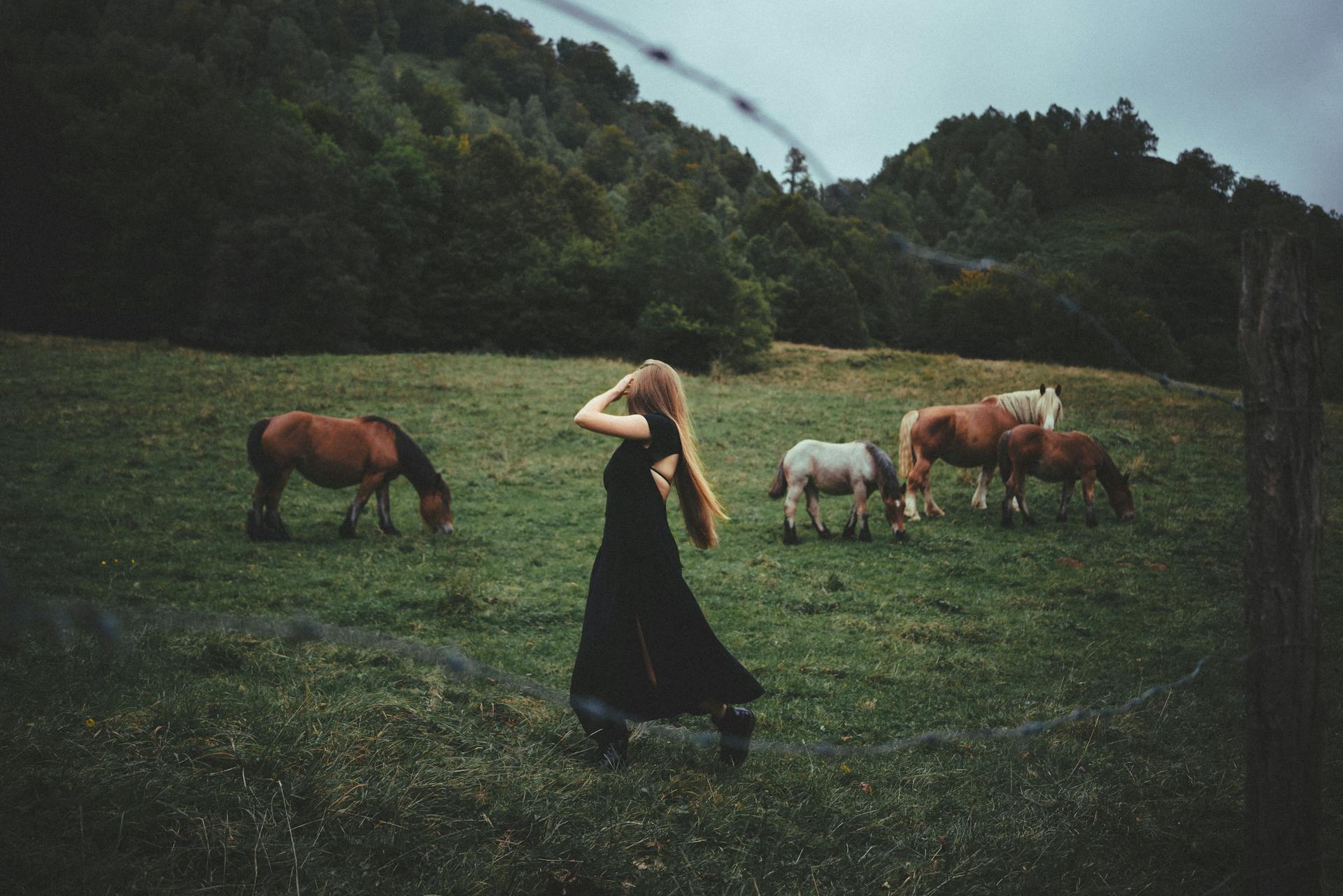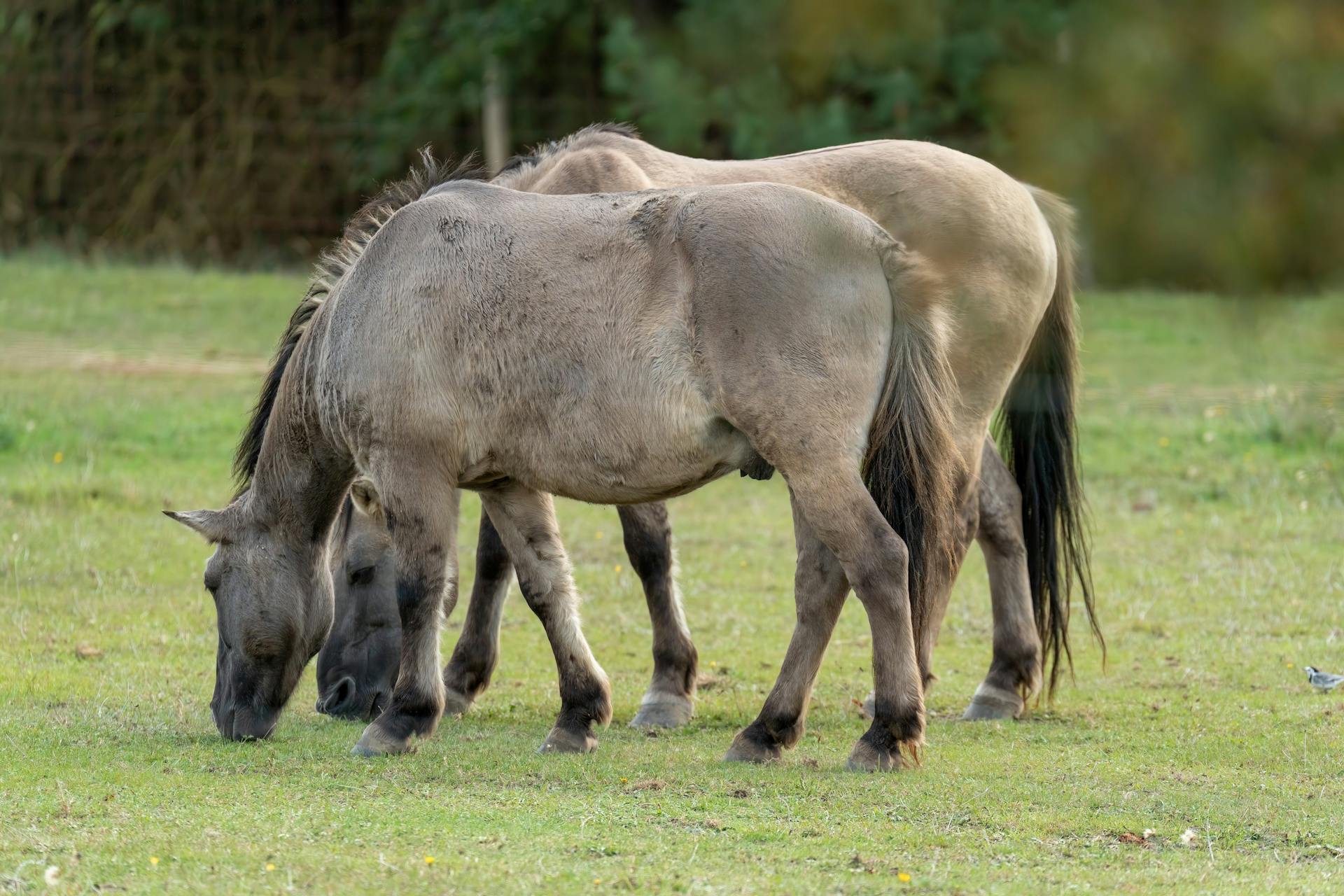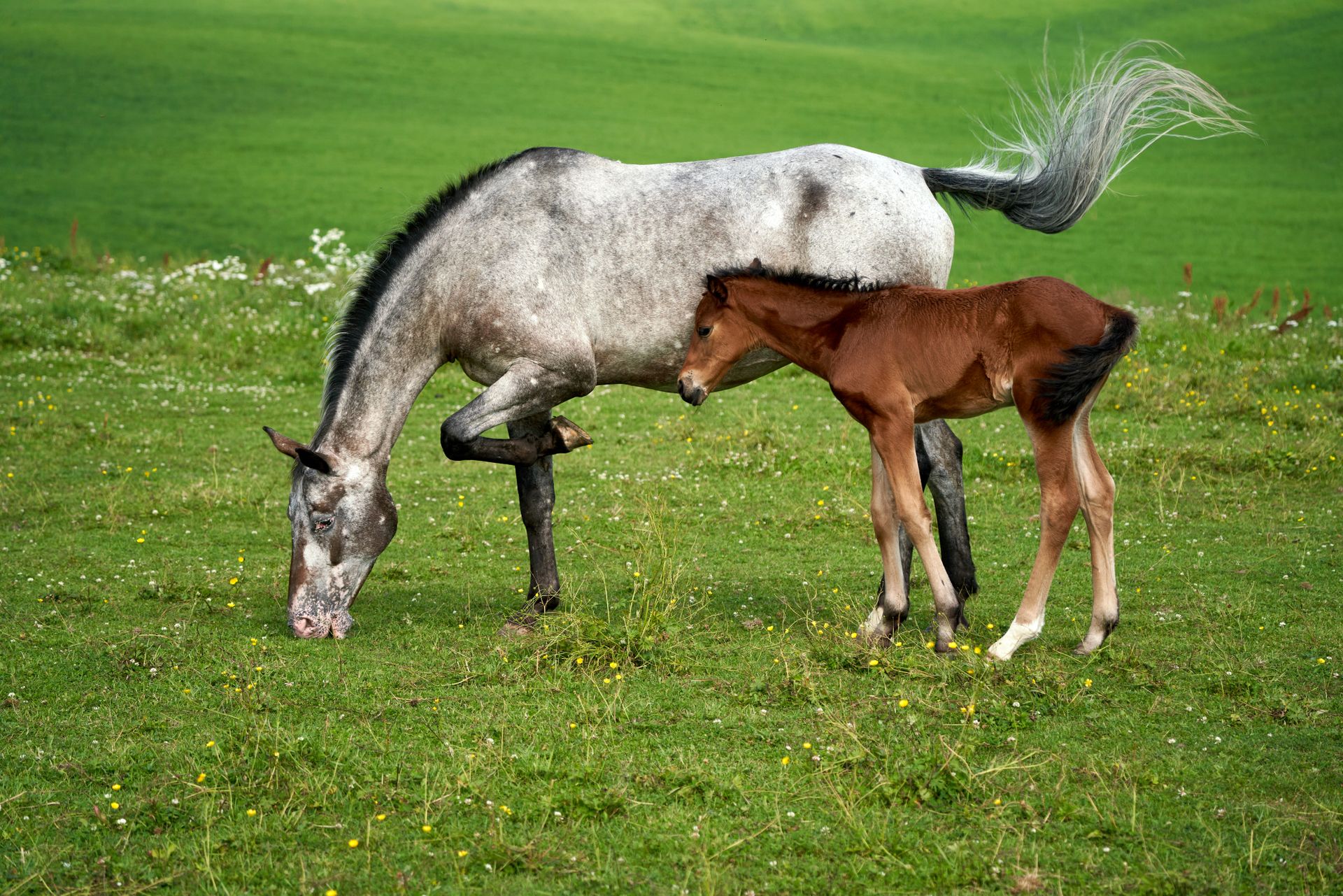
Roan horses are a unique and stunning breed, characterized by their distinctive coat pattern. They have a mix of white and dark hairs, giving them a speckled or streaked appearance.
There are several roan horse breeds, including the Welsh Pony, which is known for its roan coloring. The Welsh Pony is a small to medium-sized horse, typically standing between 12 and 14 hands high.
Roan horses can be found in a variety of patterns, including the classic "roan" pattern, which features a mix of white and dark hairs. This pattern can appear in a range of shades, from a light silver to a dark brown.
The roan pattern is caused by the interaction of two types of melanin, eumelanin and pheomelanin. This interaction creates the characteristic speckled or streaked effect on the horse's coat.
What is a Roan Horse?
A Roan Horse is a type of horse that gets its distinctive coat color from a mix of white and dark hairs.
Roan horses have a unique coat pattern where the white hairs are scattered throughout the dark hairs, giving them a speckled or streaked appearance.
The exact cause of the roan coat pattern is still debated among equine experts, but it's believed to be a result of the interaction between two different genetic traits.
Roan horses can be found in many breeds, including the Appaloosa and the American Paint Horse.
Their coat pattern can vary in intensity, ranging from a light speckling to a more pronounced roaning effect.
Roan Horse Characteristics
Roan horses have a unique coat color pattern with a combination of white and colored hairs on the body and solid-colored points on the head, mane, lower legs, and tail.
The true roan color occurs at birth, although it's hardly visible until the foal coat sheds. Roan horses can have an even mixture of white hairs with any other color.
Roans can have different shades, including blue roan, red roan, and bay roan, depending on the underlying coat color. These shades occur in combination with the roan pattern to produce distinct colors.
One unusual characteristic of roan horses is that their coat grows back in solid colors when their skin is cut or damaged.
Terminology
The term "roan" can be a bit confusing, but it's actually quite straightforward. In the most general sense, "roan" refers to any animal with a mixture of white and colored hairs in the coat.
Recent research has shown that there are different types of roaning patterns, but "true roan" or "classic roan" is distinct from these similar patterns. This is important to note because it helps us understand the different characteristics of roan horses.
The study of laboratory mice has also provided insight into the genetics of white patterning, revealing that multiple genotypes can produce roaning or flecking. This suggests that there may be other types of roaning conditions beyond what's been identified.
In the context of horses, the word "roan" specifically refers to a coat color pattern with solid-colored points on the head, mane, lower legs, and tail.
Explore further: Types of Rotweiler
Inverted V Shape on Legs
The inverted V shape on the legs is a distinctive feature of roan horses. It's where the roaned pattern ends and the solid color begins, forming a spear-like shape.
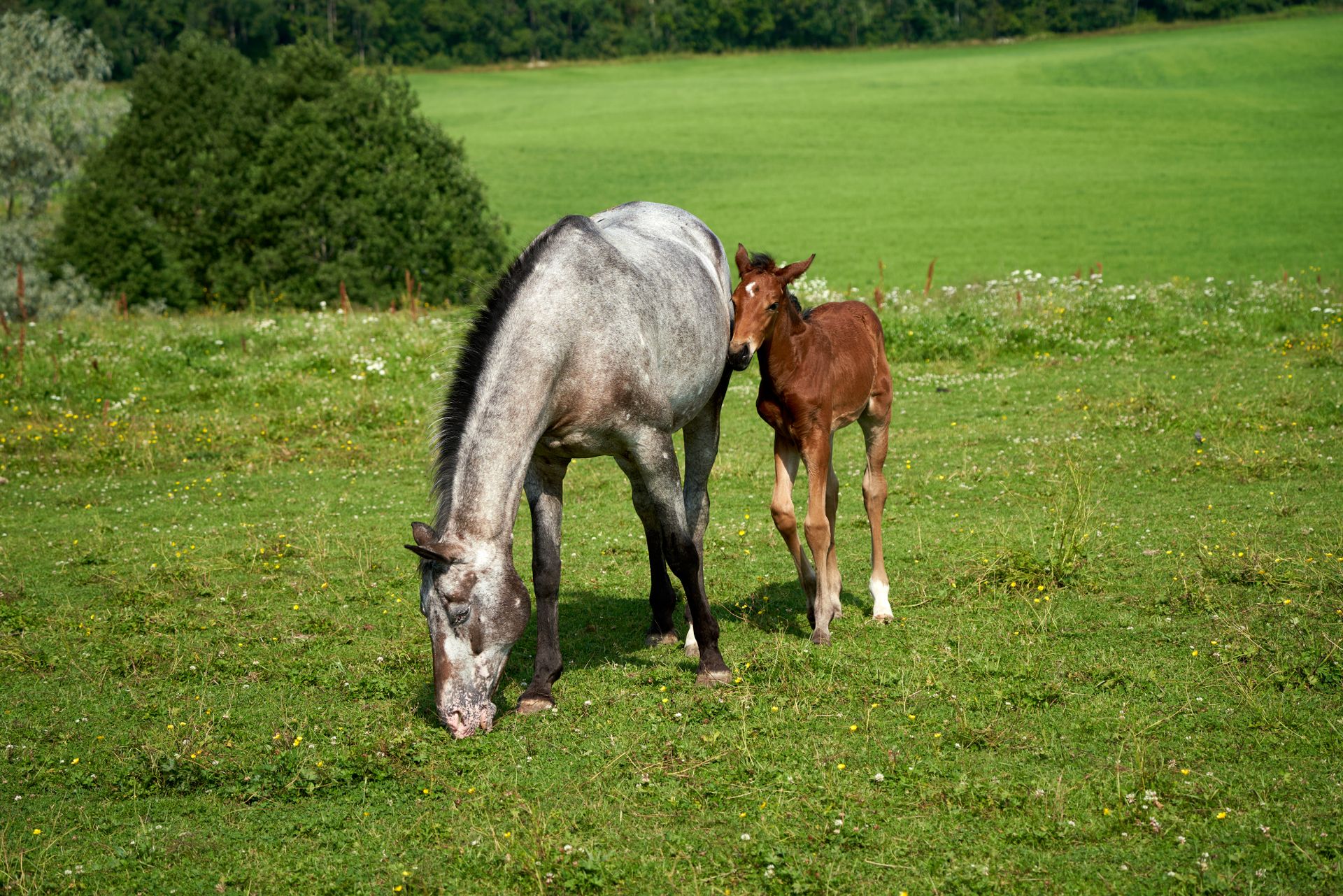
This characteristic is especially noticeable on dark-colored roans. The contrast between the roaned pattern and the solid color creates a striking visual effect.
If the solid color is light, like palomino or buckskin, the effect of roaning on the body is almost impossible to see. The inverted V shape on the legs becomes the only way to identify the roan pattern.
Variation by Season
The amount of white in a roan horse's coat can vary significantly between seasons. This is because the long, harsh hairs of the winter coat seem to be less affected by roan than the short hairs of the summer coat.
In the spring and summer, the roaning pattern is more visible because the winter coat is shed. This allows the underlying roaning pattern to shine through.
Roan Horse Genetics
Roan horses owe their unique coat pattern to a dominant gene, Rn, which is responsible for mixing white hairs with a solid base color. This gene is inherited, meaning at least one parent must carry the roan gene for a foal to be roan.
You might enjoy: Roan Cockapoo
The University of California, Davis School of Veterinary Medicine's genetics services has developed a DNA test that uses genetic markers to indirectly determine the number of Rn or rn alleles a horse has. This test is reliable for certain breeds, including American Quarter Horses and Welsh Ponies.
The roan gene doesn't affect the mane, tail, or lower legs, which usually stay the horse's base color. This is why roan horses often have a distinctive look, with their body coat blending white and colored hairs.
The roan gene is linked to other genes, including the chestnut gene. This means that if a horse has one chromosome with the dominant roan allele and the recessive chestnut allele, it will appear blue roan.
A horse can be homozygous roan, meaning it has two copies of the Rn gene (Rn/Rn), or heterozygous roan, meaning it has one copy of the Rn gene and one non-roan gene (Rn/rn). Homozygous roan stallions produce 100% roan offspring, while heterozygous roan stallions will produce a mix of roan and non-roan offspring.
Check this out: String Test
Genetics
Roan is a simple dominant trait symbolized by the Rn allele. This means that if a horse is Roan, then at least one of the parents must have been Roan as well.
Traits that are dominantly inherited cannot skip generations, so two non-roan parents cannot produce a roan offspring. However, a roan can be born from two seemingly non-roan parents if the roan coat is "masked" by extensive white markings or gray.
The University of California, Davis School of Veterinary Medicine's genetics services has developed a DNA test that uses genetic markers to indirectly determine the number of Rn or rn alleles a horse has. This test is reliable for American Quarter Horse, American Paint Horse, Welsh Pony, and Gypsy Cob breeds.
The mutation responsible for true roan has not yet been identified exactly, but it has been assigned to equine chromosome 3 (ECA3) in the KIT sequence. This is the same sequence that affects other coat colors, such as sabino and dominant white spotting.
The roan gene doesn't affect the mane, tail, or lower legs, which usually stay the horse's base color. This creates the classic roan look.
Here's a summary of the possible genotypes and phenotypes of roan horses:
Note that homozygous roans can be identified by an indirect DNA marker test and produce 100% roan offspring.
White Hairs Intermixture
Roan horses have an intermixture of white hairs across the body, but the head and points (mane, tail, and lower legs) are a mostly solid color with only a few white hairs scattered or even none at all.
This unique pattern is a result of the dominant roan gene (Rn) that affects a horse's coat by evenly mixing white hairs with a solid base color.
Roans can have an even mixture of white hairs with any other color, resulting in different shades such as blue roan, red roan, and bay roan.
The true roan color occurs at birth, although it's hardly visible until the foal coat sheds.
Roan horses maintain their distinct blend of white and colored hairs throughout life, unlike gray horses which lighten over time.
Their coat may appear darker in winter and lighter in summer due to shedding, but the roan gene doesn't affect the mane, tail, or lower legs, which usually stay the horse's base color.
In minimal expressions of the Roan gene, the roaning will only exist over the croup and hip area.
The roan gene is inherited, meaning at least one parent must carry the roan gene for a foal to be roan.
Roan Horse Breeds and Prevalence
Roan horse breeds can be found in many parts of the world, with a prevalence in European draft breeds such as the Brabant and Ardennes, as well as North American breeds like the Quarter Horse and Paint Horse.
The classic roan pattern is also common in British ponies like Dales, Welsh, and Connemara ponies, as well as Icelandic Horses and Miniature Horses. In fact, many breeds worldwide have the roan pattern, including European draft breeds, European ponies, and North American breeds.
See what others are reading: Draft Horses
Here are some of the breeds where we can find the roan pattern:
- European draft breeds like Ardennes, Trait Du Nord, Italian Heavy Draft, Belgium, and Rhenish-German Cold-Blood.
- European ponies like Dales Ponies, Welsh Ponies, Gypsy Cobs, Shetland Ponies, Connemara ponies, and New Forest ponies.
- North American breeds like Quarter Horse, Paint Horse, Peruvian Paso, Paso Fino, Standardbred, Mustang, and Tennessee Walking Horse.
It's worth noting that Thoroughbreds and Arabians with roan-like coats are often related to graying or rabicano characteristics, rather than true roan.
Breeds Where We Can Find the Pattern
The roan horse pattern is a unique and beautiful trait found in many breeds worldwide. Roan horses come in many shapes and sizes, but they all have one thing in common: their coat, which is a mix of white hairs blended into a solid color.
Roan is found in European draft breeds, including the Ardennes, Trait Du Nord, Italian Heavy Draft, Belgium, and Rhenish-German Cold-Blood. These powerful horses are a sight to behold, with their roan coats shimmering in the sunlight.
In addition to European draft breeds, roan is also found in European ponies, such as Dales Ponies, Welsh Ponies, Gypsy Cobs, Shetland Ponies, Connemara ponies, and New Forest ponies. Icelandic horses and Miniature horses also display this beautiful pattern.
Roan is not as common in North American breeds, but it can be found in Quarter Horses, Paint Horses, Peruvian Paso, Paso Fino, Standardbred, Mustang, and Tennessee Walking Horses.
Here are some breeds where we can find the roan pattern:
- European draft breeds: Ardennes, Trait Du Nord, Italian Heavy Draft, Belgium, and Rhenish-German Cold-Blood
- European ponies: Dales Ponies, Welsh Ponies, Gypsy Cobs, Shetland Ponies, Connemara ponies, and New Forest ponies
- North American breeds: Quarter Horse, Paint Horse, Peruvian Paso, Paso Fino, Standardbred, Mustang, and Tennessee Walking Horse
Appaloosa
The Appaloosa breed is known for its distinctive spotted coat pattern, but some Appaloosas have a unique roan-like pattern called varnish roan.
These horses get lighter with age, especially around their face and legs, unlike true roans.
Appaloosas with this varnish roan pattern still turn heads with their bold personalities and striking coat patterns.
Their coat patterns are truly one-of-a-kind, making each Appaloosa stand out from the rest.
Suggestion: Appaloosa Horses
Roan Horse Color Facts
Roan horses are known for their unique coat pattern, which is a combination of white and colored hairs. Their coat stays a consistent mix of white hairs and their base color for life.
Roans come in three main shades: blue roan (black base), red roan (chestnut base), and bay roan (bay base). Their mane, tail, and lower legs stay dark, making them easy to recognize.
Their coat can change seasonally, often looking darker in winter and lighter in summer as they shed. Roans are also known for their ability to grow back in their base color if injured, leaving dark spots on their coat.
Here are some key facts about roan horses:
- Roans keep their color for life, unlike grays which fade over time.
- Their coat is a mix of white hairs with a solid base color.
- Mane, tail, and lower legs stay dark.
- Their coat can change seasonally.
- They grow back in their base color if injured.
- Roan is a dominant gene, so a horse must inherit it from at least one parent to be roan.
Roans can be found in many breeds, including the American Quarter Horse, Belgian Draft, Mustang, and Percheron. They are often mistaken for other patterns, such as gray, rabicano, sabino, and varnish roan horses, but each pattern is genetically different.
Gray
Gray horses are born with a solid coat, and it's not uncommon to see a dark gray foal.
Gray horses lighten with age, and this process is one of the defining characteristics of the gray coat color. Gray foals may be born any color, and there may be no indication of the future gray coat at birth.
Mature grays may retain none of their original coat color, and have a "white" coat, while the color of the skin and eyes is unchanged. The first white hairs are usually seen around the muzzle and eyes.
As a gray horse may go from entirely colored to entirely white over the course of its life, the process of "graying out" can, at times, closely resemble roan.
A fresh viewpoint: Bernedoodle Coat Types
Varnish
A varnish roan is an all-over blend of white and colored hairs, giving it a unique marbled appearance.
You might notice that patches of skin close to the bone, like on the face and legs, don't grow as much white hair, resulting in darker patches called "varnish marks".
These varnish marks are a key distinguishing feature between varnish roans and true roans, and they're not found in true roans.
Varnish roans can also be identified by their leopard complex characteristics, such as white sclera, finely striped hooves, and mottled skin around the eyes, muzzle, and genitals.
As varnish roans age, their white hairs increase, leading to a more pronounced marbled effect.
In contrast, true roans have an even mix of white and color, which doesn't change over time.
True roans are also born with their color and keep it for life, although their coat may appear darker in winter and lighter in summer.
The key difference between varnish roans and true roans is how their coat color develops and changes over time.
Scars Heal with Colored Hair
Scars on a roan horse heal with colored hair, not white hair like most other horses. This is a unique characteristic that can help identify a roan horse.
The colored hair scars are called "corn spots." For example, a chestnut roan's scar will have red hair, while a chestnut horse's scar will have white hair.
Some roan horses have dark spots that are not the result of scarring, and these are also referred to as corn spots.
Grey
Grey horses are often mistaken for roans due to their similar intermixing of white and colored hairs. However, they're actually a different pattern altogether.
One of the key differences between grey and roan horses is that grey horses can change from a completely colored foal to a completely white horse over time. This is because grey is a modifier that causes a progressive whitening of the horse's hair throughout its lifetime.
Unlike grey horses, roan horses keep the amount of white hairs stable during all stages of their life. This means their coat stays a consistent mix of white hairs and their base color.
As a result, roan horses can be easily distinguished from grey horses, especially in their head, which typically remains colored. In contrast, grey horses have a similar intermix of hairs on their head as the rest of their body.
It's worth noting that grey horses are not born with their characteristic coat pattern, but rather develop it over time. This is in contrast to roan horses, which are born with their characteristic coat pattern and don't change much over their lifetime.
Color Facts
Roan horses keep their color for life, unlike gray horses that fade to white over time.
Their coat stays a consistent mix of white hairs and their base color, making them easy to recognize.
The mane, tail, and lower legs of a roan horse stay dark, while the body is mixed with white hairs.
Roan horses often look darker in winter when their thicker coat grows in and lighter in summer as they shed.
Injuries on a roan horse grow back in the base color, leaving dark spots on the coat.
The roan gene is dominant, meaning a horse must inherit it from at least one parent to be roan.
Roan horses can be found in many breeds, including the American Quarter Horse, Belgian Draft, Mustang, and Percheron.
Their color can look brighter when groomed, as the white hairs shimmer in the sunlight.
The roan pattern can occur with any base coat color, including black, chestnut, and bay, or diluted coat colors like dun and cream.
Roan horses can have an even mixture of white hairs with any other color, producing different shades.
Their underlying coat color occurs in combination with roan to produce different shades, including blue roan and bay roan.
The American Roan Horse Association is responsible for defining, promoting, and registering roan horses.
Red roan horses have a chestnut base coat mixed with white hairs, creating a warm, reddish-pink look.
Their mane and tail can be red, flaxen, or mixed, while their lower legs often remain darker.
Blue
Blue roan horses have a distinctive appearance, with a black base coat mixed with white hairs giving them a smoky, steel-blue appearance.
Their mane, tail, and lower legs stay black, creating a striking contrast that's hard to miss.
Blue roans can sometimes be mistaken for grays, but unlike gray horses, their dark coat stays consistent and doesn't lighten with age.
In fact, blue roans are often found in breeds like the American Quarter Horse, Percheron, and Tennessee Walking Horse.
The blue roan pattern is created by combining the roan pattern with a black base color, which gives the impression of a bluish tint.
Some people call these horses black roans instead, but they're officially known as blue roans.
Bay
Bay roans have a bay base coat, meaning a mix of brown with black points on the mane, tail, and legs. This gives them a unique appearance that's hard to confuse with other colors.
Their coat stays consistent throughout life, making them easy to recognize. This is one of the defining characteristics of roan horses.
Bay roans can be mistaken for red roans, but their darker points set them apart. This is because red roans have a chestnut base coat instead of a bay base coat.
This color is seen in breeds like the American Quarter Horse, Mustang, and Standardbred. These breeds are known for their versatility and intelligence.
In the past, bay roans and red roans were grouped together and both were called red roans. This shows how our understanding of horse colors has evolved over time.
Their coat can change seasonally, looking darker in winter and lighter in summer. This is due to their thicker coat growing in during the winter months.
A clean, well-groomed bay roan horse often looks even more striking because the white hairs shimmer in the sunlight. This is especially true for bay roans with a lot of white hairs on their body.
Roan Horse Comparison and Facts
Roan horses are known for their unique coat color pattern, which is a combination of white and colored hairs. This pattern is present at birth and remains consistent throughout their lives.
Roans can be found in three main shades: blue roan (black base), red roan (chestnut base), and bay roan (bay base). The mane, tail, and lower legs of a roan horse typically remain the base color, making them easy to recognize.
The coat of a roan horse can change seasonally, appearing darker in winter and lighter in summer. This is due to the growth and shedding of their coat hair.
Injuries to a roan horse's coat can cause the new hair to grow back in the base color, leaving dark spots on the coat. This is a unique characteristic of roan horses.
Roan is a dominant gene, meaning a horse must inherit the roan gene from at least one parent to be roan. If neither parent is roan, the foal will not be roan.
The following breeds often feature the roan pattern: American Quarter Horse, Belgian Draft, Mustang, and Percheron.
Here are the main characteristics that distinguish classic roans from other white patterns:
- Colored face and lower legs
- Inverted V on the knees
Roan horses can be confused with other coat patterns, such as gray, rabicano, sabino, and varnish roan. However, each of these patterns is genetically distinct from the classic roan.
Frequently Asked Questions
What is the difference between roan and dun?
Dun horses have a solid, one-shade color that doesn't change with age, whereas roan horses have intermingled black and white hairs. The key difference lies in the uniformity and aging characteristics of their coat colors
What is the rarest roan?
The rarest roan is the true blue roan, which appears as a striking indigo color with silver tones due to its even mixture of white and black. This unique coat pattern makes it a rare and sought-after sight in the equine world.
What is the difference between a roan and a rabicano?
Rabicano and roan are two distinct horse coat patterns, with rabicano being a specific set of white markings on the tail, flank, and belly, whereas roan is a mix of white and dark hairs giving a speckled appearance. Understanding the difference between these patterns can help you identify and appreciate the unique characteristics of a horse's coat.
Featured Images: pexels.com