The Eastern Screech Owl is a fascinating bird, and one of the most common owl species in North America. They're small, but don't let their size fool you - they're fierce hunters.
These owls are known for their distinctive calls, which sound like a high-pitched whistle. They're often heard in the evenings and at night.
Eastern Screech Owls are cavity-nesting birds, which means they make their homes in tree holes or other enclosed spaces. They're also known to take over abandoned nests from other birds.
One of the most interesting things about Eastern Screech Owls is their ability to adapt to different environments. They can be found in a variety of habitats, from urban parks to rural forests.
For your interest: Will Owls Attack Small Dogs
For more insights, see: Java Birds
Physical Characteristics
The Eastern Screech Owl is a small but mighty bird, with some pretty distinctive physical characteristics.
Adult owls are about 6 to 10 inches long, with a wingspan of 18 to 24 inches. They're stocky birds with short tails and wide wings.
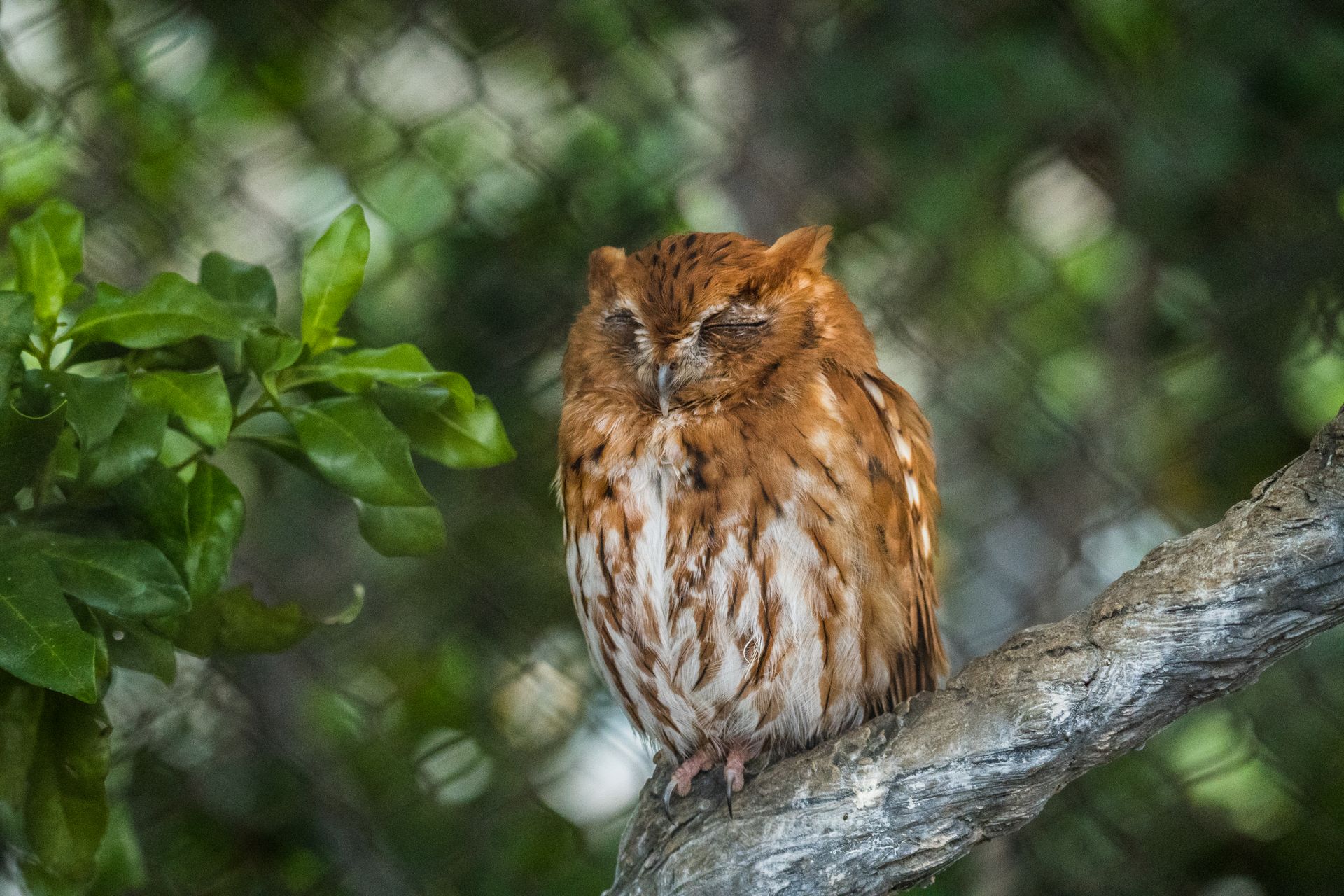
Their feathers come in two main colors: rusty or reddish-brown, and dark gray. The gray owls blend in perfectly with tree bark, while the red owls can hide in pine trees or colorful autumn leaves.
Female owls are usually a bit heavier than males. They weigh between 121 and 244 grams, which is roughly 4 to 8.6 ounces.
Their eyes are a bright yellow, and their beak is yellowish. They have strong feet, usually covered in feathers, and distinctive ear tufts that stick up on their heads.
The Eastern Screech Owl has two color phases: rufous and gray. Rufous individuals live mainly in the south, while gray individuals live in the north.
They have bold streaking on their breasts and bellies, which helps them blend in with their surroundings. Their breast and belly are heavily streaked and spotted with black.
Males and females look alike, which can make them tricky to tell apart.
Check this out: How Long Do American Bald Eagles Live
Nesting
Eastern screech owls are fascinating birds, and their nesting habits are just one of the many interesting things about them. They form stable pairs, usually one male with one female, but occasionally one male with two females.
Here's an interesting read: North American Raccoon Male vs Female
Eastern screech owls typically breed once a year from February through March, and the female lays her eggs on whatever debris is at the bottom of her nesting cavity. The female usually lays 2 to 6 eggs, with 27 to 34 days of incubation.
Males feed females and guard nest cavities during incubation and brooding, which is a crucial time for the female to sit on the eggs and keep them warm. The young leave the nest at about 28 days old and remain with the parents until they are 8 to 10 weeks old.
Eastern screech owls readily accept nest boxes, including those built for Wood Ducks or Purple Martins, and sometimes nest in wood piles, mailboxes, or crates left on the ground. This adaptability is one of the reasons why they are such successful survivors.
Females tend to choose cavities that have been well supplied with food by the male, which is a clever strategy to ensure they have a reliable food source for their young. Nestlings leave the nest in the order they hatched, with older nestlings leaving first and younger ones leaving on following days.
The incubation period is 26 to 30 days, and because incubation usually begins with the first egg, the eggs develop at different rates and therefore hatch at different times (asynchronous hatching). This unique hatching pattern is one of the many fascinating aspects of eastern screech owl biology.
A unique perspective: American Bald Eagle Food Chain
Behavior and Habitat
Eastern screech owls are adaptable birds that thrive in a variety of habitats, from farmland to city parks. They can live and breed successfully in areas with tree cover, and can even recolonize after trees are replanted.
These owls are primarily active at night, though they may hunt at dawn or dusk, and occasionally in daylight. They perch in trees, waiting for prey to pass below, then pounce from 6-10 feet off the ground.
Eastern screech owls form stable pairs, with one male and one female, and occasionally one male with two females. Males defend small territories containing several cavity roost spots, and females stay in the nest hole except for brief excursions.
They are common in neighborhoods, but can be hard to spot because they're small and blend in well. You're more likely to hear them than see them, especially at night when they call.
Intriguing read: Were the Tsavo Lions Male or Female
Habitat
Eastern Screech-Owls are incredibly adaptable birds when it comes to their habitat. They can thrive in almost any environment with sufficient tree cover.
They're not picky about where they live, as long as there are trees to nest in. In fact, they've been known to live and breed successfully in farmland, suburban landscapes, and even city parks.
If you're looking to attract Eastern Screech-Owls to your yard, consider adding some nest boxes or providing a brushy cover. They'll readily recolonize an area if trees are replanted, especially if nest boxes are also provided.
In areas where trees are scarce, Eastern Screech-Owls will often make do with alternative nesting sites, such as abandoned woodpecker holes or hollow stumps and limbs.
Check this out: Red Breasted Nuthatch Nest
How They Behave
Eastern Screech-Owls are mostly active at night, though they often hunt at dawn or dusk, and occasionally in daylight. They tend to pounce from perches six to ten feet off the ground to snag prey.
These owls are versatile hunters who sit and wait in the trees for prey to pass below. Most flights are short, less than 75 feet.
Related reading: What Is Birds in Madagascar Prey
Eastern Screech-Owls form stable matches, usually one male with one female but occasionally one male with two females. Males defend small territories containing several cavity roost spots.
At night, these owls often call, especially in spring when they are breeding. Their call sounds like a trembling whinny, like a tiny horse.
They also make a steady purring sound that lasts a few seconds. Their voices are unique and easy to recognize.
These owls tend to rest in tree holes or next to tree trunks during the day. They are common, even in neighborhoods, but it's hard to see them because they are small and blend in well.
Expand your knowledge: Eastern Whippoorwill Call
Diet and Types
Eastern screech owls are skilled hunters, using their sharp hearing and vision to catch prey in the dark. They typically hunt from dusk until dawn, with most of their hunting done in the first few hours after dark.
Their diet is quite diverse, consisting of mammals, birds, insects, and other small creatures. In fact, studies show that their diet is about 41% mammals, 18% birds, and 41% insects and other small creatures.
In the winter, they tend to eat more mammals, while in the summer, they eat more insects and crayfish. They also eat less food per day in the summer than in the winter, likely because they're busy feeding their babies.
Expand your knowledge: Eastern Screech Owl Diet
What They Eat
Eastern screech owls are skilled hunters, and their diet reflects their adaptability. They primarily hunt from dusk until dawn, using their sharp hearing and vision to find food.
They have a varied diet that includes mammals, birds, and insects. Small mammals like shrews, mice, and young rabbits are a common food source, especially in winter.
Insects are a staple of their diet, with large insects like beetles, moths, crickets, and cicadas being eaten during the breeding season. Crayfish and snails are also on the menu.
Birds are another common prey, with small birds like chickadees, sparrows, and warblers being caught while they're sleeping or flying at night. They've even been known to catch larger birds like mourning doves and pigeons.
Their diet is quite diverse, with small fish, snakes, lizards, frogs, and toads also being eaten. They've even been spotted fishing in cracks in ice during winter.
Discover more: Common Snapping Turtle Predators
Different Types
There are five main types of eastern screech owls, each with unique characteristics that help them blend in with their local habitat.

The northern types tend to be larger, while the southern types are smaller. The colors of these owls can also change depending on where they live.
In the north, you'll often find owls that are cold gray with red markings. These are typically the largest type in size.
In contrast, owls in the south are often rusty-brown and are the smallest type of eastern screech owl.
Here's a breakdown of the different types of eastern screech owls:
Frequently Asked Questions
How rare is it to see a screech owl?
It's not rare to spot a screech owl, as they are common in many urban areas, including city parks and suburbs. In fact, many people unknowingly have an owl as a neighbor.
Featured Images: pexels.com