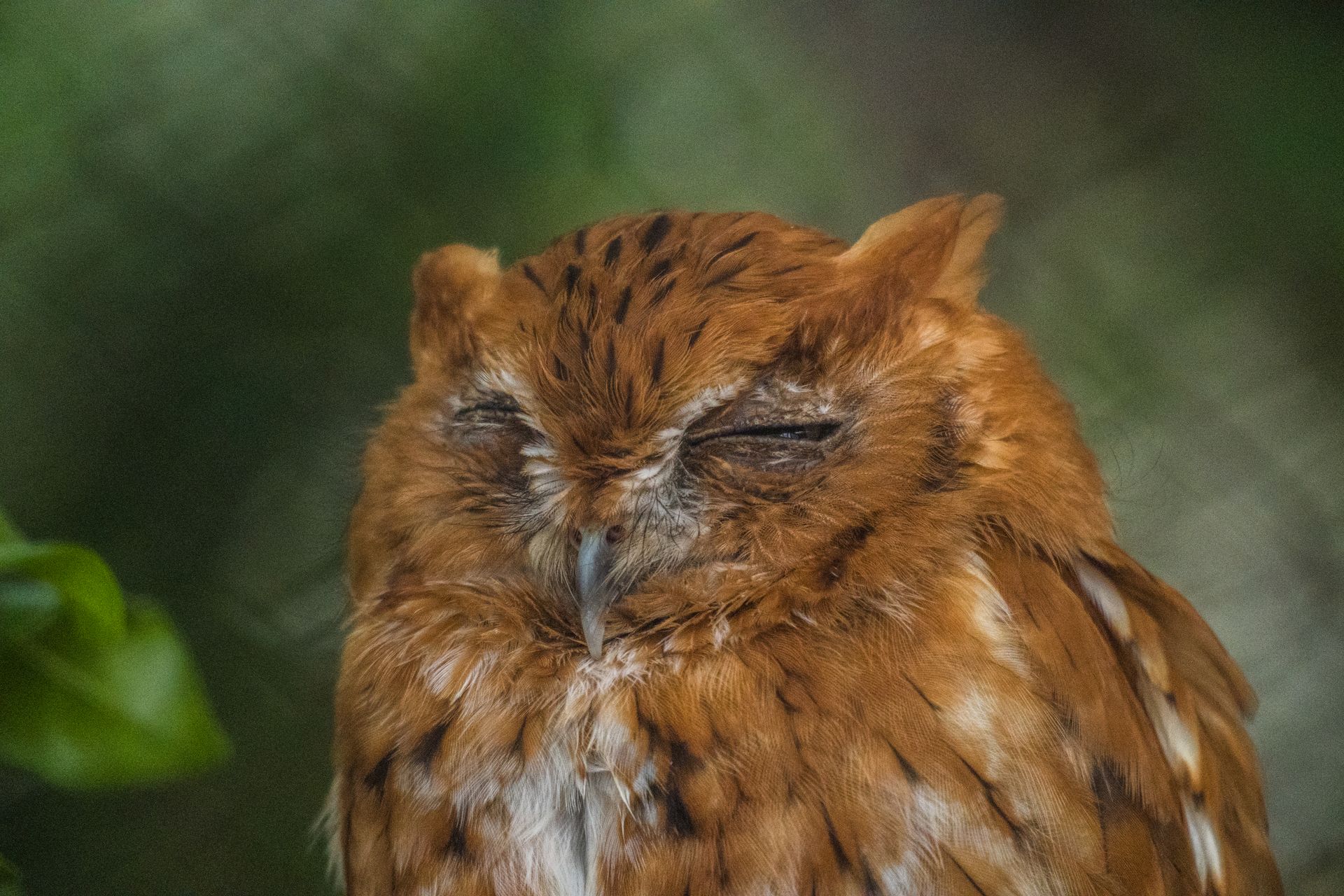
The eastern screech owl's camouflage abilities are truly remarkable. Their mottled brown and gray feathers allow them to blend in seamlessly with their surroundings.
These owls can be found in a variety of habitats, from urban backyards to dense forests, which is a testament to their adaptability. Their camouflage helps them to remain hidden from predators and prey alike.
One of the key features of the eastern screech owl's camouflage is its ability to break up their outline, making it difficult for other animals to spot them. This is achieved through the use of intricate patterns and markings on their feathers.
Explore further: Eastern Screech Owl Feathers
Eastern Screech Owls Can
They can camouflage completely, blending in with their surroundings to the point of being almost invisible.
You can even put up a nesting box for them in your own backyard, and they might keep rodents off your lawn.
They eat a wide variety of prey, including insects, rodents, worms, songbirds, and even bats.
They spit out the undigestible parts of their food as pellets, which can sometimes be found on rooftops or other surfaces.
You might not even notice an Eastern Screech Owl if it hadn't moved, even experienced birders admit they have trouble spotting them.
They can be found in many suburban and urban areas throughout the eastern United States, and they often coexist with humans.
They are nocturnal, which means they are most active at night, and their song can be heard echoing through wooded areas.
They are expertly adapted to their woodland environment, with gray or reddish-brown plumage that mimics the texture of bark, leaves, and lichen.
They can compress their body and flatten their feathers to match the contours of their surroundings, further enhancing their camouflage.
You can see examples of their camouflage in photos taken by birders, which show how well they blend in with their surroundings.
Recent research has shown that screech-owl chicks grow quicker and healthier in vermin-free nests that the owls share with "helper" blind snakes.
Eastern Screech Owl Overview
The Eastern Screech Owl is a master of disguise, blending seamlessly into its woodland environment. It's small, about eight inches tall, and weighs around 0.2-0.5 lb (0.09-0.2 kg).
The owl's camouflage abilities are so effective that it can even look like a dead tree branch when feeling threatened. It does this by stretching its body and tightening its feathers to match the contours of its surroundings.
These owls come in two colors: rufous and gray. Rufous colored birds live mainly in the south, while gray individuals live primarily in the north. The rufous birds tend to live in pine trees, while the gray birds prefer oak trees.
A different take: New Zealand Birds Also Known as Owl Parrots
Owl Behavior and Habitat
The Eastern Screech Owl is a master of camouflage, blending in with its surroundings to avoid detection. It's a small bird-of-night, about eight inches tall, and weighs around 0.2-0.5 lb.
These owls live in wooded environments and are commonly found in Eastern North America, from Mexico to Canada. They're nocturnal hunters, which means they do most of their hunting at night.
The Eastern Screech Owl comes in two colors: rufous and gray. Rufous colored birds live mainly in the south, while gray individuals live primarily in the north.
During the breeding season, the Eastern Screech Owl is a solitary animal, but the pair is primarily monogamous. The female owl lays eggs in nests located in natural cavities and hollow stumps.
The incubation period is around 26 to 30 days, and the male bird helps the female bird with brooding and brings food for the female and the hatchlings. The male's contribution to the family dish is a tasty mix of small birds and animals, reptiles, insects, crayfish, and earthworms.
These owls hunt a wide variety of prey, including fish, crayfish, grasshoppers, beetles, and other insects, small mammals, reptiles, amphibians, and other small birds. Their major predators are skunks, snakes, blue jays, and Virginia opossums.
When feeling threatened, these owls stretch their body and tighten their feathers to look like a dead tree branch to avoid being discovered. They're experts at hiding in plain sight, often impossible to tell apart from a broken knot on a tree branch.
Interesting Facts
Eastern Screech Owls are known for their unique, high-pitched calls that can be heard up to a mile away.
The Eastern Screech Owl's call is often described as a loud, whistled "whinny" or "kek-kek-kek", which is a distinctive sound that helps with identification.
These owls are relatively small, with adults reaching lengths of about 9-12 inches.
In terms of wingspan, Eastern Screech Owls have a wingspan of around 20-25 inches.
They have large, round heads and forward-facing ears, which help them pinpoint sounds in the dark.
Their eyes are relatively large and round, which allows them to see well in low light conditions.
Eastern Screech Owls are cavity-nesting birds, meaning they often take over existing nests or use tree cavities as their home.
They are found in a variety of habitats, including urban and suburban areas, as well as forests and woodlands.
Expand your knowledge: Do Owls Attack Dogs
Camouflage and Hiding
Eastern screech owls are masters of camouflage, and it's not uncommon for them to go unnoticed even by experienced birders. They can blend in so perfectly with their surroundings that it's like they're wearing the best disguise ever.
Their grey and brown feathers blend in with tree bark, making it impossible to tell them apart from a broken knot. Even when they're perched on a branch, they're often indistinguishable from the tree itself.
These owls are experts at compressing their bodies and flattening their feathers to match the contours of their surroundings, further enhancing their camouflage. It's like they're wearing a built-in cloak of invisibility.
You might be surprised to know that eastern screech owls can even be found living in close proximity to humans in suburban and urban areas. They're not as rare as you might think, and they might even be secretly living in your own backyard.
If you're lucky, you might catch a glimpse of one hiding in broad daylight, camouflaged perfectly within the confines of a tree. But be warned, it's not always easy to spot them, even with a good pair of binoculars.
Eastern Screech Owl
The Eastern Screech Owl is a master of camouflage, and its ability to blend in with its surroundings is truly impressive. It's a small bird, about eight inches tall and weighing around 0.2-0.5 lb, but it can easily hide in plain sight.
These owls can be found in wooded environments throughout Eastern North America, from Mexico to Canada. They're commonly found in deciduous trees, where their gray or reddish-brown plumage helps them blend in with the bark.
The Eastern Screech Owl's camouflage abilities are not just limited to its coloration. It can also compress its body and flatten its feathers to match the contours of its surroundings, making it even harder to spot.
If you're lucky, you might even catch a glimpse of one of these owls in broad daylight, camouflaged perfectly within the confines of a tree. I've been trying to spot one myself, and I've even reached out to experts like Matt Johnson and Nolan Schillerstrom for tips and photos.
During the day, Eastern Screech Owls often roost in tree cavities or nest boxes, barely visible even when in plain sight. They're experts at hiding, and it's not uncommon for them to be overlooked by even the most experienced birdwatchers.
Featured Images: pexels.com