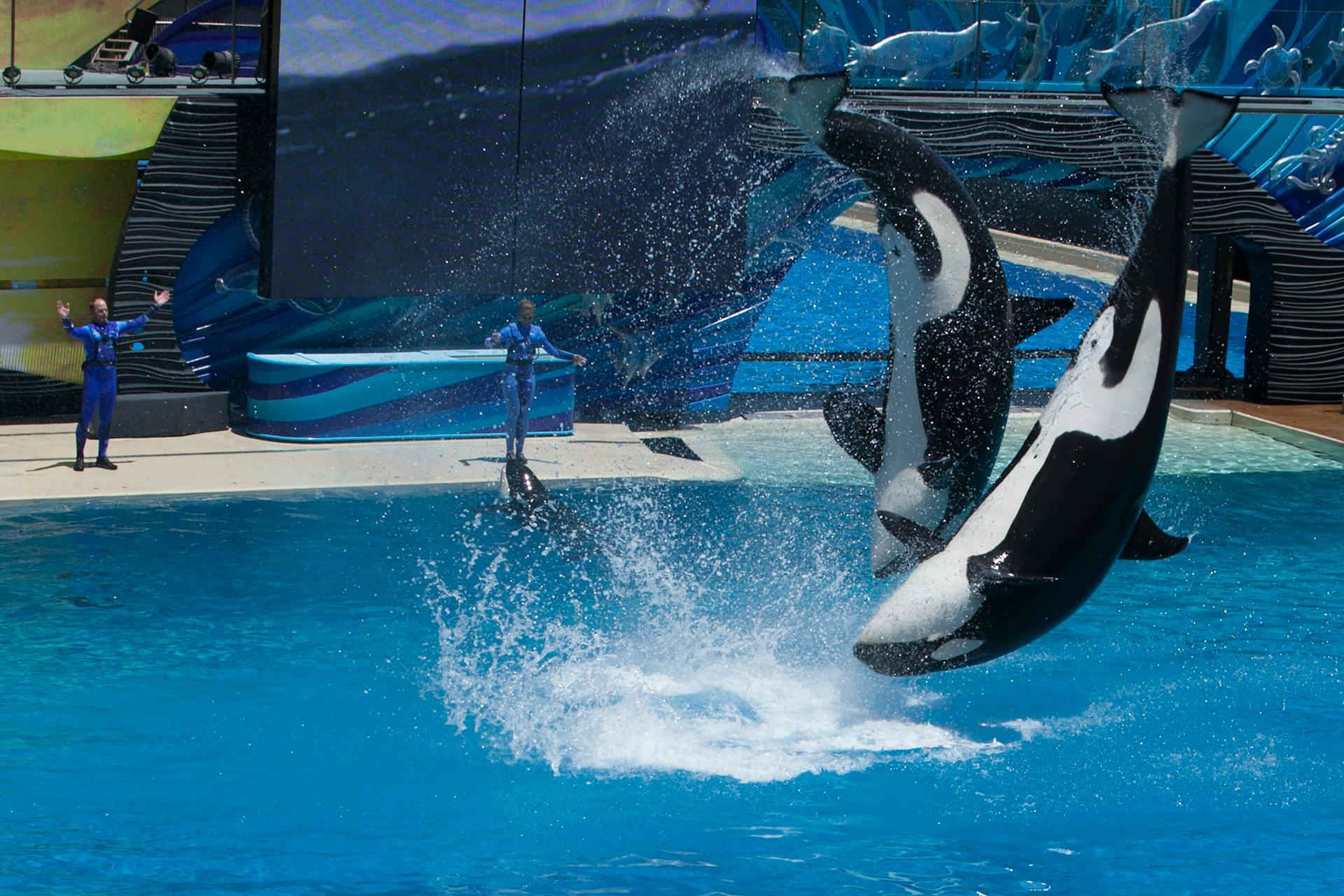
SeaWorld has been at the center of controversy for decades, with many experts and advocates speaking out against the park's treatment of orcas in captivity.
Since the 1960s, SeaWorld has been capturing orcas from the wild to display in their parks, with 25 orcas being taken from their natural habitats between 1965 and 1971 alone.
The stress of captivity has taken a devastating toll on the orcas, with many dying prematurely.
In the 1990s, SeaWorld's orca population began to dwindle, with several orcas dying in the early 2000s due to a bacterial infection known as Morbillivirus.
Despite these alarming statistics, SeaWorld continues to keep orcas in captivity for entertainment purposes.
Orcas in Captivity
Orcas in captivity are often kept in artificial social groups, which can lead to stress and conflict. This is especially true for captive-born orcas, who are typically separated from their mothers at a young age and transferred between facilities multiple times.
Kayla, a captive orca, was separated from her mother at just 11 months old and moved between SeaWorld properties four times. This kind of disruption can have a profound impact on an orca's mental and emotional well-being.
Orcas in captivity don't have the ability to escape conflict with other orcas or engage in natural swimming behaviors, which can lead to stress and aggression. In fact, SeaWorld documented over 100 instances of orcas being aggressive towards trainers between 1988 and 2009, with 11 resulting in injury and one in death.
Tilikum, the orca from the documentary "Blackfish", was a prime example of the psychological toll of captivity. His stress and frustration eventually led to aggression towards humans, including the death of a trainer in 2010.
Related reading: Cruelty towards Animals Essay
Stress in Captivity
Orcas in captivity experience extreme stress due to their unnatural environment. They are kept in concrete tanks that are only 1/10,000th the size of their natural habitat.
The lack of space and social interaction can cause low levels of stress, making them susceptible to disease. This is evident in the fact that pneumonia and septicemia are the two most common causes of death in captive orcas.
Captive orcas often live without their social network, which is crucial for their well-being. In the wild, orca calves are raised by not just their mother, but also by others in the pod.
The stress of captivity can also make it difficult for mother orcas to care for their calves. In small tanks, swimming and nursing become challenging, leading to stress for both the mother and the calf.
At least 164 killer whales have died in captivity worldwide, with 46 of those deaths occurring at SeaWorld-owned facilities. This number does not include at least 30 miscarried and still-born calves in captivity.
Captive orcas often develop severe tooth damage due to grinding their teeth on tank walls. This stress-induced behavior has been documented since the late 1980s and is a common sign of suffering in captive orcas.
Curious to learn more? Check out: Elephants in Captivity
Killer Whale Dead
Tilikum, the killer whale from the documentary "Blackfish", has passed away at an estimated 36 years old.
His death was attributed to an unnamed bacteria found in water and soil, both in wild habitats and zoological settings.
Tilikum was near the high end of the average life expectancy for male killer whales, according to an independent scientific review.
SeaWorld is still trying to convince the world that its killer whales are well off in captivity, despite the documentary highlighting the mistreatment and poor living conditions of the whales.
The orca was surrounded by trainers, care staff, and veterinarians who provided him with around-the-clock world-class care.
SeaWorld plans to keep the whales it already owns, arguing that they wouldn't survive if they were released.
The public relations team at SeaWorld is trying to downplay the significance of Tilikum's death, but the orca's life and death are still tied to the documentary "Blackfish."
Related reading: Seaworld Orcas Tilikum
Orcas at SeaWorld
Orcas at SeaWorld have been a topic of concern for many years.
SeaWorld has a history of keeping orcas in captivity, with the first orca being captured in 1965.
Kasatka, a female orca, was one of the longest-held orcas at SeaWorld, spending 25 years in captivity before dying in 2017.
Trainers and visitors were often in close proximity to the orcas, increasing the risk of accidents.
Lolita, a female orca, has been living in a small tank at the Miami Seaquarium since 1970.
Several orcas have died at SeaWorld, including Kalia, who died in 2010 at the age of 20.
The orcas at SeaWorld have been bred in captivity, resulting in a lack of genetic diversity.
Many experts agree that keeping orcas in captivity is not suitable for their well-being.
A fresh viewpoint: Orca Dog
Orcas' Survival
Only about one in five dead orcas from the endangered southern resident killer whales wash up on shore.
Few, if any, dead killer whales wash up on shore, said Joseph Gaydos, a veterinarian who studies diseases in wildlife, including orcas.
Scientists are still in the early days of trying to figure out what types of diseases hit wild killer whales and what causes them.
Gaydos and his team have found orcas can contract bacteria such as species in the Brucellagenus transmitted by ingesting contaminated food.
There are only 78 members left in the southern resident killer whale population and keeping them healthy may require medical interventions in the future.
Kyara was the last killer whale born into captivity, since SeaWorld announced in March 2016, that it would end its captive breeding program.
Of the 61 killer whales in captivity around the world, SeaWorld currently has 22, according to WDC.
Kasatka, Kyara's grandmother, was captured from the wild in Iceland on Oct. 26, 1978, and is also being treated for a chronic bacterial respiratory infection, according to SeaWorld.
Scientists do not understand how killer whale health is impacted by human contaminants, such as plastics or persistent organic pollutants that remain in the marine ecosystem for years.
If this caught your attention, see: Dead Wild Rabbit
Frequently Asked Questions
How does SeaWorld dispose of dead orcas?
SeaWorld disposes of deceased orcas in accordance with state laws and zoological best practices. The remains are often donated to scientific programs and museums to continue contributing to knowledge and education.
Featured Images: pexels.com