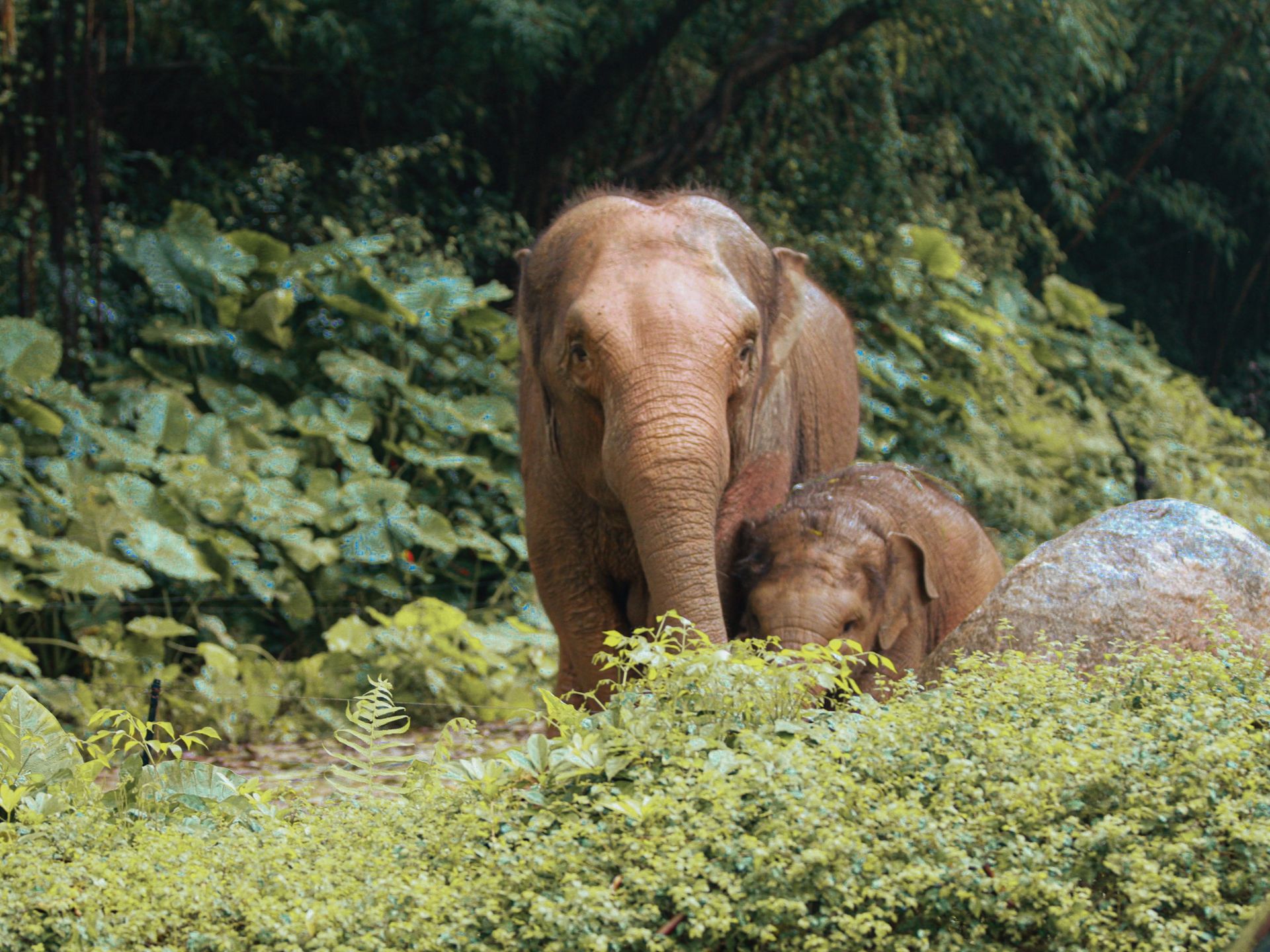
Elephants in captivity face significant health and welfare issues. The cramped living spaces in zoos and circuses can lead to stress and behavioral problems, such as pacing and self-mutilation.
Inadequate social interaction is another major concern. Elephants are highly social animals that live in large matriarchal herds in the wild, but in captivity, they are often kept isolated from each other.
A lack of space to roam and forage can cause a range of health problems, including obesity and joint issues.
Expand your knowledge: Which Country Has Most Elephants in the World
History of Captivity
Tame elephants have been recorded since the Indus Valley civilization around 2,000 BCE.
Elephants have been used as working animals in forestry and as war elephants by commanders such as Hannibal. They've also been used for cultural and ceremonial use, like temple elephants.
The expression "white elephant" originates from the story that the kings of Siam gave white elephants as a gift to courtiers they disliked, in order to ruin the recipient by the great expense incurred in maintaining the animal. This tradition is where the phrase "white elephant" comes from.
Despite the large and growing volume of evidence highlighting the problems associated with keeping elephants in captivity, upwards of 1,000 elephants are housed in zoos around the world.
Explore further: Samoyed Big White Fluffy Dog
Welfare
Elephants in captivity face unique welfare challenges due to their complex social structure and spatial requirements. In the wild, they can walk up to 50 miles a day, but in zoos, the Association of Zoos and Aquariums recommends a minimum of 5400 ft (500 m) of space per elephant.
The AZA also requires zoos to house at least three females, two males, or three mixed-sex individuals to mimic wild herd structure. However, many zoos fail to meet this standard, with one-fifth of elephants living alone or with only one other elephant.
Some zoos have made progress in integrating smaller elephant herds into larger groups, but more work is needed to ensure the welfare of these animals. A study found that the mean number of elephants held in many zoos was only 4.28.
To determine the welfare of an individual elephant, the Department for Environment, Food, and Rural Affairs developed a set of indicators, including:
- Stereotypies: including head bobbing, swaying, and pacing (as a negative indicator of welfare)
- Comfort behavior: including wallowing, swimming, and dust bathing (as a positive indicator of welfare)
- Feeding (as a positive indicator)
- Interacting with the environment (as a positive indicator)
- Interacting with other elephants (as a positive indicator, except for excessive aggression, which is a negative indicator)
These indicators can help zoos and animal welfare organizations identify areas where they can improve the lives of elephants in captivity.
Training and Behaviour
Elephants in captivity require a unique approach to training and behavior due to their complex social structure and large brains.
Elephants have been renowned for their cognitive skills since the time of Ancient Greek philosopher Aristotle, and in the wild, they exhibit a wide variety of behaviors, including those associated with grief, learning, and compassion.
In the wild, elephant herds are typically led by a matriarch who guides a stable group of related adult females and their young offspring.
Elephants in captivity face challenges in recreating their natural social structure, particularly when it comes to male elephants, who disperse from herds at around 12 years old and can be extremely aggressive during musth.
Providing a social structure that resembles their natural lifestyle is difficult in captivity, partly due to the logistical challenges of moving elephants between facilities to mimic male dispersal or facilitate breeding.
Male elephants in musth pose a significant health and safety threat to keepers and other animals, making it a pressing concern for elephant caretakers.
A different take: Killer Whales in Captivity vs Wild
Health Issues
Elephants in captivity face a range of health issues that can be linked to their living conditions. One of the most common problems is foot and musculoskeletal diseases, which can be caused by factors such as older age, more time spent on hard floors, and less space in nighttime enclosures.
Overgrown nails, soles, and cuticles are common foot problems among captive elephants, which can lead to serious, chronic issues. Regular foot care is crucial to prevent these problems, and many facilities train their elephants to accept and assist with routine foot care.
In addition to foot problems, musculoskeletal issues such as degenerative joint disease, osteoarthritis, trauma, and soft tissue strains are also prevalent among captive elephants. These problems can be exacerbated by the sedentary lifestyle of captive elephants compared to their wild counterparts.
Obesity is another significant health issue affecting captive elephants, with 74% of zoo elephants found to be overweight or obese in a 2016 study. This is often linked to factors such as a high diversity of food offered, less exercise, and a regular feeding schedule.
Elephant endotheliotropic herpesvirus (EEHV) is a serious health threat to young Asian elephant calves, with over 100 deaths reported since 1988. This virus can cause widespread hemorrhaging of endothelial tissue and has a high mortality rate, especially in untreated cases.
Intriguing read: Essential Foot Care for Horses
Foot and Musculoskeletal Diseases
Elephants in captivity are prone to foot problems due to their sedentary lifestyle. Overgrown nails, soles, and cuticles are common issues, as well as necrotic pododermatitis, abscesses, and split nails and soles.
These conditions can be prevented with regular foot care, which includes nail filing and trimming of the foot pad. In free contact or protected contact facilities, elephants can be trained to accept and assist with routine foot care.
Elephants in the wild wear down their feet as they walk, and the goal of captive foot care is to simulate this effect. Anesthetizing elephants for foot care can be risky for both the elephant and the handler.
Degenerative joint disease, osteoarthritis, trauma, and soft tissue strains are common musculoskeletal problems in elephants. These issues are often caused by the elephant's large body mass and long life, as well as their relatively sedentary lifestyle in captivity.
Predictors of poor foot health include older age, more time spent on hard floors, less space in nighttime enclosures, and a high percentage of time spent in exhibits that allow choice between being indoors or outdoors.
Check this out: Problems with Dog Rescue Groups
Here are some factors that can contribute to poor musculoskeletal health in elephants:
- More time spent on hard floors
- Lack of space in daytime exhibits
- Less space in nighttime enclosures
- Higher percentage of time spent in exhibits with indoor/outdoor choice
Using soft sand on floors and providing access to grass, dirt, or sand outside can help improve foot and musculoskeletal health in elephants. Giving them increased space in their day and night enclosures and avoiding large changes in temperature and humidity between indoor and outdoor spaces can also be beneficial.
Elephant Endotheliotropic Herpesvirus
Elephant Endotheliotropic Herpesvirus is a serious health issue affecting Asian elephants. It's a family of herpesviruses that has caused the death of over 100 young Asian elephant calves since 1988.
The virus is particularly deadly, with a high mortality rate. In North America, it's responsible for 58% of the deaths of Asian elephants in captivity between the ages of 4 months and 15 years.
EEHV is carried in latency in most Asian and African elephant adults. These adults tend to become infectious when they experience stress or excitement, including after the birth of a calf.
Intriguing read: Nepal Elephants
The virus is extremely contagious and can cause widespread hemorrhaging of endothelial tissue. This can lead to symptoms such as lethargy, unwillingness to eat, lameness, colic, and diarrhea.
There's no cure for EEHV, but zoos have developed some treatments that can help suppress the virus. These treatments include fluid therapy, fresh plasma from adult elephants with antibodies against the virus, and antiviral drugs like famciclovir or ganciclovir.
Even with treatment, the survival rate is relatively low. Of elephants treated for severe EEHV, there's an approximate 40% survival rate.
The virus acts quickly, usually causing death within one hour to seven days after the onset of symptoms. This is why prompt treatment is crucial in preventing fatalities.
You might like: People for the Ethical Treatment of Animals
Reproduction and Life
Many elephant populations in captivity are struggling to survive due to low birth rates.
Female elephants in captivity often suffer from infertility, and the causes are not yet fully understood.
Moving elephants from one facility to another for breeding purposes can be extremely stressful for both the moved and resident elephants.
Young males, on the other hand, would naturally disperse from their herds in the wild, making relocation a more feasible option.
Artificial insemination is being explored as a solution to increase birth rates and genetic diversity in captive populations.
Semen can be collected from males in other collections or from wild males to further improve the genetic diversity of captive populations.
Intriguing read: Australian Wild Dog Crossword Clue
Captive Life
Elephants in captivity face a life of isolation, living within substandard facilities that breed boredom, neglect, and even abuse.
Unfortunately, it's a reality that's deeply connected to human greed and a lack of understanding about these incredible animals.
Elephants are designed to migrate up to 30 miles a day, their family structures are complex, and their society is profound.
In the wild, elephants can live to be 60-70 years old, but in captivity, their average life span is cut in half.
The primary cause of their early demise is foot disease, infections in the bones of their feet that become systemic and joint disease.
Some zoos are trying to make a difference by expanding enclosures and providing a more natural diet, but the limiting parameters and lack of sizable habitats cannot be disregarded.
Sanctuary life can literally add years to an elephant's projected longevity as fear and psychological burdens melt away.
Explore further: Familial Renal Disease in Animals
Defending Elephants
In Defense of Animals is a powerful force for change in the care and housing of captive elephants in the US.
Around 370 elephants are currently imprisoned in North American zoos, circuses, and private properties, including those kidnapped from the wild or born in captivity.
Many of these elephants are held in solitary confinement, without any other elephants to keep them company, for decades.
In Defense of Animals has a proven commitment to ending elephant captivity and is working to eliminate demand for elephant captivity in zoos.
ASK FOR CARE and join the fight against elephant captivity to make a difference.
Consider reading: Are Zoos Cruel to Animals
Taking Action
Elephants are languishing in zoos, where they're kept in conditions that can't mimic their natural environment.
Captivity destroys all that's special about elephants, including their complex social structures and lifelong devotion to family and social interaction.
It's past time for zoos to follow the Detroit Zoo's lead and close their elephant exhibits to transfer their elephants to sanctuaries.
To confine elephants is to condemn them to a life sentence, as they value family above all else and need vast spaces to thrive.
The drastically reduced lifespans, low breeding rates, and poor mental health of elephants in captivity are testament to this fact.
We have a moral responsibility to ensure no more elephants are subjected to such purgatory – and to find solutions for those who are.
Frequently Asked Questions
How many elephants are left in captivity?
There are approximately 15,000-20,000 elephants in captivity worldwide, often in poor living conditions.
Are captive elephants aggressive?
Yes, captive elephants can display aggressive behavior, often due to trauma, frustration, or boredom in their environment. This highlights the importance of providing suitable living conditions for these animals.
Featured Images: pexels.com