Killer whales in captivity have been a topic of debate for decades.
The first successful breeding program for killer whales in captivity was established at SeaWorld in 1985, with the birth of a male calf named Kalia.
This program was a significant milestone, but it also raised concerns about the welfare of the animals in captivity.
Many experts argue that killer whales are highly intelligent and social creatures that thrive in their natural habitat, not in artificial tanks.
In captivity, killer whales are often subjected to stressful and unnatural environments that can lead to physical and psychological problems.
Captivity and Breeding
Orcas have been caught for entertainment display since the 1960s, with the most infamous being the mass capture in Penn Cove, Washington in 1970.
The Icelandic coast has also seen its fair share of orca captures, with 48 orcas captured between 1976 and 1988. The capture process was based on luring the orcas with herring leftovers and then capturing them in a purse seine net.
Some notable captives from the Icelandic coast include Keiko, who was caught in 1979 and later became the star of the movie Free Willy. Keiko was airlifted to his new home in 1996 and eventually returned to the wild in 2002.
However, many captive orcas are not wild-caught, but rather born and bred in captivity. The majority of captive orcas today are the product of captive breeding programs, which marine parks actively pursue to increase their supply of entertainers.
Female orcas in captivity have been impregnated at ages as young as 8, whereas in the wild, the average age for reproduction is 15. This premature breeding can lead to health problems and inbreeding among captive orcas.
Some examples of captive orcas include Tilikum, who fathered at least 21 orcas in captivity, and Corky II, the oldest orca ever kept in human care, estimated to be 58 years old.
Here are some key statistics about captive orcas:
- At least 60 orcas are in captivity around the world today.
- Over 3,700 whales and dolphins are held captive globally.
- The majority of captive orcas are the product of captive breeding programs.
- Female orcas in captivity have been impregnated at ages as young as 8.
Locations and Exhibitions
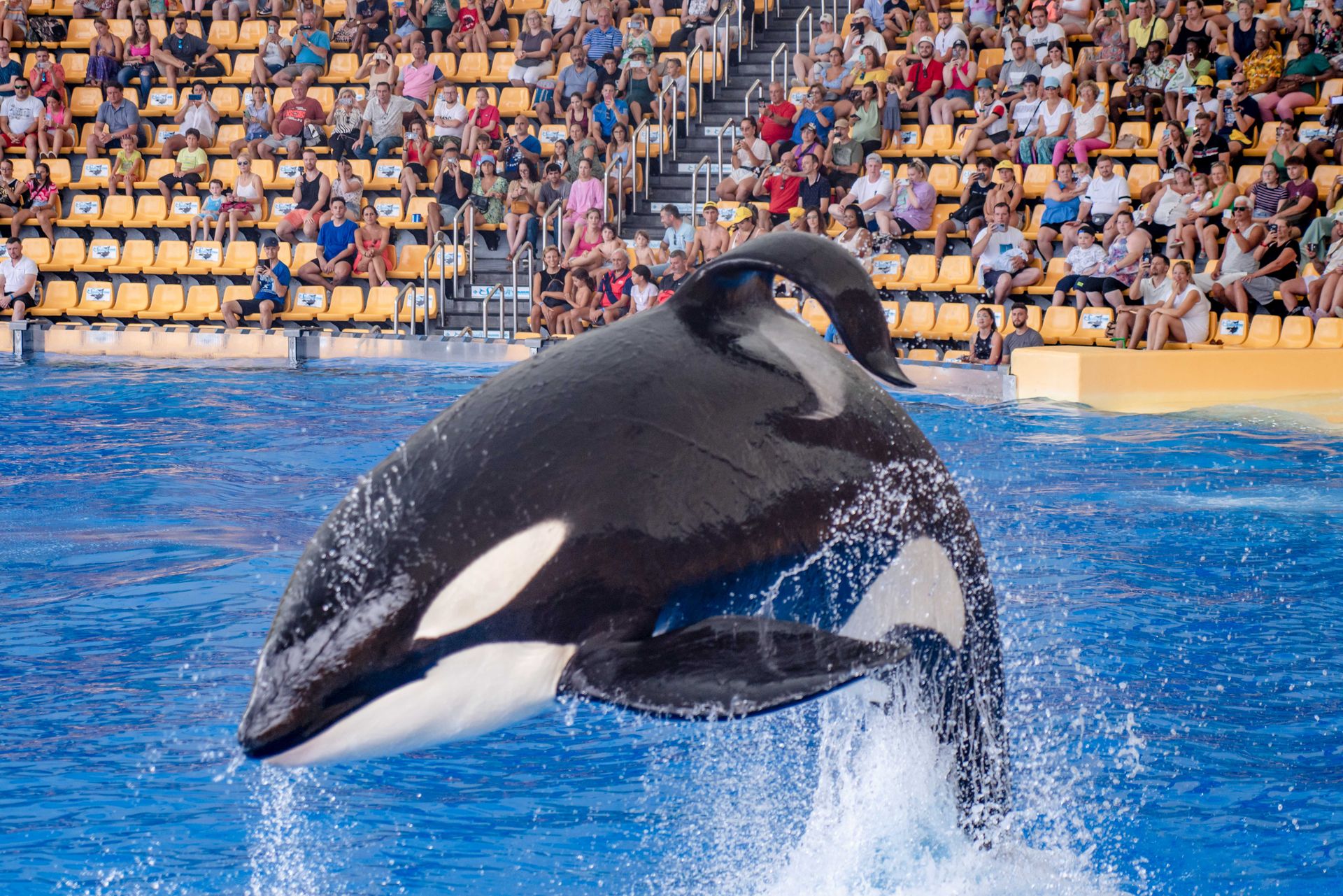
Killer whales can be found in captivity at various theme parks and exhibitions around the world.
As of September 29, 2016, orcas in 13 facilities in North and South America, Europe and Asia provide entertainment for theme park visitors. These facilities have invested heavily in building the physical infrastructure of the parks.
Some notable marine exhibitions include Moskvarium in Moscow, Russia, which is home to Naja/Naya, and Shanghai Haichang Ocean Park in Shanghai, China, which is home to Pànghǔ, Shawn II/Sean, Dora, Cookie, Cody/Fat Beans, and Dora's calf born in December 2023.
Here's a list of some of the notable marine exhibitions:
- Moskvarium, Moscow, Russia; home of Naja/Naya
- Shanghai Haichang Ocean Park, Shanghai, China; home of Pànghǔ, Shawn II/Sean, Dora, Cookie, Cody/Fat Beans and Dora's calf who was born in December 2023
- SunAsia Beluga Whale World, China; home of females "Samara" and "Kyra" (real names unknown)
- Wuxi Changqiao Killer Whale Ocean World Resort, Jiangsu, China; home of two unnamed males
- Kobe Suma Sea World, Kobe, Japan; new home of Stella and Ran
- It is unknown where TIN-OO-C1306 and Malvina currently reside; they may be at a park previously listed
Marineland Canada
Marineland Canada was the last facility in Canada to hold a captive orca.
The last orca held there was Kiska, who died of a bacterial infection on March 9, 2023, ending orca captivity in Canada.
Marineland is a privately held themed amusement and animal exhibition park in the city of Niagara Falls, Ontario, and one of the main tourist destinations in town.
It's located in a popular tourist area, making it a well-known destination for visitors.
Broaden your view: Animal Welfare and Rights in Canada
Kamogawa Sea World
Kamogawa Sea World is an aquarium located in Kamogawa, Chiba Prefecture, Japan.
It first started breeding orcas in Japan in 1970.
Stella succeeded in giving birth and received a breeding award from JAZA in 1998.
Maggie gave birth to the aquarium's first calves, but unfortunately, none survived.
Currently, Lovey, Lara, Ran II, and Luna are housed at the facility.
Check this out: Animal Welfare and Rights in Japan
Loro Parque
Loro Parque is a zoo located on the outskirts of Puerto de la Cruz on Tenerife, Spain.
The park has the world's largest indoor penguin exhibition and the longest shark tunnel in Europe.
One of the park's main attractions is its Orca Ocean facility, where you can see orcas up close. However, be aware that trainers no longer enter the water with the orcas during live shows, following a tragic incident in 2009.
Loro Parque has a long history of collaborating with SeaWorld, with eight trainers from the park being sent to SeaWorld parks in Texas and Florida for training in 2004 and 2005.
Other Marine Exhibitions
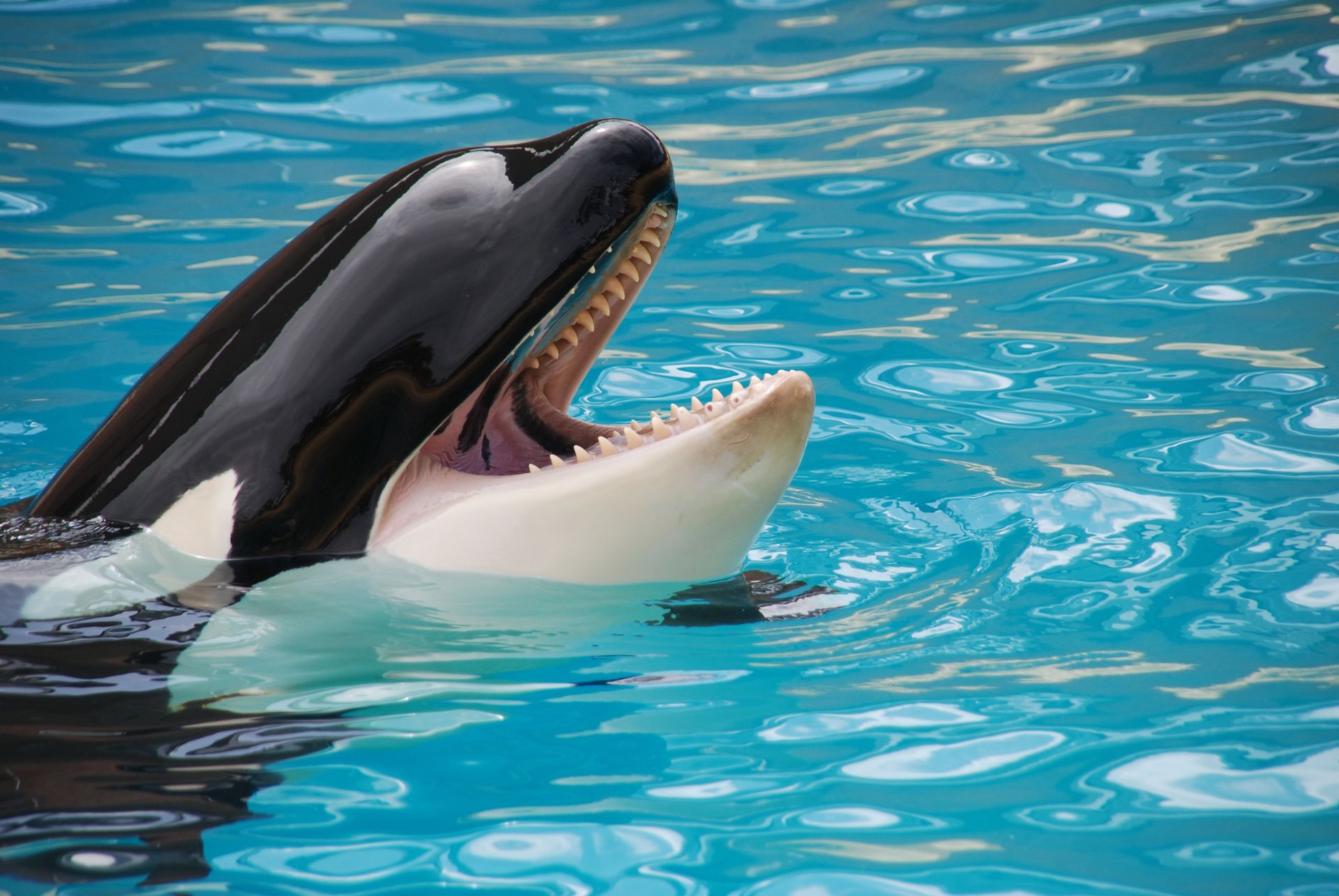
If you're interested in visiting marine exhibitions beyond the ones mentioned earlier, there are several options to consider. Moskvarium in Moscow, Russia is home to Naja/Naya.
Shanghai Haichang Ocean Park in Shanghai, China has a diverse collection of marine animals, including Pànghǔ, Shawn II/Sean, Dora, Cookie, Cody/Fat Beans, and Dora's calf born in December 2023.
SunAsia Beluga Whale World in China is home to two females named Samara and Kyra.
Wuxi Changqiao Killer Whale Ocean World Resort in Jiangsu, China has two unnamed male orcas.
Kobe Suma Sea World in Japan is a new home for Stella and Ran.
Here's a list of some of the marine exhibitions mentioned:
- Moskvarium, Moscow, Russia
- Shanghai Haichang Ocean Park, Shanghai, China
- SunAsia Beluga Whale World, China
- Wuxi Changqiao Killer Whale Ocean World Resort, Jiangsu, China
- Kobe Suma Sea World, Kobe, Japan
Specific Orcas
Some orcas are more suited to captivity than others.
Orcas like Tilikum, who spent 25 years in captivity, are often the ones that make headlines due to their aggressive behavior.
Kasatka, a female orca, was known to be particularly aggressive, causing injuries to trainers and other orcas.
However, orcas like Corky, who has been in captivity for over 40 years, have adapted surprisingly well to life in tanks.
Health and Welfare
Killer whales in captivity face numerous health concerns. At least 160 orcas have died in captivity, and survivors often suffer from dorsal fin collapse and tooth damage.
The dorsal fin collapse in male orcas is thought to be caused by their inability to swim in straight lines and develop musculature common in the open ocean. This can lead to a range of health problems.
Severe dental issues are common in captive orcas, often resulting from chewing on bars or walls out of frustration. Their teeth are drilled and left unfilled to prevent infection, requiring daily flushing and sometimes antibiotic treatment.
Here are some common health issues faced by captive orcas:
Health Concerns
At least 160 orcas have died in captivity, a staggering number that highlights the health concerns associated with keeping these intelligent creatures in tanks.
Male orcas in captivity often develop dorsal fin collapse, a condition thought to be caused by their inability to swim in straight lines and develop the necessary musculature.
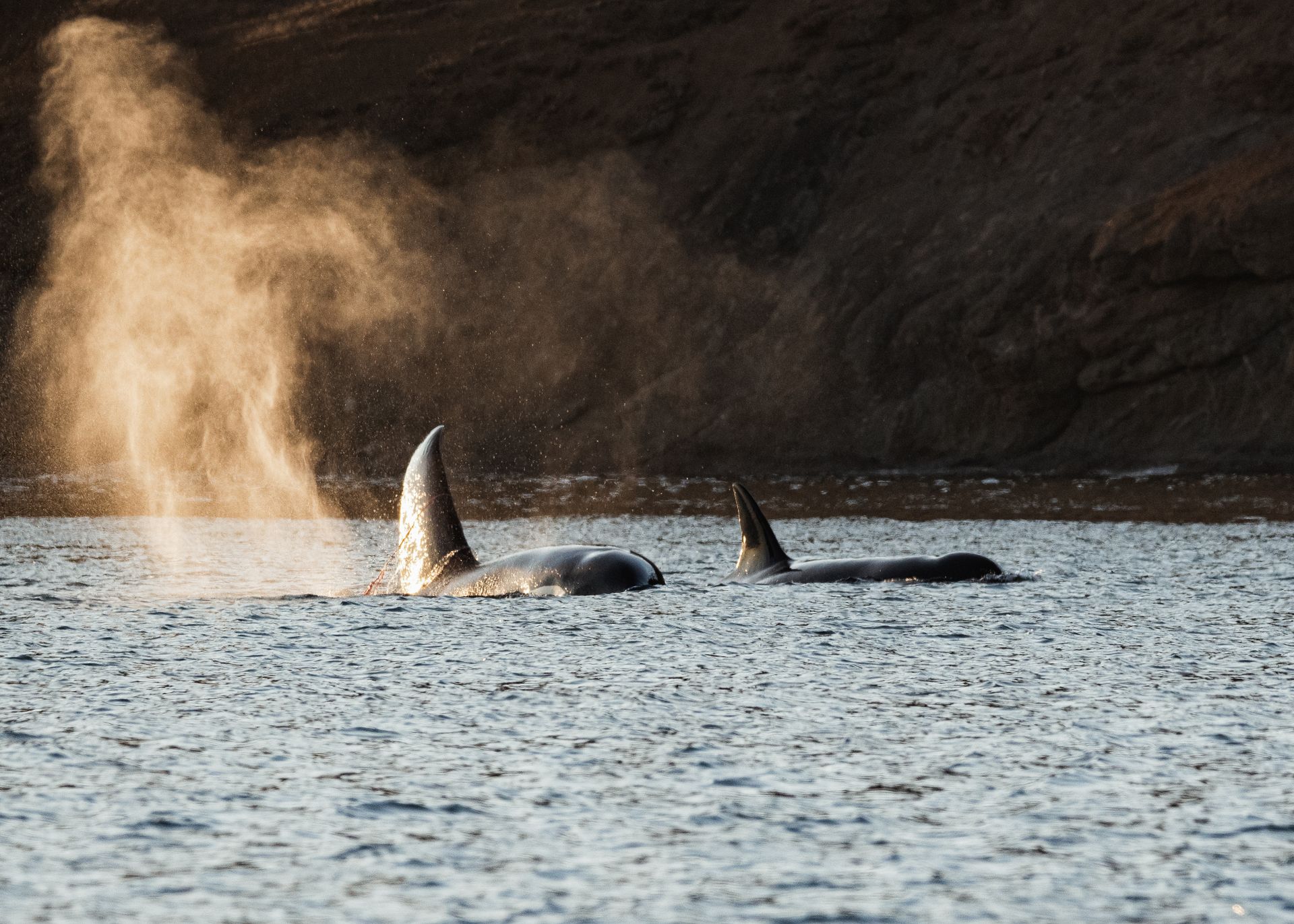
Severe dental issues are common among captive orcas, who often chew on bars or walls out of frustration, leading to tooth damage and the need for daily flushing and sometimes antibiotic treatment.
In fact, the constant drilling of their teeth to prevent infection can even lead to resistant strains of pneumonia and other infections, which have been a cause of death for many captive orcas.
Sunburns and cataracts are also a concern for orcas in captivity, due to their exposure to ultraviolet rays from the surface of the water.
Prolonged exposure to UV rays can have the same negative effects on orcas as it does on humans, including melanoma, or skin cancer.
The shallowness of orca tanks forces orcas to spend a lot of time at the surface, where they are exposed to these harmful rays.
Aggressive Behavior
Aggressive behavior in orcas is a serious concern, especially in captivity. In fact, there have been four human deaths and numerous incidents involving captive orcas. Tilikum, a well-known orca, was responsible for three of those deaths.
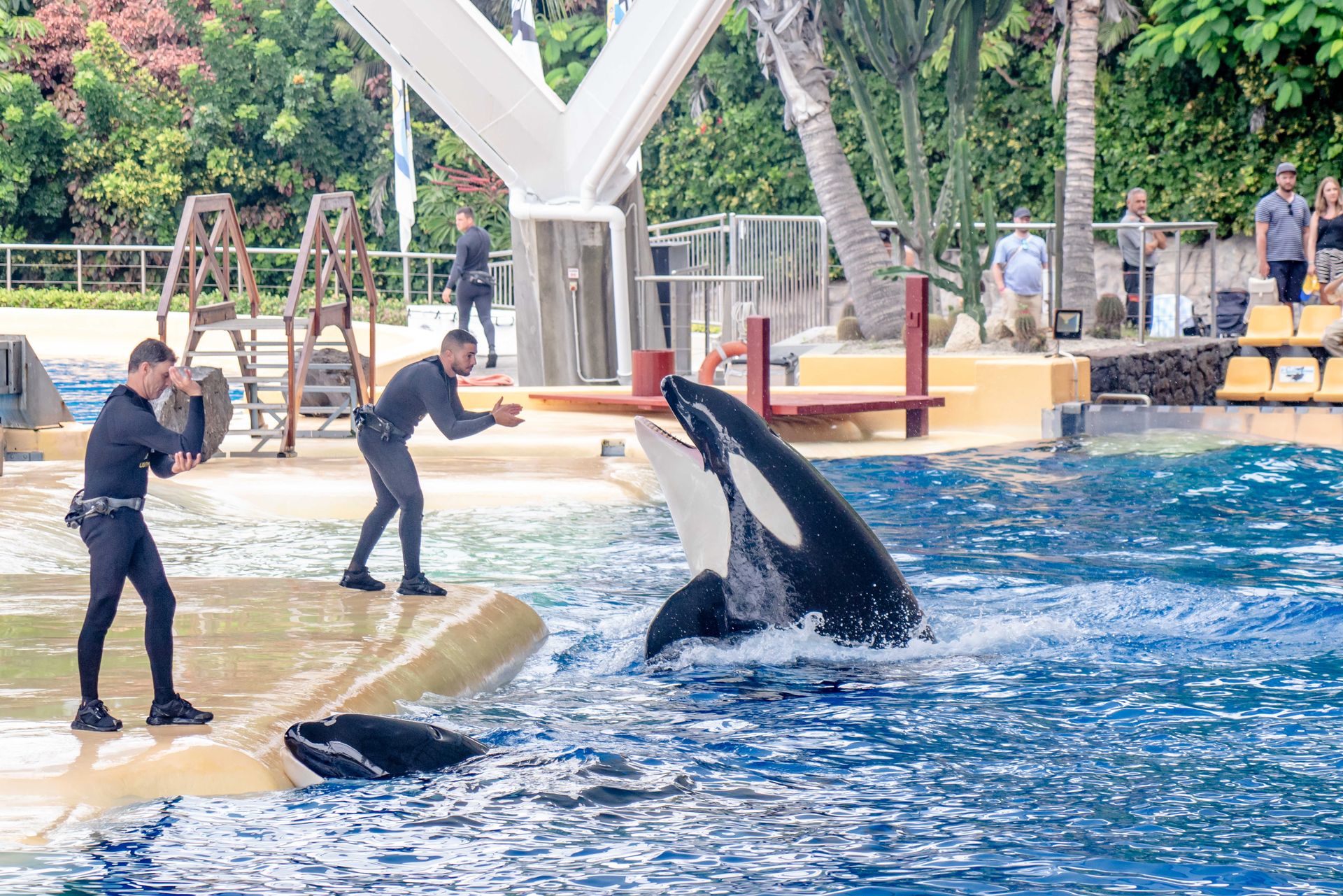
Captive orcas often display aggression towards each other, which can be quite intense. In one notable incident, a dominant female orca named Kandu V attacked a newcomer named Corky at SeaWorld San Diego, causing her to die.
Self-destructive behavior is also common in captive orcas. For example, Kandu V ruptured an artery in her jaw after ramming the wall of her enclosure. This type of behavior is often a result of the stress of captivity.
Captive orcas also engage in harmful stereotypic behaviors, such as gnawing on tank walls or gates. This can be a sign of boredom, stress, or frustration.
Orcas in captivity often lack the social structure and space they need to thrive. This can lead to aggression and other problems. For instance, Kohana, an orca at Loro Parque, has yet to establish a maternal bond with her calf, which is being hand-raised by trainers.
Here are some examples of aggressive behavior in captive orcas:
- Kandu V died after attacking Corky at SeaWorld San Diego.
- Kotar bit a part of Kanduke's genitals, causing an infection.
- Tilikum was responsible for three human deaths in captivity.
Captivity Issues
Orcas in captivity may develop physical pathologies, such as the dorsal fin collapse seen in 80-90% of captive males. This is a result of the unnatural environment they're kept in.
The captive environment bears little resemblance to their wild habitat, and the social groups that the orcas are put into are foreign to those found in the wild. This can lead to stress and aggression.
Captive orcas have been observed acting aggressively toward themselves, other orcas, or humans, which is a result of stress. In fact, there have been four deaths and numerous other "incidents" in captivity.
The lifespan of orcas in captivity versus wild orcas is disputed, but several studies show that the average mortality rate for captive orcas is approximately three times higher than in the wild.
For your interest: Killer Whales Captivity vs Wild
Breeding for Profit
Orcas in captivity are often bred for profit, with marine parks prioritizing the supply of entertainers over their well-being. Female orcas are impregnated at a young age, typically around 8 years old, which is much earlier than their average age of 15 for reproduction in the wild.
The captive breeding program is designed to maximize the number of orcas available for display, but it comes at a great cost to the animals. Female orcas are repeatedly impregnated without allowing for a normal period after giving birth to raise their calf.
In the wild, orca calves often stay with their mothers for life, but in captivity, they are frequently separated and transported to other facilities. This can be traumatic for the calves and can lead to behavioral problems.
As the captive orca population becomes more inbred, the number of stillbirths and miscarriages increases. In one disturbing example, an orca was mated with her own son, a practice that would never occur in the wild.
For another approach, see: Animals in Captivity vs Animals in the Wild
Aggression Between
Aggression between captive orcas is a serious issue, as seen in the case of Kandu V, who died after ramming the wall of her tank at SeaWorld San Diego in 1989.
Captive orcas often fight with each other, as was the case with Kanduke and Kotar, who engaged in increasingly serious aggression, leading to an incident in which Kotar bit a part of Kanduke's genitals.
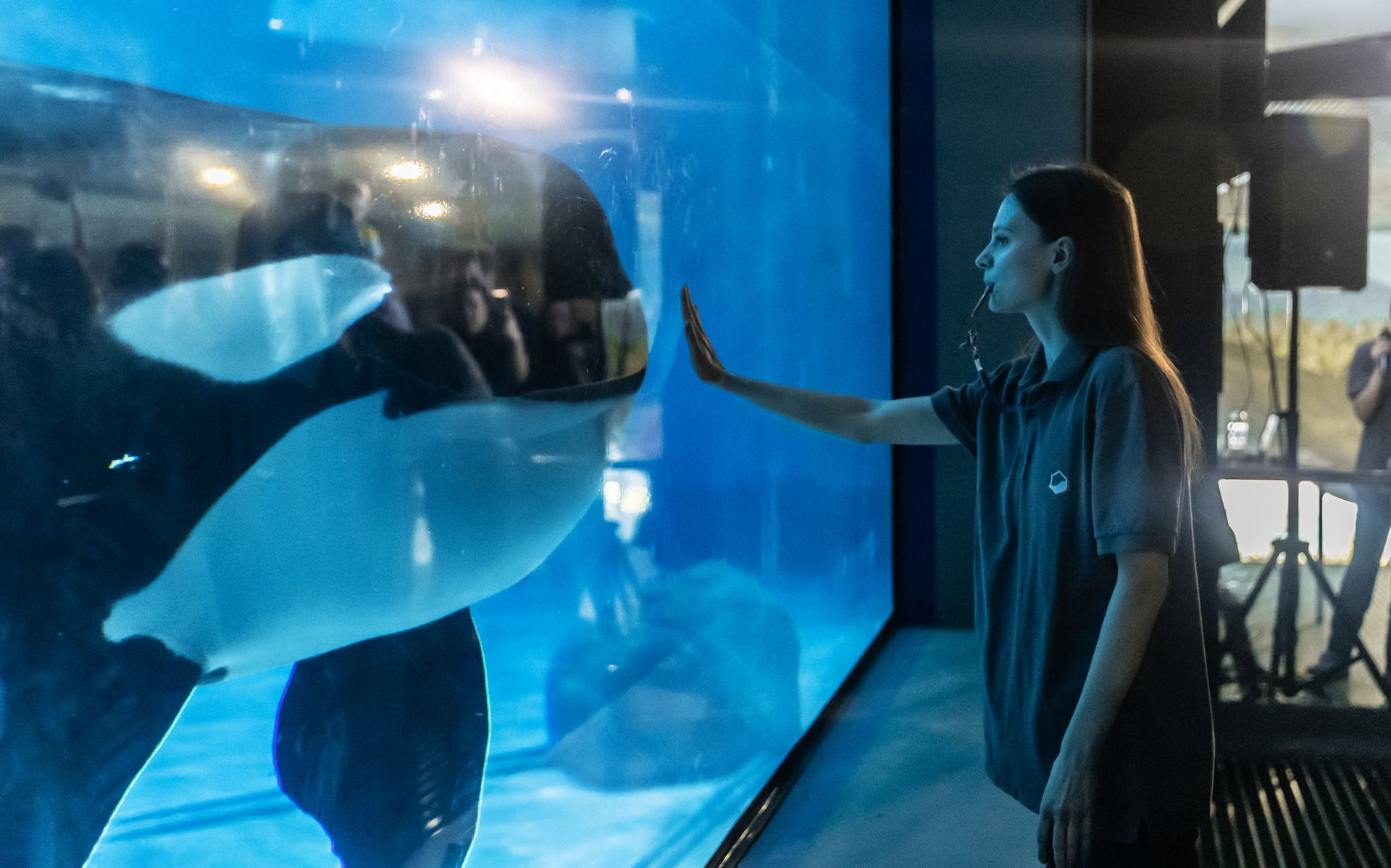
This behavior is not only stressful for the orcas, but also for the trainers and spectators.
The stress of captivity plays a significant role in these aggressive behaviors, which can lead to serious injuries and even death.
The lack of socialization and the unnatural environment of captivity contribute to these problems.
Here are some notable cases of aggression between captive orcas:
- Kandu V died after ramming the wall of her tank at SeaWorld San Diego in 1989.
- Kanduke and Kotar engaged in increasingly serious aggression, leading to an incident in which Kotar bit a part of Kanduke's genitals.
- Kayla rejected her calf, Halyn, and she was moved to a special animal care facility to be hand raised.
- Kohana, an eight-year-old female killer whale, gave birth to a male calf (later called Adán) but has yet to establish a "maternal bond" with her calf.
Release and Transfer
Releasing killer whales into the wild is a complex issue, with experts deeming it "doomed to failure" for animals born and raised in captivity.
The main reason is that they're unable to hunt and feed themselves, and have a strong attachment to human contact, which can be a safety risk.
However, there are instances where reintroduction works, such as with Misha and Tom, two male bottlenose dolphins who were successfully released in 2012 after a thorough rehabilitation program.
Releasing Keiko, a famous orca, back into the wild in 2003 was not a success, as he kept returning to his caretakers for food and company.
A unique perspective: Wild Animals Wales
Springer, a young orphaned orca, was successfully released into the wild with her family group just seven months after being found.
Another option is to transfer the animals to another park, but this is the most controversial choice, as it would continue their captivity and involvement in shows and breeding programs.
The Loro Parque park in Tenerife has been proposed as a destination for the orcas, but it's essential to understand that most of the orcas in aquariums are grandchildren or great-grandchildren of animals captured last century.
Release into the Wild
Releasing cetaceans into the wild can be a complex and challenging process. The success of such releases depends on various factors, including the age and history of the animal.
Some experts argue that releasing animals born and raised in captivity is "doomed to failure" due to their inability to hunt and feed themselves. This is because they have never had the opportunity to learn these essential skills.
However, there are exceptions, such as Misha and Tom, two male bottlenose dolphins who were successfully released back into the wild after a thorough rehabilitation program. They had been living in a chlorinated pool at a tourist center in Turkey, where tourists swam with them.
Keiko, an orca, was also released into the wild, but his experience was different. He was kept in a closed bay in Iceland, where he would interact with boats and people, but eventually became inactive and dependent on his caretakers for food and company.
The success of releases also depends on the age of the animal. Springer, a young orphaned orca, was successfully released into the wild with her family group just seven months after being found.
Sanctuaries can be a complicated option, as cetaceans often have an aversion to change. For example, two belugas at an Icelandic sanctuary spent only 72 days in the sanctuary bay over the course of five years.
Transfer to Another Park
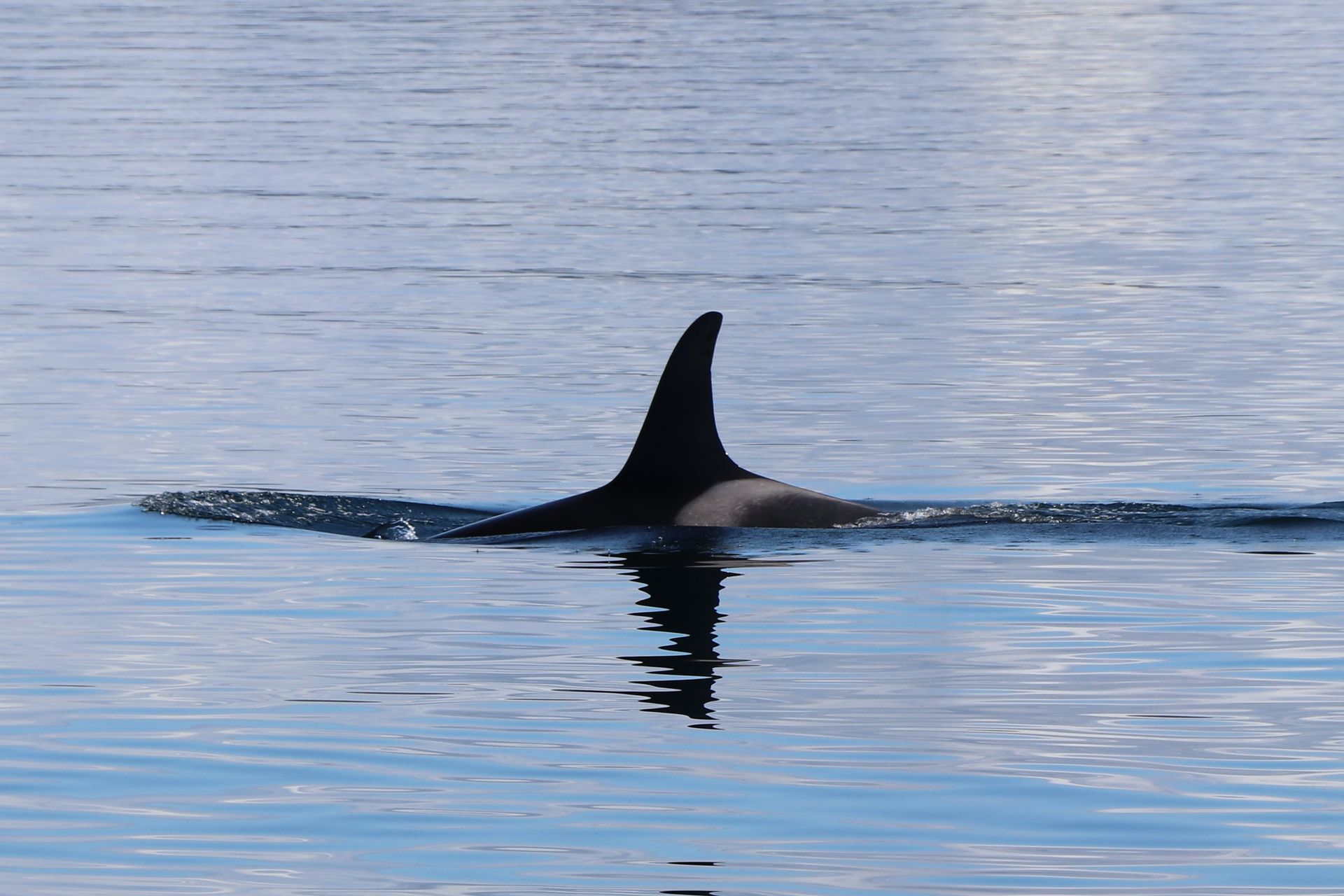
Transferring orcas to another park is a complex issue, with many arguing it would continue captivity and perpetuate involvement in shows and breeding programs.
The Madrid Zoo moved its dolphins to a modern facility in China, but the French government refused to let Marineland's orcas go to the Kobe Suma aquarium in Japan due to quality standards.
Loro Parque in Tenerife is now being considered as a potential new home for Marineland's orcas.
Javier Almunia, Loro Parque's director, notes that most orcas in aquariums today are descendants of those captured last century, so they've never known a life outside captivity.
Loro Parque is home to three orcas, including a deaf female named Morgan, who communicates with trainers through lights.
Three calves have been born at Loro Parque over the past 19 years, but only one has survived.
Individual Orcas
Meet Orky II, one of the largest whales ever held in an aquarium, measuring 22 feet long and weighing 11,000 pounds.
Orky II was captured in 1968 and spent many years in captivity at Marineland of the Pacific. He was later transferred to SeaWorld San Diego, California in 1986.
He was a father figure to Orkid and Kayla, and his enormous size can be seen in his daughter, Orkid, who grew up to be quite a large female.
Orky II was involved in one trainer incident in 1987, where he accidentally breached on a miscue and landed on a trainer while riding Corky II as a stunt.
He mated with two females, Kandu V and Kenau, and Kandu V gave birth to his only living (captive) relative, a female named Orkid, three days before he died.
Orky II's death was brought on by acute pneumonia and chronic wasting, which caused him to lose a lot of weight before he passed away.
Lists and Status
There are currently a number of killer whales in captivity around the world.
You can find a list of living captive orcas in human care as of May 18, 2025, in the table provided.
Some orcas in captivity have uncertain status, which can be concerning for their welfare.
Malvina, a female orca of Russian Transient breed, is one such case. She was captured in 2012 and was last seen in 2015, with a possible escape in 2016.
The table also lists possible locations where Malvina might be, including Dalian Laohutan Ocean Park and Linyi Polar Ocean World.
It's worth noting that the table only includes orcas with uncertain status, and does not provide information on the overall number of orcas in captivity.
Consider reading: Blue Whale Conservation Status
Frequently Asked Questions
What is the longest an orca has lived in captivity?
Corky, a captive orca, holds the record for the longest-lived orca in captivity, having lived for over 50 years
Why is it legal to keep orcas in captivity?
It's not federally illegal to keep orcas in captivity because they are not considered to be suffering in captivity. However, their captivity is being phased out due to various reasons, including politics and welfare concerns.
How long did Keiko live after being released?
Keiko lived for over 5 years after being released into the wild. He spent time in a sea sanctuary, Atlantic waters, and a protected cove in Norway.
Does SeaWorld still have killer whales in captivity?
Yes, SeaWorld still has killer whales in captivity, with 18 orcas held at their three US parks in San Diego, San Antonio, and Orlando. Learn more about the current status of these marine mammals and the efforts to care for them.
Featured Images: pexels.com