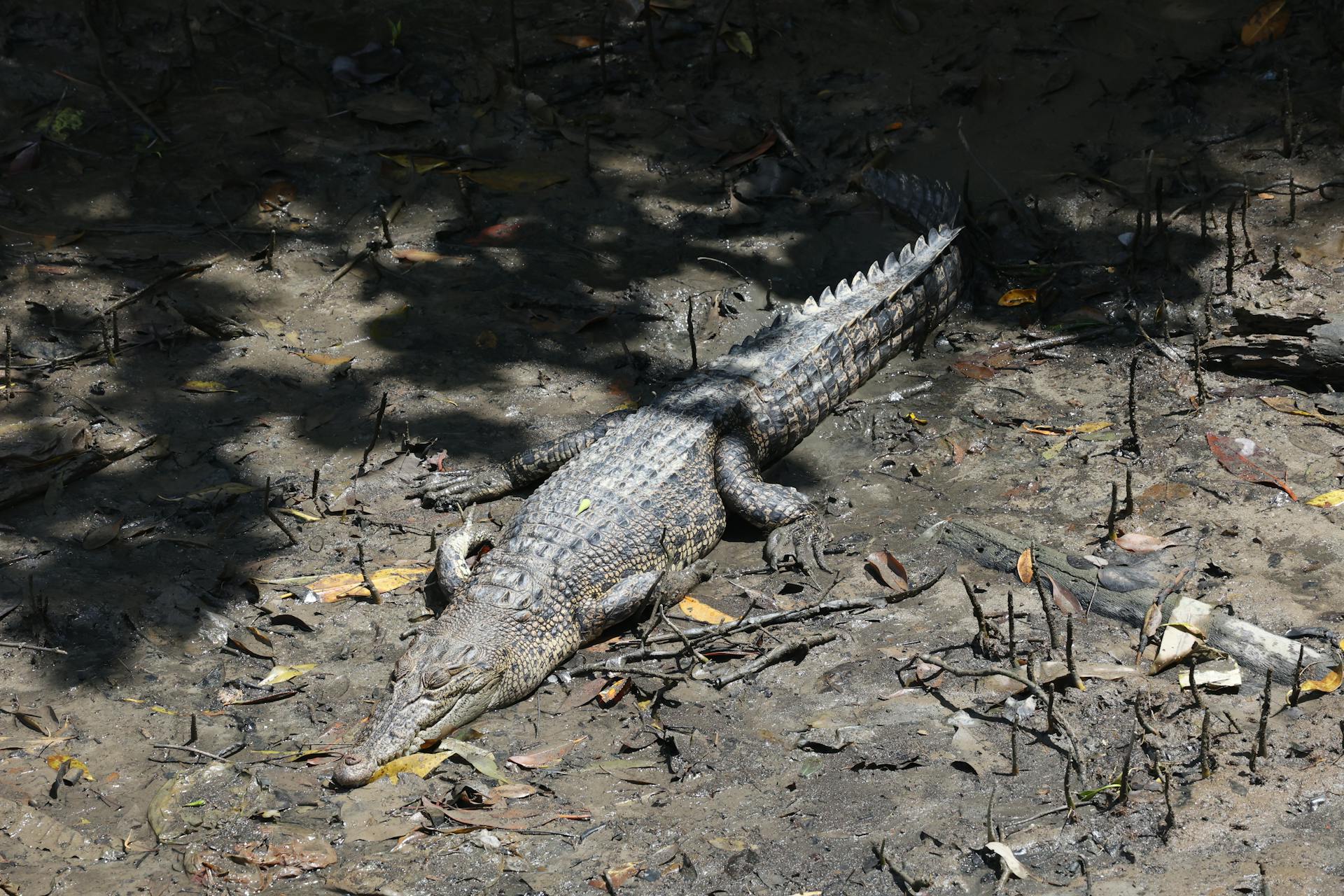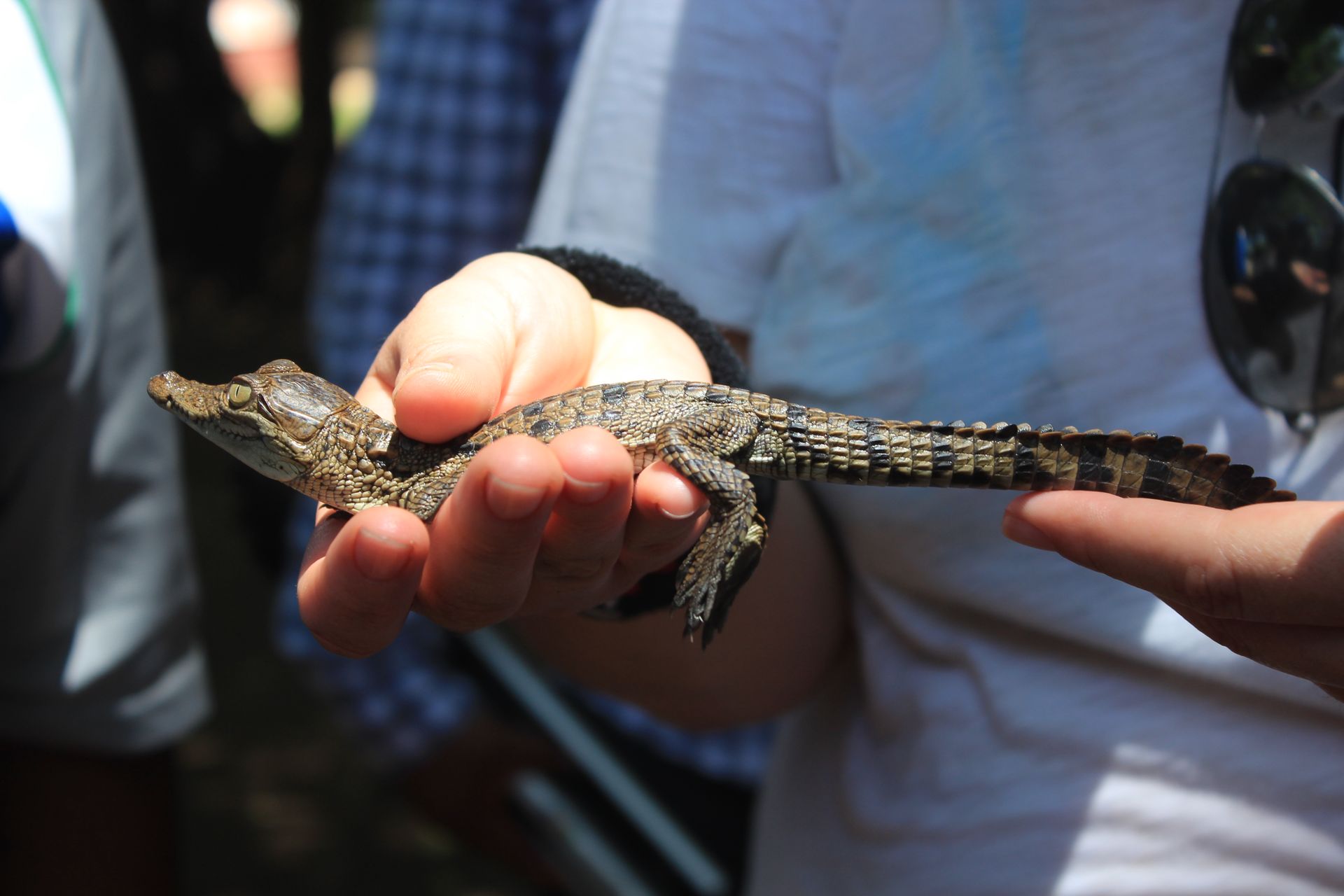
In Papua New Guinea, crocodiles play a vital role in maintaining the balance of their ecosystem. They are apex predators that help regulate the populations of other animals.
Saltwater crocodiles, in particular, are the largest reptiles in Papua New Guinea, with some individuals reaching lengths of up to 23 feet.
These massive creatures are an important part of the coastal ecosystem, helping to control the populations of fish and other marine animals.
Physical Characteristics
The New Guinea crocodile is a fascinating creature, and understanding its physical characteristics is essential to appreciating its unique features.
They come in a range of colors, from brown to gray, with dark brown to black bands on their bodies and tails.
One notable difference between northern and southern populations is the shape of their premaxillary symphysis, a fibrocartilaginous joint.
New Guinea crocodiles can grow up to 3.5m (11ft) in length for males and 2.7m (8.9ft) for females, although most specimens are smaller.
See what others are reading: Himalayan Brown Bear
Their snout is relatively narrow and pointed, especially in juveniles, but becomes wider as they mature.
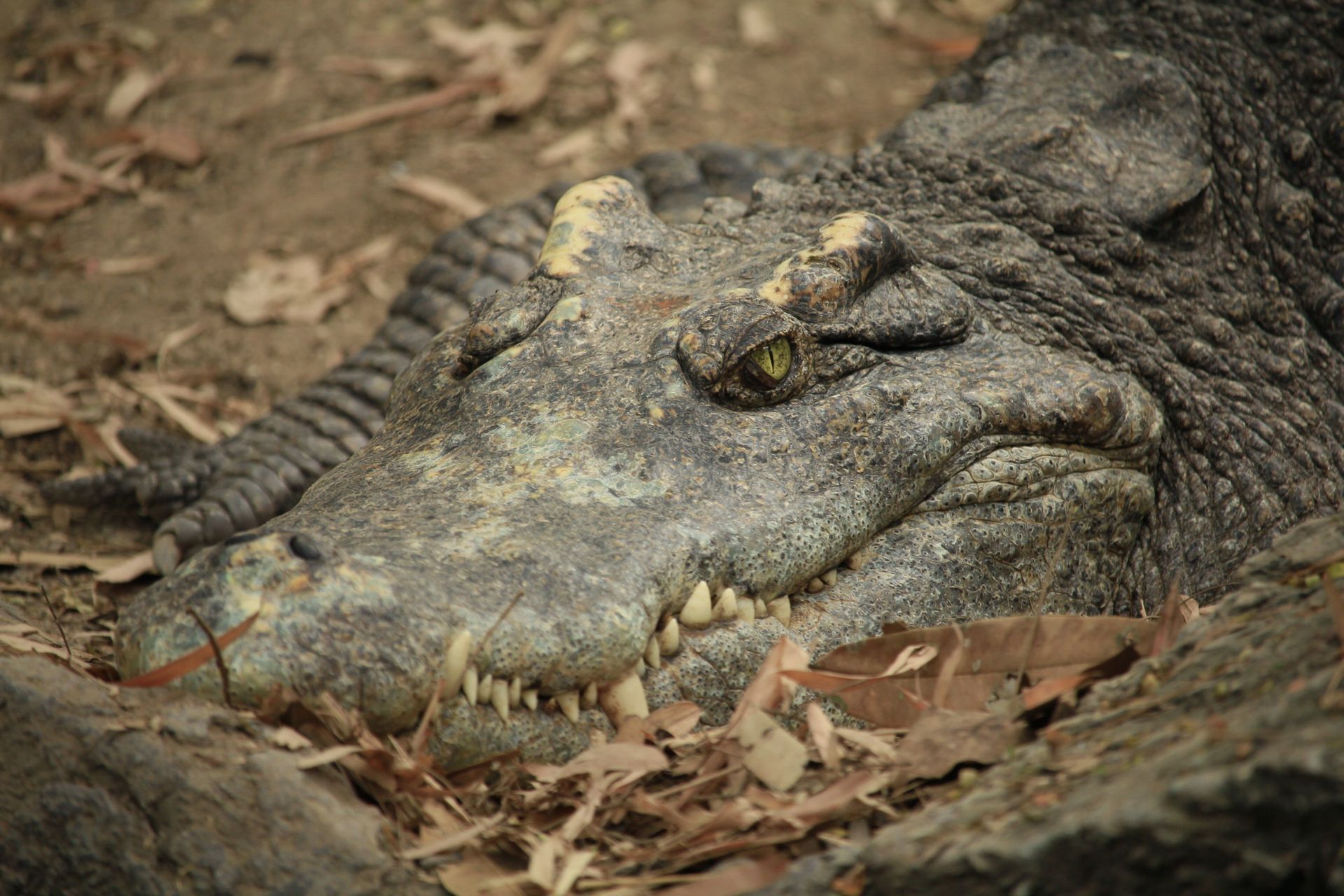
They have a distinctive body shape, with longitudinal ridges in front of their eyes and granular scales on the back of their neck between four large scales.
Here are some key physical features of the New Guinea crocodile:
- ectothermic (meaning they regulate their body temperature using external sources)
- bilateral symmetry (meaning their body is roughly the same on both sides of a central axis)
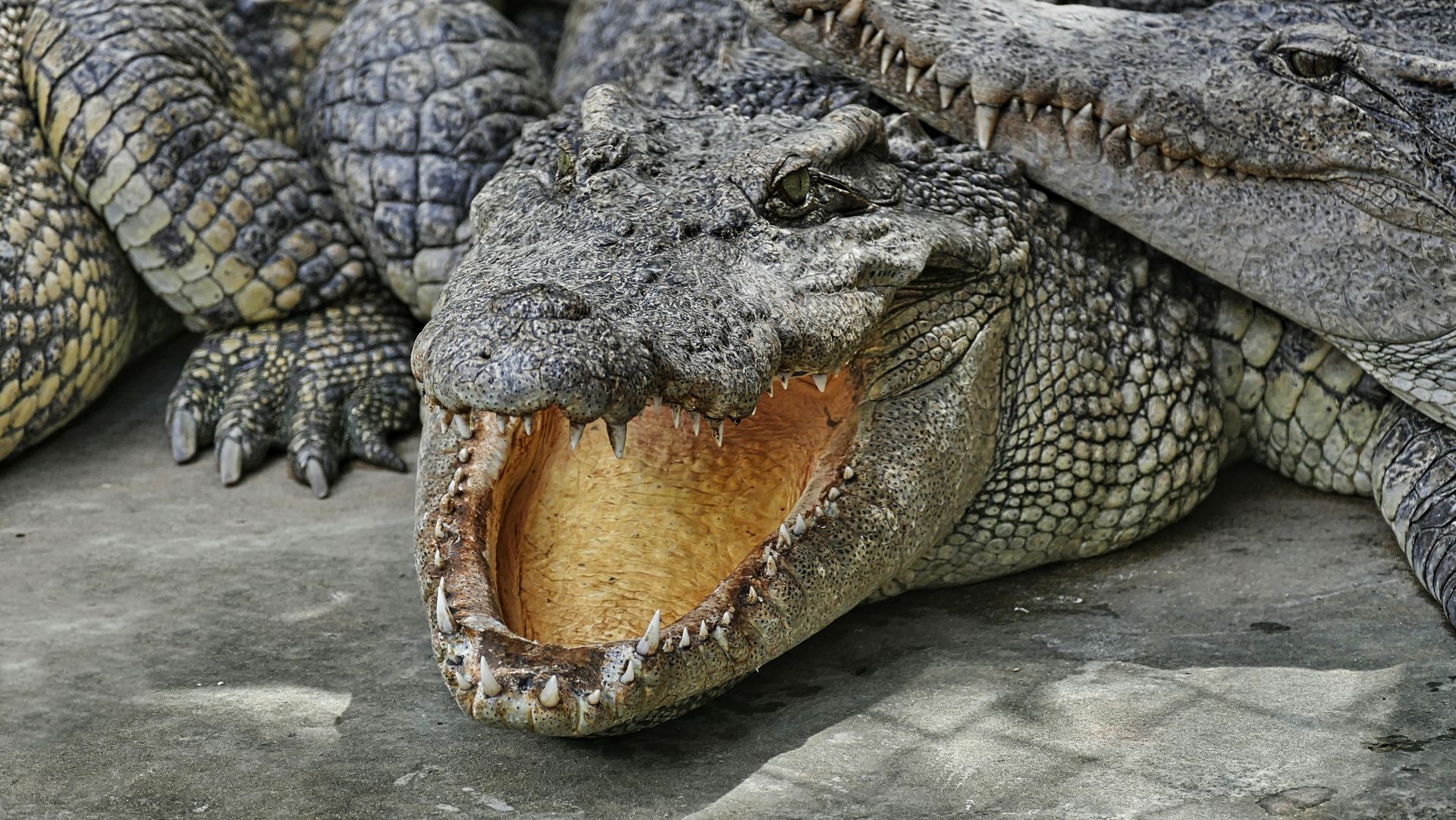
Their jaws are equipped with 66-68 teeth, which are arranged in a specific pattern to help them catch and eat their prey.
The New Guinea crocodile's physical characteristics are distinct from those of the saltwater crocodile, with differences in belly scales and nape of the neck scales.
Habitat and Distribution: Papua New Guinea
New Guinea crocodiles inhabit freshwater lakes, swamps, and marshes, with larger individuals occupying main river channels and juveniles inhabiting nearby grassy wetlands. The population density and distribution are significantly affected by seasonal changes in water levels.
The habitat of New Guinea crocodiles includes terrestrial, freshwater, and aquatic biomes, specifically lakes and ponds, rivers and streams, and wetlands such as marshes and swamps. They can be found in a range of elevations from 0 to 600 meters.
Suggestion: Are Crocodiles Freshwater or Saltwater
New Guinea crocodiles are found in the freshwater environments of New Guinea, particularly in the interior part of the island, where they thrive in swamps, rivers, and lakes. They can tolerate saltwater but tend to avoid brackish coastal regions.
A key factor in their habitat is the tropical climate, with abundant vegetation providing essential cover and hunting grounds. The crocodiles have been known to enter brackish waters during the dry season, but they generally prefer freshwater habitats.
Here's a breakdown of the habitat regions and biomes where New Guinea crocodiles can be found:
- Habitat Regions: terrestrial, freshwater
- Aquatic Biomes: lakes and ponds, rivers and streams
- Wetlands: marsh, swamp
The range of New Guinea crocodiles extends from 0 to 600 meters in elevation and 3.0 to 3.5 meters in length.
Behavior and Diet
The New Guinea Crocodile is a nocturnal hunter, doing most of its hunting at night with remarkable stealth and efficiency.
Their diet primarily consists of fish, amphibians, and small mammals, making them skilled predators in their aquatic habitat.
As nocturnal hunters, New Guinea Crocodiles rely on their powerful jaws and swift movements to catch prey in the dark.
Adults feed chiefly on fish, waterbirds, amphibians, and reptiles, while juveniles catch insects and small aquatic invertebrates, showing a clear distinction in their dietary needs.
Their habitat is characterized by tropical climate conditions, with abundant vegetation providing essential cover and hunting grounds for these reptiles.
New Guinea Crocodiles are well-adapted to their surroundings, thriving in freshwater environments such as swamps, rivers, and lakes.
Related reading: Venomous Reptiles
Reproduction and Lifespan
The New Guinea crocodile is a remarkable species, and its reproductive habits are just as fascinating. The female typically attains sexual maturity at a length of 1.6-2 meters (5-6 feet), while males need to reach a size of roughly 2.5 meters (8 feet).
After mating, the female will deposit her eggs in a nest created by her, and she will stay close to her nest during the incubation period. The offspring hatch after roughly 80 days, and both males and females have been reported helping the hatchlings by digging them out of the nest and carrying them to the water.
Check this out: North American Raccoon Male vs Female
In terms of lifespan, there is little information available, but it's known that mortality is greatest during the early life stages. A record of a New Guinea crocodile reaching 24.6 years of age in captivity exists, providing a glimpse into the species' potential longevity.
The lifespan of New Guinea crocodiles in captivity can be broken down as follows:
- Range lifespan: 24.6 years (high)
Reproduction
Reproduction is a crucial aspect of a crocodile's life cycle. Female New Guinea crocodiles typically attain sexual maturity at a length of 1.6-2 meters (5-6 feet).
Males, on the other hand, need to reach a size of roughly 2.5 meters (8 feet) to become sexually mature. The female will deposit her eggs in a nest created by her, around two weeks after mating.
After mating, the female will stay close to her nest during the incubation period but will not necessarily defend it. The offspring hatch after roughly 80 days.
Both males and females have been reported helping the hatchlings by digging them out of the nest and carrying them to the water. Crocodile populations living in the northern part of the species range produce 22-45 eggs per batch.
If this caught your attention, see: Red Breasted Nuthatch Nest
These crocodiles typically use overgrown river tributaries and floating mats of vegetation as breeding habitat. They always lay their eggs during the dry season.
Crocodiles living in the southern part of the range, on the other hand, construct their nests at the start of the wet season and place them on dry land to minimize the risk of them being flooded.
Curious to learn more? Check out: Florida Wild Turkey Season
Lifespan
The lifespan of a New Guinea crocodile is a fascinating topic.
In the wild, mortality is greatest during the early life stages.
This makes sense, as young crocodiles are more vulnerable to predators and other dangers.
Adult New Guinea crocodiles, on the other hand, suffer little mortality outside of predation by humans.
Interestingly, there is a record of a New Guinea crocodile reaching 24.6 years of age in captivity.
This is a remarkable age, and it's a testament to the care and dedication of the people who are working to protect these amazing creatures.
Here's a summary of the lifespan of a New Guinea crocodile in captivity:
- Range lifespan: 24.6 years
Conservation and Threats
The New Guinea Crocodile is listed as Least Concern on the IUCN Red List, thanks to a highly successful management program in Papua New Guinea. This program has led to large and healthy populations of the species.
However, the species still faces natural threats, including habitat loss and climate change. Deforestation and human encroachment on their habitats pose significant challenges, while changing climate patterns can impact their breeding cycles and food availability.
The IUCN listed the New Guinea Crocodile as Vulnerable in 1986, but changed the assessment to Least Concern in 1996, citing a large area of suitable habitat and a plentiful population.
A unique perspective: Large Exotic Cats for Pets
Status and Conservation
The New Guinea crocodile has had a rollercoaster ride when it comes to its conservation status. It was listed as Vulnerable in 1986 and 1988, but was later reassessed and changed to Least Concern in 1996.
The species has a large area of suitable habitat and seems to be plentiful. The IUCN Red List of Threatened Species currently lists it as Least Concern.
In the 1950s and 1960s, the animals in the northern population were heavily hunted, and it's possible they might have become extinct. Around 1970, legislation was put in place to protect them.
The harvest of wild skins was over 20,000 per year from 1977 to 1980, but declined to 12,000 to 20,000 in the 1980s. Since 1995, the demand for the eggs and juveniles of the New Guinea crocodile has dried up, and cropping of wild animals has been controlled in both Indonesia and Papua New Guinea.
In Indonesia, cropping is limited to a belly width of 25 to 51cm (10 to 20in) for wet skins, and in Papua New Guinea, it's limited to salted skins with a belly width of 18 to 51cm (7 to 20in). Some eggs and hatchlings are still removed from the nest and raised in enclosures.
On a similar theme: Snakes Bali Indonesia
Human Conflict: A Growing Concern
Human conflict with crocodiles is a pressing issue, often resulting from habitat loss that forces these animals into human-inhabited areas.
On a similar theme: Human and Wildlife Conflict
Crocodiles are venturing further into human territory, leading to confrontations and putting both humans and crocodiles at risk.
Effective management strategies are needed to mitigate these conflicts and ensure the safety of both humans and crocodiles.
Habitat loss is a significant contributor to human-crocodile conflict, as crocodiles are being pushed out of their natural habitats and into areas where they can come into contact with humans.
Here's an interesting read: Do African Wild Dogs Attack Humans
Classification
Classification is a crucial aspect of understanding the New Guinea crocodile. It's a reptile, to be specific.
The New Guinea crocodile belongs to the kingdom Animalia, which is home to a vast array of animals. Animalia: information (1) provides more details on this kingdom.
Within the kingdom Animalia, the New Guinea crocodile falls under the phylum Chordata, which includes chordates. Chordata: information (1) offers more insights into this phylum.
Chordata is further divided into subphyla, with the New Guinea crocodile belonging to the subphylum Vertebrata. Vertebrata: information (1) provides more information on this subphylum.
Take a look at this: United Kingdom Wildlife
Vertebrata is then classified into classes, with the New Guinea crocodile falling under the class Reptilia. Reptilia: information (1) offers more details on this class.
Reptilia is further divided into orders, with the New Guinea crocodile belonging to the order Crocodylia. Crocodylia: information (1) provides more information on this order.
Crocodylia is then classified into families, with the New Guinea crocodile belonging to the family Crocodylidae. Crocodylidae: pictures (169) and Crocodylidae: specimens (7) showcase examples of this family.
The family Crocodylidae is then divided into genera, with the New Guinea crocodile belonging to the genus Crocodylus. Crocodylus: pictures (68) and Crocodylus: specimens (2) showcase examples of this genus.
Finally, the genus Crocodylus is divided into species, with the New Guinea crocodile being classified as Crocodylus novaeguineae. Crocodylus novaeguineae: information (1) and Crocodylus novaeguineae: pictures (2) provide more information on this species.
Here's a simplified classification table:
Ecosystem and Economic Importance
Papua New Guinea's saltwater crocodiles play a vital role in maintaining the delicate balance of the ecosystem.
Their impressive size, strength, and intelligence make them apex predators, helping to regulate populations of other animals, including fish, waterfowl, and amphibians.
As a keystone species, saltwater crocodiles have a significant impact on their ecosystem, serving as a host to various parasites.
Their role in the ecosystem is crucial, and their loss could have far-reaching consequences for the balance of nature.
Some of the parasites found in saltwater crocodiles include Edwardsiella sp., Sebekia sp., and Gedoelstascaris mawsoni, which can be found in the article section below.
Ecosystem Roles
In Papua New Guinea's ecosystem, saltwater crocodiles play a vital role in maintaining ecological balance. As apex predators, they regulate populations of other animals, including fishes, waterfowls, and amphibians.
Their presence helps keep these populations in check, preventing any one species from dominating the ecosystem. This delicate balance is crucial for the health of the entire ecosystem.
Saltwater crocodiles also serve as hosts to a number of parasites, including bacteria and worms. In captivity, they are particularly susceptible to these infections.
Here are some of the parasites that have been found in saltwater crocodiles:
- Edwardsiella sp.
- Sebekia sp.
- Sebekia novaeguineae
- Gedoelstascaris mawsoni
- Capilluria sp.
- Micropleura sp.
- Deurithitrema sp.
- Cyathocotyle crocodili
These parasites can have significant impacts on the health and well-being of the crocodiles, and can even be transmitted to other animals in the ecosystem.
Economic Benefits to Humans
In Papua New Guinea, a large industry for crocodile skin has been established, providing a significant source of income for small villages through crocodile hunting.
This industry is a vital economic driver, generating revenue for local communities.
Crocodile hunting is a major source of income in small villages, where the valuable material from their body parts is highly sought after.
The positive impacts of this industry are clear, with two notable benefits being:
- Food
- Body parts as a source of valuable material
General Information
The New Guinea crocodile is a fascinating species. It's also known as Puk Puk, Wahne huala, Buaya air tawar, and New Guinea freshwater crocodile.
These crocodiles are generally found in covered areas during the day, making it uncommon to spot them basking in the open.
The New Guinea crocodile is a unique species that was once considered to consist of two subspecies, but it's now recognized as a single species, C. novaeguineae.
The species is divided into two genetically distinct populations in New Guinea, separated by a mountain range. The northern crocodiles have 4 post-occipital scales on the neck, while the southern crocodiles can have anywhere from 4 to 6 scales.
The skin of the New Guinea crocodile is highly valued and can be quite expensive, almost as expensive as the skin of the Saltwater crocodile.
Frequently Asked Questions
Is it safe to swim in Papua New Guinea?
Swimming in Papua New Guinea can be hazardous due to the presence of sharks and crocodiles, so it's essential to exercise caution. Be aware of your surroundings and follow local guidelines to minimize risks.
What is the largest predator in Papua New Guinea?
In Papua New Guinea, the saltwater crocodile is the largest and most powerful predator, found in the tropical waters. This massive reptile reigns supreme in its native habitat.
Featured Images: pexels.com