The Chelydridae family is a group of turtles that have been around for over 80 million years, with fossil records showing they existed during the Cretaceous period.
They are also known as snapping turtles due to their powerful jaws that can snap shut quickly.
These turtles are primarily found in freshwater habitats, such as rivers, lakes, and wetlands, in North America.
One of the distinctive characteristics of Chelydridae is their long neck and legs, which allow them to swim efficiently in the water.
For your interest: Box Turtles of North America
Physical Characteristics
The Chelydridae family of turtles is quite impressive, and their physical characteristics are a big part of what makes them so fascinating.
They're large and strong, with some species growing up to 19.3 inches in length, and weighing up to 33 pounds.
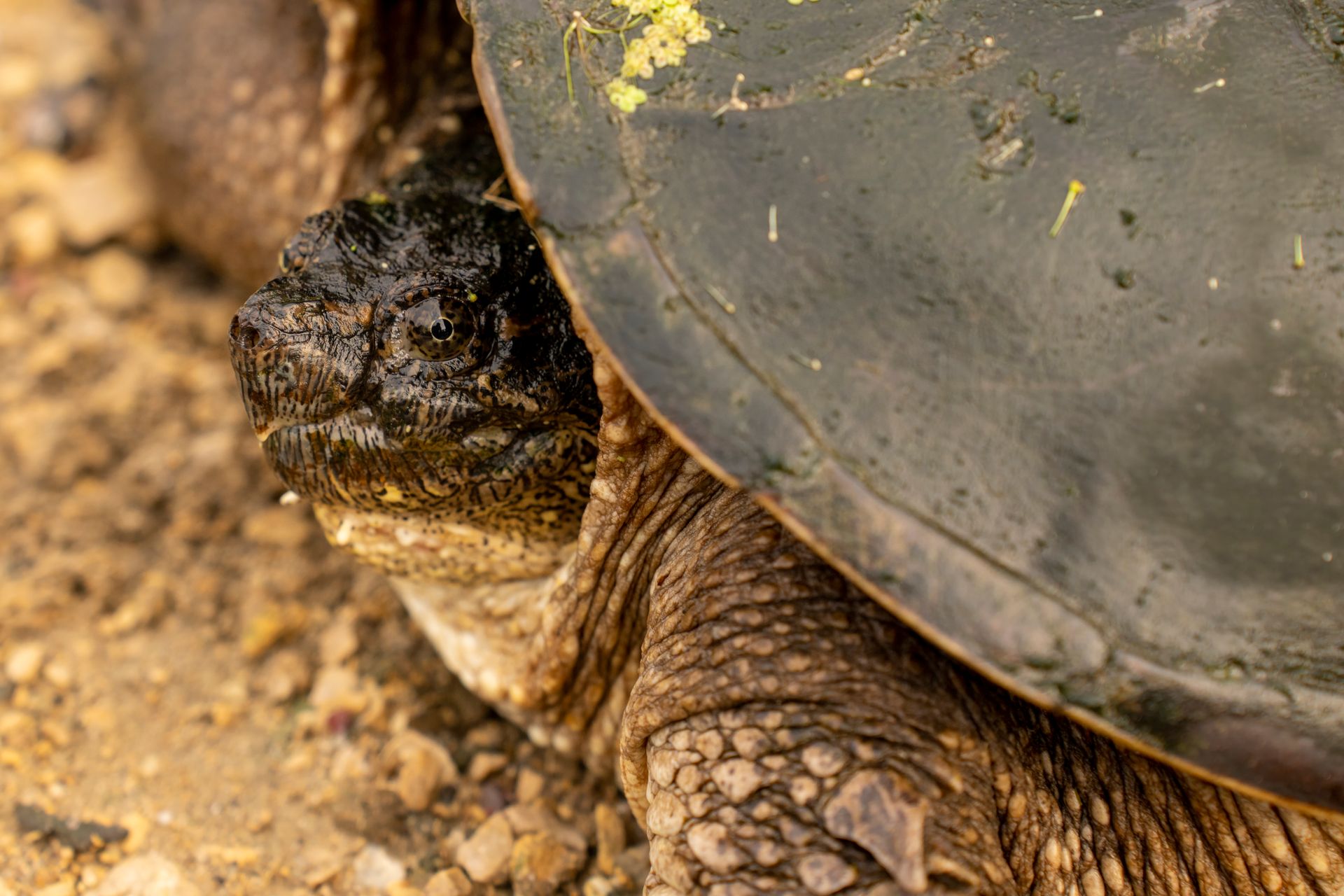
One of the most distinctive features of these turtles is their shell, which bears three low, knobby keels, although the oldest individuals may not have this feature.
Their shell is also quite dark, ranging in color from brown to olive to black, which helps them blend in with their surroundings.
The head of these turtles is large and somewhat hooked, with the upper jaw being particularly noticeable.
Their eyes are also quite interesting, opening dorsolaterally, or towards the top and side of the head.
Here are some key physical characteristics to keep in mind:
Males are larger than females, and the carapace and plastron are connected by a narrow bony bridge.
The plastron is also quite interesting, with reduced, cruciform, hingeless features, and only 11 marginal scutes present on each side of the carapace.
Feeding Ecology and Diet
Snapping turtles are primarily carnivorous, but can also be omnivorous or herbivorous in different populations.
Their diet consists of a wide variety of animal foods, including sponges, flatworms, earthworms, leeches, clams, snails, crustaceans, spiders, insects, amphibians, snakes, other turtles, birds, and small mammals.
They also eat carrion and can survive on a completely carnivorous diet. However, some snapping turtles can subsist on a completely herbivorous diet.
In addition to animal foods, snapping turtles also eat algae, duckweed, and other submergent and emergent aquatic plants, as well as their seeds.
Alligator snapping turtles, in particular, have a unique way of luring prey with a pink, wormlike projection on their tongue that they can wriggle to attract prey.
Species and Classification
The Chelydridae family is composed of three species in monotypic genera: Macrochelys temminckii (alligator snapping turtle), Chelydra serpentina (common snapping turtle), and Platysternon megacephalum (big-headed turtle). These species are distributed throughout North America, northern South America, and southeastern Asia.
The members of this family are united by their distinctive physical characteristics, including very large heads and limbs that cannot be fully retracted within the shell. The jaws are very strong, and the upper jaw is hooked, which is likely an adaptation for their diet.
The big-headed turtle, Platysternon megacephalum, is notable for its long tail, which equals the length of its carapace. This is a unique feature among the Chelydridae family.
Explore further: Japanese Pond Turtle
Fossil History
The fossil history of the Chelydridae family is a long and fascinating one. The earliest described chelydrid is Emarginachelys cretacea, known from well-preserved fossils from the Maastrichtian stage of the Late Cretaceous of Montana.
One of the most interesting things about Emarginachelys cretacea is that it lived during a time when large, turtle-eating crocodilians were present. This is a trait that is also seen in the fossil record of the genus Protochelydra.
Protochelydra zangerli, a well-preserved fossil chelydrid from North Dakota, has a carapace that is higher-domed than that of the recent Chelydra. This suggests that it may have coexisted with large, turtle-eating crocodilians.
The genus Chelydropsis contains several well-known Eurasian chelydrid species that existed from the Oligocene to the Pliocene. Chelydrids in South America, such as C. acutirostris, only occupy the northwestern corner of the continent, reflecting their recent arrival from Central America as part of the Great American Interchange.
Here are some key fossil species mentioned in the article:
Evolution and Systematics
Chelydridae, the family of snapping turtles, has a fascinating evolution and systematics. The family is most closely related to Platysternidae, the family of big-headed turtles. Molecular evidence supports their separate family recognition.
The fossil record dates back to the Paleocene of North America and the Oligocene of Eurasia. This suggests that the family has been around for a long time. Chelydra, the genus of snapping turtles, is known from as far back as the Pliocene in North America.
The genus Macrochelys is known from as early as the Miocene. This means that the family has been evolving and adapting over millions of years. The largest and heaviest freshwater turtles in the world belong to the genus Macrochelys.
Here are some key characteristics of the family Chelydridae:
- Lateral processes of the nuchal bone are extensive.
- The plastron and carapace maintain a ligamentous connection.
- The caudal vertebrae have a specific pattern: a single procoelous vertebra is most anterior, followed by a single amphicoelous vertebra; all remaining vertebrae are opisthocoelous.
These characteristics are unique to the family and help distinguish it from other turtle families. The family is divided into two subfamilies: Chelydrinae and Platysterninae. This reflects the many differences between the New World species (Chelydra and Macrochelys) and the Old World species (Platysternon).
Conservation and Habitat
The alligator snapping turtle, despite its impressive size, is facing some challenges in the wild. It's classified as Vulnerable on the IUCN Red List due to significant declines in its population caused by overharvesting.
Tropical forms of the turtle are not as common and their conservation status is uncertain. However, they're not yet considered endangered.
Snapping turtles can be found in a wide range of freshwater habitats, from shallow still waters to brackish environments. They seem to prefer warm, shallow waters with soft bottoms and abundant aquatic vegetation.
Additional reading: Asiatic Softshell Turtle
Habitat
Snapping turtles can be found in nearly any body of freshwater within their range.
Their habitats often overlap with brackish water environments.
They tend to prefer warm, shallow, still water.
Soft bottoms and abundant aquatic vegetation are common features of their preferred habitats.
Conservation Status
The conservation status of the alligator snapping turtle is a bit of a mixed bag. They're not yet endangered, but their tropical forms are relatively rare and uncertain.
Unfortunately, the alligator snapping turtle has declined significantly due to overharvesting. This has led to a classification of Vulnerable on the IUCN Red List.
Their ability to persist in altered habitats is a testament to their adaptability, but it's also a reminder of the need for conservation efforts.
Frequently Asked Questions
How big is a 100 year old snapping turtle?
A 100-year-old snapping turtle typically weighs 140-180 pounds and measures 38 inches in length.
Featured Images: pexels.com


