The Black Footed Albatross is an incredible bird species, known for its impressive wingspan and distinctive black and white feathers.
They can grow up to 3 feet 11 inches in length.
These birds are expert navigators, able to travel thousands of miles across the ocean.
Their wingspan can reach up to 7 feet 7 inches, making them one of the largest seabirds in the world.
Despite their impressive size, they are incredibly agile and can reach speeds of up to 50 miles per hour.
Black Footed Albatrosses are known to form long-term monogamous relationships, with some pairs staying together for over 20 years.
They are also skilled hunters, feeding on small fish, squid, and crustaceans.
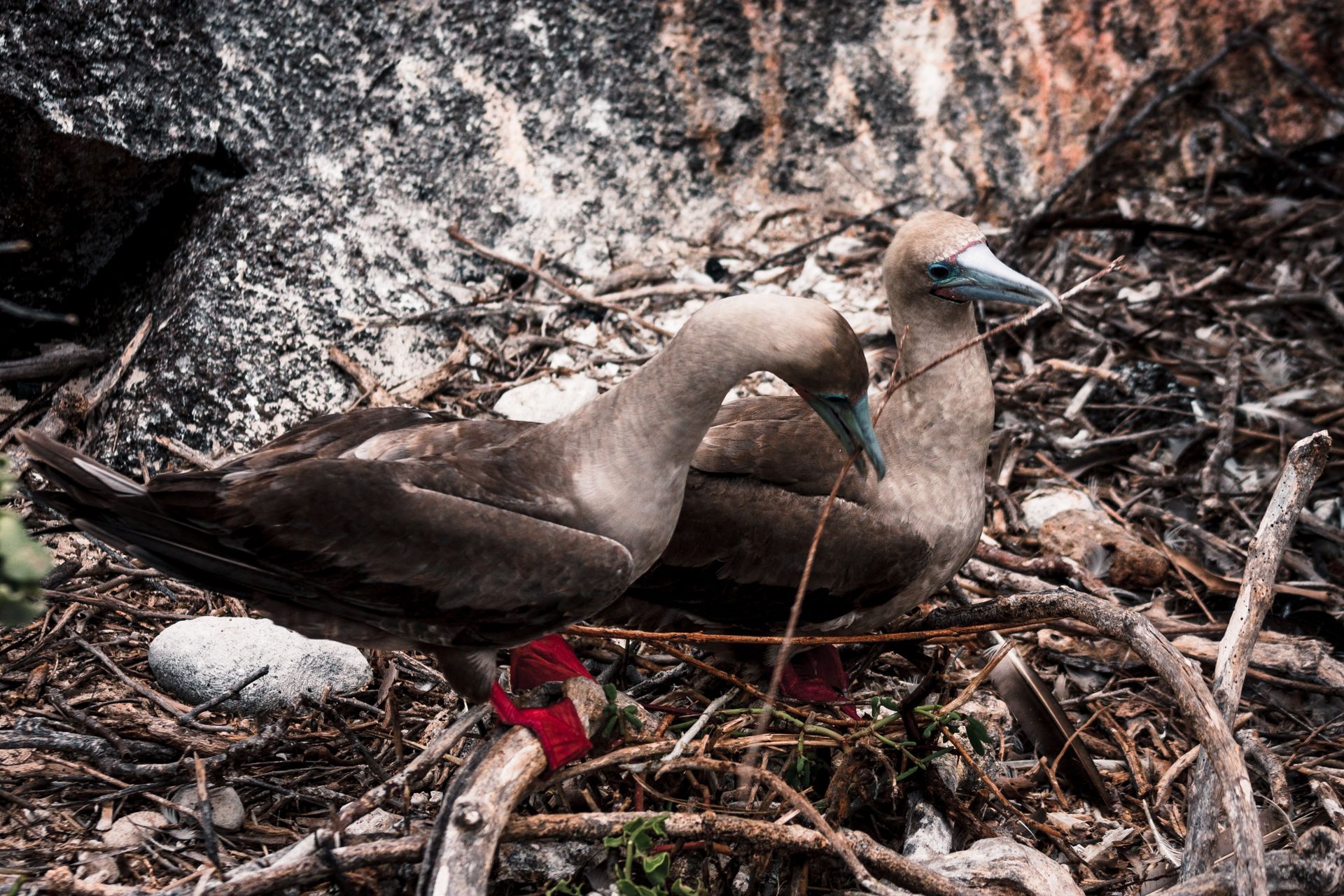
A unique perspective: Blue Footed Boobies Bird
Taxonomy and Species
Black-footed albatrosses are part of the Diomedeidae family, which also includes shearwaters, fulmars, storm petrels, and diving petrels. They share some unique features with these birds.
One of the distinctive features of Procellariiformes, the order that black-footed albatrosses belong to, is that their bills are split into between seven and nine horny plates.
These birds have a special way of dealing with the saltwater they ingest, thanks to a salt gland located above the nasal passage that helps desalinate their bodies.
They also produce a stomach oil made up of wax esters and triglycerides, which is stored in the proventriculus and used as an energy-rich food source for chicks and adults during long flights.
Here's a summary of the taxonomy of the black-footed albatross:
Taxonomy
Taxonomy is a fundamental concept in biology that helps us understand the relationships between different species. It's like a family tree, but for animals.
Black-footed albatrosses, also known as Phoebastria nigripes, belong to the family Diomedeidae, which is a group of seabirds that also includes shearwaters, fulmars, storm petrels, and diving petrels.
These birds have some unique features that distinguish them from other species. They have nasal passages that attach to the upper bill, called naricorns.
The bills of these birds are also special, being split into between seven and nine horny plates. This is a characteristic feature of the order Procellariiformes, to which they belong.
Black-footed albatrosses produce a stomach oil made up of wax esters and triglycerides, which is stored in the proventriculus. This oil is used as a defense mechanism against predators and as a source of energy for chicks and adults during long flights.
The specific epithet "nigripes" is derived from two Latin words, "niger" meaning "black" and "pes" meaning "foot". This refers to the black coloration on their feet.
Here's a list of the taxonomic identifiers for the Black-footed albatross:
Species Information
The black-footed albatross is the smallest of the three northern hemisphere albatross species.
It breeds primarily at islands in the Hawaiian archipelago, with a small portion (5%) breeding on outlying islands of Japan. This species was recently reclassified as Near Threatened by the IUCN Red List.
After breeding, black-footed albatrosses disperse widely over the North Pacific Ocean, often heading towards North America. There are occasional records in the southern hemisphere, including one from New Zealand.
Take a look at this: Are North Carolina Frogs Poisonous to Dogs
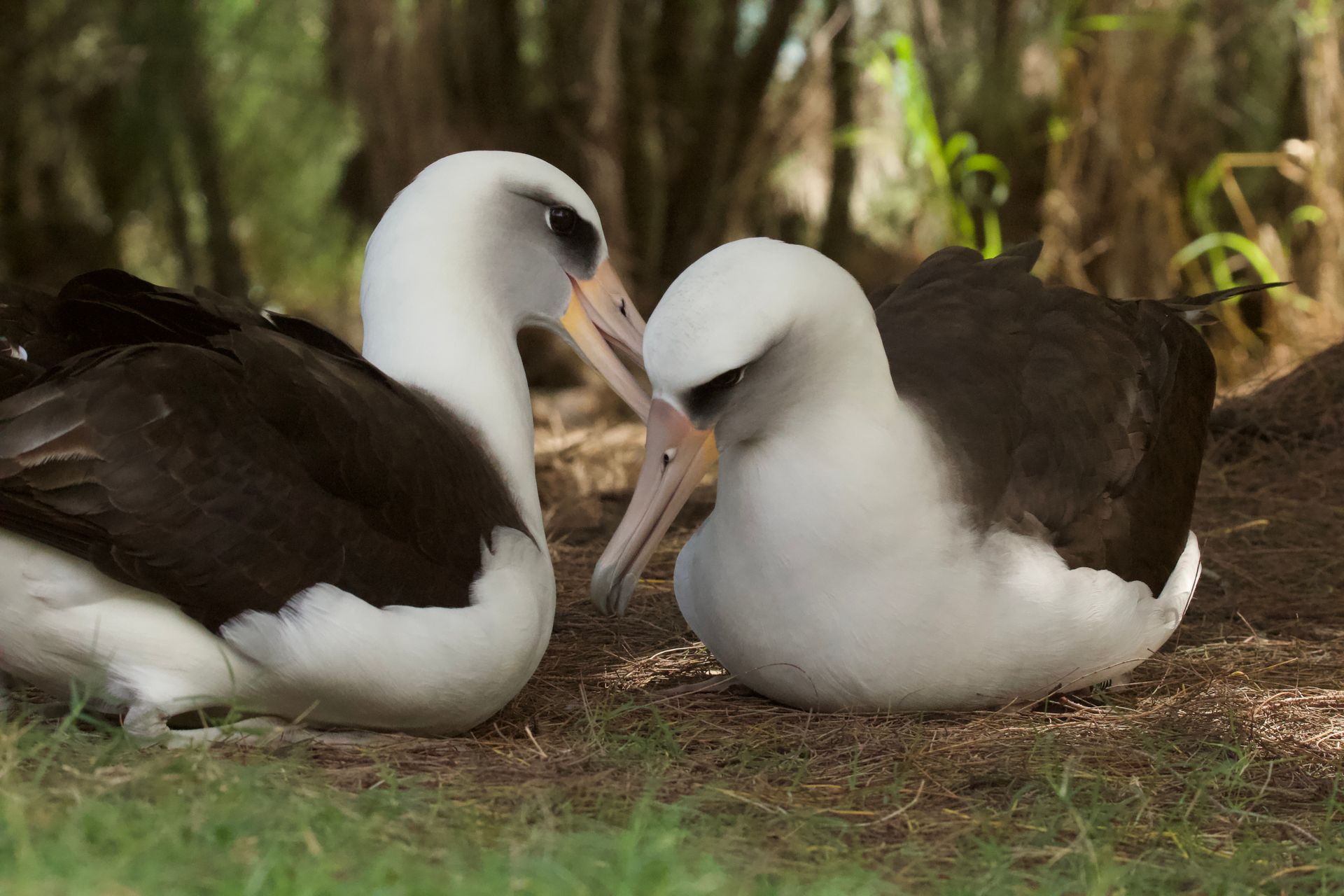
Adult black-footed albatrosses have a distinctive appearance, with a dusky brown color and white patches around the base of the bill, below each eye, across the rump, and under the tail. Their large bill, legs, and feet are black.
Juveniles, on the other hand, are uniformly brown with a pale brownish bill and a dark grey tip that turns black with age.
Additional reading: Brown Black Lab
Physical Characteristics and Behavior
The black-footed albatross is a large seabird with a distinctive appearance. They have a wingspan of up to 6.5 feet (2 meters) and weigh between 6 and 9 pounds (2.7 to 4 kilograms).
Their feathers are a mix of black and white, with a white belly and black back. They also have a black stripe that runs along their head and neck.
In terms of behavior, black-footed albatrosses are known to be excellent flyers, able to stay aloft for long periods of time and cover great distances in search of food.
Description
The black-footed albatross is a relatively small bird, measuring 68 to 74 cm (27–29 in) in length.
Their wingspan is quite impressive, ranging from 190 to 220 cm (6.2–7.2 ft), which allows them to soar through the skies with ease.
Males of the species tend to be slightly larger than females, weighing an average of 3.4 kg (7.5 lb) compared to the females' average weight of 3 kg (6.6 lb).
Their plumage is almost entirely black, with some adults displaying white undertail coverts and white markings around the base of the beak and below the eye.
As the birds age, they acquire more white at the base of the beak, giving them a distinctive appearance.
Their beak and feet are dark in color, matching the rest of their plumage.
A different take: 6 Pack Rings Animals
Behaviour and Ecology
The black-footed albatross is a surface feeder, foraging by surface-seizing, contact dipping, and scavenging.
Its primary prey species include squid, fish, and other invertebrates.
It breeds on coastal beaches on tropical and subtropical islands and atolls with sparse vegetation.
During incubation, adult birds at Tern Island forage in the vicinity of the island.
The foraging range extends during chick rearing to include the distant and more productive Californian Current.
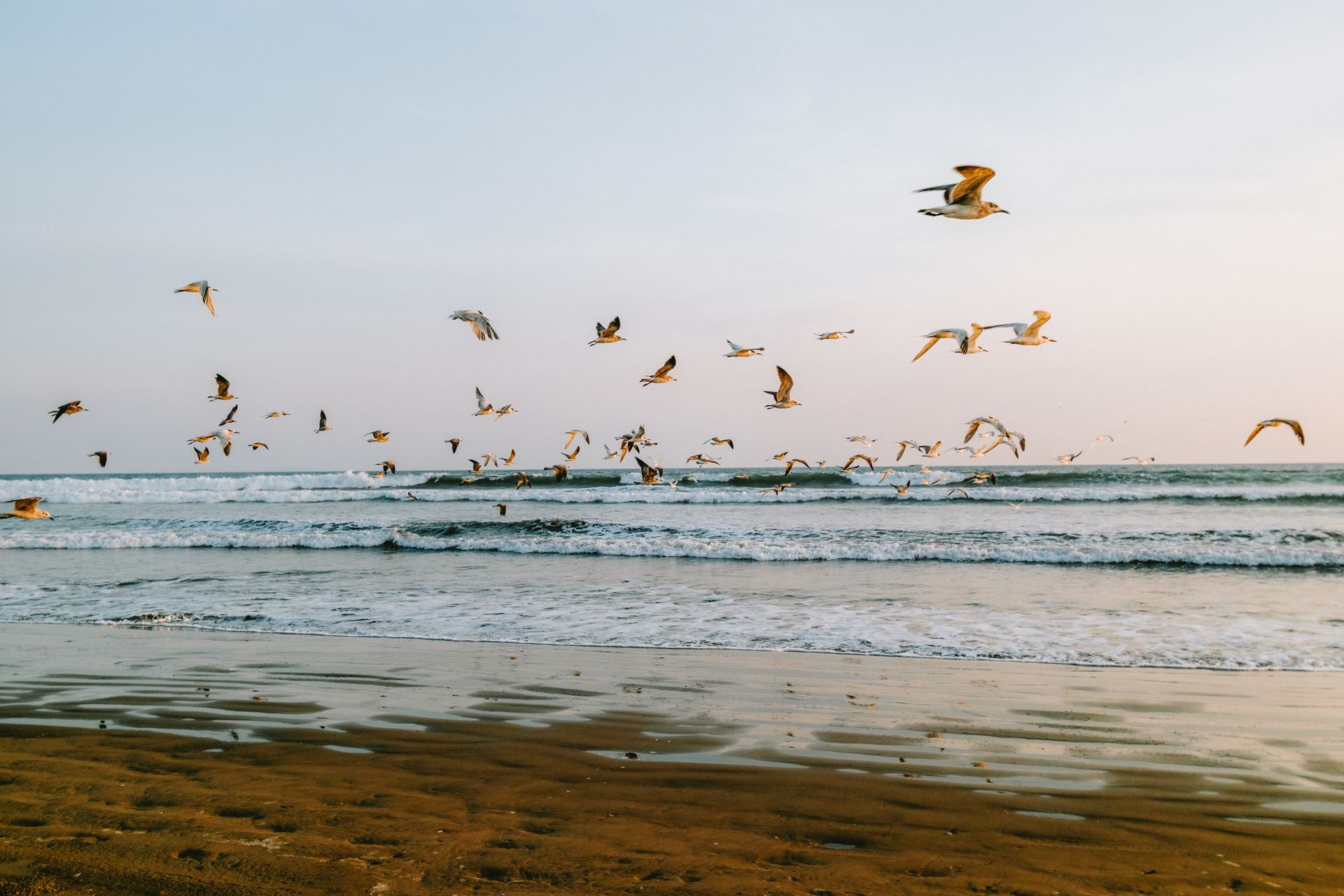
Forages singly or in groups, sometimes in hundreds, mostly during daytime.
Catches prey at the sea surface by surface-seizing and surface-diving.
Follows fishing vessels to scavenge discarded fish offal and grab baits from submerged longline hooks.
Distribution and Habitat
The black-footed albatross is found in the northern hemisphere, unlike the rest of its family which ranges from the Equator south.
They breed colonially on isolated islands, with 97.5% of the population found on the Northwestern Hawaiian Islands, specifically on Laysan, Midway, and the French Frigate Shoals.
Their range at sea varies with the seasons, but they can be found feeding from Alaska to California and Japan, with a preference for the northeastern Pacific Ocean.
Intriguing read: Giant Tortoise on the Galapagos Islands
You can spot them nesting on sandy, wind-swept beaches, often in remote areas like the Japanese islands of Tori Shima, Bonin, and Senkaku.
Outside of breeding season, they're an open ocean species, commonly seen over shelf breaks and along boundaries between water masses.
They're most concentrated northeast of Japan to the US West Coast, often associated with the California Current.
In the summer, they can be found in the Gulf of Alaska and along the Aleutian Islands.
Breeding and Reproduction
Black-footed albatrosses form long-term pair bonds that last for life, with a behavior that probably evolved to ensure maximum trust between the birds.
They spend two years building nests, dancing, and being with prospective mates, which is a crucial investment in raising an albatross chick.
The average age of sexual maturity for black-footed albatross is 7 years.
Nests are simple depressions scraped in the sand, where one dull white egg with reddish-brown spots is laid.
Consider reading: Grey Headed Albatross
The egg is incubated for just over two months, with both birds taking turns to incubate it.
The male typically incubates more as the female leaves soon after hatching to recoup reserves used for egg-laying.
The chick is brooded for 20 days by its parents, after which both parents leave the nest and return to feed the chick.
The chick is fed regurgitated food by sticking its bill inside that of its parent.
The chick fledges after 140 days.
Black-footed albatross females lay only one egg per clutch, and the average incubation period is 66 days.
Chicks hatch in January and February, and the chicks are brooded by their parents for several days.
Once the chicks fledge in June-July, the parents spend most of their time at sea, returning only to feed their chick.
Feeding and Migration
The black-footed albatross is a skilled feeder, taking in a variety of prey including the eggs of flying fish, live fish, fish offal, squid, and crustaceans. It will also consume floating debris, including plastics.
For your interest: Afghanistan Fish
This bird is a surface feeder, foraging by surface-seizing, contact dipping, and scavenging. Its primary prey species include squid, fish, and other invertebrates.
During breeding season, adults travel thousands of kilometers between their breeding colonies and summer foraging grounds in the North Pacific. They generally remain at the breeding colonies through June before making the long journey back to the foraging grounds.
Feeding Ecology
The black-footed albatross is a surface feeder, which means it spends most of its time at the sea surface looking for food. It forages by surface-seizing, contact dipping, and scavenging, making the most of its surroundings.
Its primary prey species include squid, fish, and other invertebrates. These are the main sources of nutrition for the black-footed albatross.
The albatross will also consume floating debris, including plastics, which is unfortunate given the impact of human waste on marine life. This highlights the importance of responsible waste management and conservation efforts.
Check this out: Wandering Albatross Size
During chick rearing, the foraging range of the black-footed albatross extends to include more productive areas like the Californian Current. This is a crucial time for the young birds, and they need all the nutrients they can get.
The black-footed albatross has been known to follow fishing vessels to scavenge discarded fish offal and grab baits from submerged longline hooks. This behavior is a testament to the bird's adaptability and resourcefulness.
Migration
Migration is a remarkable journey for these birds, with breeding adults traveling up to thousands of kilometers between their breeding colonies and summer foraging grounds.
In October, they make their way to the nesting islands, where they'll stay until June.
They generally remain at the breeding colonies through June, when they return to foraging grounds throughout the North Pacific.
Conservation and Threats
The black-footed albatross is considered near threatened by the IUCN, mainly due to fisheries bycatch. An estimated 4,000 birds are taken every year, although more recent estimates put the number at 6,150, with the majority of deaths caused by Taiwanese and Japanese fishing fleets.
Longline fishing is outlawed in a 50 nmi buffer zone around the breeding islands in the U.S., but the species is still vulnerable to oil pollution in the water and the ingestion of floating plastics. This reduces the space in the stomach available for food to be brought to its chicks.
Volcanic eruptions on Torishima also continue to pose a threat to the black-footed albatross. The species has an occurrence range of 37,600,000 km and a breeding range of 28 km.
A total of 64,500 black-footed albatross breed in the Pacific, with 24,000 pairs on Midway Atoll and 21,000 pairs on Laysan Island. The majority of the breeding population is counted or sampled each year, and most fisheries take measures to prevent seabird bycatch.
Here's a breakdown of the breeding population and trends in some of the key locations:
The black-footed albatross has seen a significant decline in population over the years, with a 60% drop over 56 years.
Did You Know?
Black-footed albatrosses are known for their unique mating rituals. They form pair bonds through ritualized dance displays.
These birds are incredibly skilled flyers, with some individuals covering over 1,000 miles in a single day.
Their impressive wingspans can reach up to 6.5 feet, allowing them to soar through the skies with ease.
Black-footed albatrosses are found in the North Pacific Ocean, specifically on islands such as Midway and the Hawaiian Islands.
They're a protected species, with conservation efforts in place to help safeguard their populations.
Their distinctive black and white feathers make them a striking sight to behold.
Similar Species
The black-footed albatross has some close relatives in the albatross family. The short-tailed albatross and the Laysan albatross are two species that share a similar range with the black-footed albatross.
One way to tell the black-footed albatross apart from the other two species is its fairly uniform dark coloration. This makes it a bit easier to identify.
You can also use the size and color of the bill to distinguish between these species. The short-tailed albatross has a large pink bill that's a dead giveaway.
Suggestion: Great Tailed Grackle Flying
Albatross Overview
The black-footed albatross is a majestic bird species.
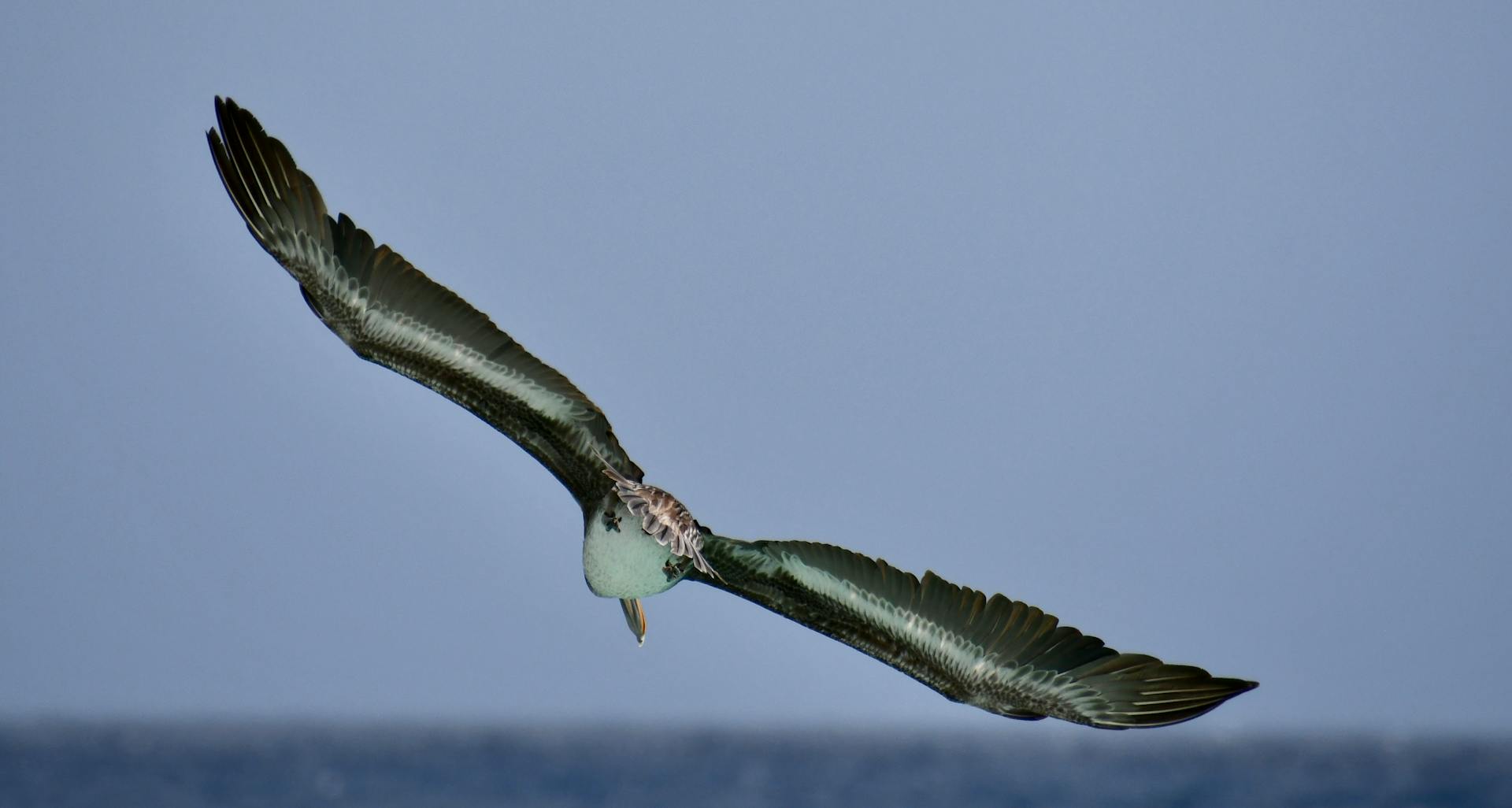
Adult black-footed albatross can be identified in flight.
The image of the adult black-footed albatross in flight was taken by Ian Wilson on Tori-shima, Japan in April 2019.
Trends
The black-footed albatross has had a tough time in the past. In the late 1800s and early 1900s, they were almost wiped out by feather hunters.
Feather hunters were a major threat to their survival. Later, rabbits were introduced to their breeding colonies and destroyed their nesting habitat.
This habitat destruction was a significant blow to the population. In the 1950s and 1960s, the birds were culled by the military to reduce the number of collisions with aircraft.
Despite these severe population declines, the black-footed albatross was able to recover each time. However, the population is currently experiencing a slight decline.
It's impressive that they've been able to bounce back from such significant threats.
Readers also liked: Population Distribution Pattern of Eastern Gray Squirrel
Frequently Asked Questions
What is the Hawaiian name for the black-footed albatross?
The Hawaiian name for the black-footed albatross is ka'upu. It is also known as the smallest albatross in Hawai'i.
What is a black-footed albatross called?
The black-footed albatross is scientifically known as Phoebastria nigripes. This seabird is a species of albatross found in the Pacific Ocean.
Can an albatross be black?
An albatross can appear black due to its dark brown to black coloration. However, it's worth noting that the bird's true color is actually a dark brown hue.
Featured Images: pexels.com