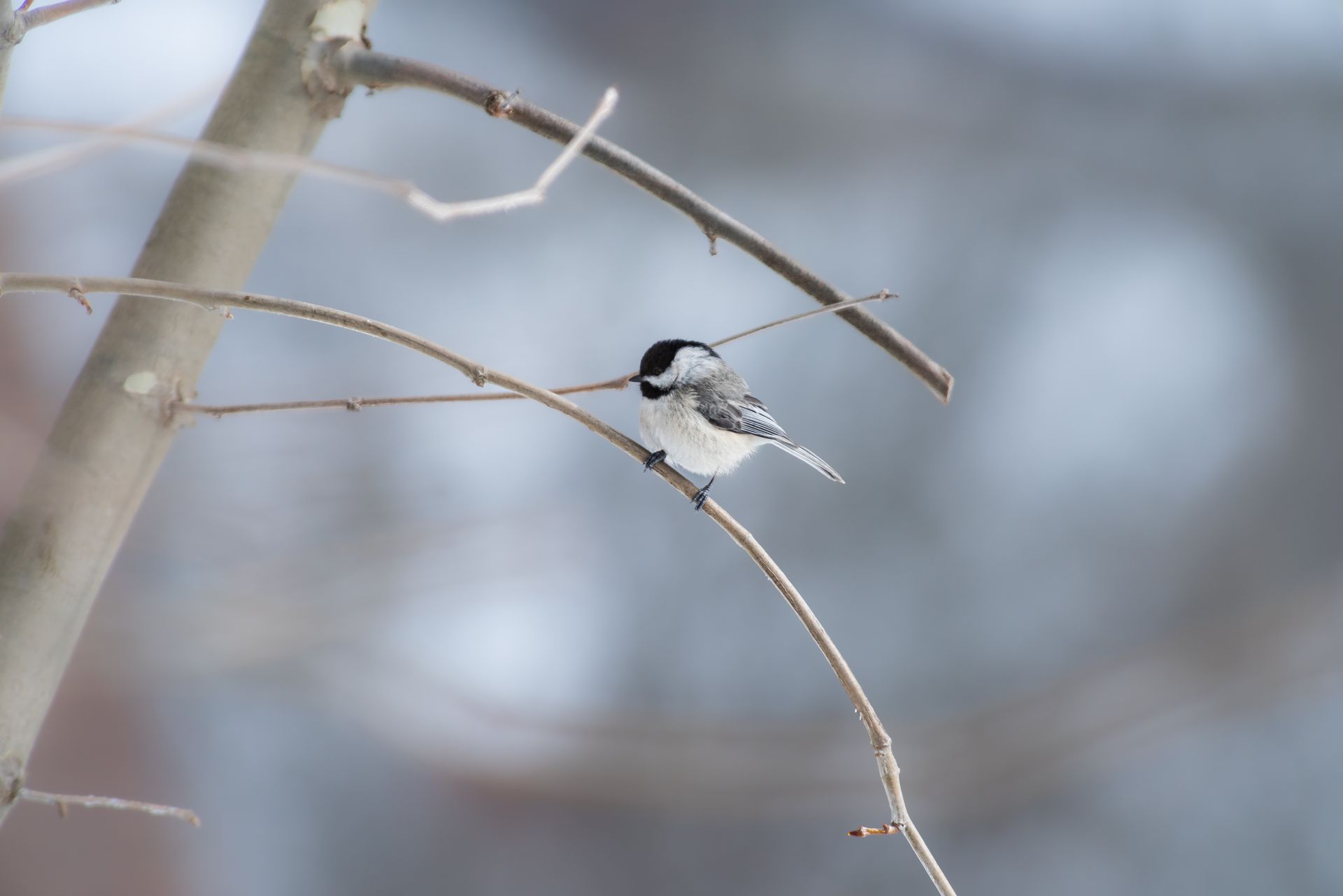
The Black-capped Chickadee is a feisty bird that's adapted to surviving in a variety of environments. They're common in North America, but their populations are threatened by predators.
One of the main predators of the Black-capped Chickadee is the hawk. Hawks are skilled hunters that can swoop down on unsuspecting chickadees with ease. They're a major threat to chickadee populations in many areas.
Chickadees have a few tricks up their sleeves to avoid becoming hawk food. For one, they're highly alert and can spot hawks from a distance. This allows them to take evasive action and avoid becoming a meal.
You might enjoy: Common Snapping Turtle Predators
Predators and Threats
Black-capped chickadees face a variety of predators, including birds of prey like owls, hawks, and shrikes.
These birds of prey are skilled hunters and can swoop down on unsuspecting chickadees at any time.
Raccoons, squirrels, opossums, and snakes are also known to raid chickadee nests, stealing eggs and chicks.
You might enjoy: What Is Birds in Madagascar Prey
House wrens will often destroy chickadee eggs to reuse the location for their own nest, showing a clever but ruthless side to their behavior.
Black-capped chickadees are also susceptible to diseases like West Nile Virus and avian keratin disorder, which can have serious consequences for their health and well-being.
Blood parasites, including those that cause malaria, can also affect chickadees, but high rates of infection have not been detected.
These threats highlight the challenges that black-capped chickadees face in their daily lives, and remind us of the importance of conservation efforts to protect these amazing birds.
Chickadee Behavior
Chickadees are incredibly alert birds that can signal the deadliness of predators to their flock through their alarm calls. These calls increase in length depending on the threat level.
The alarm call system is surprisingly sophisticated, with researchers finding that chickadees can differentiate between predators based on their size. They also discovered that smaller predators, which pose a greater risk to chickadees, receive a more vociferous response from the flock.
Chickadees are able to assess the threat level of a predator by considering its size and maneuverability. For example, a smaller predator with a smaller wingspan may be more adept at hunting chickadees than a larger predator with a larger wingspan.
You might enjoy: Shortfin Mako Shark Size
Dominance Hierarchy
In chickadee flocks, dominance hierarchies are established during the winter, and they play a significant role in determining social behaviors among the birds.
Dominant birds have better access to food, leading to a better body condition, increased territory size, and higher reproductive success. This is because they control access to preferred resources and restrict subordinates to foraging in novel or riskier environments.
Older and more experienced birds tend to be dominant over younger ones, and males are generally dominant over females.
Subordinate birds, on the other hand, are more likely to take risks when approaching novel foods or objects, as they are accustomed to foraging in suboptimal environments.
Interestingly, subordinate birds are just as capable of learning novel foraging tasks as their dominant counterparts, but they are more willing to try new foods and objects.
Chickadees Recall Fear
The chickadee's alarm call is one of the animal kingdom's most intricate, with a specific pattern of syllables that signals the deadliness of a predator.
Researchers found that the number of "dees" in the chickadee's call corresponds to the size of the predator. Smaller hunters got the most vociferous response.
A team of US researchers tested the alarm call responses of a flock of six chickadees against various predators, including birds of prey and mammals.
The chickadees' calls were recorded and analyzed, revealing a sophisticated judgment of predation risk. The team found that the chickadees can accurately assess the danger posed by a predator.
The researchers were surprised by the complexity of the alarm call system, which allows the chickadees to communicate effectively with each other.
You might like: Black Capped Chickadee Calls
Conservation and Science
The IUCN classifies the black-capped chickadee as least concern due to its wide distribution and large populations.
However, this doesn't mean they're completely safe from harm. In fact, yearly bird counts such as the Christmas Bird Count indicate that the population is increasing, but it's still vulnerable to human-related mortality causes.
Flying into windows and ingesting pesticide are two major threats to black-capped chickadees, and it's heartbreaking to think that these simple actions can be fatal to these beautiful birds.
Conservation
The black-capped chickadee is considered a species of least concern by the IUCN due to its widespread distribution and large populations.
Yearly bird counts, such as the Christmas Bird Count, show that the population is increasing.
Flying into windows is a significant human-related mortality cause for black-capped chickadees.
Dying from ingesting pesticide is another human-related threat to these birds.
Cats pose a threat to chickadees, making them a significant predator in certain areas.
You might like: Human and Wildlife Conflict
Mad About Science: Chirping Chickadees Signal Danger
Chirping chickadees signal danger to their flock by changing the length of their alarm calls. The more syllables in the call, the greater the perceived threat.
Researchers tested the alarm calls of six chickadees against 13 birds of prey and two mammals. The team found that smaller predators, like the pygmy owl, received the most vociferous response.
The number of "dees" in the chickadee's trademark call corresponds to the size of the poised predator. Smaller hunters, which pose the greatest risk, received the most alarm calls.
The chickadees' judgment of predation risk is surprisingly sophisticated. They can detect the deadliness of a predator just by looking at its size.
The researchers analyzed 5000 recorded alarm calls to come to this conclusion. The findings suggest that the chickadees' alarm call system is one of the most intricate in the animal kingdom.
Featured Images: pexels.com