The Australian Scrub Python is an incredible creature, and the largest native snake in the country. Found in the tropical regions of Northern Australia, this snake can grow up to 7.5 meters in length.
Let's talk about their impressive size and strength. They can weigh up to 30 kilograms, making them a formidable presence in their natural habitat.
Their large size allows them to take on prey much larger than themselves, including small wallabies and other mammals. They are skilled hunters, using their powerful coils to constrict their prey before consuming it whole.
Taxonomy and Description
The Australian scrub python is one of the world's largest and longest arboreal species of snakes. It's commonly considered arboreal or tree-dwelling.
This snake has an impressive ornate dorsal pattern consisting of browns and tans, with many different natural variations, and an iridescent sheen.
Taxonomy
The taxonomy of the amethystine python is a complex and fascinating topic.
Olive Griffith Stull described this taxon as Liasis amethistinus kinghorni in 1933 from a specimen at the Museum of Comparative Zoology.
The specific name, kinghorni, is in honour of Australian herpetologist and ornithologist James Roy Kinghorn.
In 1984, Wells and Wellington first raised it to species status and gave it the name Australiasis kinghorni.
American biologist Michael Harvey and colleagues confirmed its classification as a separate species based on cladistic analysis of mitochondrial cytochrome b sequences and morphology.
Additional reading: Common Snapping Turtle Species
Description
The Australian scrub python is one of the world's largest and longest arboreal species of snakes. It's commonly considered arboreal or tree-dwelling, which is quite impressive given its size.
Its dorsal pattern is quite intricate, consisting of browns and tans with many different natural variations. This gives each snake a unique appearance.
The Australian scrub python has an iridescent sheen to its scales, which can catch the light in interesting ways. This sheen is a result of the way its scales reflect light.
Its belly is usually white, sometimes with some yellows. This coloration can vary from snake to snake.
The top of the head is covered with large symmetrical shields, which provide protection for the snake's sensitive eyes and nostrils. These shields are a distinctive feature of the Australian scrub python.
Heat-sensing pits are located on the rostral and some labial scales, allowing the snake to detect warm-blooded prey. These pits are an essential tool for the snake's hunting success.
Distribution and Habitat
The Australian scrub python is found in Northern Australia, specifically in Queensland and the Cape York Peninsula.
S. kinghorni inhabits several islands in the Torres Strait, including Hinchinbrook.
On the mainland, its range extends from the tip of the Cape York Peninsula south along the coastal rainforest.
It can also be found on the Atherton Tableland and in the forested eastern foothills of the Great Dividing Range.
The species has been spotted along the coast through Mount Speck to the Burdekin River, south of Townsville.
In 2004, a more southern population was discovered in the Conway rainforest, south of Airlie Beach.
A fresh viewpoint: Snakes in South America
In Captivity and Diet
In the wild, Australian scrub pythons are skilled hunters, but in captivity, they still require a varied diet to stay healthy.
They thrive on a diet that includes small mammals, birds, and reptiles, and feeding them live prey is essential for their well-being.
In captivity, a python's diet should be tailored to its age, size, and activity level, and a good rule of thumb is to feed them as often as they can eat in one sitting.
In Captivity
The Australian scrub python is somewhat rare in the pet trade outside of Australia. However, with captive breeding projects and hobbyists interested in the species, it is becoming more available.
Its New Guinea counterparts are much more available, especially in the United States.
What It Eats
The Australian scrub python is a carnivore, which means it only eats meat. Its diet is quite varied, including birds, mammals, and even other reptiles.
In the wild, these snakes are skilled hunters that can take down prey much larger than themselves. They have been known to eat animals like wallabies and small kangaroos.
Their diet also includes smaller animals like rodents, lizards, and snakes. This adaptability is crucial for their survival in the wild.
The Australian scrub python's dietary needs are an important consideration for anyone caring for one in captivity. They require a diet that's high in protein, which can be achieved with a variety of meat sources.
Old Python Shocks Far North Queensland Keepers
The massive scrub python, affectionately named Scrubby, was estimated to weigh 50 kilograms.
Scrubby is one of the "fattest you will ever see" according to Chris Grantham, general manager of Rainforestation Nature Park.
The python is five metres long and was described as "really thick, very well fed" by Mr. Grantham.
It took four men to hold up Scrubby for a photo, which went viral after it was posted on the nature park's Facebook page.
The scrub python is Australia's largest snake, commonly between three to seven metres long, but can grow up to 8.5 metres.
A unique perspective: How Long Do Reticulated Pythons Live
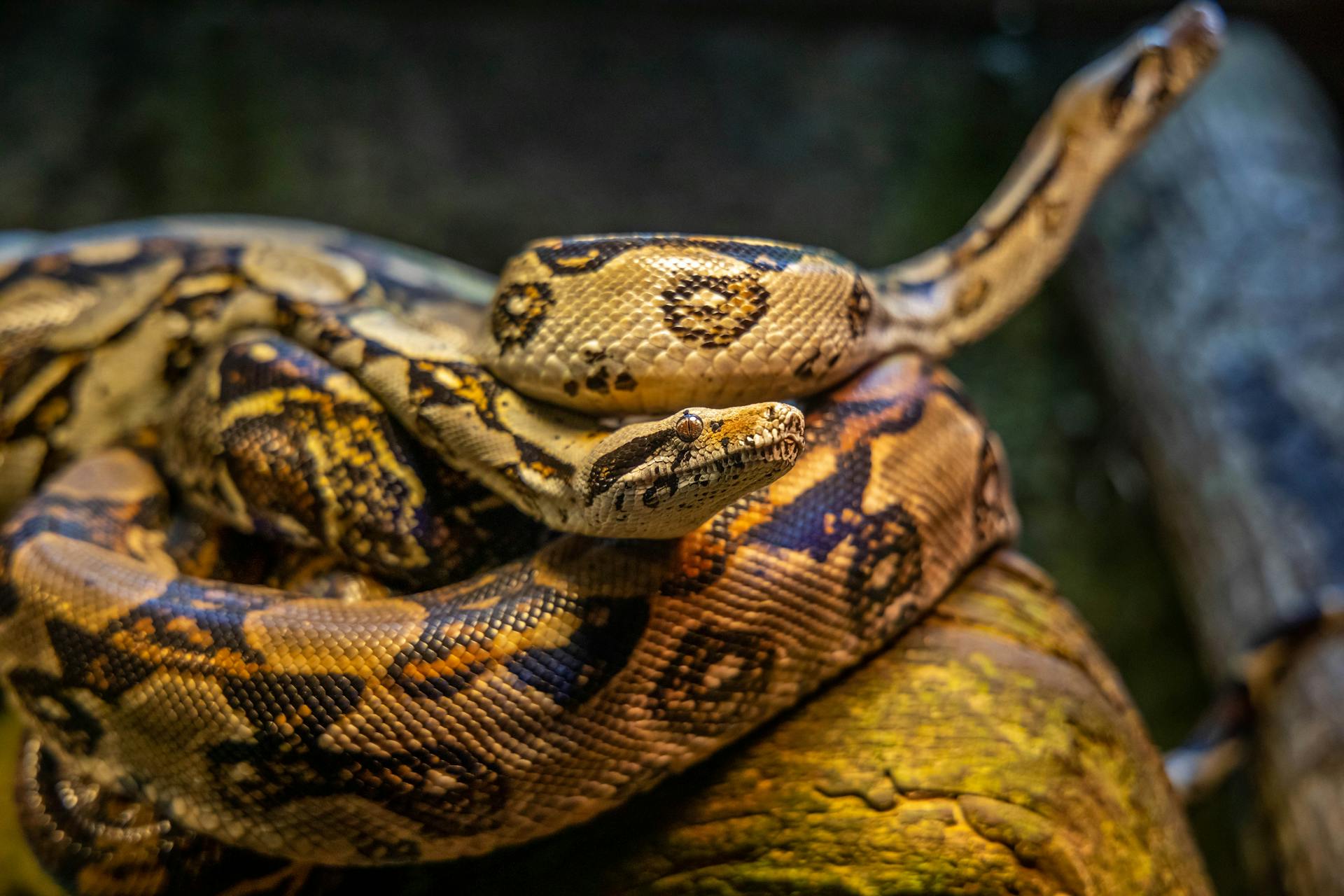
Scrubby was estimated to be at least 20 years old, which is pretty amazing considering their average lifespan.
Here's a comparison of Scrubby's size to other common lengths of scrub pythons:
The massive python was discovered near Kuranda, a town in far north Queensland, where scrub pythons are very common.
Size and Behavior
Australian scrub pythons are truly massive creatures. Males are typically a third longer and twice as heavy as females, which is a pretty significant size difference.
Females reach maturity at a snout-to-vent length (SVL) of about 2.27 metres, while males mature at an SVL of 1.34 metres. This is a notable difference, and it's interesting to see the size disparity between the sexes.
On the Tully River, measurements of 24 adult females revealed an average SVL of 2.68 metres and a mass of 3.4 kilograms. In the same area, 80 adult males had an average SVL of 2.91 metres and a weight of 5.1 kilograms.
Discover more: Adult California Kingsnake
The largest male ever recorded in this region was an astonishing 3.76 metres in length and weighed 11 kilograms. This is an incredible size, and it's no wonder that these snakes have earned their reputation as one of the largest python species in Australia.
Historical reports of individuals exceeding 6 metres in length have been mentioned, but these accounts are now viewed with scepticism. It's worth noting that some of these reports may have been exaggerated or based on incomplete information.
Giant of Northern Rainforests
The Australian scrub python is a true giant of the reptile world, dominating the tropical rainforests of northern Australia.
This magnificent species holds the distinction of being Australia's longest snake and ranks among the largest snakes globally.
It's found in the lush forests of Queensland and the Cape York Peninsula, showcasing the remarkable diversity of Australia's wildlife.
The species has undergone significant taxonomic evolution in recent years, with a notable scientific development in 2014 where it was reclassified into the genus Simalia alongside several other former Morelia species.
This taxonomic placement continues to spark discussion among herpetologists, highlighting the ongoing efforts to understand and classify this incredible species.
A different take: Blue Tongue Lizards Australia
Frequently Asked Questions
Do scrub pythons make good pets?
Scrub pythons can make good pets for experienced snake owners, but their aggressive nature requires careful handling and consideration. If you're new to handling pythons, it's best to start with a more docile species.
What is the lifespan of a scrub python?
Scrub pythons typically live for 20-30 years in the wild and captivity.
Featured Images: pexels.com