Arctocephalus forsteri, also known as the New Zealand fur seal, is a species of fur seal that can be found in the coastal waters of New Zealand and Australia.
They are known for their distinctive spotted coats, which help them blend in with their rocky and kelp-covered habitats.
Arctocephalus forsteri typically weigh between 100-150 kg and reach lengths of up to 2.5 meters.
These seals are carnivores and primarily feed on fish, squid, and crustaceans.
A different take: Subantarctic Fur Seal
Physical Description
Arctocephalus forsteri, also known as the New Zealand fur seal, has a distinctive physical appearance.
Their adult coat consists of two layers: a topcoat and a thick undercoat. The topcoat is dark grey-brown on the dorsal side, which gradually lightens to a lighter gray-brown underside, providing camouflage.
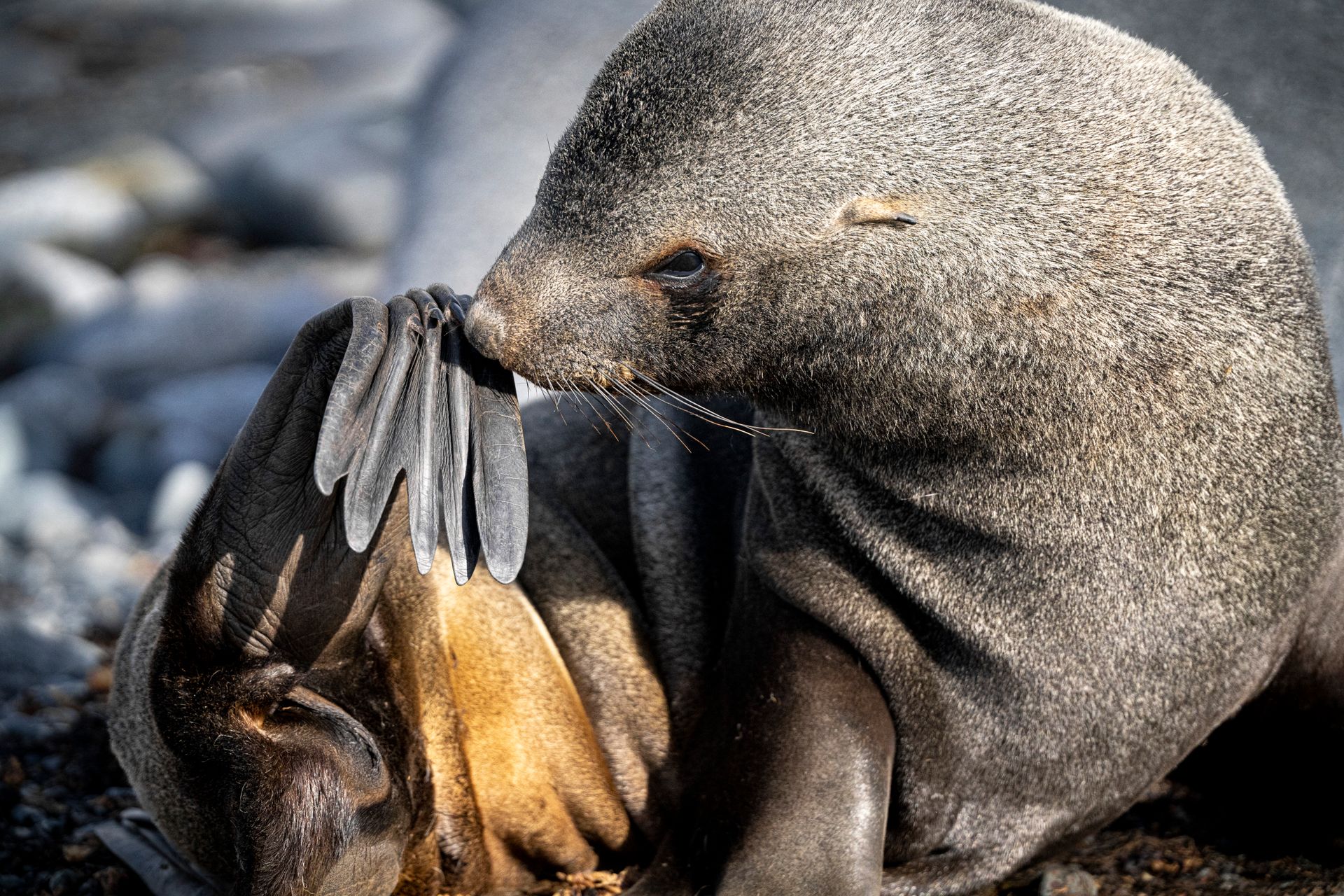
New Zealand fur seals have a pointed nose, long whiskers, and ear flaps. Males have a long, thick mane of guard hairs, while females do not develop this mane.
Additional reading: Southern Brown Bandicoot
Adult males average 1.5 to 2.5 meters in length and weigh 120 to 180 kilograms. Females are significantly smaller, averaging 1 to 1.5 meters in length and weighing 30 to 50 kilograms.
Here's a comparison of the average sizes of males and females:
As they grow, New Zealand fur seal pups shed their black coats for their more adult silvery-grey coats at around five months old.
Habitat and Distribution
Arctocephalus forsteri, also known as the New Zealand fur seal, can be found in various locations around Australia and New Zealand.
They inhabit rocky coastlines and offshore islands, which provide protection from strong ocean waves. These areas often feature large rocks, reefs, and smooth rocky ledges that allow easy access to the sea.
In warmer islands, they use rock pools to cool down. Vegetation with tussock and scrub is a common sanctuary for breeding seals and their young.
New Zealand fur seals are mid-water feeders, with the distance and depth of their feeding depending on the season and the age of their pups. During the breeding season, they feed just beyond the continental shelf.
On a similar theme: Falkland Islands Wolf
Here are some key facts about the habitat and distribution of New Zealand fur seals:
- Habitat Regions: temperate, terrestrial, saltwater or marine
- Range elevation: Sea Level (low)
- Range depth: 0 to 380 m
Their range spans across Australia, New Zealand, Tasmania, and associated islands, with a preference for oceans, seas, or other bodies of salt water. They are non-migratory coastal species, with a distribution largely influenced by their food source.
Behavior and Reproduction
Arctocephalus forsteri, the "eared" seal, has some fascinating breeding habits. Mating occurs from mid-November to mid-January.
Females give birth from 4-6 years of age and live up to 26 years in the wild. Males, on the other hand, mature at 5-6 years of age and hold territories.
A small proportion of males defend territories, generally containing around 5-8 females.
Lifespan/Longevity
New Zealand fur seals have a relatively short lifespan in the wild. The average lifespan for a female is about 12 years, while males live for around 15 years.
The first year of life is particularly challenging, with a high mortality rate of around 40% during the first 300 days. This is a critical period for pups to develop and adapt to their environment.
In contrast, a New Zealand fur seal in captivity was recorded to have lived up to 23.1 years, making it the longest recorded age for this species.
Here's a breakdown of the lifespan of New Zealand fur seals in both wild and captive environments:
- Wild: Female - 12 years, Male - 15 years
- Captive: 23.1 years
Reproduction
Reproduction is a complex process for the "eared" seal, with mating occurring from mid-November to mid-January.
Females typically give birth a year later, after a gestation period that's not specified in the article. They start reproducing from 4-6 years of age and live for up to 26 years.
Males mature at 5-6 years of age, hold territories, and mate from 8-9 years. They live up to 15 years in the wild.
A small proportion of males defend territories, generally containing around 5-8 females.
Communication and Perception
New Zealand fur seals have a unique way of communicating with each other. They use a variety of methods to convey their intentions, including posture and physical movement.
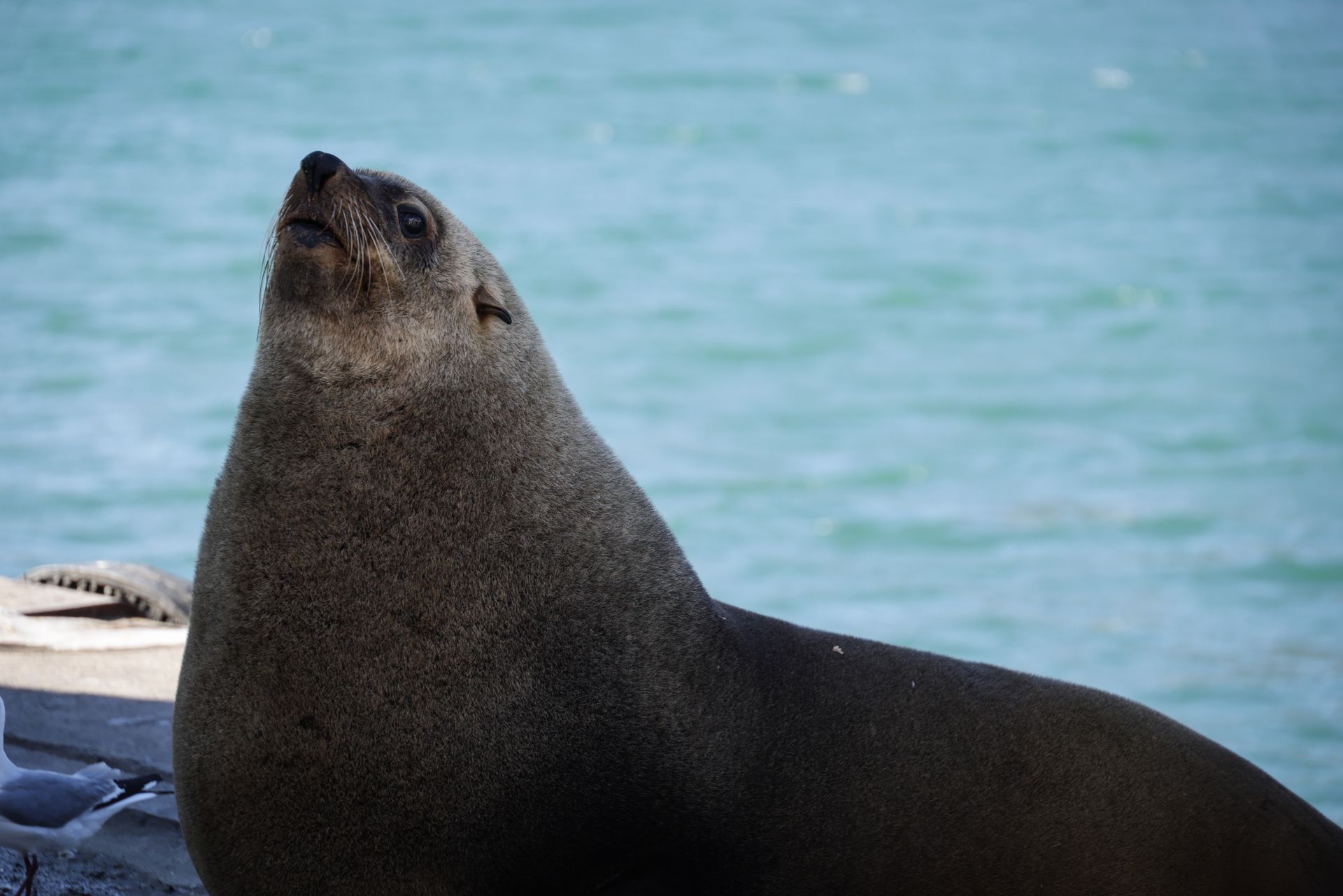
One way they communicate is through the full neck display, where a male seal will sit upright, with its chest protruding out, head tilted back, and nose pointed up towards the sky. This display is used to establish status and can be a sign of readiness to fight.
The alert posture is also a way for seals to show general awareness. They'll often display an open-mouth, which can be both aggressive and submissive. Young pups have even been seen doing these displays during play-fighting with each other.
Seals also produce vocalizations to communicate. Territorial males will often bark to demonstrate their status, while females will whine or squeal to show submission. A loud, deep, throaty, gruff call known as a choke call is also used by males to demonstrate their status.
To locate their pups, female seals use a combination of vocalization and vision. They'll hold their body upright, extend and arch their head and neck forward, and produce a high-pitched, rising screech to search for their young.
Here are the different communication channels used by New Zealand fur seals:
- Visual
- Tactile
- Acoustic
- Chemical
Seals also use their whiskers to sense underwater vibrations, which helps them locate food. Their sense of smell is also important for recognition and acceptance of their pups.
Predation
New Zealand fur seals have a unique adaptation to protect themselves from predators. Their coat color blends in with the rocky land surroundings.
Sharks, orcas, and leopard seals are among the predators that target New Zealand fur seals. These predators pose a significant threat to the seals' survival.
Their ability to swim swiftly through water is a crucial defense mechanism. This allows them to escape predators in the water.
New Zealand sea lions and humans are also known to prey on New Zealand fur seals. This highlights the importance of conservation efforts to protect the seals and their habitats.
Climbing onto shore is another adaptation that helps the seals avoid predators. This ability allows them to escape danger and find refuge in the rocky terrain.
Additional reading: Hawaiian Monk Seals
Conservation and Ecology
Arctocephalus forsteri, also known as the New Zealand fur seal, has made a remarkable recovery from being decimated by commercial sealing in the late 18th and early 19th century.
Numbers have now increased to around 80,000 in Australia, showing a significant improvement in conservation efforts.
Conservation Status
The conservation status of some species is a heartening story. This species was decimated by commercial sealing in the late 18th and early 19th century but numbers have now increased to around 80,000 in Australia.
Many species have made a remarkable recovery. However, the exact numbers vary depending on the species and location.
Economic Importance: Positive
New Zealand fur seals have played a significant role in the economic lives of humans. They were a popular source of food for the Polynesian culture.
In the 19th century, European sealers nearly caused the extinction of fur seals, which would have had devastating economic consequences. Today, they are a popular tourist attraction.
The value of New Zealand fur seals extends beyond their role as a food source. Their body parts are a source of valuable material. This has contributed to the growth of ecotourism in the region.
Swim-with-seal programs have been created to increase the profit of tourism. These programs allow tourists to interact with the seals in their natural habitat.
Here are some of the positive economic impacts of New Zealand fur seals:
- Food
- Body parts are a source of valuable material
- Ecotourism
- Research and education
Scientific Taxonomy
Arctocephalus forsteri, also known as the New Zealand fur seal, belongs to the kingdom Animalia.
This classification puts it in a group with other animals, including insects, fish, and birds.
Within the kingdom Animalia, Arctocephalus forsteri falls under the phylum Chordata.
This phylum includes all animals with a backbone or spinal cord.
Arctocephalus forsteri is a vertebrate, which means it has a backbone.
Here's a breakdown of its classification:
Arctocephalus forsteri is also known by its scientific name, which is Arctocephalus forsteri (Lesson, 1828).
This name is part of its scientific taxonomy, which includes the following classification: Animalia; Chordata; Gnathostomata; Tetrapoda; Mammalia; Theria; Eutheria; Pinnipedia; Otarioidea; Otariidae, Actocephalinae.
Take a look at this: Nine Banded Armadillo Scientific Name
Research and Data
A total of 14 metatranscriptomic libraries were constructed from pools of tissue from 18 individual New Zealand fur seals.
These libraries were made from tissue types such as brain, liver, lung, and kidney, with no mammalian-associated viruses identified in any of these tissues.
Data Availability
The data from this research is available for anyone to access and use. All A. forsteri sequence reads can be found on the NCBI Sequence Read Archive under BioProject PRJNA1013207.
The researchers have also made the viral genomes assembled in this study available in the GenBank, with accession numbers OR531434, OR590706, and OR590707.
You can view the sequences, alignments, and phylogenetic trees generated in this study on a GitHub repository at https://github.com/JonathonMifsud/Identification-of-a-novel-papillomavirus-in-a-New-Zealand-Fur-seal-with-oral-papilloma.
Contributions

In research and data, contributions from a team are crucial to the success of a project. J.C.O.M., J.H., K.R., E.C.H., and E.H. conceptualized the project.
The methodology behind the research was a collaborative effort. J.C.O.M., J.H., K.R., E.C.H., E.H., K.V.B., and R.H.P. worked together to develop the approach.
Investigation was led by J.C.O.M, J.H., K.R., and K.V.B. They were responsible for collecting and analyzing the data.
Formal analysis was a team effort as well. J.C.O.M., J.H., K.R., K.V.B., and R.H.P. worked together to interpret the data.
Visualization was a key component of the project. J.C.O.M. and J.H. created the visual representations of the data.
Funding for the project was acquired by E.C.H. Their efforts ensured the project had the necessary resources.
Supervision of the project was shared between E.C.H. and E.H. They guided the team and made key decisions.
The writing process was also a collaborative effort. J.C.O.M. and J.H. wrote the original draft, while all authors reviewed and edited the final version.
Article Details
The article "A novel papillomavirus in a New Zealand fur seal (Arctocephalus forsteri) with oral lesions" was published in npj Viruses in 2024.
This study was conducted by a team of researchers including J.C.O. Mifsud, J. Hall, K. Van Brussel, and others.
The team's findings were published in npj Viruses, volume 2, with the article number 10.
The article's DOI is 10.1038/s44298-024-00020-w.
Frequently Asked Questions
How many NZ fur seals are left?
The estimated population of New Zealand fur seals is over 200,000, with numbers likely higher due to a growing trend.
Featured Images: pexels.com