The Andalusian horse is a breed known for its stunning appearance, and its coat colors are a big part of that. They come in a variety of colors, but the most common ones are bay, gray, and black.
One of the most striking features of the Andalusian horse is its ability to display a range of colors, including chestnut, which is a reddish-brown color. This color is caused by a specific genetic combination.
Andalusian horses can also display a roan pattern, which is a mix of white and dark hairs giving a speckled appearance. This pattern is the result of a specific genetic interaction between the horse's coat color genes.
The Andalusian horse's coat colors are determined by the interaction of two types of melanin: eumelanin and pheomelanin.
For your interest: Chocolate Color Lab
Horse Colors
The Andalusian horse is known for its stunning coat colors, which can range from the most common grays and bays to the rarer cremellos and roans.
Gray Andalusians can range from a nearly white shade to a darker dapple gray, making each one unique. Their gray coats often come with a beautiful, long, wavy mane and tail that adds to their allure.
Bay Andalusians, on the other hand, can have coats that range from light to dark bay with black accents on their legs, mane, and tail, creating a striking contrast. Some bays may even have flaxen manes and tails, which provide an eye-catching contrast to their overall appearance.
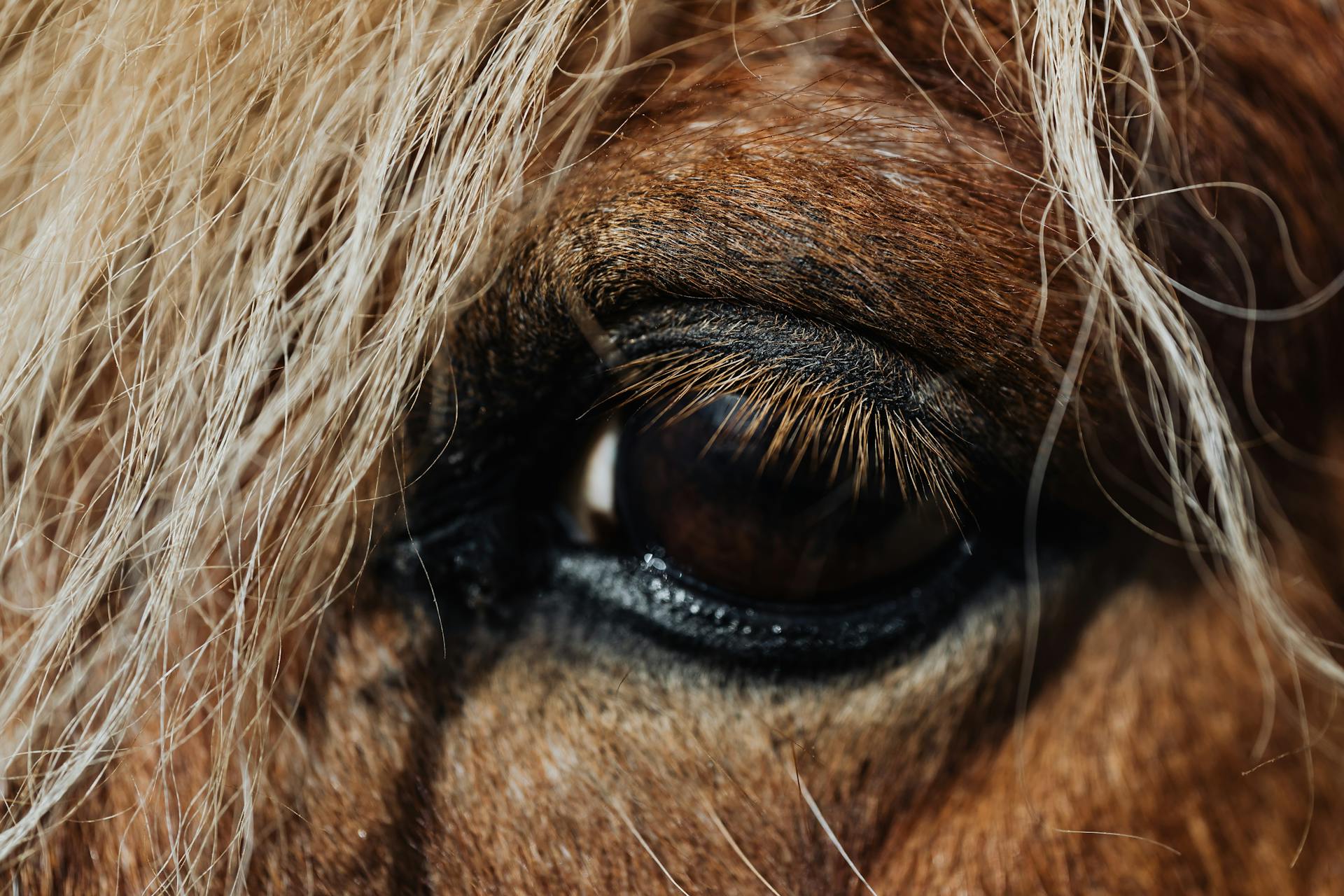
Chestnut Andalusians can fall anywhere within a spectrum of light golden to dark liver chestnut, and some may even exhibit flaxen manes and tails. This beautiful coat color is often associated with athleticism and beauty.
The rarer coat colors in Andalusian horses, such as cremello and perlino, are less common but undeniably striking. Cremello horses have a cream-colored coat that often comes with blue eyes, while perlino horses display a similar cream color, albeit with a slightly darker shade.
Andalusian horses are also known for their unique birth coat color, which can differ from their adult color. They shed their foal guard coat at varying ages, with some as early as a few months and others taking up to two years.
The Cream gene plays a significant role in determining the coat colors of Andalusian horses. Located on the MATP chromosome, this gene can impact coat color by diluting the base pigment, resulting in a range of colors from palomino to cremello.
Expand your knowledge: What Color Was Napoleon's White Horse?
Genetics and Coloration
The genetics behind Andalusian horse coat colors is a fascinating topic. The Cream gene, located on the MATP chromosome, plays a significant role in diluting the base pigment, resulting in various coat colors.
Andalusian horses can inherit one or two Cream genes, which affects the intensity of the coat color. A chestnut Andalusian with one Cream gene might display a palomino coat color, while two Cream genes result in a cremello coat.
Interestingly, some Andalusian horses are born with a different birth coat color than their adult color, which sheds off at varying ages. This is due to a dominant factor acting upon their color gene, and it's not uncommon for gray Andalusians to have a base coat color that turns gray over time.
The Cream gene is not the only factor influencing coat colors in Andalusian horses. Other genetic factors, such as the interaction between the Cream gene and the base coat color, also play a role in determining the final coat color.
See what others are reading: Andalusian Hound
Specific Colors
Gray Andalusian horses can range from a nearly white shade to a darker dapple gray.
The rare coat color Cremello has a cream-colored coat that often comes with blue eyes, while Perlino horses display a similar cream color with a slightly darker shade.
Roan Andalusians have a coat consisting of white and colored hairs intermingled, resulting in a visually unique appearance.
In Andalusian horses, the Agouti gene can create unique color variations that differentiate them from other horse breeds.
Rare Horse Colors
The Andalusian horse breed is known for its stunning coat colors, with some being more rare than others. The Perlino Andalusian is one such example, characterized by a cream-colored coat with a slightly darker shade.
These horses are relatively rare, but their unique color is undeniably striking. The Perlino coat color is the result of a genetic combination that's different from the Palomino and Cremello Andalusians.
In addition to Perlino, the Cremello Andalusian is another rare coat color in this breed. Cremello horses have a cream-colored coat and often come with blue eyes.
On a similar theme: Smartest Breed
The Cremello coat color is a result of a genetic combination that's unique to this breed. The Andalusian horse breed has a rich history, which has contributed to the variety of coat colors observed in them.
Roan Andalusians have a coat consisting of white and colored hairs intermingled, resulting in a visually unique appearance. This coat color is less common but is undeniably striking.
The Agouti gene plays a crucial role in determining the coat colors of Andalusian horses. It interacts with the Melanocortin 1 Receptor to influence the distribution of black and red pigment in the horse's coat.
The Palomino Andalusian is another rare coat color in this breed, characterized by a stunning golden or yellow coat that catches the eye. This coat color is complemented by a white or cream-colored mane, creating a remarkable contrast.
A different take: Horse Breed
Cremello
Cremello Andalusians are truly a sight to behold, with their uniform cream-colored coats that seem to glow in the light.
Their coat color is often lighter than that of a Perlino, and is described as a uniform cream color.
The creme gene carried by Cremello Andalusians results in pink skin and blue or pale-colored eyes, adding to their unique appearance.
Their light and uniform coat color highlights the elegant lines and contours of their compact, athletic body, making them a truly unforgettable sight.
A Cremello horse's coat is typically lighter than that of a Perlino, often described as a uniform cream color.
The presence of two Cream genes in a Cremello Andalusian results in a more pronounced dilution effect, contributing to their distinctive coat color.
Color Changes Through Time
The Andalusian horse's coat color changes over time due to genetic factors and human influence. This process is a natural part of the horse's life cycle.
As the Andalusian horse matures, its coat color can change significantly. The graying process is a common phenomenon in this breed.
The Andalusian horse's coat stabilization, or the point at which its coat color becomes fixed, can occur at different ages depending on various factors.
Care and Miscellaneous
The Andalusian horse's coat color is a significant aspect of its beauty and charm. Andalusians can be found in a variety of colors, including bay, black, gray, and chestnut.
To maintain their coat health, regular grooming is essential. This includes brushing their mane and tail daily, as well as providing regular baths and conditioning treatments.
It's also important to note that Andalusians are prone to certain coat-related health issues, such as sun damage and skin cancer, due to their light coat colors. This highlights the need for proper sun protection and regular veterinary check-ups.
Check this out: Horse Health
Maturity Stabilization
As your Andalusian horse matures, its coat colors may undergo changes before stabilizing. Foals often display unusual markings on their baby coats, which disappear around one year of age.
The adult coat typically emerges and remains stable throughout the horse's life, although the graying process might continue to alter its appearance.
Factors like seasonal changes, nutrition, and overall health can influence the appearance of the coat. A healthy diet and proper grooming are essential for maintaining a vibrant and healthy coat.
It's not uncommon for a horse's coat to become lighter in the summer due to sun exposure and return to a darker shade during the winter months.
Related reading: How to Get a Horse's Attention?
Care
To care for your Andalusian's coat, use a curry comb, dandy brush, body brush, and face brush to remove dirt, debris, and loose hair efficiently and gently.
The mane and tail on an Andalusian are long and thick, making them prone to tangles.
Using a mane and tail comb is a good way to keep those hairs free of tangles, but be gentle to avoid causing breakage.
If you find it difficult to comb through the hair or remove tangles with your fingers, try a conditioner or detangler that's formulated for the mane and tail, as these can help make the job easier.
Some people opt to braid their Andalusian's mane, tail, or both for easier maintenance.
For more insights, see: Horses Tail
Frequently Asked Questions
How do you tell if a horse is Andalusian?
To identify an Andalusian horse, look for a straight or slightly convex profile, a long and broad neck, and a massive chest. These distinctive features are key characteristics of the breed, but there's more to learn about this elegant and ancient horse type.
What is the difference between an Iberian horse and an Andalusian horse?
While the terms "Iberian horse" and "Andalusian horse" are often used interchangeably, the latter specifically refers to the Pure Bred Spanish horse breed, also known as PRE. Iberian horse is a broader term that encompasses 17 breeds, including the Andalusian.
Featured Images: pexels.com