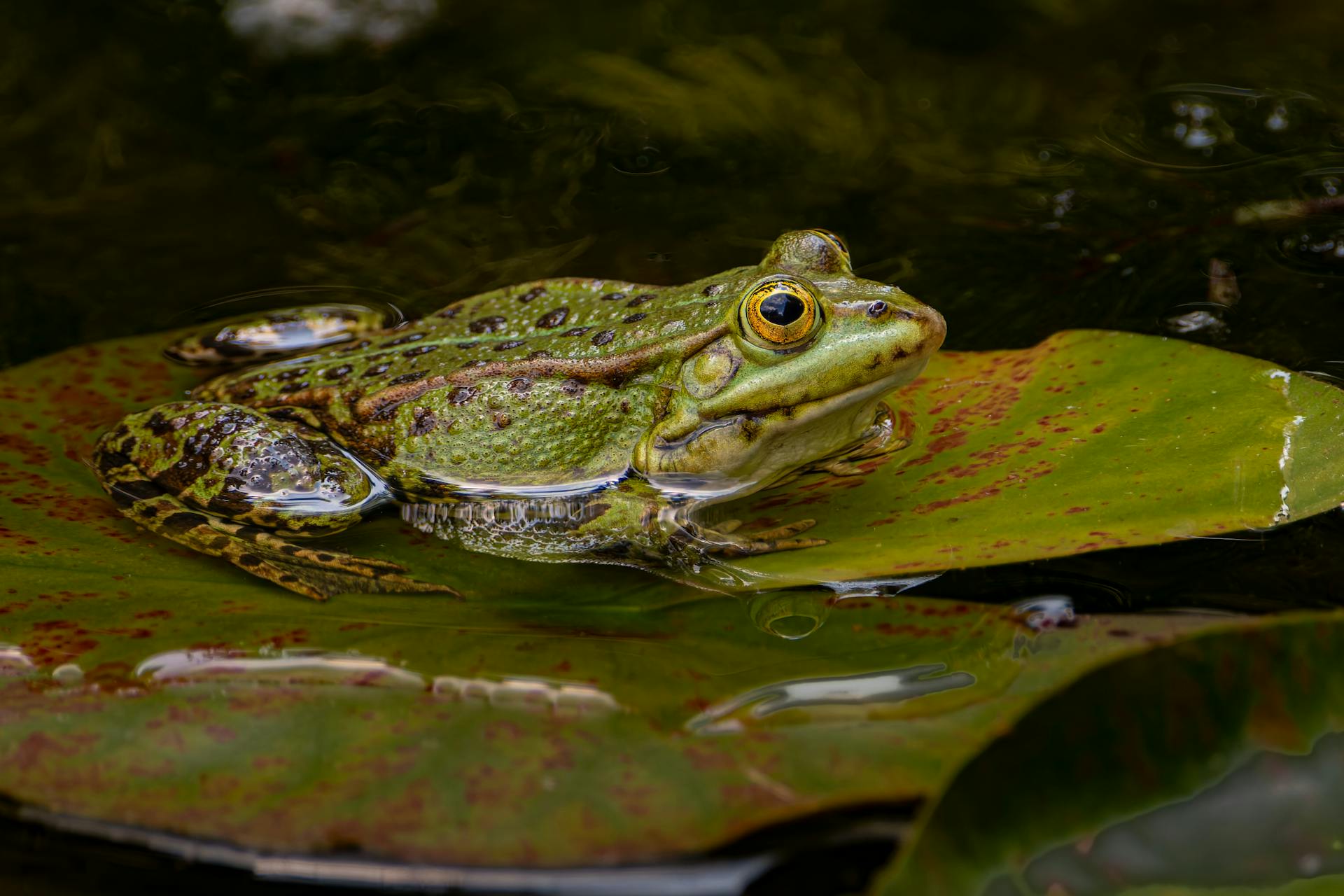
Human activities have a significant impact on amphibian populations. Habitat destruction is a major threat, with deforestation and urbanization leading to the loss of natural habitats.
The chytrid fungus, a disease that affects amphibians, has been linked to human activities such as the introduction of invasive species and climate change. This fungus has caused widespread declines in amphibian populations.
Amphibians are also vulnerable to pollutants in the water, such as pesticides and heavy metals, which can cause birth defects and other health problems.
Suggestion: National Amphibian Conservation Center
Human Impact on Amphibians
Amphibians are more susceptible to pollution than other groups because their skin is permeable, allowing toxins to invade critical organs.
Climate change is not the only stressor on amphibian populations, and increasing UV-B radiation is thought to cause genetic damage in amphibians.
Toxins from common insecticides, pesticides, and herbicides like Roundup can cause developmental problems in amphibians, including external deformities and damage to the central nervous system.
Consider reading: Life Cycle of Amphibians
Amphibians are highly susceptible to common pollutants, and their extinction rates are over 200 times the global average.
A related pathogen, fungus, or disease often provides the final blow to an amphibian population that has been weakened by environmental changes or pollution.
The loss of amphibians will have a direct impact on a broad part of the food chain, as they are an important part of the diet of many species of reptiles, birds, and mammals.
Amphibians are an important bellwether of global change, and their extinction rates are a warning sign for the impact of human activities on global diversity.
There are more than 7,000 amphibian species on Earth, including frogs, toads, caecilians, newts, mudpuppies, and hellbenders.
Amphibians are the most ancient group of terrestrial vertebrates surviving today, with origins reaching back more than 300 million years.
Amphibian Genetics and Evolution
Amphibians have a unique genetic makeup that allows them to thrive in both aquatic and terrestrial environments. Their genetic diversity is a result of their ability to undergo metamorphosis, a process that transforms them from aquatic larvae to air-breathing adults.
Some amphibians, like the African clawed frog, have a diploid number of chromosomes, meaning they have two sets of chromosomes in their cells. This is in contrast to humans, who have a diploid number of 46 chromosomes.
The evolution of amphibians is closely tied to the evolution of their environments. As continents drifted apart, amphibians adapted to new habitats and developed distinct characteristics.
Amphibians have a relatively slow rate of evolution compared to other animals, likely due to their complex life cycle and the need for precise environmental conditions to undergo metamorphosis.
Zoonoses and Amphibians
Amphibians can carry zoonotic diseases, which can be transmitted to humans through contact with their bodily fluids or contaminated environments.
Some amphibians, like frogs, can carry the chytrid fungus, a deadly disease that has caused mass die-offs in wild populations.
This fungus can be transmitted to humans through skin contact with infected amphibians, causing skin lesions and other health problems.
The chytrid fungus is a significant threat to amphibian populations worldwide, and its impact on human health is still being studied.
Amphibians can also carry bacteria like Salmonella and E. coli, which can cause food poisoning in humans if contaminated food or water is consumed.
In some cases, amphibians can even carry parasites like tapeworms and liver flukes, which can infect humans if ingested.
It's essential for people who handle amphibians, like pet owners or researchers, to take precautions to prevent the transmission of zoonotic diseases.
These precautions include wearing gloves, washing hands thoroughly, and keeping environments clean and free of contamination.
Frequently Asked Questions
What does it mean when humans are amphibians?
Humans are considered amphibians because they have a dual nature, consisting of a spiritual aspect that is eternal and an animalistic aspect that is subject to change and time. This duality makes humans unique, with the potential for spiritual growth and transformation amidst the flux of their physical lives.
Why does Screwtape call humans amphibians?
Screwtape calls humans "amphibians" because they have both a physical body and a spiritual soul, existing in different realms. This dual nature is the source of the trouble that arises when humans forget or confuse their two distinct aspects.
Featured Images: pexels.com