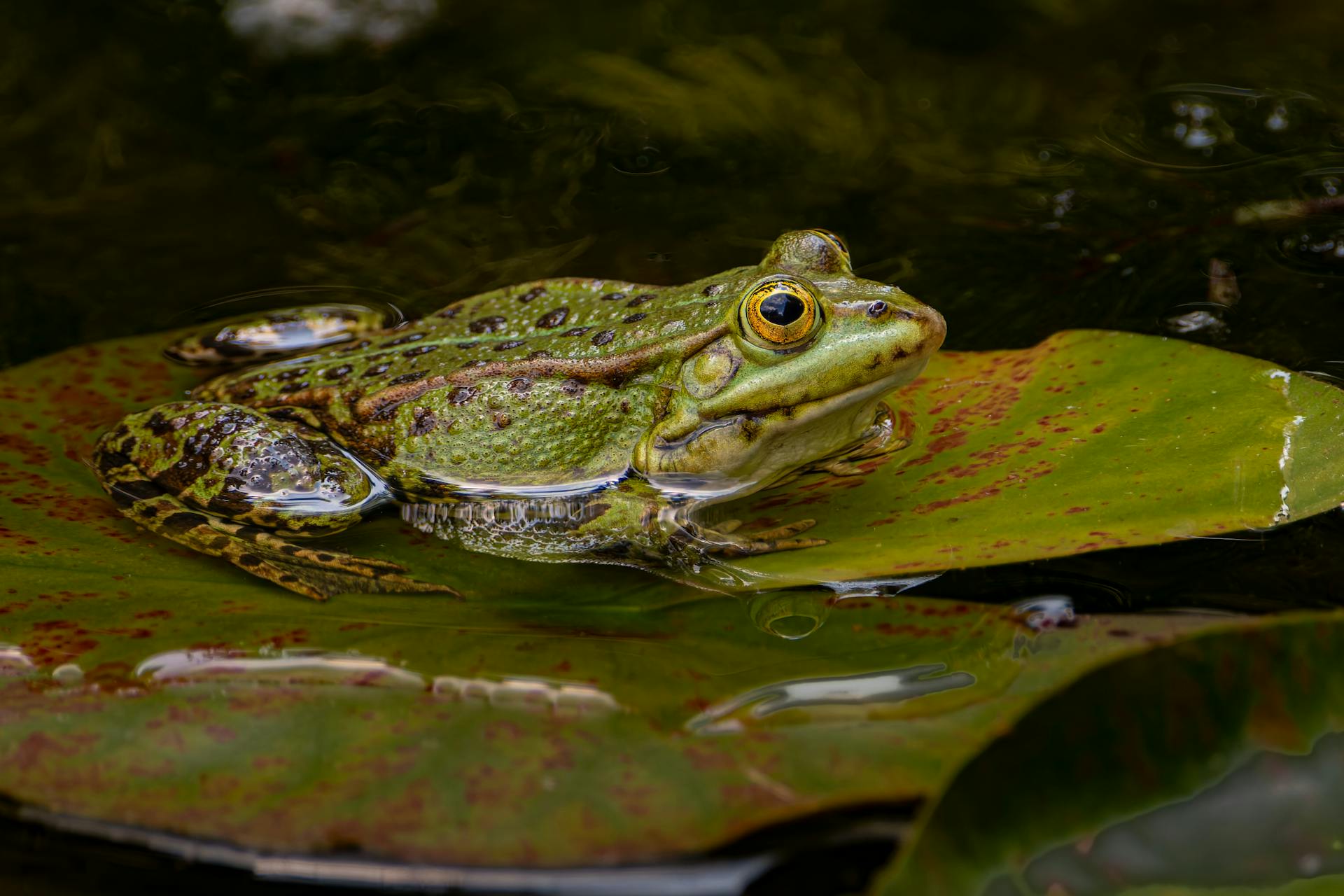
The life cycle of amphibians is a fascinating process that spans from egg to adult. Amphibians typically lay their eggs in water, which hatch into aquatic larvae after several weeks. These larvae go through a process called metamorphosis, where they transform into air-breathing adults.
One of the most notable changes during metamorphosis is the development of lungs and the loss of gills. This process can take anywhere from a few weeks to several months, depending on the species.
Amphibians undergo a dramatic transformation from eggs to adults, and it's a process that's crucial to their survival.
Life Cycle
Amphibians have a unique life cycle that involves a dramatic transformation from aquatic eggs and larvae to terrestrial or semiaquatic juveniles and adults.
Many amphibians lay large numbers of eggs in water, with some species like the tiger salamander depositing over 5,000 eggs at a time.
Egg size and water temperature play a crucial role in determining the development time of the embryo, with warmer water leading to faster development.
Some amphibian eggs can take up to 30 to 40 days to hatch in cold water, while others may hatch in just one or two days in warm water.
As the larvae grow and develop, they undergo a series of dramatic changes, including the formation of limbs, lungs, and other essential organs.
The transition from larval to adult stage is known as metamorphosis, a process that involves the transformation of the body's physiology and biochemistry.
Stage 1: Egg
Frog eggs are quite remarkable, with some species laying up to 45,000 eggs at a time, like the large bullfrog.
The eggs of many anuran species can develop in just one or two days in warm water, but it can take up to 40 days for eggs deposited in cold water to hatch.
Frog eggs are unique in that they have no solid outer shell, instead consisting of a yolky center surrounded by a matrix of protein called albumen.
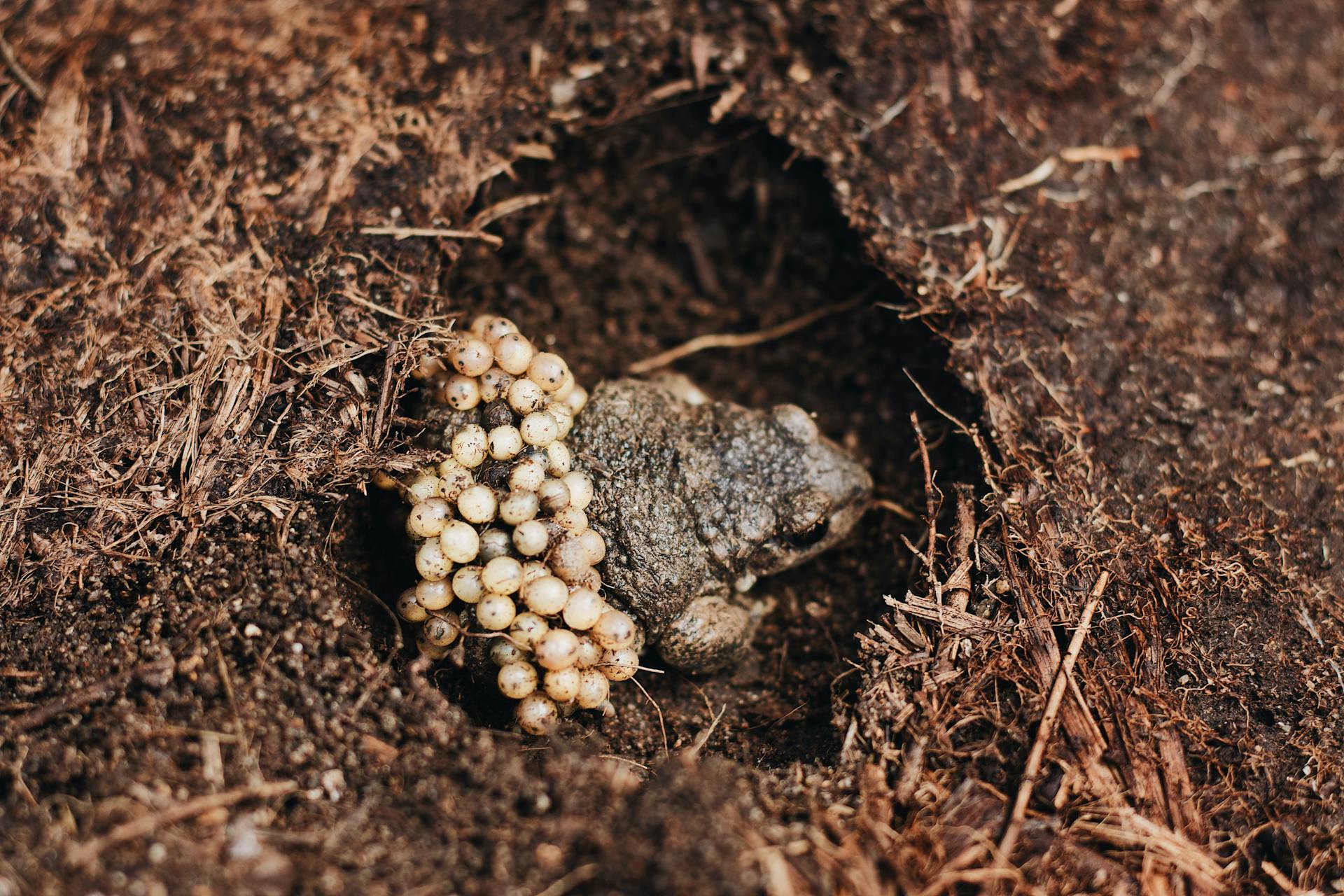
Female frogs can lay up to 4,000 eggs, which they deposit in large clumps known as "egg masses" to increase the chances of some of their offspring surviving to adulthood.
Frogs tend to lay their eggs in vegetation near the surface of the water for protection, and the gelatinous albumen coating helps the eggs to stick to surfaces.
The eggs remain stuck in place for one to three weeks as the embryos mature, developing internal organs, gills, and a strong tail before leaving the egg.
Stage 4: Adult Frog
Most metamorphosed frogs are well adapted for terrestrial life, but they still need access to water.
Some species only require water to breed, while others live close to ponds and lakes to shelter from predators and prevent drying out.
Other frog species, such as the African dwarf frog and the African clawed frog, remain aquatic throughout their entire lives.
Adult frogs are carnivores by nature, and their diet varies depending on size and species.
Their diet can range from insects and spiders to small lizards, snakes, and other frogs.
Frogs and toads undergo a dramatic transformation during metamorphosis, and their bodies change in many ways to adapt to their new lifestyle.
This transformation can happen in as little as a day, where they develop a big jaw, lose their gills, and grow eyes and legs.
Adult frogs have a unique way of eating, with a big jaw and a tongue that helps them catch their prey.
They also have a specialized digestive system that allows them to eat a variety of foods.
In some species, adult frogs only require water to breed, but they still need to live close to ponds and lakes to shelter from predators and prevent drying out.
The Australian Green Frog's life stages follow a normal embryotic development within the class amphibia life cycle: egg - tadpole - metamorph - adult.
This means that they go through the same life stages as other frogs, but with some unique adaptations to their environment.
Adult frogs can be found in various habitats, including ponds, dams, and streams, where they live among vegetation and eat insects, spiders, small lizards, snakes, and other frogs.
Reproduction
Reproduction is a crucial part of an amphibian's life cycle, and it's quite fascinating to learn about.
Frogs can take up to four years to reach sexual maturity.
Males develop a specialized vocal sac, which allows them to call and attract mates.
Females are typically larger than males at sexual maturity, and in some species, females can be as much as three times larger than males!
Male frogs may also develop bright colors during the breeding season to show off their good health.
Females of some species will carry their mates around for long periods before laying their eggs.
The male typically grasps the female in an embrace known as “amplexus” and holds on while the female deposits her eggs, fertilizing them externally in the process.
Related reading: Can Dogs Develop Allergies Later in Life
Metamorphosis and Development
Metamorphosis is a radical transformation that amphibians undergo as they transition from a larval to an adult stage. This process is controlled by hormones and can involve dramatic changes to an animal's physiology, biochemistry, and structure.
In anurans, such as frogs and toads, metamorphosis is a sudden and complete transformation from a tadpole to a adult form. Limbs develop, the tail is resorbed, and the skin becomes thicker. Gills disappear, and lungs and pulmonary ventilation develop.
During metamorphosis, the urogenital system is also modified. A mesonephric or opisthonephric kidney replaces the degenerating rudimentary pronephric kidney, and gonads and associated ducts appear and begin their maturation.
In some amphibian species, such as salamanders, metamorphosis is not as dramatic. The skin thickens, dermal glands develop, and the caudal fin is resorbed. Gills are resorbed, and gill slits close as lungs develop and branchial circulation is modified.
Here's a list of the main changes that occur during metamorphosis:
- Limbs develop
- Tail is resorbed
- Skin becomes thicker
- Gills disappear
- Lungs and pulmonary ventilation develop
- Urogenital system is modified
- Gonads and associated ducts appear and mature
The timing and rate of developmental events can also be altered, leading to heterochrony. This is a widespread feature in amphibian evolution, particularly in salamanders, where structures can begin to develop sooner or later, or continue to develop beyond the previous embryological sequence.
Amphibian Types
There are three main types of amphibians: frogs, toads, and salamanders.
Frogs are characterized by their long legs and webbed feet, which they use for jumping and swimming.
Toads, on the other hand, have shorter legs and dry, bumpy skin.
Salamanders have a slender body and are often found in aquatic environments.
Some amphibians, like the axolotl, have the unique ability to regrow their limbs.
The American bullfrog is a large and carnivorous frog species.
Specific Species
Frogs and toads undergo a remarkable transformation from tadpoles to adult frogs. Their external gills are covered with a gill sac after a few days, and lungs are quickly formed.
Front legs are formed under the gill sac, and hindlegs are visible a few days later. This is followed by a longer stage where the tadpole lives off a vegetarian diet, using a relatively long, spiral-shaped gut to digest it.
The rapid changes that occur during metamorphosis are truly astonishing, happening in just about a day. The spiral-shaped mouth with horny tooth ridges is resorbed, along with the spiral gut, and a big jaw develops.
Frogs and Toads
Frogs and toads undergo a remarkable transformation from tadpoles to adult frogs. This process, called metamorphosis, can happen in as little as a day.
Their external gills are covered with a gill sac after a few days, and lungs are quickly formed. The newly formed lungs allow the tadpoles to breathe air.
Front legs are formed under the gill sac, and hindlegs are visible a few days later. This is a crucial stage in their development.
Tadpoles use a relatively long, spiral-shaped gut to digest their vegetarian diet. This diet is essential for their growth and development.
Rapid changes in the body can then be observed as the lifestyle of the frog changes completely. The spiral-shaped mouth with horny tooth ridges is resorbed, along with the spiral gut.
The animal develops a big jaw, and its gills disappear along with its gill sac. Eyes and legs grow quickly, and a tongue is formed.
All these changes are accompanied by associated changes in the neural networks. The development of stereoscopic vision is a remarkable example of this.
The tail is reabsorbed a few days later, due to the higher thyroxin concentrations required for tail resorption. This final stage of metamorphosis is a critical part of their development.
Salamanders
Salamanders are incredibly resilient creatures. They can regenerate their limbs, a process made possible by their ability to activate controlled cell death or programmed cell death.
Some salamander species undergo a dramatic transformation when transitioning from aquatic larvae to terrestrial adults. This transformation can be quite a spectacle to witness.
The Axolotl is a fascinating example of a salamander that never develops into a terrestrial adult, a phenomenon known as paedomorphosis.
The Newts
Newts are semi-aquatic amphibians that lay their eggs near a body of water, where their larvae start their lives.
Their development is unique, with no true metamorphosis like some other amphibians. Newt larvae already feed as predators and continue to do so as adults.
Newts have external gills that are never covered by a gill sac, and they are resorbed only just before the animal leaves the water. This allows them to adapt to both aquatic and terrestrial environments.
In newts, the hormone prolactin is required for adaptation to a water phase, while thyroxin is needed for adaptation to the land phase. This hormonal balance is crucial for their survival.
Newts often have an aquatic phase in spring and summer, and a land phase in winter. They can be found in both water and on land, depending on the season.
Australian Green Frog
The Australian Green Frog is a fascinating creature.
They are most commonly found in eastern and south-eastern New South Wales.
These frogs live among vegetation in or at the edges of ponds, dams, and streams.
Their life stages follow a normal embryotic development: egg - tadpole - metamorph - adult.
As a functional common frog, they eat a wide variety of prey, including insects, spiders, small lizards, snakes, and other frogs.
This predatory lifestyle comes with its own set of risks, as many of their prey can also turn predator upon them.
What Is a Frog?
Frogs have a unique life cycle with four distinct stages: egg, larval (tadpole), metamorphosis, and adulthood.
The egg phase is where it all begins, but sadly, only a small percentage of young frogs make it to adulthood, with a survival rate of around four percent.
Frogs start as eggs, which are laid by their mothers in water, and then undergo a transformation into tadpoles.
As tadpoles, they have gills for breathing and a tail for swimming, but they don't have lungs or limbs yet.
After a few weeks or months, the tadpoles go through a process called metamorphosis, where they transform into frogs with lungs, limbs, and a new body shape.
This transformation is a remarkable process that's crucial for the frog's survival.
Here are the four stages of a frog's life cycle:
- Egg phase
- Larval (tadpole) phase
- Metamorphosis (tadpole to frog)
- Adulthood
Unique Features
One of the coolest things about amphibians is their unique features that set them apart from other animals.
Amphibians undergo a dramatic transformation from egg to tadpole to adult, a process called metamorphosis.
Their skin is smooth and moist, which helps them to breathe and absorb water.
Some amphibians, like the African clawed frog, have webbed feet that allow them to swim quickly and efficiently.
Amphibians have a three-chambered heart, which is different from the four-chambered heart found in mammals and birds.
Their life cycle is closely tied to water, and they often lay their eggs in aquatic environments.
Tadpole and Larval Stages
Tadpoles hatch from eggs after one to three weeks, depending on water temperature. They initially live off the yolk that stays with them, but after a few days, they need to feed.
Tadpoles are fully aquatic, living in water, and lack lungs to breathe air. They have simple gills instead and paddle-shaped tails to help them swim.
Frog and toad tadpoles feed on plant matter, while newt tadpoles eat microorganisms like freshwater plankton. Predatory tadpoles will happily eat anything small enough to be swallowed, including other tadpoles.
Tadpoles have many predators, such as fishes, dragonfly larvae, and even other tadpoles. Their main job is to eat as much as they can to provide energy for growth.
Here are the stages of a tadpole's life:
- Infant tadpoles rely on their egg's nutritious yolk until their mouthparts develop.
- Tadpoles move into the "swimming" phase and start to use their tail to swim and actively forage for food.
- Tadpoles develop teeth and may start to eat live prey such as insects.
- Limbs sprout from the tadpole's body as it begins its metamorphosis.
Tadpoles can consume a range of foods, depending on their size and species. Many smaller tadpoles feed on algae or sift through detritus, while larger ones eat live prey.
Amphibians
Amphibians have a unique way of developing, starting with eggs laid in water that hatch into larvae with external gills.
These larvae, found in frogs, toads, and newts, are adapted to an aquatic lifestyle and will eventually develop pulmonary respiration.
Newt larvae start a predatory lifestyle, while tadpoles mostly scrape food off surfaces with their horny tooth ridges.
Metamorphosis in amphibians is regulated by thyroxin concentration in the blood, which stimulates metamorphosis, and prolactin, which counteracts its effect.
After metamorphosis, the lateral line organ becomes redundant and is resorbed by apoptosis, a process of controlled cell death.
Tadpoles have many adaptations to specific ecological circumstances, such as horny ridges for teeth, whiskers, and fins, which become redundant after metamorphosis.
Frequently Asked Questions
What are the 7 stages of the frog's life cycle?
There are actually only 4 stages in a frog's life cycle: egg, tadpole, young frog, and adult frog. The stages are not typically numbered as 7, but rather described as distinct developmental phases.
What are the 5 stages of the frog life cycle?
The frog life cycle consists of five stages: egg, tadpole, tadpole with legs, froglet, and frog. This process begins with egg-laying and ends with the development of a fully formed frog.
Featured Images: pexels.com