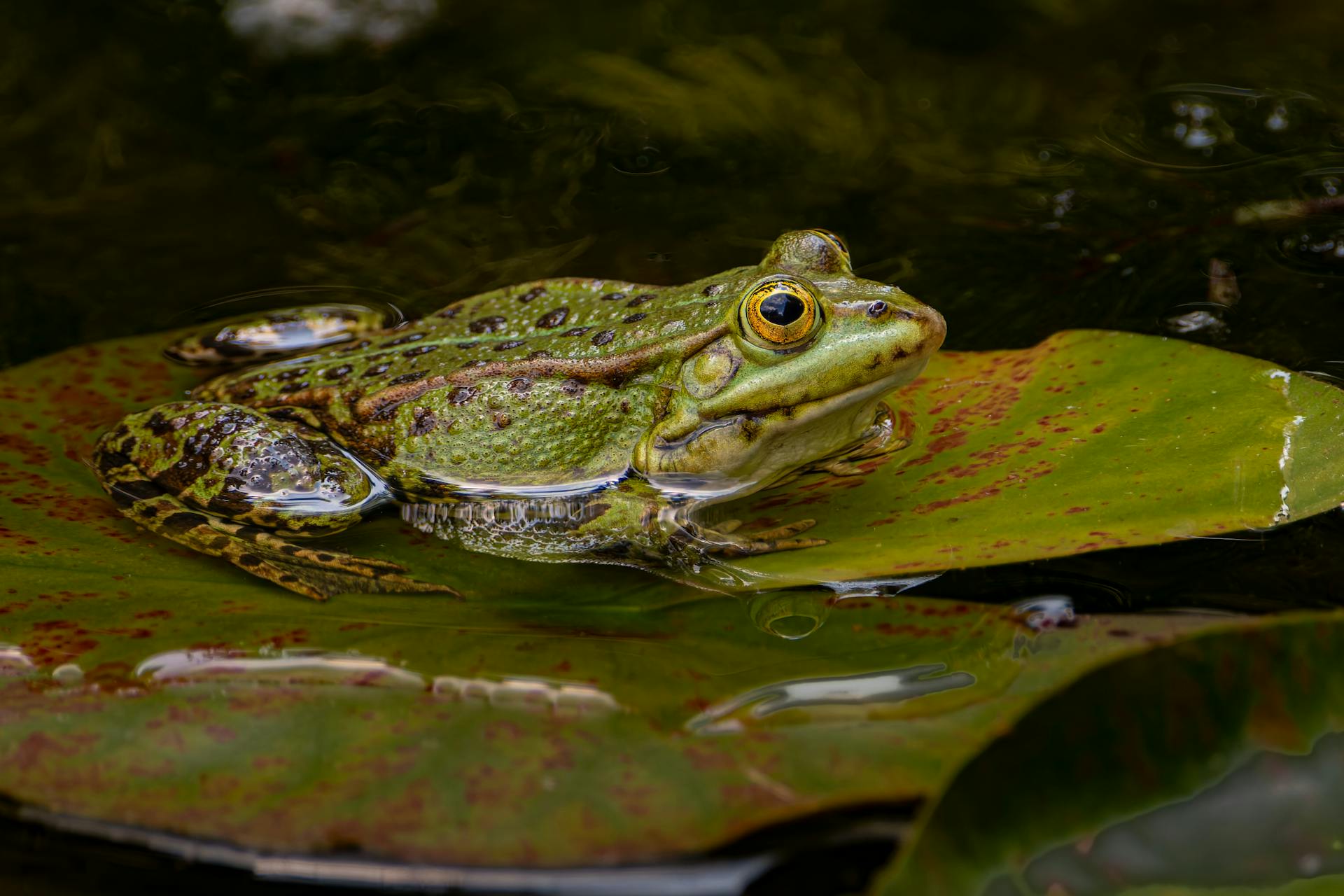
The National Amphibian Conservation Center is a vital hub for protecting species worldwide. It's a one-stop-shop for learning about and preserving the world's amphibians.
The center has a vast collection of amphibian species, with over 50 species currently in their care. This is a remarkable feat, considering the decline of many amphibian populations due to habitat loss and disease.
The center's team of experts works tirelessly to develop and implement conservation strategies that make a real difference. Their efforts have already led to the recovery of several endangered species.
One of the center's key initiatives is the Amphibian Species Survival Plan, which aims to breed endangered species in controlled environments. This plan has shown remarkable success, with several species experiencing significant population growth.
You might like: Wildlife Conservation
National Conservation Efforts
The Detroit Zoological Society is helping a species hop back from extinction through its national amphibian conservation center. The center is working to prevent salamanders from going extinct.
Salamanders are born with a larval stage, similar to the tadpole stage of a frog, and undergo metamorphosis, losing their gills and developing legs as they transfer from water to land. This process is critical to their survival.
Almost 50 percent of salamander species are threatened with extinction, according to the International Union for Conservation of Nature (IUCN).
National Conservation Center
The National Amphibian Conservation Center at the Detroit Zoo is doing some amazing work to help salamanders and other amphibians thrive. The center is led by Dr. Ruth Marcec, who is dedicated to preventing these incredible creatures from going extinct.
There are over 600 species of salamanders, and most of them prefer cool, damp places to live, such as under logs or in rock crevices. These critters are often found in a variety of places, including high in trees or living in cool bodies of water.
Salamanders have moist, scale-less skin that helps them intake water, absorb nutrients, and even breathe. This unique skin is one of the key characteristics that distinguishes salamanders from lizards.
Almost 50 percent of salamander species are threatened with extinction, according to the International Union for Conservation of Nature (IUCN). This is a stark reminder of the importance of conservation efforts to protect these incredible animals.
The Appalachian region is home to more salamander species than anywhere else in the world, making it a true hotspot for salamander biodiversity. With almost half of all salamander species listed as threatened or endangered, the Appalachian region has become a primary focus of salamander conservation research and planning.
Detroit Reviews
The National Amphibian Conservation Center in Detroit is a must-visit destination for anyone interested in learning about amphibians. It's located somewhere, but the article doesn't specify the exact address.
Exhibits at the center offer engaging instruction, making it easy for visitors to learn about these fascinating creatures. One exhibit showcases the wonders of metamorphosis, featuring clusters of see-through bullfrog eggs with unhatched tadpoles inside, as well as free-swimming tadpoles and mature animals.
Visitors can also learn about the significance of amphibians in scientific research, including their potential as a source of potent new antibiotics. This is a fascinating area of study that could lead to breakthroughs in medicine.
The center also highlights amphibians' impact on popular culture, from the Chinese "toad in the moon" to French frog legs and American love for Kermit. This diverse representation shows just how integral amphibians are to our shared culture and history.
Amphibian Conservation in Central America
In Central America, the chytrid fungus has been a major threat to amphibian populations. This fungus, also known as Batrachochytrium dendrobatidis (Bd), is deadly to amphibians.
Scientists believe that the spread of chytrid is responsible for mass amphibian extinctions on several continents. The Center for Species Survival is working to develop ex situ assurance colonies for amphibian species at highest risk for extinction.
The goal of these conservation efforts is to find a cure for the amphibian chytrid fungus so that amphibians can be reintroduced to their native habitat. This would require significant research and development, but it's a crucial step towards saving these species.
Amphibian Conservation in North America
The Detroit Zoological Society is helping a species hop back from extinction! This is a great example of the important work being done in amphibian conservation.
The Detroit Zoological Society's national amphibian conservation center is making a real difference in the lives of these incredible creatures.
Some species are on the brink of extinction, but conservation efforts like the one at the Detroit Zoological Society are giving them a second chance.
The Detroit Zoological Society's conservation center is helping a species hop back from extinction, which is a remarkable achievement.
Their work is a testament to the power of conservation and the impact one organization can have on the environment.
Breeding Programs
The National Amphibian Conservation Center at the Detroit Zoo is making significant strides in breeding programs for imperiled salamanders, with a recent grant from the Institution of Museum and Library Sciences (IMLS) providing $500,000 for this purpose.
Natural breeding is the first goal when breeding animals for conservation, but it can be extremely challenging, especially for species like the eastern tiger salamander, which responds to changes in air pressure and temperature when seasonal rain storms occur.
For another approach, see: When Is National Dog Show 2023
In vitro fertilization is a technique used to assist salamanders and other amphibians in breeding, where sperm is collected from males and eggs are collected from females, then combined in a controlled environment to produce offspring.
The training session for other partners on the grant involved eastern tiger salamanders, with nearly 100 babies produced, demonstrating the success of the training.
Expertise Sharing for Accredited Zoos
Accredited zoos can benefit from sharing their expertise with one another to improve breeding programs.
By participating in collaborative breeding programs, accredited zoos can increase the genetic diversity of their animal populations.
This can be achieved through the exchange of animals, data, and knowledge between zoos.
For example, the European Endangered Species Programme (EEP) allows accredited zoos to collaborate on breeding programs for endangered species.
The EEP has been successful in increasing the population of the European bison, with over 6,000 individuals in 2020.
Accredited zoos can also learn from each other's successes and failures through regular meetings and workshops.
By sharing their experiences, accredited zoos can improve their breeding programs and better care for their animals.
Regular veterinary check-ups and health monitoring are crucial for the success of breeding programs.
Accredited zoos must also ensure that their breeding programs are scientifically sound and meet the needs of the animals.
Breeding Eastern Tiger Salamanders
Breeding Eastern Tiger Salamanders is a challenging task, but with the right techniques, it's possible to increase the chances of success. The Detroit Zoological Society, one of the primary partners on a recent $500,000 National Leadership Grant, has been working to improve reproduction within captive assurance colonies of imperiled salamanders.
Eastern tiger salamanders are regionally threatened and endangered in various areas of North America, making conservation efforts crucial. These salamanders are very difficult to breed in human care due to their unique breeding behavior, which is triggered by changes in air pressure and temperature similar to those caused by seasonal rain storms.
In vitro fertilization is a technique used to assist salamanders and other amphibians in breeding. The process involves collecting sperm from males by giving them a massage and then placing it on top of eggs in a small dish.
Cryopreservation, or freezing and long-term storage, of salamander sperm is another technique that's being used to aid in breeding. This allows for the preservation of sperm for future use, increasing the chances of successful breeding.
Dr. Ruth Marcec, the director of the National Amphibian Conservation Center at the Detroit Zoo, has been instrumental in training other conservationists in these techniques. Her research on salamander reproductive physiology and techniques to help them breed has been the basis for the recent IMLS grant proposal.
Frog Conservation Status
The Detroit Zoological Society is helping a species hop back from extinction at the national amphibian conservation center.
Unfortunately, many amphibian species are still at risk due to the spread of chytrid, a deadly fungus.
Scientists believe that chytrid is responsible for mass amphibian extinctions on several continents.
This fungus causes a skin disease that is deadly to amphibians.
In 1999, researchers discovered the fungus, which is referred to as Batrachochytrium dendrobatidis (Bd).
The Center for Species Survival is working to develop ex situ assurance colonies for amphibian species at highest risk for extinction.
This will help ensure the survival of these species until a cure for the fungus can be found.
Featured Images: pexels.com