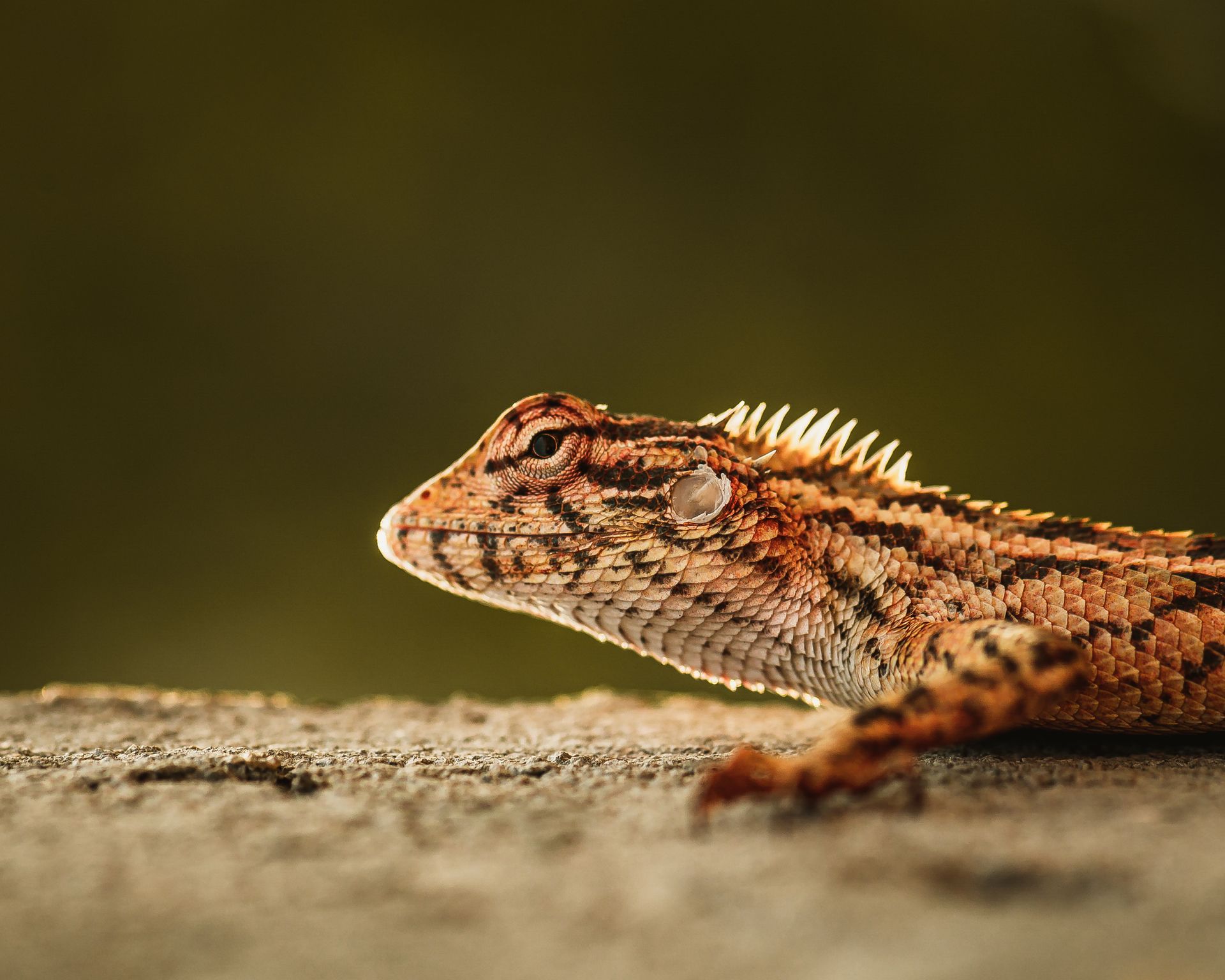
So you want to know about Agamidae lizards? Well, let's start with the basics - they're a family of lizards that are native to Asia and Australia.
Agamidae lizards are carnivores, which means they primarily feed on insects, worms, and other small invertebrates.
They're known for their vibrant colors and patterns, which serve as a form of communication and camouflage in the wild.
Readers also liked: Legless Lizards
Classification
The Agamidae family is divided into six subfamilies, which are widely recognized by herpetologists. These subfamilies are Agaminae, Amphibolurinae, Draconinae, Hydrosaurinae, Leiolepidinae, and Uromastycinae.
Agaminae is found in Africa, Europe, and South Asia, while Amphibolurinae is found in Australia and New Guinea, with one species in Southeast Asia. Draconinae is found in South and Southeast Asia, and Hydrosaurinae is found in Papua New Guinea, the Philippines, and Indonesia.
Here's a breakdown of the 64 genera within the Agamidae family:
- Acanthocercus (15 species)
- Acanthosaura (20 species)
- Agama (47 species)
- Agasthyagama (2 species)
- Amphibolurus (4 species)
- Aphaniotis (3 species)
- Bronchocela (15 species)
- Bufoniceps (1 species)
- Calotes (29 species)
- Ceratophora (6 species)
- Chelosania (1 species)
- Chlamydosaurus (1 species)
- Complicitus (1 species)
- Cophotis (2 species)
- Coryphophylax (2 species)
- Cristidorsa (2 species)
- Cryptagama (1 species)
- Ctenophorus (38 species)
- Dendragama (4 species)
- Diploderma (47 species)
- Diporiphora (28 species)
- Draco (41 species)
- Gonocephalus (17 species)
- Gowidon (1 species)
- Harpesaurus (6 species)
- Hydrosaurus (5 species)
- Hypsicalotes (1 species)
- Hypsilurus (18 species)
- Intellagama (1 species)
- Japalura (8 species)
- Laodracon (1 species)
- Laudakia (13 species)
- Leiolepis (10 species)
- Lophocalotes (2 species)
- Lophognathus (2 species)
- Lophosaurus (3 species)
- Lyriocephalus (1 species)
- Malayodracon (1 species)
- Mantheyus (1 species)
- Microauris (1 species)
- Moloch (1 species)
- Monilesaurus (4 species)
- Otocryptis (2 species)
- Paralaudakia (8 species)
- Pelturagonia (5 species)
- Phoxophrys (1 species)
- Phrynocephalus (36 species)
- Physignathus (1 species)
- Pogona (6 species)
- Psammophilus (2 species)
- Pseudocalotes (23 species)
- Pseudocophotis (2 species)
- Pseudotrapelus (6 species)
- Ptyctolaemus (3 species)
- Rankinia (1 species)
- Saara (3 species)
- Salea (2 species)
- Sarada (3 species)
- Sitana (15 species)
- Trapelus (13 species)
- Tropicagama (1 species)
- Tympanocryptis (23 species)
- Uromastyx (15 species)
- Xenagama (4 species)
Systematics and Distribution
The Agamidae family of lizards has a fascinating systematics and distribution. Very few studies have been conducted on this family, with the first comprehensive assessment by Moody (1980) being a significant milestone.
The distribution of agamids is quite curious, covering much of the Old World, including continental Africa, Australia, southern Asia, and sparsely in warmer regions of Europe. They are absent from Madagascar and the New World.
One notable difference in distribution is that agamids are found in areas where iguanids are not, and vice versa. This faunal divide is also seen between the boas and pythons.
A few notable studies have been conducted on the Agamidae, including those by Frost and Etheridge (1989), Macey et al. (2000), Honda et al. (2000), and Joger (1991).
Agamids show a unique distribution pattern, which is worth noting:
- Found in: Continental Africa, Australia, southern Asia, and sparsely in warmer regions of Europe
- Absent from: Madagascar and the New World
Taxonomy
Taxonomy is a crucial aspect of understanding the Agamidae family. The Agamidae family is divided into six subfamilies, which are Agaminae, Amphibolurinae, Draconinae, Hydrosaurinae, Leiolepidinae, and Uromastycinae.
These subfamilies can be further split into 64 genera, each with its own unique characteristics. For example, the genus Acanthocercus has 15 species, while the genus Agama has 47 species.
The taxonomy of the Agamidae family is complex and has been studied by various researchers. Moody (1980) conducted a comprehensive assessment of the family, which was later expanded by Frost and Etheridge (1989). Other studies have focused on mitochondrial DNA loci and sampling across the Agamidae family.
Here is a list of some of the genera within the Agamidae family, along with the number of species in each genus:
- Acanthocercus (15 species)
- Acanthosaura (20 species)
- Agama (47 species)
- Agasthyagama (2 species)
- Amphibolurus (4 species)
- Aphaniotis (3 species)
- Bronchocela (15 species)
- Bufoniceps (1 species)
- Calotes (29 species)
- Ceratophora (6 species)
- Chelosania (1 species)
- Chlamydosaurus (1 species)
- Complicitus (1 species)
- Cophotis (2 species)
- Coryphophylax (2 species)
- Cristidorsa (2 species)
- Cryptagama (1 species)
- Ctenophorus (38 species)
- Dendragama (4 species)
- Diploderma (47 species)
- Diporiphora (28 species)
- Draco (41 species)
- Gonocephalus (17 species)
- Gowidon (1 species)
- Harpesaurus (6 species)
- Hydrosaurus (5 species)
- Hypsicalotes (1 species)
- Hypsilurus (18 species)
- Intellagama (1 species)
- Japalura (8 species)
- Laodracon (1 species)
- Laudakia (13 species)
- Leiolepis (10 species)
- Lophocalotes (2 species)
- Lophognathus (2 species)
- Lophosaurus (3 species)
- Lyriocephalus (1 species)
- Malayodracon (1 species)
- Mantheyus (1 species)
- Microauris (1 species)
- Moloch (1 species)
- Monilesaurus (4 species)
- Otocryptis (2 species)
- Paralaudakia (8 species)
- Pelturagonia (5 species)
- Phoxophrys (1 species)
- Phrynocephalus (36 species)
- Physignathus (1 species)
- Pogona (6 species)
- Psammophilus (2 species)
- Pseudocalotes (23 species)
- Pseudocophotis (2 species)
- Pseudotrapelus (6 species)
- Ptyctolaemus (3 species)
- Rankinia (1 species)
- Saara (3 species)
- Salea (2 species)
- Sarada (3 species)
- Sitana (15 species)
- Trapelus (13 species)
- Tropicagama (1 species)
- Tympanocryptis (23 species)
- Uromastyx (15 species)
- Xenagama (4 species)
Agamidae
The Agamidae family is a fascinating group of lizards. They are found over much of the Old World, including continental Africa, Australia, southern Asia, and sparsely in warmer regions of Europe.
The agamids show a curious distribution, being absent from Madagascar and the New World. This is the opposite of the distribution of the iguanids, which are found in just these areas, but absent in areas where agamids are found.
The first comprehensive assessment of the Agamidae was conducted by Moody in 1980, followed by a more inclusive assessment by Frost and Etheridge in 1989. Subsequent studies were based on mitochondrial DNA loci by Macey et al. in 2000 and Honda et al. in 2000.
The agamids are not as well investigated as the Iguanidae, with few studies focused on clades within the family. However, some species, such as the bearded dragon and the earless dragon, have been studied in more detail.
Here are some key characteristics of the Agamidae family:
- Agamidae
- Extant Cenomanian first appearances
- Lizard families
- Taxa named by John Edward Gray
Angle Headed Agama
The Angle Headed Agama is a fascinating species, native to the Indochina region and the Malay peninsula. These lizards thrive in fog-dampened mountain forests and tea plantations, up to elevations of 2,600 feet.
Their sharp-spined neck and back comb are distinctive identifying characteristics. They live in trees and bushes, often in loose groups, and are diurnal.
To keep an Angle Headed Agama as a pet, you'll need a cube-shaped terrarium with plenty of plants from the rain forest of Southeast Asia. Branches, twigs, and bark will also provide a natural environment.
A temperature range of 68° to 77°F by day and 59° to 68°F by night is ideal. Humidity levels should be high in the morning, around 100 percent, and then gradually decrease to 70 to 90 percent.
These lizards are insectivores and will feed on insects and spiders. They will also drink water from the plants, so be sure to spray them with water once a day.
Here's a quick rundown of the Angle Headed Agama's stats:
Spiny Agama
The Spiny Agama is a large, flattened lizard with very spiny tails, found in the Sahara Desert of northern Africa.
They are gray, yellowish, or reddish in color and have six recognized subspecies.
These lizards inhabit rocky slopes in small mountain valleys with rich vegetation and dig extensive burrows to retreat into when threatened.
They block off the entrance with their very spiny, sharp, and muscular tails, which they thrash vigorously from side to side to discourage predators.
Spiny Agamas are vegetarians, eating flower buds of a wide variety of plants, and are especially fond of yellow flowers.
In droughts, they even subsist by eating wood, and their powerful jaws can shear and crush even hard grains.
They also eat insects such as beetles, when they are available.
Courtship takes place from April to June, and a complete courtship sequence may take from two hours to an entire day.
Females lay two clutches of about 23 eggs in a lateral chamber dug off the main tunnel at a depth of about 23.6 in (60 cm).
Hatchlings appear in September or October and have a total length of about 3 in (75 mm).
These young lizards eat both insects and flowers and grow rapidly, reaching 8 in (20 cm) in their first year of life.
Spiny Agamas are kept in captivity in terraria and are known to live in colonies of about 20 individuals.
Species
The Agamidae family is made up of over 300 species of lizards.
These species can be found in a wide range of habitats, from deserts to rainforests.
Some species, like the thorny devil, have evolved unique adaptations to survive in their environments.
The thorny devil's spiky skin helps protect it from predators.
These lizards are native to the deserts and dry forests of Australia.
Their ability to change color also helps them blend in with their surroundings.
Many species of Agamidae are known for their vibrant colors and patterns.
The zebra-tailed lizard is a great example of this, with its black and white stripes.
Some species, like the frill-necked lizard, have frills on their necks that they can fan out when threatened.
This frill can make the lizard appear larger and more intimidating to predators.
Agamidae species can be found in many parts of the world, including Asia, Africa, and Australia.
They are highly adaptable and can thrive in a variety of environments.
Physical Characteristics and Habitat
Agamids are small to large diurnal terrestrial lizards, ranging from commonplace to bizarre to spectacular. They have movable eyelids, legs, and irregularly shaped scales that are rough, spiny, or keeled in many species.
Some agamids have enlarged scales scattered across their dorsal surface, and others have dorsal crests of enlarged scales along their spines. Tails do not regenerate in any species.
Agamids can be found in a variety of habitats, including sandy and rocky deserts, savannas, thornscrub, and dry forests. They also thrive in open coastal tropical areas with sandy soils.
Males and females of some species exhibit striking sexual dimorphism in body size and color patterns. For example, the Spiny agama has males with a blue head and bright red nape, while females are drab with orange, brown, and cream splotches.
Physical Characteristics
Agamids are a diverse group of lizards, ranging from small to large in size. They are typically diurnal, terrestrial lizards, but some species are arboreal or saxicolous.
All agamids have movable eyelids and legs. Scales are irregularly shaped and can be rough, spiny, or keeled in many species. Some species have enlarged scales scattered across the dorsal surface.
Enlarged scales can also form dorsal crests along the spines of some agamids. Tails do not regenerate, which is a distinguishing characteristic of this group.
Many agamids possess intrascalar pores, and head scales are usually smooth and not enlarged. The external ear opening and tympanic membrane is conspicuous in most agamids.
Some agamids exhibit striking sexual dimorphism in body size, as well as dichromatism, or sexual dimorphism in color patterns. This is seen in species such as the bearded dragon and the leaf-horned agama.
Spiny agamas have a distinctive appearance, with males having a blue head, a bright red nape, and yellow shoulders, while females are drab with orange, brown, and cream splotches.
Flying Lizard
The flying lizard is a slender, long-legged lizard with folding ribs that expand to form a winglike structure.
These lizards can be found in various habitats, including open forests and dense rainforests of both lowlands and highlands.
They inhabit the Indonesian islands, including Borneo, Java, Sumatra, Sulawesi, and Timor, as well as Thailand, western Malaysia, and the Philippines.
Flying lizards have a unique way of gliding between trees, losing altitude along the way, and can travel as far as 55 yards (50 meters) in one glide.
They use their tails to steer and can rise up and stall at exactly the right moment to make a gentle landing.
When on the ground, flying lizards are clumsy and vulnerable to predators.
Their diet consists almost exclusively of ants and termites.
The wings of males and females are of different colors, allowing them to identify the sex of another at a distance.
Females lay one to four eggs, which are elongated and spindle-shaped with dense calcium carbonate "caps" at each end.
Habitat
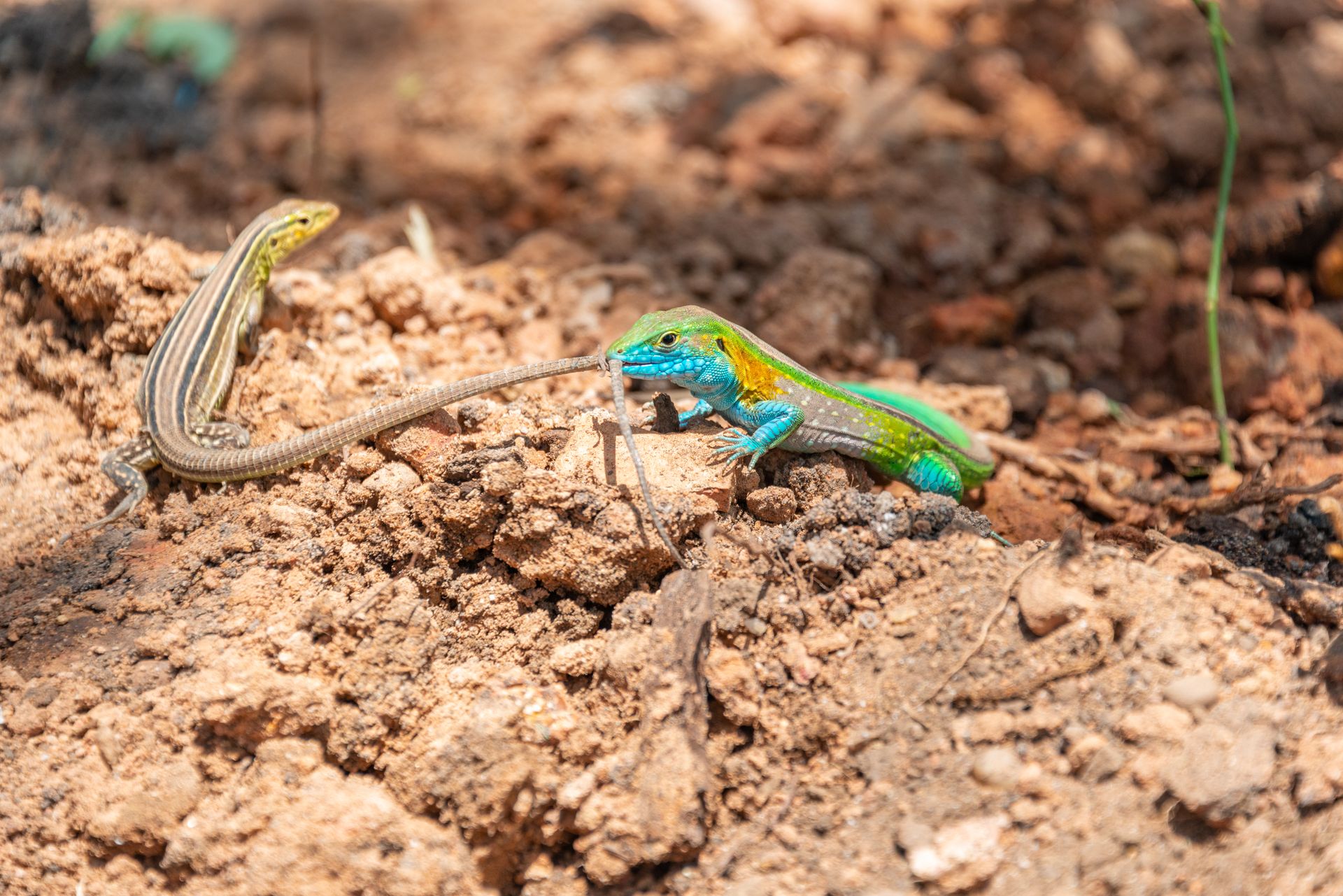
Agamids, a type of lizard, thrive in a variety of habitats, including sandy and rocky deserts, savannas, and dry forest habitats.
They can also be found in open forests, dense rainforests, and low-lying areas of light forest.
In some cases, they inhabit human dwellings and cultivated land, making them adaptable to different environments.
Flying lizards, specifically, are found in open forests and dense rainforests, where they can glide between trees using their "wings" extended.
These lizards are expert hang gliders, able to travel up to 55 yards (50 meters) and land on adjacent trees with ease.
Their habitat also includes red sandy deserts and shrub acacia woodlands.
Here's a breakdown of the habitats where different types of lizards can be found:
The brown garden lizard, another type of agamid, can be found in open habitats, such as light, sun-drenched forests, and even in human-made environments like parks and gardens.
Behavior and Diet
Agamidae, also known as dragon lizards, are primarily herbivores, feeding on leaves, flowers, and fruits.
Their diet is quite varied and can include nectar, pollen, and even small insects on occasion.
In the wild, they have been observed drinking water from puddles and streams.
Some species of Agamidae have been known to eat small amounts of animal matter, such as snails and worms.
They have also been observed eating bird eggs and nestlings on rare occasions.
Agamidae are diurnal, meaning they are active during the day and rest at night.
They are generally solitary animals and only come together for mating or territorial disputes.
In the wild, they are known to be quite territorial and will fiercely defend their territories from other Agamidae.
Evolution and History
The evolutionary history of Agamidae is a fascinating topic. The oldest known unambiguous agamid is Protodraco from the mid-Cretaceous period, dating back around 99 million years ago.
This ancient species is similar to primitive, extant Southeast Asian agamids. Gueragama from the Late Cretaceous of Brazil may also be an agamid, although this is not as well-established as Protodraco.
Interestingly, Jeddaherdan, a supposed agamid from the Late Cretaceous of Morocco, was later shown to be actually a young subfossil of the living genus Uromastyx. This highlights the importance of thorough research and verification in the field of paleontology.
Agamids are derived descendants of ancestors of New World Iguanidae, and they have numerous highly convergent ecological equivalents in the Old World. These equivalents include species such as Phrynosoma and Moloch.
A unique shared derived feature that ties Agamidae to Chamaeleonidae is acrodont dentition, in which teeth are fused to the top of the jawbones and are not replaced after they are formed.
Significance
Agamids play a significant role in controlling insect populations in various habitats.
Some species are kept as pets in terraria, which can be a fun and educational hobby for people of all ages.
Agamids are a vital food source for humans in certain regions, providing a nutritious and sustainable food option.
They are distributed across the central deserts of Australia, where they can be found thriving in their natural habitat.
Reproduction
Agamids are primarily oviparous, meaning they lay eggs. The eggs are often found in damp soil or rotting logs to maintain moisture during incubation.
The clutch size varies significantly, ranging from four to 10 eggs for most species. Most species have a consistent clutch size.
Incubation typically lasts around 6-8 weeks, giving the eggs enough time to develop. The incubation period is a critical aspect of agamid reproduction.
In the Leiolepidinae subfamily, agamids use a unique burrowing system to reach moist soil. This burrowing system is also used for daily or seasonal retreats.
The Leiolepidinae burrow system allows agamids to regulate their body temperature or seek refuge from predators. It's an essential adaptation for their survival.
Frequently Asked Questions
What is the meaning of Agamidae?
Agamidae refers to a family of lizards found in the Old World, characterized by their unique dental structure and diverse habitats. This group includes species like the frilled lizard and flying dragon, known for their insectivorous diet and varied lifestyles.
Are agamids venomous?
Agamids are part of the Toxicofera clade, which includes venomous lizards, but they do not possess venom apparatus themselves. However, some species of agamids have evolved unique defense mechanisms, making them worth exploring further.
Featured Images: pexels.com


