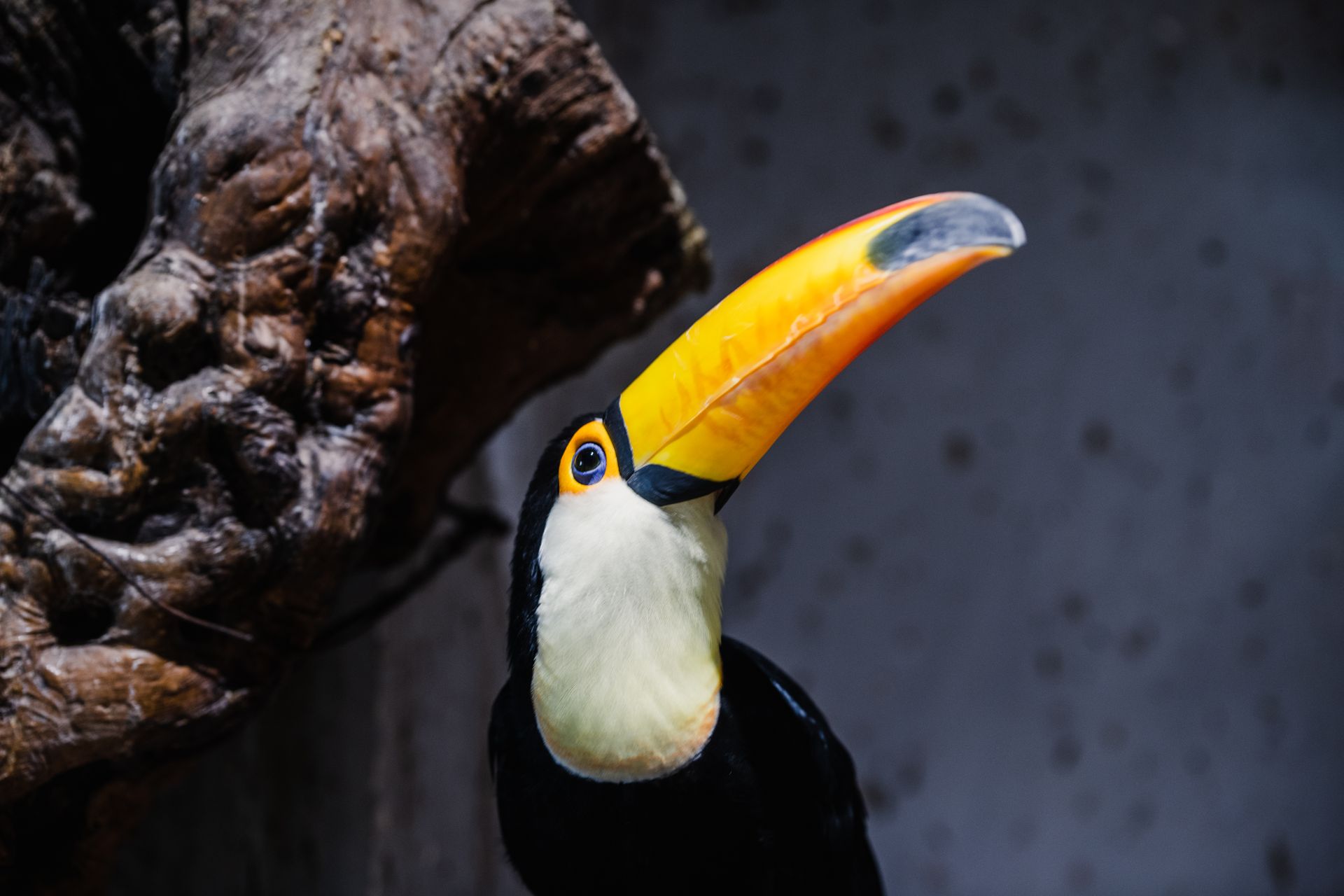
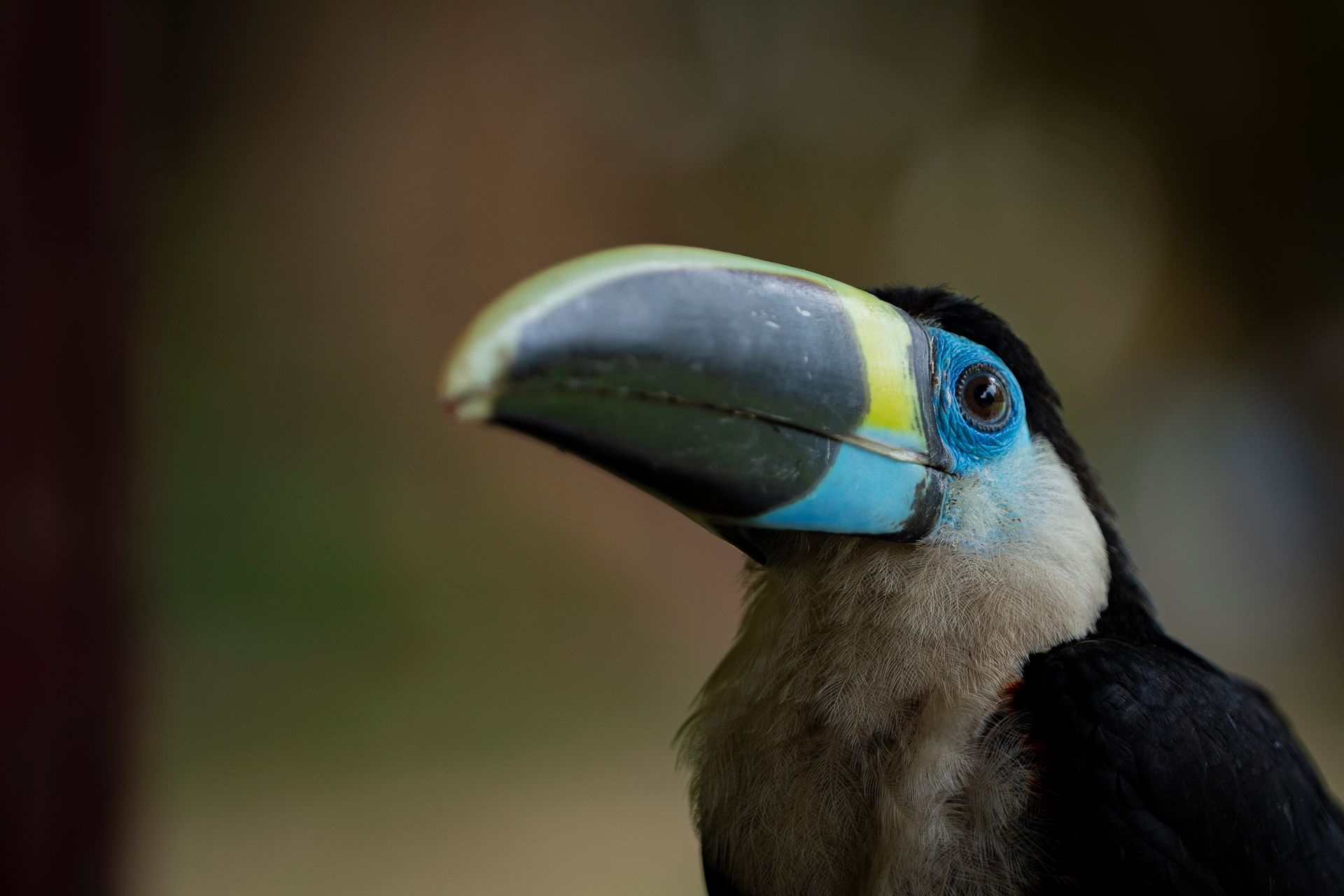
The Yellow-throated Toucan is a vibrant bird species found in the tropical forests of Central and South America. They are known for their bright plumage and distinctive beak.
Their diet consists mainly of fruits, insects, and small reptiles. This varied diet allows them to thrive in their forest habitat.
One of the most striking features of the Yellow-throated Toucan is its oversized beak, which is used for foraging and eating. This unique beak is a key identifier for the species.
They are social birds and are often found in small groups, foraging and interacting with each other in the forest canopy.
Expand your knowledge: White Throated Toucan
Taxonomy and Classification
The yellow-throated toucan has undergone some changes in its classification over the years. Three subspecies are currently recognized.
The "Chestnut-mandibled" toucan, R. a. swainsonii, is one of the subspecies found in the region. It is distributed from southeastern Honduras through Nicaragua, Costa Rica, Panama, and western Colombia to southwestern Ecuador.
Curious to learn more? Check out: Channel Billed Toucan
The "Black-mandibled" toucan, R. a. ambiguus, is another subspecies with a distinct distribution. It is found from southwestern Colombia on the eastern slope of the Andes, through Ecuador to south-central Peru.
A third subspecies, R. a. abbreviatus, is found in northeastern Colombia and northwestern and northern Venezuela. This subspecies was originally described as a separate species but was later reassigned.
These subspecies were once considered separate species, but advances in taxonomy have led to their reclassification. The subspecies R. a. swainsonii differs from R. a. ambiguus by 1.35% in mitochondrial DNA.
Here are the three recognized subspecies of the yellow-throated toucan:
- R. a. swainsonii - "Chestnut-mandibled" toucan
- R. a. ambiguus - "Black-mandibled" toucan (in part)
- R. a. abbreviatus - "Black-mandibled" toucan (in part)
Physical Characteristics
The yellow-throated toucan can grow up to 61 cm long.
Their weight ranges from 584 to 746 grams.
The length of their bill varies between 15.1 and 19.8 cm in males and 12.9 and 16.0 cm in females.
Females' bills are shorter than males' in all three subspecies.
Their wing chord is approximately 20.4 to 24.8 cm long.
The yellow-throated toucan's plumage is mostly black with a maroon tint to the hindneck and upper back.
They have white uppertail coverts and a bright yellow face, throat, and upper breast.
Their vent and undertail coverts are bright red.
The bare skin around their eye is sky blue in the nominate subspecies.
They weigh from 620 to 740 grams.
The yellow-throated toucan's bill has a mostly yellow maxilla with a greenish yellow stripe on the culmen.
Their beak measures approximately 18 cm.
The three subspecies have essentially the same plumage.
Recommended read: Black Mandibled Toucan
Behavior and Diet
The yellow-throated toucan is primarily a fruit eater, with a diet consisting mainly of fruits, as well as small amounts of animal matter such as insects and other arthropods.
They forage mainly in the forest canopy, but also retrieve fallen fruit from the ground, often hopping from branch to branch to reach it.
Individuals may hang upside down to access fruit that's out of reach, and they've even been known to defend a single fruiting tree from other toucans.
In terms of their foraging behavior, yellow-throated toucans can be found foraging singly, in pairs, or in small groups, but they're not territorial birds.
Feeding
The yellow-throated toucan's diet is primarily composed of fruit, with small amounts of animal matter.
They forage mainly in the forest canopy, often hopping from branch to branch to reach fruit. They also hang upside down to access fruit that's out of reach.
In addition to fruit, they eat insects, arthropods, small lizards, and the eggs and young of other birds. Most of this animal matter is fed to their nestlings.
They're not territorial, but individuals will often defend a single fruiting tree.
They're skilled foragers, able to retrieve fallen fruit from the ground.
Sounds
Sounds play a crucial role in the behavior of toucans, and they're quite vocal. The yellow-throated toucan's primary vocalization is a series of loud, far-carrying yelps.
These yelps are somewhat variable in tempo and the number of notes, and have been transcribed as "Díos te dé te dé", which translates from Spanish as "God give you". The species calls year round, usually from the tops of trees.
Toucans also make other sounds, such as grunts, croaks, and rattles, which they use in aggressive displays. In flight, their wings rustle due to notches in the two outer primaries.
Here's a breakdown of the different types of toucans and their genera:
Featured Bird
The Yellow-throated Toucan is a stunning bird with a unique appearance. Its most distinctive feature is its bright yellow throat patch, which is a vibrant contrast to its otherwise black plumage.
This bird's diet consists mainly of fruit, which it forages for in the rainforests of Central and South America.
Scientific Name
The scientific name of the Yellow Throated Toucan is actually up for debate. The IOC list of World Birds and the Internet Bird Collection refer to it as the Black-mandibled Toucan.
There are several Toucans with a yellow throat, so it's possible that the name is being used loosely. The name change is a result of the way species are being split and reclassified.
The IOC list and the Internet Bird Collection are two reputable sources that use the name Black-mandibled Toucan.
Environmental Information
The yellow-throated toucan lives in humid montane forests, with a preference for the canopy and edge. These forests can be found at altitudes of 100-2400 meters.
It generally occurs at higher elevations than other Ramphastos toucans, usually above 1000 meters. This is where they compete directly with the similarly-sized white-throated toucan.
Yellow-throated toucans are most common in areas where white-throated toucans are rare, and vice versa. This suggests that they have a unique niche in their ecosystem.
Frequently Asked Questions
What is the population of the yellow-throated toucan?
The estimated population of the yellow-throated toucan is between 500,000 and 4,999,999 mature individuals. It is considered a fairly common species.
Featured Images: pexels.com