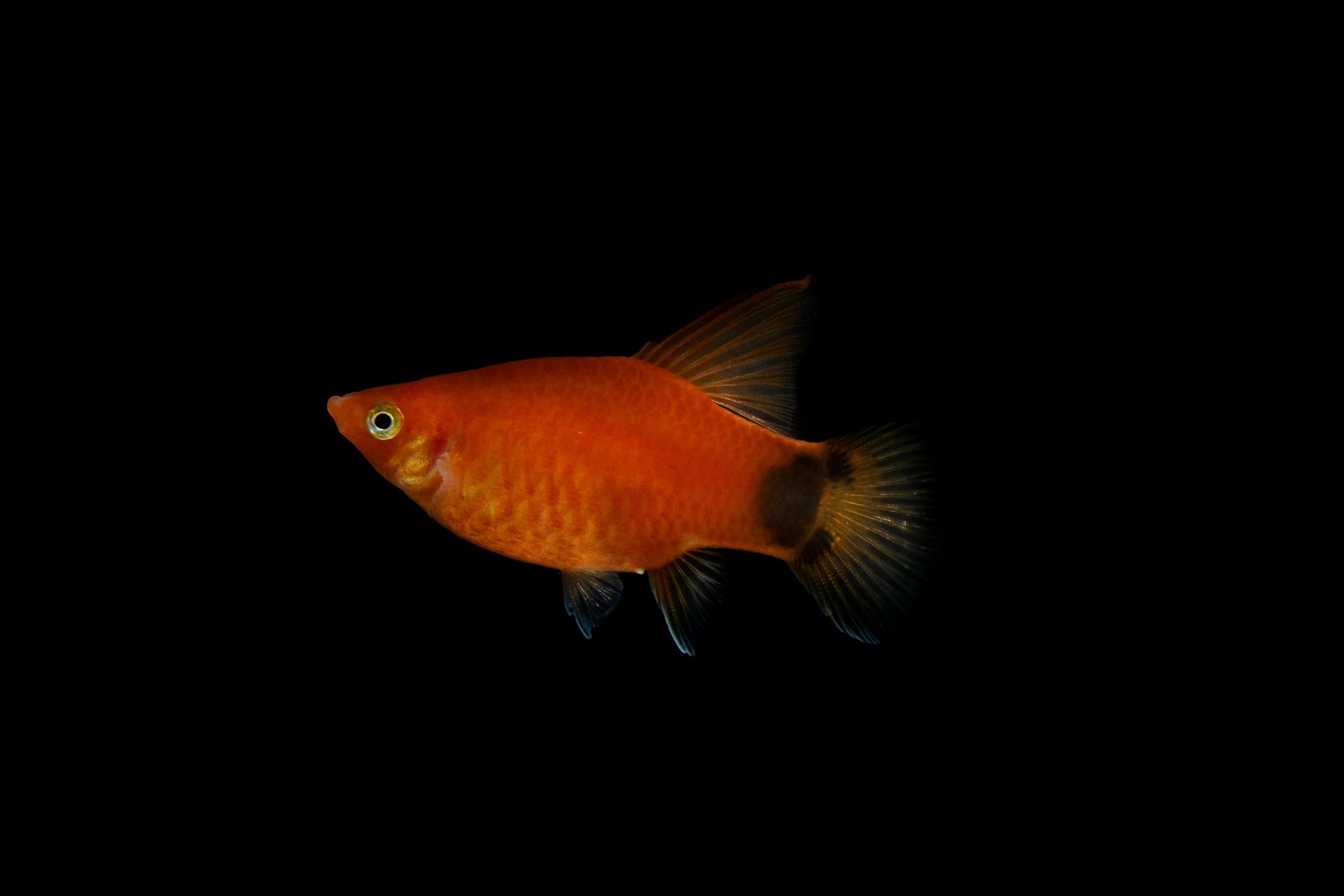
Xiphophorus taxonomy is a complex and fascinating field of study. The genus Xiphophorus is divided into 26 recognized species, with new species continuing to be discovered.
These species can be broadly classified into two main groups: the swordtails and the platies. The swordtails are characterized by their long, sword-like tails, while the platies have shorter tails.
Xiphophorus maculatus, also known as the southern platyfish, is one of the most well-studied species in the genus. It has a distinctive blue or green stripe running along its body.
Intriguing read: Xiphophorus Maculatus
Species and Taxonomy
The Xiphophorus genus is quite diverse, with 28 recognized species according to FishBase. Two species, X. clemenciae and X. monticolus, are thought to be the result of natural hybrid speciation.
Traditionally, Xiphophorus species were divided into swordtails and platies, but phylogenetic studies have shown that this separation is not supported. In fact, the swordtails are paraphyletic compared to the platies.
There are three monophyletic groups within the genus: northern swordtails, southern swordtails, and platies. The common names given to individual species often don't reflect their actual relationships.
The northern swordtails, marked with a star in the list, are a distinct group. They are found in the Pánuco River basin.
The southern swordtails are found in southern Mexico to Honduras. They are a separate group from the northern swordtails.
Here is a list of some of the species within the Xiphophorus genus:
- Xiphophorus alvarezi (Chiapas swordtail)
- Xiphophorus birchmanni (sheepshead swordtail)
- Xiphophorus clemenciae (yellow swordtail)
- Xiphophorus continens (short-sword platyfish)
- Xiphophorus cortezi (delicate swordtail)
- Xiphophorus hellerii (green swordtail)
- Xiphophorus kallmani
- Xiphophorus malinche (highland swordtail)
- Xiphophorus mayae
- Xiphophorus mixei (Mixe swordtail)
- Xiphophorus montezumae (Montezuma swordtail)
- Xiphophorus monticolus (southern mountain swordtail)
- Xiphophorus multilineatus
- Xiphophorus nezahualcoyotl (mountain swordtail)
- Xiphophorus nigrensis (Panuco swordtail)
- Xiphophorus pygmaeus (pygmy swordtail)
- Xiphophorus signum
The platies are another distinct group within the Xiphophorus genus. They are found in various parts of Mexico.
Here is a list of some of the platy species:
- Xiphophorus andersi (spiketail platyfish)
- Xiphophorus couchianus (Monterrey platyfish)
- Xiphophorus evelynae (Puebla platyfish)
- Xiphophorus gordoni (northern platyfish)
- Xiphophorus kosszanderi
- Xiphophorus maculatus (southern platyfish)
- Xiphophorus meyeri (marbled swordtail)
- Xiphophorus milleri (Catemaco platyfish)
- Xiphophorus roseni
- Xiphophorus variatus (variable platyfish)
- Xiphophorus xiphidium (swordtail platyfish)
Research
Xiphophorus is a leading animal model system in the study of hybridization between species. This has led to some fascinating discoveries, including the origin of spontaneous melanoma in hybrids.
Studies in Xiphophorus have shown that recombination controlled patterns of ancestry in hybrid genomes. This means that the genetic material from two different species can combine in complex ways, leading to new traits and characteristics.
Researchers have also identified specific genes and mutations that cause pigment pattern variation in Xiphophorus. For example, a mutation that allows males to mimic females by creating spots on their bodies has been identified.
Research

Research has been a crucial aspect of studying Xiphophorus, a leading animal model system. The study of hybridization between species has provided early evidence that recombination controls patterns of ancestry in hybrid genomes.
One of the most interesting consequences of hybridization is the origin of spontaneous melanoma in hybrids. This was observed in the Gordon-Kosswig cross between X. maculatus and X. hellerii, where hybrids developed spontaneous melanoma due to an interaction between the oncogene xmrk and a repressor locus on a distinct chromosome.
Researchers have also been studying the pigmentation of Xiphophorus since the 1920s. Classical genetics techniques such as crosses have been used to describe the inheritance patterns of many traits.
Taxon Sampling
Seventy-three individuals from all described species of the genus Xiphophorus were used in the research.
These individuals included 16 specimens from four recently described species.
The Xiphophorus Genetic Stock Center in San Marcos, TX, USA provided two of these recently described species, Xiphophorus mixei and X. monticolus.
Two outgroup species, Priapella compressa and P. olmecae, were chosen for the study.
The genera Heterandria and Priapella were found to be the most closely related taxa to Xiphophorus.
Sampling localities and detailed information about each of the samples are listed in Additional file 7.
Emerging Models
Researchers are exploring new disease models in Xiphophorus fish, which are in the early stages of development.
These emerging models are being tested for their face, construct, and predictive validity, but have not been fully assessed yet.
Xiphophorus birchmanni males can develop a nuchal hump, a visible characteristic that's being studied in these emerging models.
A male from a wild population of X. multilineatus does not have a nuchal hump, unlike some laboratory strains that are overfed and develop this trait.
The Xiphophorus Genetic Stock Center (XGSC) has provided photos of these emerging models, giving researchers a visual reference point for their studies.
An albino mutant X. hellerii strain is also being used in these emerging models, providing a unique genetic perspective for researchers to explore.
Genomics and Phylogenomics
The genomes of all Xiphophorus species have been published, with 28 additional genomes added to the existing 5 chromosome-level assembled genomes. These genomes were sequenced using various techniques, including Illumina, 10X, PacBio, and Hi-C.
Each assembly ranges from ~636 Mb to 720 Mb, with a scaffold N50 ranging from ~2 Mb to 32 Mb. The assemblies cover ~92–97% of the 4584 well-conserved Actinopterygii genes.
The genomes show a high conservation of synteny, with the exception of the two platyfish species, X. maculatus and X. couchianus, which have several translocations and inversions compared to the karyotypes of the Northern and Southern swordtails.
Genome Assembly and Annotation
Genome assembly is a crucial step in genomics, and it's done using various tools and techniques. We assembled genomes using SOAPdenovo, Platanus, and Supernova, with the goal of achieving high completeness and continuity.
The completeness of each assembly was estimated using BUSCO, which checks for the presence of well-conserved genes across Actinopterygii. We found that each assembly covers ~92–97% of the 4584 well-conserved Actinopterygii genes.
To assemble scaffolds, we used de Brujin graph to merge all read-subsequences of length “k-mer”. We tried different k-mers, from 75-mer to 105-mer, and chose the result with the longest N50 scaffold length.
Gap-filled scaffolds were then broken into contigs again at the N-linked positions. We removed those contigs that aligned to the mitochondrial genome and then rescaffolded them using SSPACE.
For genomes sequenced as 10X linked-reads, we assembled using Supernova with parameters –maxreads 298666666 –local cores = 8. The assembly was output in style “pseudohap2” where two ‘parallel’ pseudohaplotypes were created and placed in separate FASTA files.
We chose the consensus assembly result with higher completeness or continuity. The continuity of the assembly was evaluated by N50 scaffold length, which was calculated by the Perl script assemblathon_stats.pl.
Genomes were annotated using a custom pipeline that combines protein sequences, RNA reads, and gene evidence. We first screened the assembly for automated discovery of transposable elements using RepeatModeler.
The consensus sequences of repeats were used as a de novo repeat library, together with Repbase and FishTEDB. They were transferred to RepeatMasker for repeat identification and masking.
We collected homology gene evidence by downloading protein sequences from the vertebrate database of Swiss-Prot and RefSeq database. These protein sequences were aligned to the assembly using Exonerate and Genewise to predict gene location and intron/exon structures.
Transcriptome gene evidence was collected by downloading RNA data from SRA NCBI and sequencing it using the BGISEQ platform. We then cleaned the RNA-seq reads using fastp and mapped them onto the assembly using HISAT.
We interpreted the resulting bam file using StringTie for gene locations and structures. In another parallel, transcript sequences were assembled based on the bam file using Trinity.
We aligned these transcript sequences to the assembly for gene prediction using splign. AUGUSTUS was used for collecting de novo gene evidence, and we trained it using BUSCO with the parameter “-long”.
We used high-quality genes predicted repeatedly by Exonerate, Genewise, StringTie, and Splign to train AUGUSTUS for the second round. The trained AUGUSTUS was then run on the assembly with all homologous and transcriptome gene evidence as hints for an ab initio gene prediction.
Phylogenomic Tree Based on Protein Coding Genes
A phylogenomic tree is a powerful tool for understanding the evolutionary relationships between different species. It's created by comparing the protein-coding genes of various species.
3259 one-to-one orthologous genes were identified across all species based on sequence similarity followed by synteny confirmation.
These genes are the building blocks of a phylogenomic tree, which can be used to infer the evolutionary relationships between species.
The phylogenomic tree was reconstructed using RAxML with the concatenated protein sequences, coding sequences, and 4DTV sequences, respectively.
This approach allows researchers to visualize the relationships between different species and gain insights into their evolutionary history.
Node confidence of each tree was assessed by 200 bootstrap replicates.
This ensures that the tree is robust and reliable, and can be used to make informed conclusions about the evolutionary relationships between species.
By analyzing the phylogenomic tree, researchers can identify patterns and trends in the evolution of different species.
For example, they can determine which species are most closely related to one another, and which species have undergone significant changes over time.
This information can be used to inform conservation efforts and to better understand the diversity of life on Earth.
The phylogenomic tree is a powerful tool for understanding the evolutionary relationships between species, and has many practical applications in fields such as conservation and medicine.
Genetic Analysis
Phylogenetic analyses were used to reconstruct the relationships of the genus Xiphophorus, including four newly described species. This was done using four different methods: Bayesian Inference, Maximum-Likelihood, Neighbor-Joining, and Maximum Parsimony.
The study used two mitochondrial and eleven nuclear loci to analyze the phylogenetic relationships. The total lengths of the aligned sequences used for the mitochondrial and nuclear phylogenies were 1239 bp and 7276 bp, respectively.
Genetic diversity indices and evolutionary models for each locus are shown in Table 1. The study also reconstructed the phylogeny using a combination of the mitochondrial and nuclear data (8515 bp) to provide an overall view of evolutionary relationships of Xiphophorus.
DNA Analysis
The researchers used a combination of sequence-similarity clustering and gene tree reconstruction to identify orthologous genes between species.
To do this, they used an all-versus-all BLAST to compare protein sequences and calculated an H-score to index the sequence similarity.
The researchers then clustered the genes using Hcluster_sg with P. lacandonae as the outgroup.
Within each cluster, they reconstructed a gene tree using TreeBeST v.0.5.
This process allowed them to identify 3259 one-to-one orthologous genes across all species.
These orthologies were then used to reconstruct the phylogenomic tree using RAxML with the concatenated protein sequences, coding sequences, and 4DTV sequences.
The researchers also used phylogenetic analyses to reconstruct the phylogenetic relationships of the genus Xiphophorus.
They used four different methods, including Bayesian Inference, Maximum-Likelihood, Neighbor-Joining, and Maximum Parsimony.
Two mitochondrial and eleven nuclear loci were used for the phylogenetic analyses.
The researchers found that the combined tree showed nearly identical phylogenetic relationships among the major lineages.
They also found that the nuclear tree was consistent with the combined tree.
The researchers used genetic diversity indices and evolutionary models for each locus to further understand the evolutionary relationships of Xiphophorus.
The total lengths of the aligned sequences used for the mitochondrial and nuclear phylogenies were 1239 bp and 7276 bp, respectively.
The researchers also identified disease-relevant genes that affect several organs, such as CLDN4, CASR, and GCK.
These genes are related to human diseases, including ovarian cancer, inflammation, and maturity-onset diabetes of the young.
The researchers found that the Xiphophorus orthologs of these genes are dysregulated in the hybrids, suggesting a link between genetic incompatibility and human disease.
Genetic Stock Center
The Xiphophorus Genetic Stock Center (XGSC) is a remarkable resource for genetic research.
Established in 1939 at Cornell University, it's now located at Texas State University, where it's been since 1993.
The XGSC hosts an impressive collection of 24 out of 26 known Xiphophorus species, categorized in 61 pedigreed lines and eight different interspecies hybrids.
These lines are maintained in over 1400 aquaria, showcasing both highly inbred lines and genetic variability across species.
One notable example is the X. maculatus Jp163A line, which is an astonishing 119th generation inbred.
The XGSC also has a repository for literature on Xiphophorus, providing access to genomic and transcriptomic resources.
Melanoma Model
The Xiphophorus model has high construct validity for modeling human cancer, particularly melanoma. This is because the human homologs of the R/Diff candidate genes, cdkn2ab, rab3d, and adgre5, are recurrently affected in human melanoma and many other cancers.
These genes are mutated or deleted in a high percentage of human melanoma cases. The Xiphophorus model recapitulates pathways that are relevant to malignant progression in human cancer.
The characterization of the molecular mechanism is pending, but studies of albinism in X. hellerii yielded the same gene underlying the human oculocutaneous albinism, i.e. Xiphophorus oca2 and human OCA2. This is another example of the construct validity of this model.
Oca2 is a membrane transporter of tyrosine for melanin synthesis, and the oca2 variant-driven albinism in X. hellerii could depend on either oca2 mutation and/or aberrant expression.
For more insights, see: Xiphophorus Hellerii
Validation of Findings for Human Diseases
The Xiphophorus model has shown high construct validity for modeling human cancer, with the human homologs of three R/Diff candidate genes being recurrently affected in human cancer.
Studies have found that the homologues of cdkn2ab are potent tumor suppressor genes and are mutated or deleted in a high percentage of human melanoma and many other cancers.
The rab3d and adgre5 homologs have been associated with the malignant phenotype of several human cancers, reflecting that Xiphophorus tumors recapitulate pathways that are relevant to malignant progression in human cancer.
The Xiphophorus model has also been validated for modeling human oculocutaneous albinism, with the gene underlying the human condition being the same as the one underlying the condition in Xiphophorus.
Oca2 is a membrane transporter of tyrosine for melanin synthesis, and the oca2 variant-driven albinism in Xiphophorus could depend on either oca2 mutation and/or aberrant expression.
The Xiphophorus model has also been used to study epistatic gene interactions that parallel human conditions such as ovarian cancer, inflammation, and vascular calcifications.
These findings indicate that the outcomes of genetic incompatibility in the Xiphophorus hybrids are relevant to human disease and underscore the construct validity of Xiphophorus as a human disease model.
Among the genes dysregulated in the hybrids, an average of 6% were related to human diseases, highlighting the potential of Xiphophorus as a model for studying human diseases.
The Xiphophorus model has already shown construct validity in the regulation of puberty onset and the related research on dietary-induced obesity, with mutations in Mc4r causing metabolic dysregulation and obesity in both mice and humans.
Reticulate Hybridization in Genus Evolution
Reticulate hybridization is a key driver of evolution in the Xiphophorus genus. It's a process where different species interbreed, resulting in the transfer of genes between them.
The AU-test and Patterson's D-statistic are tools used to infer hybridization history in species. They help researchers identify gene flow between two species by analyzing alignment sites.
Xiphophorus hybrids can be used as a model to study human disease. For example, hybrids between X. maculatus and X. hellerii have been found to develop spontaneous melanoma, a disease that can be relevant to human health.
The distribution of introgressed loci across chromosomes varies between different hybridization events. For instance, hybridization-derived regions are clustered in the middle of Chromosome 2, 15, and 18 in X. signum.
Genomic regions shared by multiple species after hybridization can provide insights into their evolutionary fate. Researchers have identified such regions in X. clemenciae, which suggests that it may be a hybrid lineage.
The sequence divergence between X. clemenciae and X. monticolus is lower in hybridization-derived regions. This indicates that these regions have been under similar selective pressures.
Functional enrichment analysis of protein-coding genes in X. clemenciae has not revealed any over-represented functions. However, pairwise sequence comparison has shown lower synonymous substitution rates and higher ratios of nonsynonymous substitution to synonymous substitution in these genes.
Genome Sequencing and Annotation
Genome sequencing and annotation are crucial steps in understanding the genetic makeup of Xiphophorus species.
High molecular weight DNA was prepared from pooled soft organs of single individuals using a phenol/chloroform extraction procedure. For P. lacandonae and X. maculatus Bp, muscle samples were used to obtain high molecular weight gDNA using the QIAGEN MagAttract HMW DNA kit.
The DNA was sequenced on a NovaSeq with a 2×150 bp read metric. For P. lacandonae, muscle tissue from the same individual was used to construct a Hi-C chromatin contact map to enable chromosome-level assembly.

Genomes were assembled using SOAPdenovo, Platanus, and Supernova, with parameters such as k-mer size and number of local cores. The completeness of each assembly was estimated using BUSCO and the continuity was evaluated by N50 scaffold length.
Genomes were annotated using a custom pipeline, which involved masking repeat regions, mapping protein sequences and RNA reads, and collecting homology and transcriptome gene evidence. The final set of gene annotations was generated by synthesizing all three types of gene evidence.
Genome Sequencing and Sampling
Genome sequencing is a crucial step in understanding the genetic makeup of an organism. High molecular weight DNA was prepared from pooled soft organs of single individuals using a phenol/chloroform extraction procedure.
To ensure the quality and quantity of the DNA, a 5400 Fragment analyzer and Qubit 2.0 Fluorometer were used. The DNA libraries were generated using the 10x Genomics Chromium technology.
This technology involves creating Gel Bead-In-Emulsions (GEMs) from a library of Genome Gel Beads combined with 1.5 ng of gDNA in a Master Mix and partitioning oil. The GEMs were then subjected to an isothermal incubation step.
Bar-coded DNA fragments were extracted and underwent Illumina library construction. Library yield was measured through the Qubit dsDNA HS assay kit.
Seventy-three individuals from all described species of the genus Xiphophorus were used for taxon sampling. This included 16 specimens from the recently described four species.
Tissue fixation, chromatin isolation, and library construction for Hi-C analysis were performed according to the manufacturer’s instructions. The final libraries were sequenced using the Illumina Novaseq platform with a 150-bp paired-end strategy.
Genome Annotation
Genome annotation is a crucial step in understanding the function and behavior of an organism. The researchers used a custom pipeline to annotate the genomes, which included masking repeat regions and mapping protein sequences and RNA reads to collect homology and transcriptome gene evidence.
The pipeline was improved and developed from previous studies, with a focus on collecting high-quality gene models. Consensus gene models were used to train the de novo gene predictor, AGUSTUS, which was then run with all collected gene evidence as hints to collect ab initio gene evidence.
To identify and mask repeats from the genome, the researchers first screened the assembly for automated discovery of transposable elements using RepeatModeler. The consensus sequences of repeats were then used as a de novo repeat library, together with Repbase and FishTEDB, for repeat identification and masking.
The researchers downloaded protein sequences from various databases, including Swiss-Prot, RefSeq, and NCBI genome annotation, to collect homology gene evidence. These protein sequences were aligned to the assembly using Exonerate and Genewise to predict gene location and intron/exon structures.
RNA data from various species was used to collect transcriptome gene evidence. The RNA data was cleaned using fastp and mapped onto the assembly using HISAT. The resulting bam file was then interpreted by StringTie for gene locations and structures.
Transcript sequences were assembled based on the bam file using Trinity and then aligned to the assembly for gene prediction using splign. The trained AUGUSTUS was then run on the assembly with all homologous and transcriptome gene evidence as hints for an ab initio gene prediction.
The researchers identified and annotated ~22–25k protein-coding genes (PCGs) in each assembly, improving the BUSCO assessment of completeness by ~1%. The PCGs were clustered into 26,982 gene families, with 353 families undergoing a significant change in size during the evolution of the genus Xiphophorus.
Phylogenetic Analysis
Phylogenetic analysis is a crucial step in understanding the evolutionary relationships among species. This involves reconstructing the phylogenetic tree of the genus Xiphophorus, including four newly described species, using four different methods: Bayesian Inference, Maximum-Likelihood, Neighbor-Joining, and Maximum Parsimony.
The researchers used a large dataset of 15 genetic markers, including mitochondrial and nuclear DNA, to build the phylogenetic tree. They found that the combined mitochondrial and nuclear data provided a more resolved phylogeny compared to previous phylogenetic analyses.
The researchers also identified two species, Priapella compressa and P. olmecae, as outgroups, considering previously published phylogenies of the family Poeciliidae. This is important because outgroups help to root the phylogenetic tree and provide a reference point for understanding the relationships among the species.
Phylogenetic analysis can be complex, especially when dealing with a large number of species like in the genus Xiphophorus. The researchers used a combination of mitochondrial and nuclear DNA to build the phylogenetic tree, which provided a more complete picture of the evolutionary relationships among the species.
The phylogenetic tree showed that the northern swordtails are the sister group to the clade formed by southern swordtails and platyfish, which is consistent with previous mitochondrial phylogenies. However, the sister group relationship between the platyfish and the southern swordtails was supported by only moderate bootstrap values.
Phylogenetic analysis can also reveal hybrid origins of species. The researchers found that the mitochondrial data set indicates a well-supported sistergroup relationship between X. nezahualcoyotl (long sword) and X. continens (protrusion), whereas the nuclear DNA set suggests that X. nezahualcoyotl could be closely related to X. montezumae (long sword).
The researchers used a combination of phylogenetic methods, including concatenation and coalescence, to build the phylogenetic tree. They also used a supporting value of 10% as the cutoff for tree filtering, which resulted in the exact same topology.
Phylogenetic analysis can be used to identify conserved non-coding elements (CNEs) that are important for understanding the evolutionary relationships among species. The researchers used phastCons to identify conserved regions and removed coding regions to build the phylogenetic tree.
The phylogenetic tree based on CNEs showed that the close phylogenetic relationships among Xiphophorus species can be estimated directly from the data using an "unsupervised" learning algorithm. This is an important finding because it shows that the phylogenetic relationships among the species can be understood without the need for prior knowledge of the phylogenetic model.
Methods and Data
The researchers used the original file for figure 4 in their study.
The authors, Kang, J.H., Schartl, M., Walter, R.B., and others, conducted a comprehensive phylogenetic analysis of all species of swordtails and platies.
Their analysis uncovered a hybrid origin of a swordtail fish, Xiphophorus monticolus, and demonstrated that the sexually selected sword originated in the ancestral lineage of the genus.
The study was published in BMC Evol Biol, with the article titled "Comprehensive phylogenetic analysis of all species of swordtails and platies (Pisces: Genus Xiphophorus)" and the DOI is 10.1186/1471-2148-13-25.
Discussion
Xiphophorus species are popular aquarium fish, known for their vibrant colors and peaceful nature. Some species, like the Xiphophorus helleri, can grow up to 3 inches in length.
One of the most interesting things about Xiphophorus is their unique mating behavior. In the wild, males will often display their fins to attract females.
In aquarium settings, Xiphophorus are relatively easy to care for, requiring a balanced diet and regular water changes to thrive.
Take a look at this: Aquarium Plants Live Freshwater
Frequently Asked Questions
What type of wild is Xiphophorus?
The Xiphophorus hellerii is a wild-type species, specifically a Green Swordtail. This species is relatively rare due to extensive hybridization and line breeding.
What is the largest swordtail fish?
The largest swordtail fish is the female, which can grow up to 16 centimetres in length. This is slightly larger than the male, which reaches a maximum length of 14 centimetres.
Featured Images: pexels.com