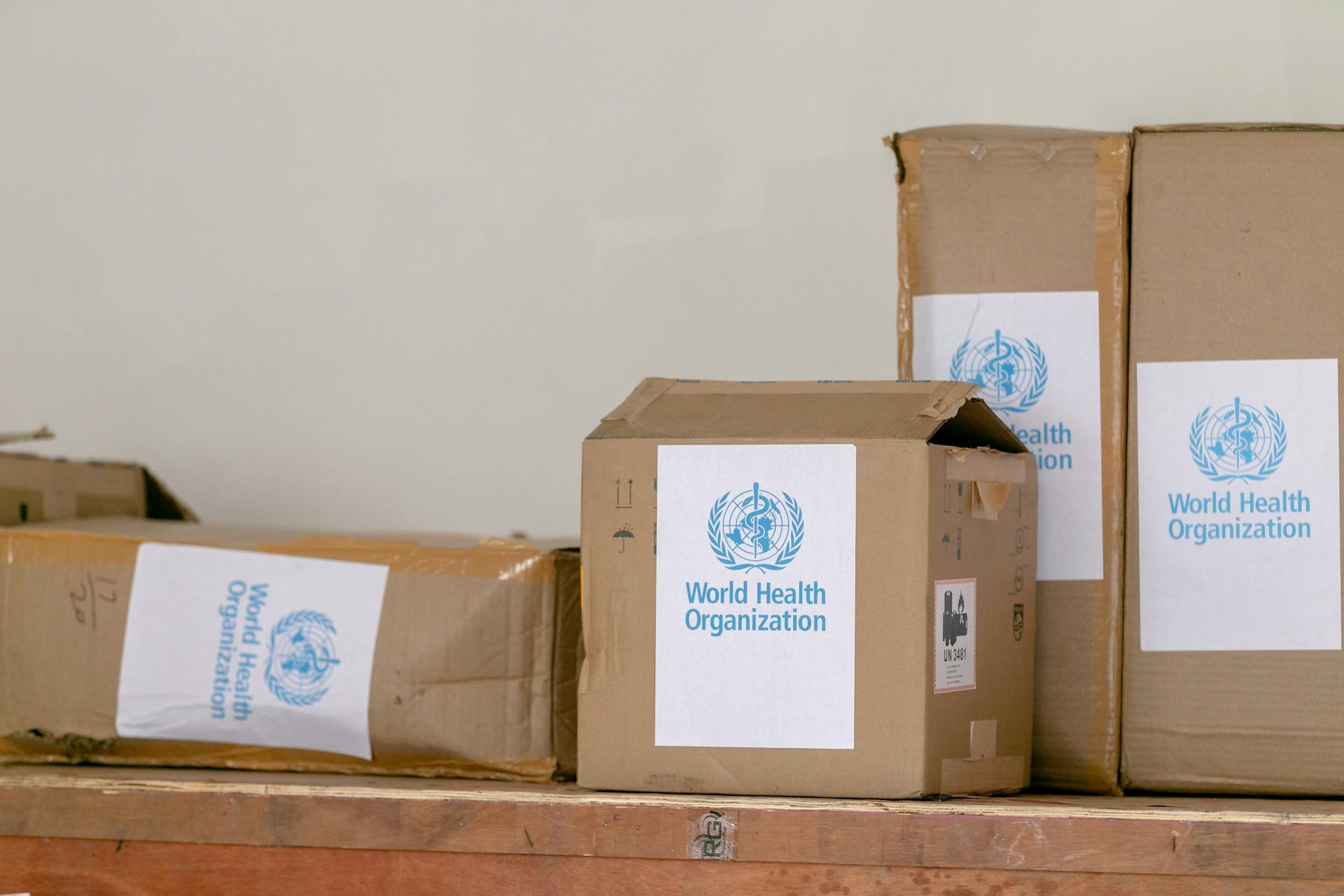
The World Health Organization (WHO) has been at the forefront of addressing the bird flu outbreaks. They have been working closely with national governments and international partners to monitor and control the spread of the disease.
The WHO has reported several bird flu outbreaks in different parts of the world, including Asia, Africa, and Europe. These outbreaks have been caused by various strains of the H5 and H7 viruses.
The WHO's response to the bird flu outbreaks has been swift and effective, with the organization providing guidance and support to affected countries. They have also been working to improve global preparedness for future outbreaks.
The WHO has established a network of laboratories and surveillance systems to monitor the spread of the disease and detect new outbreaks early. This has helped to contain the spread of the virus and prevent further outbreaks.
For another approach, see: Fish Swim Bladder Disease
Key Facts and Information
Humans can be infected with avian, swine, and other influenza viruses. This is a risk factor for human infection, particularly through direct contact with infected animals or indirect contact with contaminated environments.
Direct contact with infected animals, such as through handling or slaughtering, can lead to human infection. This can also occur through indirect contact with bodily fluids from infected animals.
Exposure to animal influenza viruses can cause a range of symptoms in humans, from mild flu-like symptoms to severe acute respiratory disease and even death. The severity of the disease will depend on the virus causing the infection and the individual's characteristics.
Currently circulating zoonotic influenza viruses have not demonstrated sustained person-to-person transmission. This means that the risk of human-to-human transmission is low, but not zero.
To minimize public health risk, quality surveillance in both animal and human populations is essential. This includes thorough investigation of every human infection and risk-based pandemic planning.
Here are some key types of contact that can lead to human infection:
- Handling infected animals
- Culling or slaughtering infected animals
- Processing infected animals
- Indirect contact with contaminated environments
Understanding the Virus
The bird flu, also known as avian influenza, is a type of virus that affects birds. It's caused by the H5 and H7 subtypes of the influenza A virus.
Bird flu viruses can be highly contagious among birds, and can spread quickly through direct contact with infected birds, contaminated feed or water, and even through the air.
The World Health Organization (WHO) has identified several strains of bird flu, including H5N1 and H7N9. These strains have been responsible for outbreaks in various parts of the world.
Birds can carry the virus without showing any symptoms, making it difficult to detect.
Recommended read: Dog Flu in Bay Area
Epidemiology and Transmission
Human infections with avian influenza viruses are rare, but have been reported sporadically, often linked to direct or indirect contact with infected animals or contaminated environments. The primary risk factor for human infection appears to be exposure to infected live or dead poultry or contaminated environments, such as live bird markets.
Slaughtering, defeathering, handling carcasses of infected poultry, and preparing poultry for consumption, especially in household settings, are also likely to be risk factors. There is no evidence to suggest that A(H5), A(H7N9) or other avian influenza viruses can be transmitted to humans through properly prepared and cooked poultry or eggs.
The incubation period for A(H5N1) infection has been estimated to be up to seven days, although it is usually two to five days after the last known exposure to sick or dead poultry. Human cases have reported direct exposure to apparently healthy looking or sick poultry, mostly backyard poultry before onset of disease.
Pandemic Potential
Pandemics can have significant health, economic, and social consequences.
Influenza pandemics occur when a virus emerges with the ability to cause sustained human-to-human transmission, and the human population has little to no immunity against the virus.
Global travel has made it easier for a pandemic to spread rapidly.
Currently circulating avian, swine, and other influenza viruses may result in a future pandemic, but it's unknown.
Strengthened surveillance in both animal and human populations is necessary to monitor zoonotic influenza viruses that have caused human infections.
You might like: Is Kennel Cough Transmittable to Humans
Epidemiology
Human infections with avian influenza viruses are rare but have been reported sporadically. Direct or indirect contact with infected animals represents a risk for human infection.
The primary risk factor for human infection appears to be exposure to infected live or dead poultry or contaminated environments. Slaughtering, defeathering, handling carcasses of infected poultry, and preparing poultry for consumption, especially in household settings, are also likely to be risk factors.
Avian influenza viruses have not demonstrated sustained person-to-person transmission. However, a few cases have been linked to consumption of dishes made with raw contaminated poultry blood.
Between 2003 and 2017, high numbers of human cases were reported from 17 countries worldwide. Since 2018, only a few sporadic cases have been reported, none from the EU/EEA.
Here are some notable outbreaks:
- In 1997, human infections with A(H5N1) viruses were reported during an outbreak in poultry in Hong Kong SAR, China.
- In 2013, human infections with A(H7N9) viruses were reported for the first time in China.
- In 2021, a mild A(H5N1) infection was reported from the United Kingdom.
Avian influenza viruses have spread in bird populations from Asia to Europe and Africa, and to the Americas in 2021. They have become endemic in poultry populations in many countries, resulting in millions of poultry infections, several hundred human cases, and many human deaths.
Transmission
The incubation period for A(H5N1) infection can be up to seven days, although it's usually two to five days after the last known exposure to sick or dead poultry.
Human infections with A(H5N1) viruses are rare, and the virus doesn't appear to transmit easily between people.
Direct or indirect contact with infected animals, such as poultry, can represent a risk for human infection.
Sporadic infections or small clusters of human cases are possible in people exposed to infected poultry or contaminated environments, especially in backyard settings.
The most commonly identified risk factors associated with A(H5N1) virus infection include contact with infected blood/organs or bodily fluids of infected poultry through food preparation practices.
Touching and caring for infected poultry, exposure to A(H5N1) by swimming or bathing in potentially virus-laden ponds, and exposure to A(H5N1) at live bird markets in Asia and via backyard poultry in Egypt are also risk factors.
Here's a breakdown of the estimated incubation periods for A(H5N1) infection:
- Up to seven days
- Usually two to five days
- Longer periods have been suggested, but not confirmed
Diagnostics
Diagnostics play a crucial role in identifying bird flu cases. Laboratory tests are required to diagnose human infection and should be done at a lab capable of safely processing and confirming zoonotic infections.
Testing for bird flu involves collecting specimens from suspected human cases for virus identification, which is done at specialized reference laboratories. This is essential for proper response measures to be taken.
In the EU, EU legislation for the detection and control of avian influenza in the EU/EEA is laid down in the Animal Health Law adopted in the Regulation (EU) 2016/429. This legislation specifies the detection and diagnosis of H5 viruses in birds.
People in the EU presenting with severe respiratory or influenza-like infection and a history of exposure to poultry or wild birds will require careful investigation, management, and infection control. Appropriate samples for influenza tests should be rapidly taken and processed from patients with relevant exposure history within ten days preceding symptom onset.
If positive specimens cannot be subtyped, those should be shared with the national reference laboratory (National Influenza Centres; NICs). Human infection with A(H5Nx) viruses should be detected as positive for influenza A virus, and negative for influenza B, A(H1), A(H1)pdm09, and A(H3) viruses.
Infection Control and Prevention
Infection control and prevention are crucial in minimizing the public health risk of bird flu. Everyone should perform hand hygiene, preferably washing their hands with soap and running water or using alcohol hand rubs, and do it frequently, thoroughly, and often.
To avoid contact with contaminated surfaces, the public should minimize contact with animals in areas known to be affected by animal influenza viruses. This includes farms and settings where live animals may be sold or slaughtered.
The public should strictly avoid contact with sick or dead animals, including wild birds, and report dead animals or request their removal by contacting local wildlife or veterinary authorities. This is especially important for children, older people, pregnant and postpartum women, and people with suppressed immune systems.
Everyone should practice good food safety habits, such as separating raw meat from cooked or ready-to-eat foods, keeping clean and washing hands, cooking food thoroughly, and handling and storing meat properly. This will help prevent the spread of bird flu through contaminated food.
If you're traveling to countries with known outbreaks of avian influenza, avoid poultry farms, contact with animals in live poultry markets, entering areas where poultry may be slaughtered, and contact with any surfaces that appear to be contaminated with faeces from poultry or other animals.
Expand your knowledge: Teeth Grinding in Animals Such as Dogs on Bones
WHO Response and Measures
The World Health Organization (WHO) is closely monitoring avian influenza viruses through its Global Influenza Surveillance and Response System (GISRS). WHO, in collaboration with other organizations, conducts surveillance at the human-animal interface and assesses the associated risks.
WHO consults with experts twice a year to review data on influenza viruses with pandemic potential and assesses the need for additional candidate vaccine viruses. This ensures that the organization is prepared for potential outbreaks.
Public health control measures are in place to protect people from avian influenza, including contingency plans for controlling the virus in poultry and birds. This involves protecting persons at risk from infection and identifying human-to-human transmission events.
WHO Response
The World Health Organization (WHO) takes a proactive approach to monitoring avian and other zoonotic influenza viruses through its Global Influenza Surveillance and Response System (GISRS).
WHO collaborates with other organizations like the World Organisation for Animal Health (WOAH) and the Food and Agriculture Organization of the United Nations (FAO) to conduct surveillance at the human-animal interface.
Twice a year, WHO consults with experts to review data on influenza viruses with pandemic potential and assesses the need for additional candidate vaccine viruses.
WHO provides guidance and develops strategies to prepare for seasonal, zoonotic, and pandemic influenza, and communicates risk assessment outcomes and intervention recommendations with Member States.
The WHO Pandemic Influenza Preparedness Framework implements a global approach to prepare for the next influenza pandemic.
WHO continuously monitors avian and other zoonotic influenza viruses closely through GISRS, assessing the associated risks and coordinating response to zoonotic influenza outbreaks.
WHO provides guidance on public health control measures, including contingency plans for the control of avian influenza in poultry and birds.
Surveillance systems have been established to monitor new introductions, and animal health control mechanisms are in place to control outbreaks of avian influenza.
The main measures for controlling outbreaks are the culling of birds in the affected holdings.
Related reading: Can Dogs Catch Bird Flu
WHO Expresses Concern
The World Health Organization is sounding the alarm about the spread of bird flu. They're expressing enormous concern about the current outbreak, which has an extremely high mortality rate in humans.

The bird flu, also known as HPAI, is an influenza infection that started in poultry and ducks and has spread to become a global zoonotic pandemic. It's predominantly found in commercial and backyard farms in 48 states.
Dr. Jeremy Farrar, WHO's chief scientist, said the current outbreak is a significant public health concern as infections are spreading among mammals. He warned that the virus may evolve to infect humans and spread from person to person.
The United States reported its first human case of bird flu in April 2022, after an inmate at a Colorado prison contracted the virus from infected poultry. In March 2024, a Texas resident contracted the bird flu from infected dairy cattle.
The virus is spread through the saliva, mucous, and feces of infected birds. Experts say that infected birds shed flu viruses, which can then be transmitted to other animals and potentially humans.
Check this out: Bird Flu in North Carolina
Clinical and Human Impact
The clinical course of human cases of A(H5N1) is characterized by initial fever and cough, with rapid progression to lower respiratory disease.
Upper respiratory tract symptoms of rhinorrhoea and sore throat might not be common in all patients.
The disease can progress to respiratory failure, acute respiratory distress syndrome (ARDS), and multi-organ failure, which is a serious and potentially life-threatening condition.
The overall case–fatality ratio (CFR) is around 50%, although this appears to differ from country to country, with Egypt reporting a lower CFR of around 50% due to a lower virulence of the virus clade and early detection and treatment of human cases.
Case Management
Case management and treatment are crucial in dealing with human infection with A(H5N1). The WHO has published guidance on the clinical management of human infection with A(H5N1).
Four licensed influenza antiviral agents are available in the EU/EEA. These include amantadine, rimantadine, zanamivir, and oseltamivir.
However, current circulating seasonal influenza A viruses are resistant to the adamantanes. This means that amantadine and rimantadine are not effective against most seasonal influenza A viruses.
For your interest: Horse Management
Zanamivir and oseltamivir, on the other hand, are included in a class of drugs known as influenza neuraminidase inhibitors. They are active against both influenza A and B viruses.
HPAI A(H5N1) viruses have been reported to be sensitive to neuraminidase inhibitors. This means that zanamivir and oseltamivir may be effective in treating human infection with A(H5N1).
Baloxavir marboxyl (Xozaflu) has been authorised in 2020 in the EU/EEA. This is a new option for treating influenza A and B viruses.
Clinical Features
The clinical features of A(H5N1) are quite alarming.
The disease starts with initial fever and cough, which can rapidly progress to lower respiratory disease.
Upper respiratory tract symptoms such as rhinorrhoea and sore throat might not be present in all patients.
The disease can progress to respiratory failure, acute respiratory distress syndrome (ARDS), and multi-organ failure.
The overall case–fatality ratio (CFR) is around 50%, which is a staggering statistic.
This percentage can vary from country to country, with Egypt having a lower CFR due to factors such as lower virulence of the virus clade and early detection and treatment.
Indonesia has reported the highest number of fatal cases, with a CFR of 84%.
Worth a look: How to Treat Swim Bladder Disease in Goldfish
Vaccines and Evaluation
Animal vaccines for H5N1 are being developed and could play a crucial role in protecting against bird flu.
There are several animal vaccines in existence or under development, including mRNA-based vaccines.
Regulatory considerations for evaluating new H5N1 candidate vaccines are complex and include assessments of safety and efficacy.
Coverage of emerging strains by available vaccines is a key concern, as new strains can arise and evade existing vaccine protection.
Novel vaccines, including those using mRNA technology, are being evaluated for their potential to protect against bird flu.
Suggestion: New World Porcupine
Frequently Asked Questions
Do N95 masks protect against bird flu?
Yes, N95 masks can protect against bird flu, as they are a type of NIOSH-approved particulate filtering respirator that filters out at least 95% of airborne particles, including viruses like bird flu.
Featured Images: pexels.com