The Wandering Albatross Diomedea Exulans is a truly remarkable bird species. It's the largest of all albatrosses, with a wingspan that can reach up to 12 feet.
These birds are found in the Southern Ocean, with a global population estimated to be around 500,000. They're incredibly efficient gliders, able to stay aloft for hours at a time.
Their wings are perfectly adapted for this, with a unique shape that allows them to soar for long distances without flapping. This adaptation is crucial for their survival, as they need to cover vast distances to find food and suitable breeding grounds.
One of the most fascinating aspects of the Wandering Albatross is their ability to dive to depths of up to 27 feet in search of food. They primarily feed on krill, squid, and small fish.
Explore further: American Bald Eagle Food Chain
Species Information
The wandering albatross is among the largest birds in the New Zealand marine area, surpassed only slightly by the southern royal albatross for size.
These magnificent creatures have an impressive wingspan, averaging 3.1 meters (10.2 feet) and reaching a verified maximum of 3.7 meters (12.1 feet), allowing them to glide for long distances with minimal wing flapping.
Adults can measure up to 135 centimeters (4.4 feet) in body length and weigh between 6 to 12.7 kilograms (13.2 to 28 pounds), with males being about 20% heavier than females.
The species has a large, pale pink bill, which is well-adapted for catching squid and fish at the ocean surface, and strong, webbed feet that assist in both swimming and taking off from the water.
Wandering albatrosses are normally found offshore, but can be seen in southern New Zealand waters and northwards to Cook Strait, and in lower numbers further north.
Care is needed to separate wandering and Antipodean albatrosses, as their plumage markings overlap almost completely, but the larger size and especially the larger bill of the true wanderer are the most reliable distinguishing characteristics.
Behavior and Ecology
Wandering albatrosses are solitary at sea, though may feed in flocks in association with fishing vessels.
They spend most of their time alone, only coming together for specific activities like feeding.
In fact, they're one of the most solitary birds in the ocean, only gathering in large groups when there's a food source nearby.
Despite their solitary nature, wandering albatrosses are highly social birds that have been observed interacting with each other in various ways.
This social behavior is particularly evident when they're feeding in association with fishing vessels, where they can be seen working together to catch fish.
Their ability to adapt to different social situations is just one of the many fascinating aspects of these incredible birds.
Threats and Conservation
Wandering albatrosses have a relatively safe breeding environment, with few predators at their breeding sites.
Their main threats, however, come from the marine environment, particularly in fisheries interactions.
Fishing mortality, especially in longline fisheries, has led to population decreases in wandering albatrosses.
Stronger winds in the southern latitudes have actually had a positive impact on wandering albatross populations, requiring less effort for foraging by breeding birds.
Lifespan and Longevity
The snowy albatross is actually not the focus of this article, but we can still learn a lot about the lifespan of wandering albatrosses. They can live for over 50 years.
One of the longest-lived birds, the snowy albatross, has a similar lifespan, ranging from 30-40 years in the wild. Some individuals even exceed 50 years, with the oldest recorded individual reaching over 60 years.
Wandering albatrosses can live for over 50 years, which is impressive considering their slow reproductive cycle. They breed only every other year, making population declines caused by human activities have long-term effects on species recovery.
Historically, adult snowy albatrosses had high survival rates due to their low natural predation risk. However, this isn't the case for wandering albatrosses, which are vulnerable to human-related threats such as fisheries interactions and climate change.
Adult mortality rates have increased significantly due to longline fishing, affecting population stability. Climate change and shifting oceanic conditions also impact food availability, reducing juvenile survival rates.
Conservation efforts focusing on bycatch mitigation and habitat protection are crucial for maintaining stable populations.
For your interest: How Long Do Galapagos Tortoises Live
Feeding and Hunting
Wandering Albatrosses make shallow dives when hunting. They'll also attempt to eat almost anything they come across.
These birds are opportunistic feeders, following ships in the hopes of feeding on its garbage. They can gorge themselves so much that they become unable to fly and just have to float on the water.
Mating and Reproduction
Wandering albatrosses mature sexually around 11 years of age.
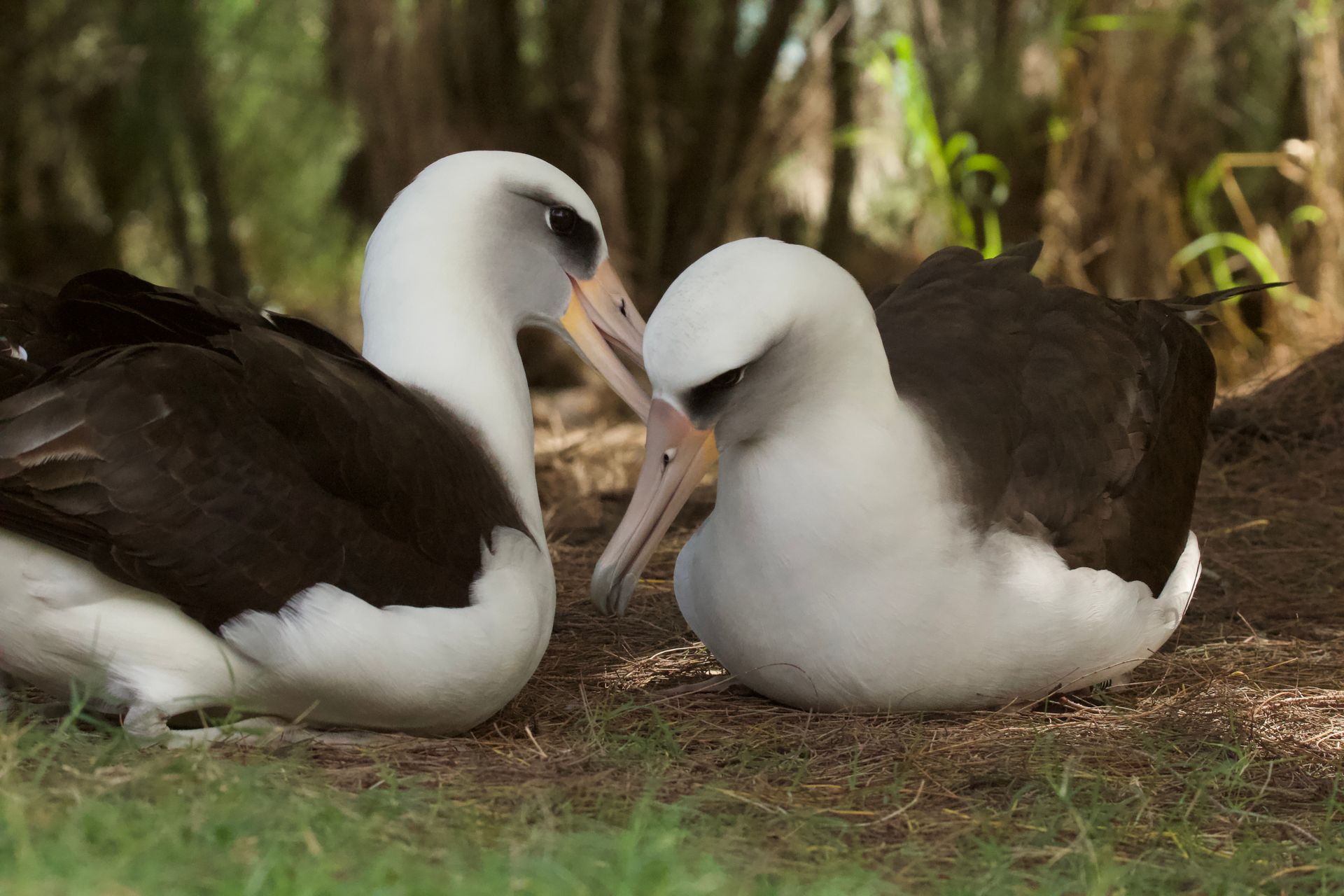
They form long-term pair bonds, with the male performing elaborate courtship displays to attract a mate. The male will spread his wings, wave his head around, and rap his bills against that of the female while making a braying noise.
Mating season starts in early November, with the albatrosses creating nests of mud and grass on one of the Sub-Antarctic islands. The female will lay 1 egg about 10 cm long, sometime between the middle of December and early January.
Incubation takes around 11 weeks, with the parents taking turns to sit on the egg. The chick takes another 7-9 months to fledge, with the full breeding cycle taking 10-12 months.
Wandering albatrosses breed biennially, as chick-rearing requires an eleven-month cycle. This means they have a sabbatical year to complete their moult before attempting to breed again.
Immature birds return to colonies when 6-10 years old, and typically do not start breeding until 11-15 years old.
If this caught your attention, see: Will Black Vultures Attack Dogs
Do Albatrosses Have Predators?
Wandering Albatrosses have almost no natural predators due to their massive size and flight habits.
They're just too big and too good at flying to be caught by most predators.
Because of this, they're able to live a relatively predator-free life, which is a big advantage in the wild.
This is especially true since they spend almost all of their lives in flight, making it hard for predators to catch them.
A unique perspective: Wandering Albatross Predators
Population and Numbers
The Wandering Albatross is a remarkable bird, and its population is quite impressive. There are about 25,200 adult Wandering Albatrosses in the world today.
The species breeds biannually, which means they have two breeding seasons per year. A global population of around 8,050 breeds during these times.
You can find Wandering Albatrosses breeding outside of New Zealand, in the southern Indian and Atlantic Oceans, and at Macquarie Island south-west of New Zealand.
Discover more: Eastern Gray Squirrel Population Distribution Pattern
Interesting Facts
The Wandering Albatross is an incredible bird, and here are some interesting facts about it:
They're the largest member of their genus (Diomedea) and one of the largest birds in the world.
Wandering Albatrosses are also one of the best known and most studied species of birds, which is a testament to their fascinating nature.
In Greek mythology, Diomedes was a hero known for his bravery, and his companions were said to have turned into birds. The name Diomedea Exulans is a nod to this mythological figure.
Wandering Albatrosses have the largest wingspan of any bird in the world, reaching up to 3.5 meters across. That's huge!
They're also incredibly efficient gliders, able to soar through the sky without flapping their wings for several hours at a time. This is a remarkable feat of aerodynamics.
Wandering Albatrosses have a special gland above their nasal passage that excretes a high saline solution to help keep their body's salt levels in balance. This is a clever adaptation to their marine environment.
As they age, Wandering Albatrosses get whiter in color. It's a subtle change, but one that's noticeable over time.
Consider reading: World Wildlife Foundation Charity Rating
Habitat and Environment
The wandering albatross is a pelagic species that spends most of its life over the open ocean, only returning to land for breeding. It primarily inhabits the Southern Ocean, where surface temperatures range from -2°C to 24°C.
This species is highly adapted to marine life, using dynamic soaring to glide over oceanic winds with minimal energy expenditure. It takes advantage of the strong westerly winds typical of its range to cover vast distances without flapping its wings.
During the breeding season, the wandering albatross nests on subantarctic islands, selecting sites on coastal slopes, ridges, and open plains that provide unobstructed access to wind currents, which are essential for takeoff.
Here's an interesting read: Wild Life Conservation
Habitat and Environment
The snowy albatross is an entirely pelagic species, spending the majority of its life over the open ocean, only returning to land for breeding. It primarily inhabits the Southern Ocean, where surface temperatures range from -2°C to 24°C.
It's adapted to a marine lifestyle, using dynamic soaring to glide over oceanic winds with minimal energy expenditure. This allows it to cover vast distances without flapping its wings.
Albatrosses from the Kerguelen Archipelago undertake extensive migrations during their non-breeding years, often circumnavigating Antarctica multiple times and covering over 120,000 kilometers (75,000 miles) in a single year.
The snowy albatross prefers waters where surface temperatures range from -2°C to 24°C, and it's highly adapted to a marine lifestyle.
Torova
The Toroa, also known as the Wandering albatross, is a majestic bird that thrives in vast oceanic environments.
Its large size and variable plumage phases allow it to blend in with its surroundings, making it a master of adaptation.
The Toroa's pinkish-salmon bill is a distinctive feature, and in some adults, a pinkish stain can be found behind the ears.
This bird's impressive wingspan allows it to soar for hours, riding the wind currents with ease.
Sounds and Communication
Wandering albatrosses are skilled communicators, and their sounds play a crucial role in their interactions.
They use bill clapping to communicate, often doing so during calls from a pair at the nest.
Wandering albatrosses are able to convey important information to each other through these sounds, which are essential for their relationships and daily lives.
The Bird That Made the Breeze Blow
The wandering albatross is known for its ability to make the breeze blow as it flies over the ocean. It's a remarkable sight to see.
The bird's large wingspan, which can measure up to 4 metres in span, allows it to swoop low over the waves and rise on the air that is pushed up again when the wave rises. This unique flying style enables it to fly continuously and cover vast distances with minimal effort.
Albatrosses are large birds, and their chicks are equally impressive, weighing around 12kg when they leave the nest. It takes the chick just over 12 months to develop fully.
The albatross's distinctive flying style is made possible by a mechanism within the base of its wing that allows it to "lock" it in an extended position, eliminating the need to strain to keep its wings out. This clever adaptation is essential for its long-distance flights.
For another approach, see: Large Exotic Cats for Pets
Sounds
Birds use a variety of sounds for communication, including calls from pairs at the nest, which can be accompanied by bill clapping.
These calls can serve as a form of identification, helping birds recognize one another and maintain pair bonds.
Torova and Toro
The Toroa and Toro are two terms associated with the Wandering Albatross, Diomedea exulans.
The Toroa is actually another name for the Wandering Albatross itself.
It's a very large white albatross with variable amounts of black on the wings.
The Toro is a specific stage in the development of the Wandering Albatross, characterized by chocolate brown juveniles with white faces and underwings.
These young birds will eventually mature into pure white adults with black wing tips and trailing edge to the wing.
Intriguing read: White Breasted Nuthatch Flying
Frequently Asked Questions
What bird does not touch land for 5 years?
The Albatross spends its first 5+ years at sea, never touching land. This remarkable bird's oceanic existence is a testament to its incredible adaptation to flight.
What is the secret of the albatross?
The secret of the albatross lies in its ability to harness wind energy by flying in a crosscurrent direction just above the ocean waves, utilizing a technique called dynamic soaring. This clever tactic allows them to soar for long periods with minimal effort, making them one of the most efficient flyers in the animal kingdom.
Featured Images: pexels.com