Horse competitions can be a thrilling experience for both riders and spectators. They come in a variety of forms, each with its own unique rules and objectives.
Dressage competitions, for instance, focus on the horse's ability to perform precise movements and patterns in a predetermined sequence. This requires a great deal of practice and training from both horse and rider.
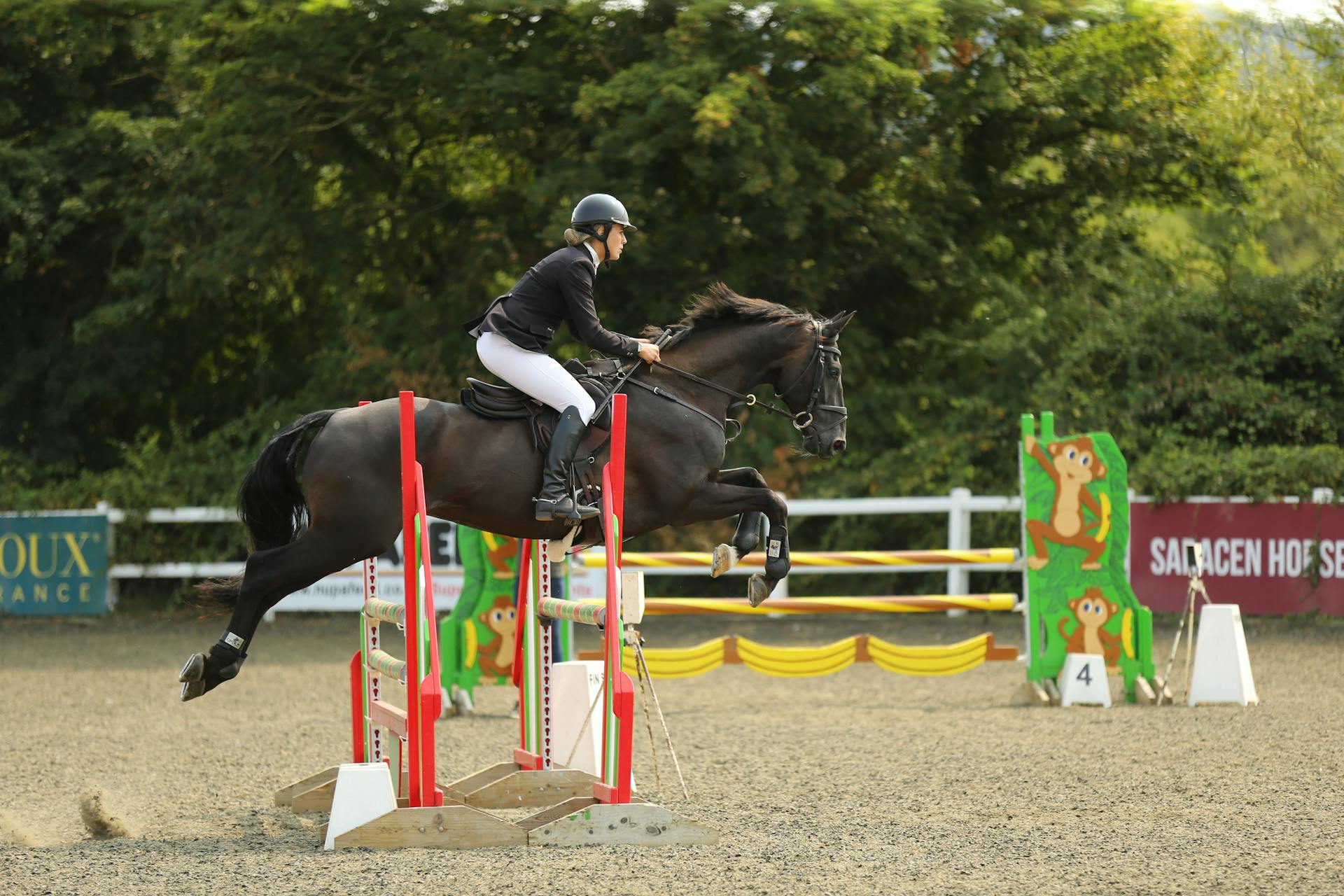
Jumping competitions, on the other hand, test the horse's agility and speed as it navigates a course of obstacles. The rider must balance the need for speed with the need to maintain control over the horse.
Riders can choose to compete in a variety of disciplines, including show jumping, eventing, and hunter classes.
Types of Horse Competitions
International jumping competitions are a thrilling sight to behold, and they come in different levels of complexity and prize money. The FEI (Fédération Équestre Internationale) organizes these events, which are called CSIs, or Concours de Saut International.
CSIO events include a team competition, adding an extra layer of excitement to the individual riders' performances. The FEI also offers FEI Grand Prix classes at international competitions, which have different star ratings based on jump height and prize money.
Here's a breakdown of the different FEI Star Ratings, which will give you an idea of what to expect from each competition:
Types of Horse Competitions
Show jumping is a thrilling equestrian discipline that involves riding a horse over a course of jumps and obstacles within a designated arena. The primary goal of show jumping is to navigate the course with speed and accuracy while avoiding knocking down any of the obstacles.
The course is designed with a variety of obstacles, including verticals, oxers, combinations, and related distances. Fence height and technical difficulty increase as combinations move up the levels.
Show jumping competitions can be held at various levels of difficulty, ranging from local shows to international events. Riders progress through these levels as their skills and experience improve.
A unique perspective: Horse Show
In competitions, riders start with a clear round score of zero faults. Throughout the course, faults can be incurred for various reasons, including altering the height or width of a fence, refusing to jump, and exceeding the time allowed to finish the course.
A disqualification occurs if a rider falls off during competition or if more than two refusals take place. The rider with the least faults and fastest time wins.
The FEI World Cup Jumping is the championship name for show jumping competitions. The competition format is typically seen in Grand Prix jumper classes, where combinations with a clear round return for a jump off on a shorter version of the course.
The jump off order is the same as the first round. In some competitions, speed round jumper classes don't have a jump off, and combinations must ride fast and jump clear in a single round to increase their chances of a high placing.
There are different formats or sets of rules for show jumping competitions, classified into different tables according to how the competition is conducted, scored, and what penalties are applied for certain faults.
Here are the different table classifications used in jumper classes:
Show jumping courses typically consist of 10 to 16 obstacles. The height of show jumping obstacles varies depending on the level of competition. Fence height and technical difficulty increase as combinations move up the levels.
In the Olympics, the show jumping event takes place over five rounds, over varying courses of jumps set at 1.60M (approximately 5’3” tall). The first three rounds are used to determine the team medals, and the fourth and fifth rounds determine the individual titles.
Polo
Polo is a team sport played on horseback that involves two teams of four players each, with the objective of scoring goals by hitting a small ball into the opposing team's goal using a long-handled mallet.
The game is divided into 7-minute sections called chukkas, with a four-minute break in between and a ten-minute halftime. Players at the highest level may switch horses every few chukkas due to the tremendous pace of the game.
The bond between horse and rider is always at the forefront, whether it's in a simple game of Polo or an intense endurance race. What matters is that both horse and rider are having fun and enjoying themselves.
Umpires keep an eye on the game to ensure that both the participants and the horses are secure. In most cases, the player who strikes the ball has the right of way, and other players are not allowed to cross the ball line in front of every player.
Consider reading: Professional Horse Rider
Polo is played on horseback, with players riding specially trained polo ponies that are athletic, agile, and responsive. Players often switch horses between chukkers to ensure the horses remain fresh and perform at their best.
The sport is often referred to as “the sport of kings” due to its historical association with nobility and royalty. Major tournaments, such as the Argentine Open and the British Open, are highly prestigious events in the world of polo.
Types of Horse Competitions
There are two main types of horse racing competitions: flat racing and speed/stakes classes.
Flat racing is a test of agility, endurance, and the jockey's strategic thinking.
Races range in length from 5 furlongs to two miles, and can take place on grass or synthetic courses.
Speed/stakes classes feature fences set at a moderate height, encouraging a fast-paced competition.
In flat racing, horses can compete in various aspects, including classics, group and classified races, maidens, and handicaps, depending on their gender, age, and aptitude.
Riders in speed/stakes classes aim to complete a clear round in the fastest time possible.
Check this out: Horse Racing
Vaulting
Vaulting is essentially gymnastics on horseback, where athletes perform acrobatic moves on a moving horse. This unique sport requires a deep connection between the rider and the horse.
The horse canters in a circle while a longer one keeps it moving, creating a dynamic and challenging environment for the riders. This setup allows riders to showcase their skills and the horse's abilities.
Competitors perform routines that include compulsory exercises and freestyle movements. The routines are planned to show the horse's majesty, brightness, force, endurance, and grace in synchrony.
The horse's performance accounts for 20% of the final score, highlighting the importance of the horse's well-being and behavior in the competition.
Expand your knowledge: How to Get a Horse's Attention?
Reining
Reining is a Western riding discipline where horse and rider work together to accomplish a sequence of maneuvers, such as galloping small and big circles, flying lead changes, fast spins, and sliding stops. It takes about 2.5 to 3 minutes to finish each pattern.
Judges evaluate performances on cleanliness, delicacy, confidence, and rapidity using a scoring system. The goal is to have a horse that is willing to be led with little or no opposition.
In reining, judges score the performance based on the execution of the required movements, emphasizing control and finesse. This means that the horse and rider must work together seamlessly to achieve a high score.
Reining competitions typically involve individual competitors, and the championship name is the NRHA Futurity.
Barrel Racing
Barrel racing is a rodeo activity where the horse and rider must pass three barrels in a cloverleaf pattern in the shortest amount of time possible.
The barrels are arranged in a triangular shape with one barrel immediately ahead, one to the left, and one to the right.
The horse and rider must execute the route around the barrels as quickly as possible from left to right and back.
There are penalties for striking or falling over a barrel, but the quickest runner wins.
The fastest time is the key to success in barrel racing, where precision and speed are essential.
Western Pleasure
Western Pleasure is a type of horse competition that showcases a horse's smooth and relaxed gaits.
Judges evaluate the horse's performance, manners, and suitability for pleasure riding, which means the horse should be calm and responsive to the rider's guidance.
In Western Pleasure, riders guide their horses through walk, jog, and lope gaits, and the horse's performance is the main focus.
This type of competition is perfect for horses that excel in calm and relaxed gaits, and it's great to see riders and horses working together in harmony.
Individual competitors participate in Western Pleasure, and the AQHA World Championship Show is the championship name for this type of competition.
For more insights, see: Dog Type
Combined Driving
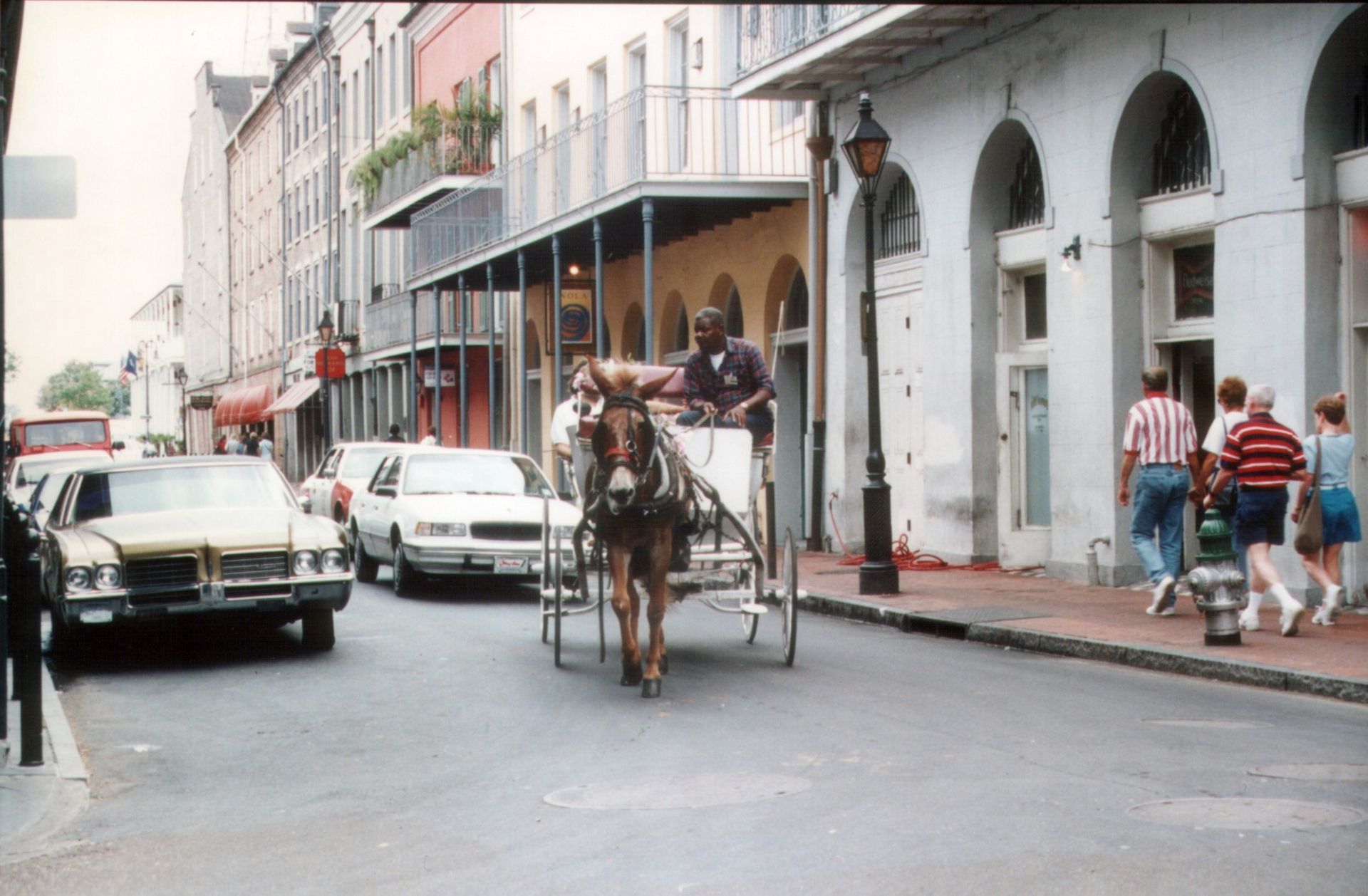
Combined driving is a type of horse competition that involves a horse-drawn carriage. It's similar to eventing but with a twist.
The competition includes three phases: dressage, marathon, and cones. Drivers must demonstrate precision, endurance, and agility throughout the event.
Competitions can be held individually or as teams. The championship name for this event is the FEI World Driving Championships.
Equitation
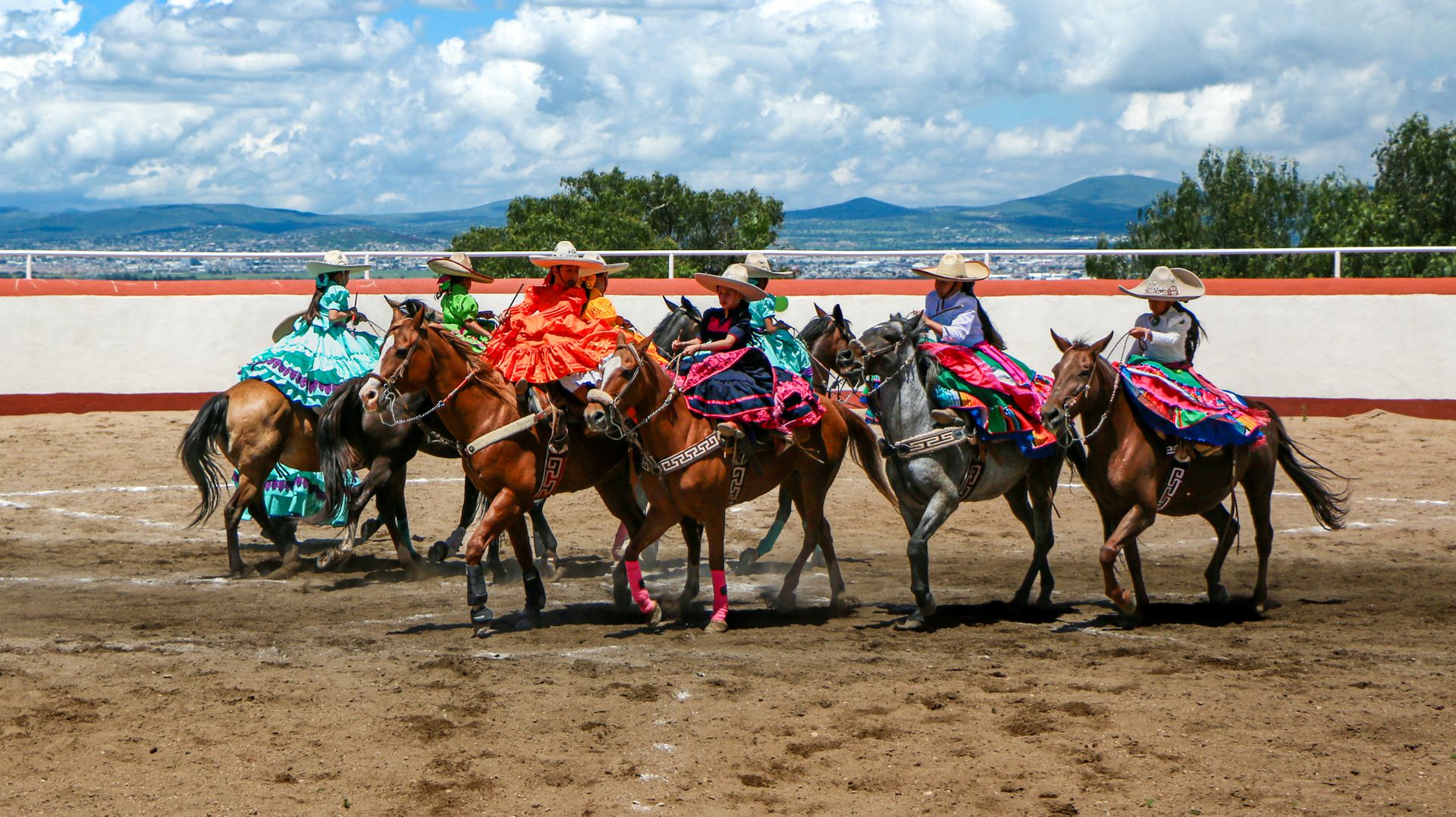
Equitation is a style of horse riding that focuses on the rider's ability to effectively communicate with the horse. It requires a deep bond between horse and rider.
There are two main types of equitation: Saddle Seat and Dressage Seat Equitation. Saddle Seat emphasizes the high-stepping action and elegance of certain horse breeds. Riders perform various classes, including equitation and pleasure, showcasing the horse's gaits and the rider's posture.
Dressage Seat Equitation, on the other hand, focuses on the rider's ability to effectively and elegantly communicate with the horse. Riders perform dressage movements, and judges evaluate their seat, posture, and effectiveness.
Both Saddle Seat and Dressage Seat Equitation have individual competitors, not teams. They also have their own championship names: the United States Saddle Seat World Cup and the USEF Dressage Seat Medal Finals, respectively.
Here are the key differences between Saddle Seat and Dressage Seat Equitation:
Working Equitation
Working Equitation is a type of horse competition that tests the versatility and skills of horse and rider in various tasks related to cattle work.
This competition is divided into several phases, including dressage, ease of handling (an obstacle course), speed, and cattle work. Points are awarded based on precision, agility, and effectiveness.
Competitions can be either individual or team based, making it a great option for horse owners and riders who enjoy working together with their horses.
In Working Equitation, the goal is to showcase the horse and rider's ability to work together seamlessly, making it a great showcase for their partnership and skills.
Flatwork
Flatwork is a crucial part of a show jumper's training, helping to develop the horse's rideability and adjustability.
Repetitive jumping can strain a horse's musculoskeletal system, so most riders don't spend much time jumping big fences at home.
Jumpers use flatwork to prepare their horses for challenging courses, where they must respond quickly to small aids to maintain their line and control stride length between obstacles.
Flatwork exercises often incorporate dressage training principles to condition the horse's body gymnastically, developing strength and coordination.
Cavaletti and ground poles are used in flatwork exercises to train coordination and timing without straining the horse's body.
This type of training helps show jumpers develop the skills they need to navigate complex courses with ease and precision.
Puissance
Puissance is a high jump class held at some show jumping competitions, where horses and riders jump four to six obstacles with starting heights of 1.70m to 1.80m.
The goal is to clear the highest jumps, rather than competing against the clock like in other classes.
Riders compete to clear the highest jumps, with only two obstacles in the jump-off rounds, which are raised between each round for a maximum of five rounds.
Competition Rules and Regulations
Competition rules and regulations are crucial to understanding how horse competitions work. In jumper classes, riders navigate a set course of jumps within an allotted time, and penalties are accumulated for faults.
Riders win the class based on the number of penalty points they accumulate. The combination with the lowest number of penalty points wins the class.
Competition Types and Levels
Competition types and levels vary depending on the discipline and the level of riders involved.
For example, in English riding, competitions can be divided into different levels such as Preliminary, Intermediate, and Advanced.
The FEI (Fédération Équestre Internationale) also has a grading system that categorizes competitions into different levels, including Grade 1, Grade 2, and Grade 3.
In dressage, competitions can range from local shows to international championships, with riders competing at levels from Training to Grand Prix.
The level of competition can also be determined by the type of event, such as a one-day event or a multi-day event.
Ranch Riding
Ranch Riding is a competition type where riders guide their horses through patterns that include various maneuvers, such as spins, circles, and stops.
Judges evaluate the horse's responsiveness and performance, making it a great test of the horse's ability to work with its rider.
This type of competition is typically held at the AQHA World Championship Show, where individual competitors showcase their skills.
Ranch Riding is perfect for those who want to see horses performing real-life tasks, rather than just fancy tricks.
Additional reading: Bulldog Dog Breed
Para-Equestrian
Para-Equestrian is an inclusive discipline that allows riders with physical disabilities to compete in equestrian sports.
Competitions are adapted to accommodate the needs of the riders, with events in dressage and driving. This means that riders can participate in a format that suits their abilities.
Riders are evaluated based on their performance and effectiveness, which is a fair and encouraging way to assess their skills.
In Para-Equestrian, individual competitors take part in events, making it a great opportunity for riders to showcase their talents.
The championship name for Para-Equestrian is the Paralympic Games, which is a prestigious title that highlights the discipline's importance.
FEI Star Ratings
FEI Star Ratings are a way to measure the level of competition in jumping events. They're based on the height of the jumps and the prize money available.
In international competitions, FEI Grand Prix classes have different star ratings. The highest jump height is 1.60m+ in the CSI 5* events. The lowest jump height is 1.40m in the CSI 1* events.
The prize money also varies depending on the star rating. CSI 5* events offer the largest prize money, over $517,000 USD. In contrast, CSI 1* events offer up to $51,424 USD.
Here's a breakdown of the FEI Star Ratings:
Novice/Introductory
If you're new to the world of horse competitions, don't worry, there are classes designed for you! Some competitions offer classes for novice horses and riders new to the sport, which have the lowest fence heights and simplest courses.
These classes are perfect for building confidence and skills, allowing you to learn the basics of the sport in a supportive environment.
Amateur
In amateur classes, riders of all skill levels can participate, including professionals who compete as a hobby.
The USEF and USHJA have simplified the language for junior and amateur sections, replacing high, medium, and low designations with fence height ranges.
This change makes it easier for riders to find the right class for their skill level.
Amateur riders can compete in jumper competitions in divisions designated specifically for their level.
Riders can enter open classes, giving them the flexibility to compete against others of varying skill levels.
USEF
The United States Equestrian Federation (USEF) is the national governing body for horse sport in the United States, originally established as the American Horse Shows Association in 1917.
The USEF recognizes eight international disciplines, in addition to 11 additional national disciplines.
The USEF recognizes the following 11 national disciplines:
- English Pleasure
- Carriage Pleasure Driving
- Hunter
- Hunter/Jumping Seat Equitation
- Parade Horse
- Reining
- Roadster
- Saddle Seat
- Western
- Western Dressage
- Western/Reining Seat Equitation
Horse and Rider Requirements
To compete in horse competitions, you'll need to meet certain requirements as a rider. Riders must be at least 18 years old.
Horses must also meet specific standards, such as being at least 15 hands high for most competitions.
Riders are responsible for ensuring their horse's health and well-being, including regular veterinary care and proper nutrition.
Saddle
A close-contact saddle, like a jumping saddle, provides a feel that's in sync with the horse's movement. This type of saddle has a shallow seat and forward flap.
Jumping saddles are designed to allow riders to maintain a balanced position over a jump.
Bridle
A well-fitting bridle is essential for both you and your horse.
Show jumper bridles are often made of plain brown leather, which is a traditional choice.
Jumper riders have more flexibility when it comes to nosebands, which can be figure eight, cavesson, flash, or dropped.
The FEI allows the use of various bits, including snaffles, pelhams, and kimberwicks.
Wire and chain bits are not permitted in competition.
Rider Attire
Helmets are essential for jumper riders, reducing injury risk by 40% to 50% due to their protective properties.
A helmet is the most important piece of equipment for jumper riders, even for the most advanced riders who can still fall during training and competition.
Knee patch breeches are preferred by jumper riders as they provide grip where the knees contact the saddle.
Jumper riders typically wear knee patch breeches, which provide grip where their knees contact the saddle.
Tall boots for jumping are softer than dressage boots, allowing for more movement in the rider’s joints over a jump.
Many riders prefer to wear gloves for extra grip and protection, although they are optional in jumper competition.
Suggestion: Wear Riding
Horses
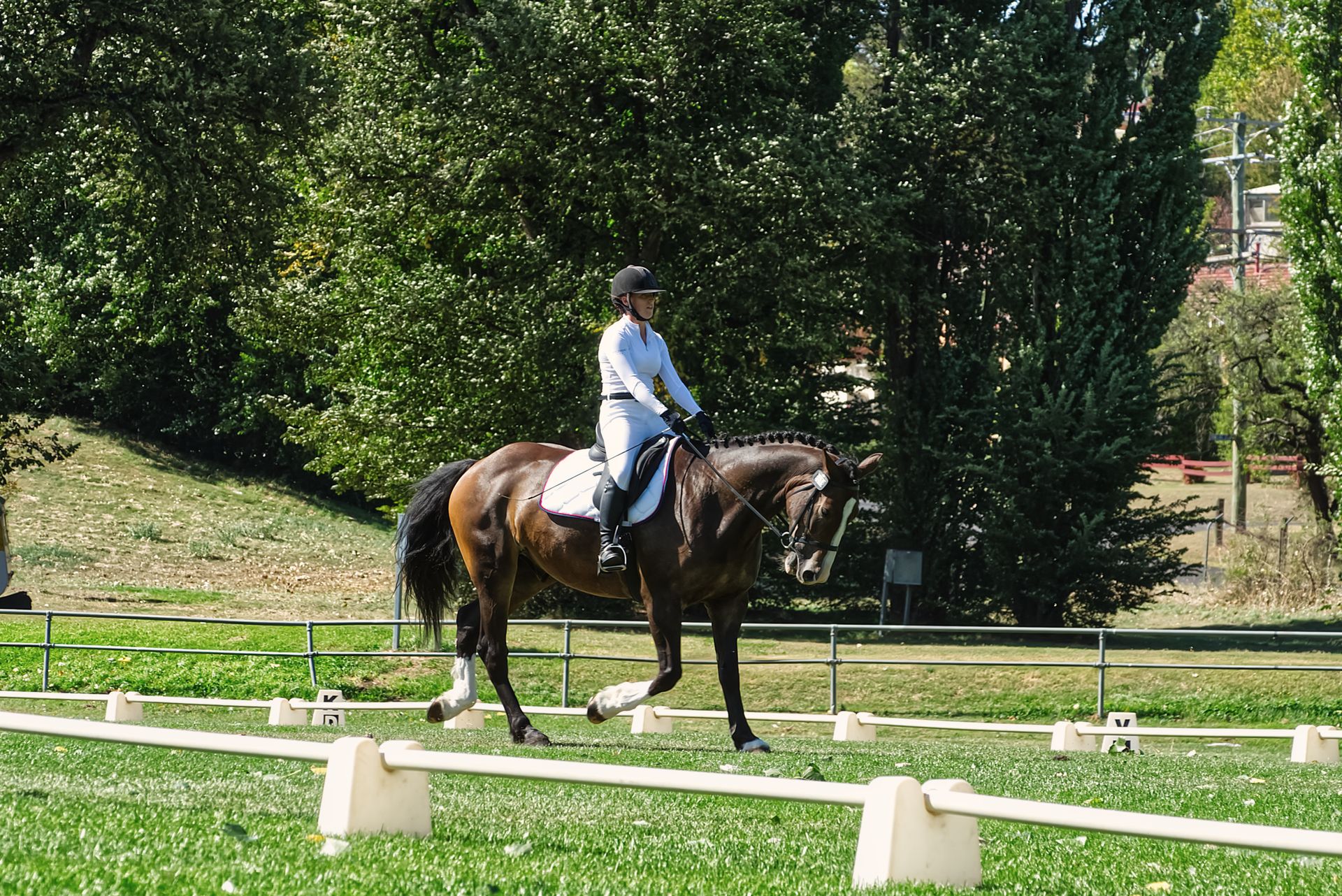
Horses need proper management and nutrition to be at their best, no matter their job.
Some horses are bred explicitly for jumping talent, but even the most talented jumper horses require good care and training to meet their potential.
Horses of all breeds need regular care and attention to thrive.
Featured Images: pexels.com