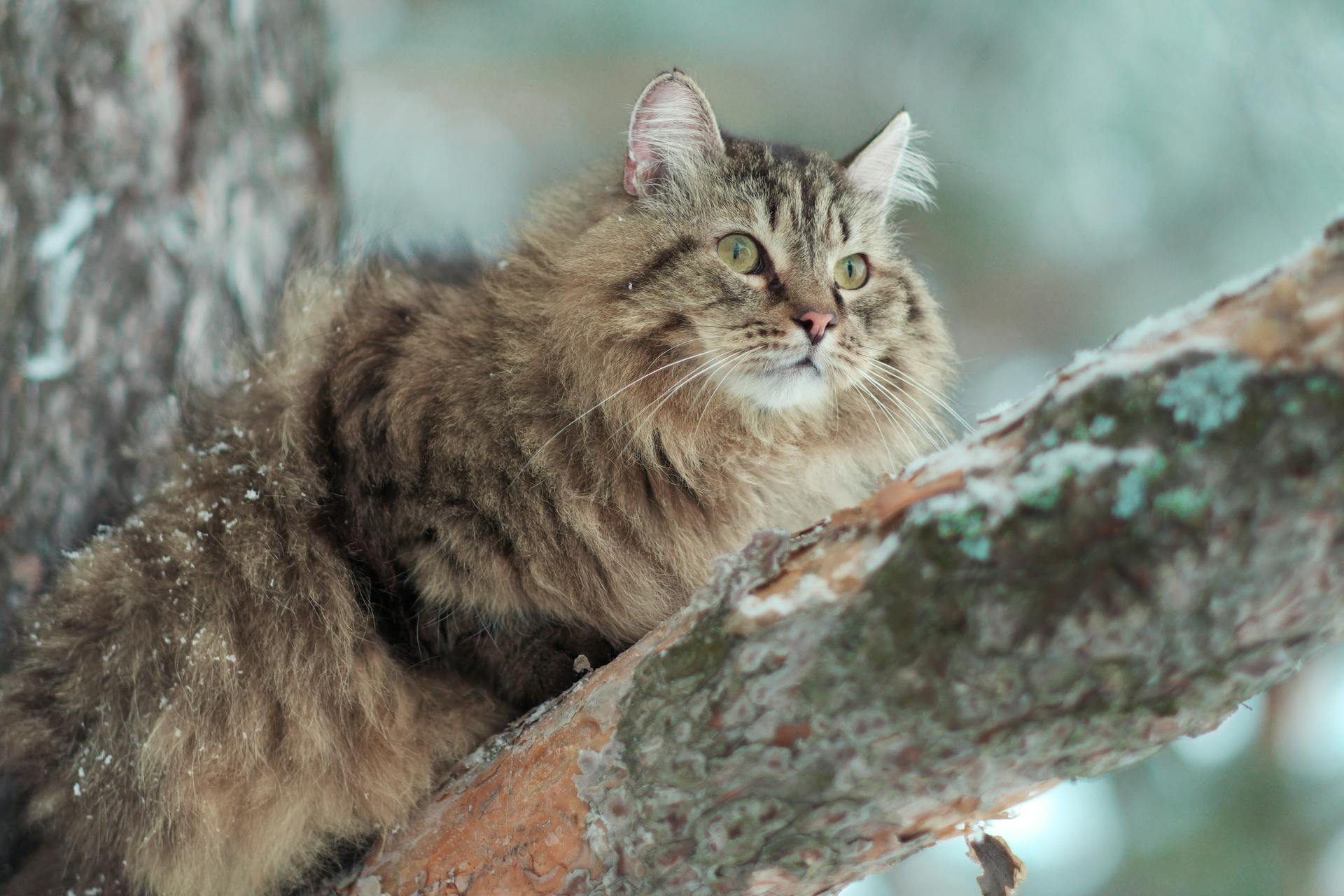
Cats can get worms, also known as parasites, which can cause a range of health problems.
Toxoplasmosis is a type of parasite that can be contracted by cats, and it's usually spread through contact with contaminated cat litter or infected prey.
Cats can also get roundworms, which are one of the most common types of cat worms. They can grow up to 5 inches in length and are often found in the cat's intestines.
Preventing worms in cats is easier than treating them, and it starts with regular deworming medication.
Types of Cat Worms
Cat worms can be a real nuisance, and there are several types to be aware of. Gastric worms, also known as ollulanosis, are a type of worm that colonize the gastric mucosa in cats.
These worms are usually up to one centimeter long and can cause occasional vomiting, reluctance to eat, emaciation, and dehydration in severe cases.
Tapeworms, on the other hand, are a common problem in cats, especially older ones. They hook into the lining of the cat's bowels and develop long ribbon-like bodies, with the ends becoming egg sacs that break off and pass out of the back passage.
You may see these segments in the cat's feces or on the hair around the cat's bottom, which can resemble grains of rice when dry. Tapeworms are often spread by fleas, so it's essential to control flea infestations to prevent tapeworm infections.
There are several types of tapeworms that can infect cats, including Dipylidium caninum and Taenia taeniaeformis. These worms need an intermediate host, such as a mouse, to complete their life cycle.
Other types of tapeworms that can infect cats include Diphylobothrium latum, which has fish as its intermediate host, and Spirometra spp, which has amphibians, reptiles, and rodents as its intermediate hosts.
Roundworms, such as Toxocara mystax and Toxascaris leonina, are also common in cats. These worms can be ingested through contaminated feces, infected transport hosts, or the mother's milk.
In severe cases, roundworm infestations can cause unspecific symptoms like mushy feces, shaggy fur, hair loss, emaciation, and dehydration, as well as growth disorders and distended joints in young animals.
Here's a list of the types of cat worms mentioned in this article:
- Gastric worms (ollulanosis)
- Tapeworms (Dipylidium caninum, Taenia taeniaeformis, etc.)
- Roundworms (Toxocara mystax, Toxascaris leonina, etc.)
Symptoms and Diagnosis
Symptoms of worm infestation in cats can be sneaky, but they're often noticeable once the worms have taken hold. The signs can vary depending on the type of worm and the age of the cat.
If your cat has roundworms, you might notice vomiting, diarrhea, weight loss, a dull coat, and a lack of energy. In severe cases, a swollen or distended tummy, also known as a "pot belly", can be a sign of a serious infestation.
Tapeworms, on the other hand, can be more difficult to spot, but common signs include an increased hunger, dragging the bottom along the ground due to irritation, and more time spent washing the anal area. In some cases, you might even see egg-filled segments around the cat's bottom, which look like small grains of rice.
Here are some common symptoms of worms in cats:
- Visible presence of worms or eggs in stool or vomit
- Change in coat, such as dullness or clumping
- Change in color of gums, indicating anemia
- Vomiting, especially if it's more frequent than usual
- Change in stool or bowel movements, including dark, tarry stool
- Increased appetite despite weight loss
Diagnosing worm infestations can be tricky, as many cats don't show obvious symptoms. However, if you suspect your cat has worms, it's essential to have them examined by a vet immediately.
Signs and Symptoms
Symptoms of worm infestation in cats can be subtle, making regular worm control essential. By the time symptoms appear, your cat's health has likely been compromised.
The most common signs of roundworms include vomiting, diarrhea, weight loss, a dull coat, and lack of energy. In severe cases, a swollen or distended tummy, also known as a pot belly, can be a noticeable symptom.
Tapeworms can be more difficult to diagnose, but common symptoms include increased hunger, dragging the bottom along the ground due to irritation, and more time spent washing the anal area.
Hookworms can cause dark stools and diarrhea due to bleeding, which can lead to anemia.
Some cats may not show any symptoms at all, making regular check-ups with your vet crucial.
Here are some common symptoms of worms in cats:
- Vomiting
- Diarrhea
- Weight loss
- A dull coat
- Lack of energy
- Swollen or distended tummy (pot belly)
- Dark stools (caused by bleeding)
- Increased hunger
- Dragging the bottom along the ground
- More time spent washing the anal area
If you notice any of these symptoms, it's essential to have your cat examined by your vet immediately.
Diagnosing
Diagnosing worm infections in cats can be a bit tricky. Most intestinal worms in cats are easily resolved with either a single dose of dewormer or a short course of deworming medication, but certain worms like hookworms and lungworms can be more stubborn to resolve.
A veterinarian will typically ask you to bring in a stool sample, which will be placed in a solution that allows the parasite eggs to separate from the feces and float to the top. This is a crucial step in diagnosing the type of worm infesting your cat.
To get a complete picture of your cat's health, a physical exam, along with blood work, may also be carried out. This will help determine the exact type of worm infesting your cat and the best course of treatment.
Recommended read: Large Breed Bulldog

Some worm infections can be detected through fecal examinations, but others, like those caused by fox and cucumber nematode tapeworms, may require more advanced methods like molecular biology.
The lifecycle of each parasite is different, so it's essential to know exactly the type of worm infesting your cat. This will determine the medication, treatment, and follow-up care your cat will need.
Here's a list of suitable test materials for detecting worm infections:
Are Painful?
Cats can experience significant discomfort due to worms.
Worms can cause gastrointestinal symptoms such as vomiting and diarrhea, leading to a range of unpleasant issues.
Cats with heavy parasite loads may become very unwell.
Worm larvae can cause inflammation of the affected tissues as they travel through the cat's internal organs.
Prevention and Treatment
You should assume that all kittens are infected with roundworms from their mother's milk, so worming should start at a young age.
Treating kittens for roundworms every fortnight from 3 weeks of age until 8 weeks of age, then monthly to 6 months of age, is a common recommendation.
Adult cats over 6 months of age should be treated every 1-3 months depending on risk, influenced by hunting behavior and outdoor access.
A product active against Dipylidium caninum should also be used in kittens that have fleas.
To prevent heartworm or lungworm infection, discuss with your veterinary team if this is needed in your area and which products to use.
Preventing Re-Infestation
To keep your cat safe from worms, it's crucial to continue being proactive after treatment. Adhering to a strict year-round flea prevention regimen can help reduce the risk of tapeworm infection, since fleas carry worms.
If your cat is an avid hunter or spends time both indoors and outdoors, preventative deworming every 3 months can help eliminate any intestinal worms before they become a large burden for your pet.
You should also pay attention to your cat's litter box, keeping it fresh and clean on a daily basis. This is especially important to protect yourself and your family from potential worm eggs and larvae.
Here's a quick rundown of some key prevention strategies:
In addition to these methods, it's essential to clean up cat feces immediately, wash your hands, and if possible, wear gloves whenever cleaning the litter box. This will help prevent the spread of worms and keep your home safe and healthy for everyone.
Worm Treatment
Worm treatment for cats can be a challenge, but there are effective options available.
NexGard SPECTRA Spot-On for Cats is a topical cat dewormer that's easy to use and effective against roundworms, hookworms, tapeworms, and lungworms.
Monthly treatment with NexGard SPECTRA also protects cats against fleas, ticks, mites, and heartworm.
It's suitable for kittens from 8 weeks of age and weighing at least 0.8 kg.
This convenient product eliminates the need for multiple products, making it a one-and-done solution for cat owners.
What Happens If Left Untreated?
If left untreated, a gastric worm infestation in cats can lead to serious health issues. These can include malnutrition, severe anemia, and intestinal obstructions.
The severity of the infestation can vary, with some cats showing occasional vomiting, while others may exhibit reluctance to eat, emaciation, and dehydration. Infection can be detected by finding worms in gastric lavage samples or vomit.
Untreated worm infestations can become life-threatening, making it essential to treat them as soon as possible.
Check this out: Different Types of Worms in Dog Feces
Rare and Specific Worms
Taenia pisiformis is a rare tapeworm found in cats, typically growing up to 150 cm long. It requires lagomorphs and rodents as intermediate hosts.
The fish tapeworm, diphyllobothrium latum, is another rare occurrence in cats, growing up to 1.5 m long and 2 cm wide. It requires two intermediate hosts: copepods and fish.
Joyeuxiella pasqualei, a member of the dipylidiidae family, is found in cats, particularly in the Mediterranean region, and can grow up to 50 cm long. Its intermediate hosts are dung beetles, but transport hosts like reptiles and small mammals may also be involved.
Infestation with representatives of the genus mesocestoides is rare in cats, despite being native to Central Europe.
A unique perspective: How Long after Deworming a Cat Are the Worms Gone?
Hookworm
Hookworms are small intestinal parasites that are up to 1.5 cm long.
They are common in cats, especially ancylostoma tubaeforme, and are often ingested by eating transport hosts or by boring through the skin.
Infection with hookworms can remain asymptomatic in cats, but in more severe infestations, they can cause emaciation, anemia, or diarrhea.
Hookworm eggs are oval, smaller than roundworm eggs, and about 60×40 μm in size, with furrowed stages already visible inside when the eggs are laid.
They can be detected by finding them in the feces using a flotation method.
Gastric Worm (Ollulanosis)

Gastric worms, specifically ollulanus tricuspis, are tiny, up to one centimeter long, and colonize the gastric mucosa of cats.
These worms nestle in the mucus layer or in the openings of the gastric glands, where they develop and multiply.
Infection can be detected by finding the worms in gastric lavage samples or vomit.
O. tricuspis is rarely seen in domestic cats, but a severe infestation can cause occasional vomiting.
Some cats may also show reluctance to eat, emaciation, and dehydration due to a severe infestation.
Because O. tricuspis is viviparous, worm eggs are not detectable in feces, making it harder to diagnose the infection.
Larvae are only occasionally detectable in feces, adding to the challenge of diagnosing this type of infestation.
Additional reading: Can Dogs Get Worms from Eating Cat Feces
Lungworm Aelurostrongylosis
Lungworm Aelurostrongylosis is a rare condition that affects cats. It's caused by the lungworm aelurostrongylus abstrusus, which is up to one centimeter long.
This worm colonizes the lungs, specifically the small bronchi and alveoli, and requires an intermediate host for its development. The female worms lay eggs that hatch into larvae while still in the airways.
The larvae are coughed up, swallowed, and then passed out of the body through the feces, where they can remain infectious for up to six months in moist environments. They can penetrate various snails, which serve as intermediate hosts.
The prepatency period, or the time from infection to excretion of the first larvae, is about six weeks. Cats usually don't get infected by eating snails, but rather through transport hosts like amphibians, reptiles, birds, and rodents.
Lungworm infestation rarely causes symptoms, and it's considered self-healing. However, massive infestations or weakened immune systems can lead to respiratory symptoms like coughing, sneezing, and difficulty breathing.
The larvae can be up to 400 μm long and are irregularly excreted in the feces, making detection challenging. More conclusive diagnosis can be made through lung lavage samples or lung biopsies.
Sudden deaths can occur when large numbers of larvae hatch in the airways, although this is extremely rare.
Trichinella
Trichinella is a type of worm that can infest cats, especially in Central Europe where it's relatively rare.
Trichinae are found worldwide and have no developmental phase outside of a host, which means they can't survive on their own.
Cats get infected by eating meat containing trichinella larvae.
A small infestation of trichinae in cats may not cause any symptoms.
However, a more pronounced infestation can lead to general disturbances, vomiting, and bloody diarrhea during the intestinal colonization phase.
In rare cases, cats may develop muscle weakness, gait disturbances, respiratory problems, and fever due to myositis caused by the larvae that have migrated into the muscles.
Intestinal Fluke
Intestinal fluke infestation is a serious issue in cats, with various species of flukes developing via two intermediate hosts.
The first intermediate host is always a freshwater snail, which is a crucial part of the fluke's life cycle.
Intestinal fluke infestation can be caused by different parasite species, each with its unique second intermediate host.
For example, alaria alata uses tadpoles, reptiles, birds, and mammals as its second intermediate host, while metagonimus yokogawai and apophallus donicus use fish.
Interestingly, isthmiophora melis uses fish and amphibians, and echinochasmus perforans uses tadpoles and fish as its second intermediate host.
Intestinal fluke infestation rarely causes noticeable disease symptoms, such as diarrhea, in cats.
Check this out: Types of Cat Fish
Lung Fluke
Lung flukes are a type of parasitic worm that can infect cats and other animals.
They are commonly found in Asia and America, but not in Europe, where aquatic snails, freshwater crabs, and crayfish serve as intermediate hosts.
Infection occurs through the ingestion of raw shellfish, which can contain the metacercariae released in the intestine.
These metacercariae then migrate to the lungs, where they develop into adult flukes in cysts, causing respiratory problems similar to feline asthma.
Symptoms can range from asymptomatic to acute respiratory distress, with bursting of the cysts potentially causing pneumothorax.
Detection of infection can be done through fecal examination for eggs, bronchoalveolar lavage, or radiography of the lungs.
Threadworm Infections
Threadworm infections are a real concern for cat owners, especially when it comes to kittens. In cats, various representatives of the nematodes (Nematoda) parasitize, especially roundworms, hookworms, lungworms, hairworms and stomach worms. Co-infections by coccidia are common, especially in kittens.
See what others are reading: Types of Cat Eye Infections

Kittens are highly susceptible to these infections due to their immature immune systems. Roundworms are one of the most common types of threadworms found in cats.
Hookworms can cause anemia in cats, leading to pale gums and lethargy. Lungworms, on the other hand, can cause respiratory problems and coughing.
Stomach worms can lead to vomiting and diarrhea in cats. Hairworms can cause skin problems and hair loss.
Preventing threadworm infections is key, and regular deworming is a must, especially for kittens.
General Information
Cat worms can be a serious issue for feline health. The most common types of cat worms are tapeworms, hookworms, and roundworms.
Tapeworms are flat, long worms that can grow up to 8 inches in length. They attach themselves to the cat's intestines and feed on nutrients.
Hookworms are small, thin worms that can cause anemia in cats. They attach themselves to the cat's intestinal wall and feed on blood.
Roundworms are the most common type of cat worm and can grow up to 6 inches in length. They can cause a range of symptoms, including vomiting, diarrhea, and weight loss.
Explore further: Common Spotted Cuscus
What Do Cats Look Like?
Cats are highly variable in their appearance, but they all share certain characteristics. They have a typical feline body shape, with a short snout, pointed ears, and a long tail.
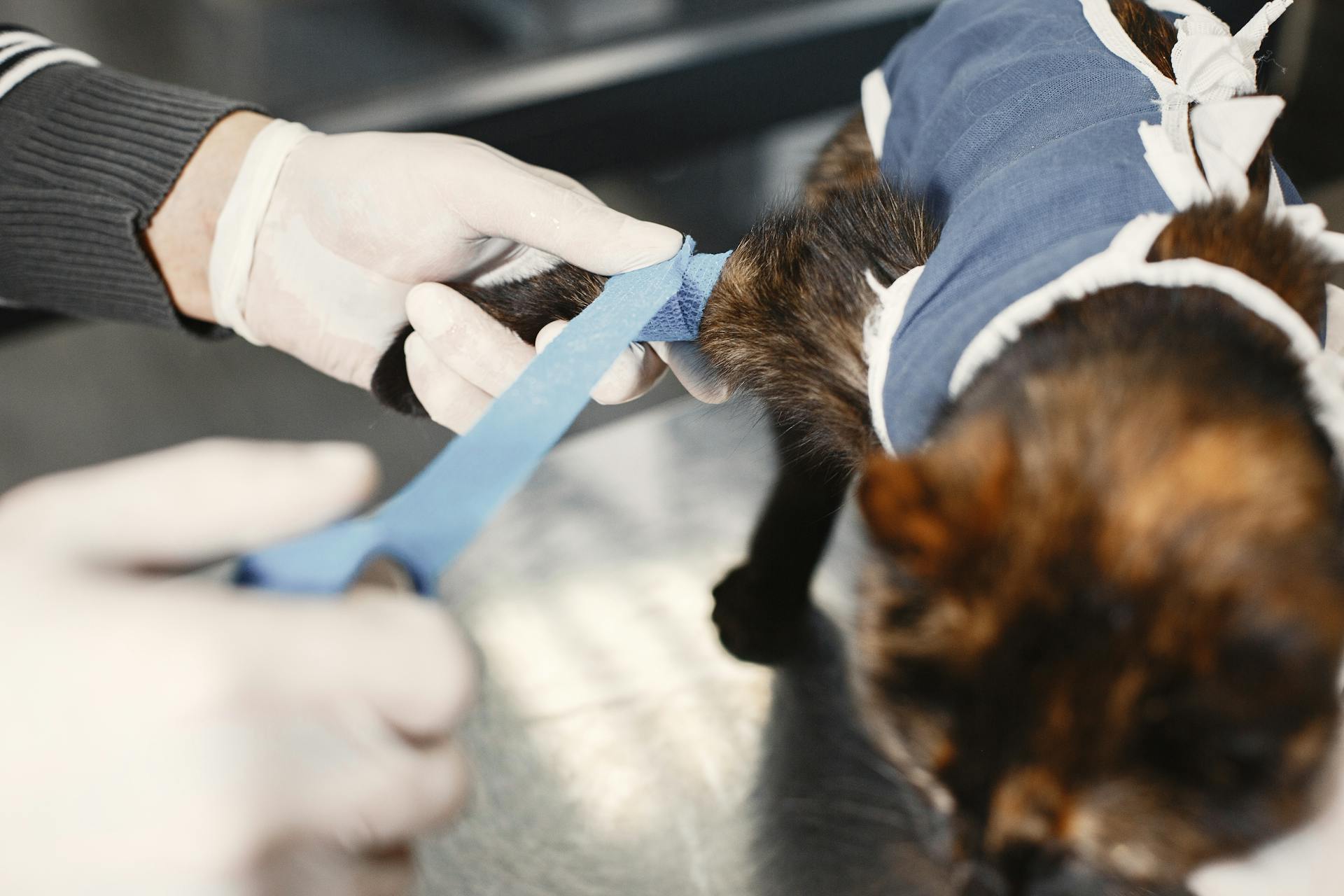
Their coats can be short or long, smooth or fluffy, and come in a wide range of colors and patterns. Some cats are sleek and slender, while others are sturdy and muscular.
Their eyes are usually almond-shaped and slanted, with vertical pupils that can open very wide. They come in a variety of colors, including blue, green, gold, and copper.
Cats are known for their agility and flexibility, and they often exhibit these qualities in their movements. They can jump, climb, and pounce with ease.
Their nails are retractable, which helps to prevent them from getting damaged. They also have scent glands located on their faces, near their cheeks and lips.
Cats are generally very clean animals, and they spend a lot of time grooming themselves to stay that way.
Check this out: Cat Hair Color Types
What Animals Get?
Cats can get infected with various types of worms, including roundworms and tapeworms.
One type of worm that affects cats is the Troglostrongylus brevior, also known as lungworm.
Can Humans Get Sick from Cats?
If you have a cat, it's essential to know that you can get worms from them if you come into contact with infected feces or soil. This can happen if you're gardening without gloves or walking barefoot through infected soil.
Direct contact with infected feces or soil is the primary way humans can get worms from cats. This is especially true for children who play in sandboxes or gardens.
Good hygiene is key to preventing worm infestations from cats. This means washing your hands thoroughly after handling soil or coming into contact with your cat's litter box.
Featured Images: pexels.com