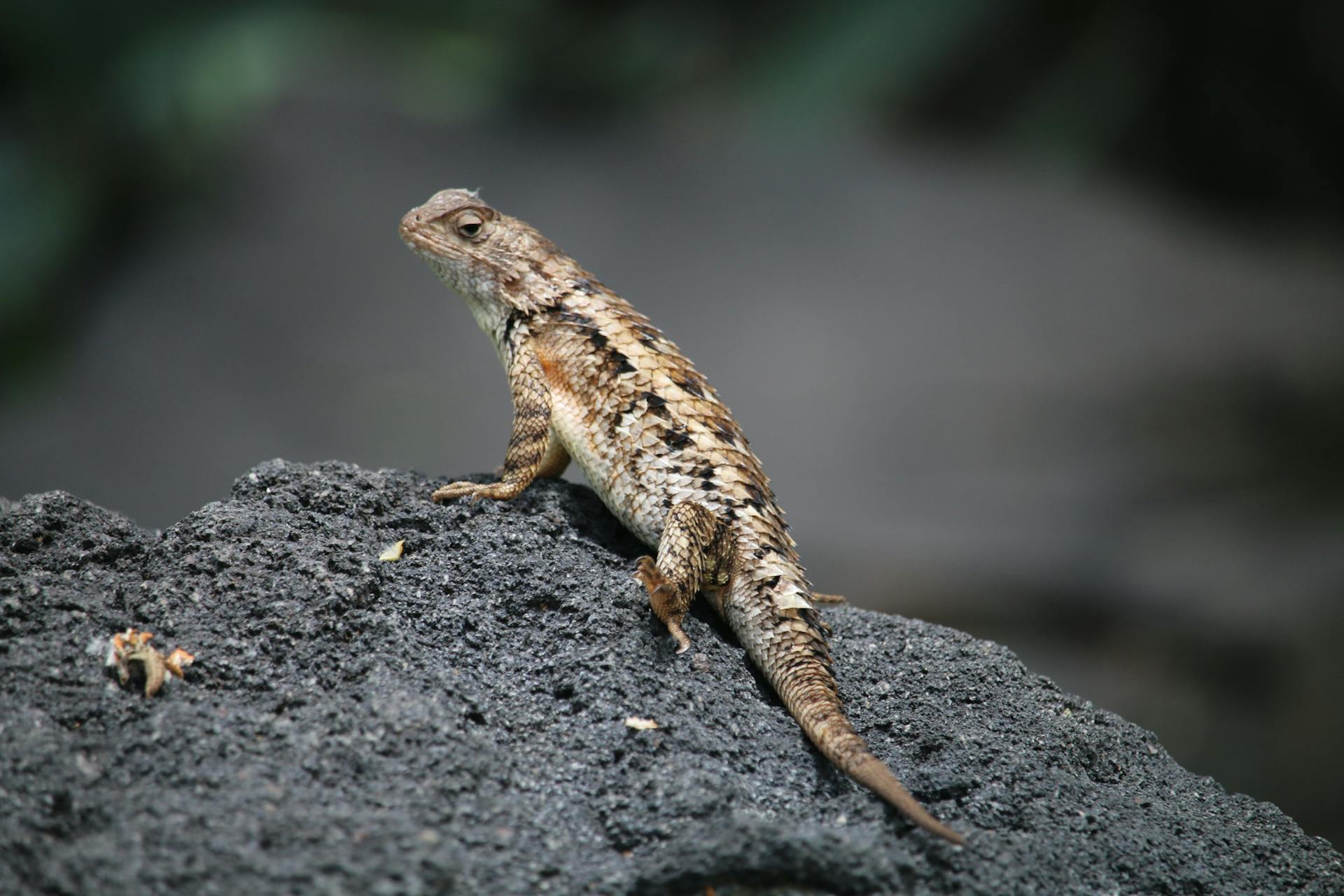
Texas Horned Lizards are found in the southwestern United States, primarily in Texas and parts of New Mexico. They inhabit dry, open areas with sandy or gravelly soil, often near rocks or bushes.
These lizards are well adapted to their desert environment, with a flat, broad body and powerful legs that allow them to run quickly. They can grow up to 5 inches in length, and their distinctive "horns" are actually projections on their head that help them defend themselves.
Texas Horned Lizards are primarily insectivores, feeding on a variety of insects, including beetles, ants, and grasshoppers. They have a specialized tongue that allows them to catch prey quickly and efficiently.
In the wild, Texas Horned Lizards are typically solitary animals, only coming together during the breeding season. Males engage in a unique form of courtship, performing a series of head bobs and push-ups to attract females.
Physical Characteristics
Texas horned lizards are quite the sight to behold, with their distinctive horns and spiky scales. They have a short and round body that can be flattened to hide from predators.
Their snout-vent length can range from 69 mm to 114 mm in females, with males reaching a maximum of 94 mm. Females are generally larger than males.
One of the most striking features of Texas horned lizards is their coloration, which can vary depending on their environment. They can blend in with the yellow or reddish-brown sands of a desert or the tan or brown grass of a prairie.
Dark bars run down their eyes to the tips of their horns, with more on their head and across their legs. They also have a single light line running down their spine from the base of their neck to the tip of their tail.
Hatchlings have a dark brown coloration that may fade into a lighter coloration upon reaching adulthood. They can weigh anywhere from 0.57 g to 0.81 g, and one hatchling was found to be 20 mm in snout-vent length.
Here are some key physical characteristics of Texas horned lizards:
- Snout-vent length: 69-114 mm (females), 69-94 mm (males)
- Weight: 25-90 g
- Coloration: varies depending on environment, with dark bars on eyes and head
- Hatchling coloration: dark brown, fading to lighter coloration upon reaching adulthood
Their bodies are also capable of inflating with air to make themselves appear larger and more difficult to consume. This is just one of the many fascinating adaptations of the Texas horned lizard.
Habitat and Distribution
Texas horned lizards are adaptable creatures that can thrive in a variety of conditions.
Their North American distribution extends from southeastern Arizona east to south-central Arkansas and north from central Kansas south into Mexico, covering a wide range of habitats.
These lizards are typically found in open areas with sandy or loamy soils and moderate grass or shrub cover.
They can also be found in arid or semi-arid regions with access to open ground and some scattered vegetative cover, including prairies, dunes, and deserts.
In the mornings and evenings, Texas horned lizards can be found on open ground where they bask and hunt for insects.
In the hot afternoon sun, they take shelter under rocks, in rodent burrows, under woody vegetation, or in crevasses to avoid predation.
Their burrows average a depth of 140 mm and tend to face the south or south-west, where sunlight exposure is highest during the winter.
Here are some specific habitats where Texas horned lizards have been reported:
- prairies
- dunes
- deserts
- playas
- bajadas
Their range extends from 106 m to 1,330 m above sea level, and they can be found in temperate and terrestrial habitats.
Behavior and Life Cycle
Texas horned lizards are active in Oklahoma from early April through September, and during this time, they can be found in open areas with sandy soil.
Their diet consists mostly of harvester ants, which they capture as they pass to and from their colony. The lizards lie motionless along ant trails, flick out their tongue, and swallow their prey whole.
They can eat up to 70 harvester ants a day, and they usually attack solitary ants several yards away from the colony to avoid being mobbed by biting ants.
In the winter, they burrow underground to hibernate, and females deposit clutches of eggs in a slanted tunnel approximately 6-8 inches into the ground. The number of eggs varies with the size of the female, with smaller females producing clutches with more than 40 eggs.
Hatchlings emerge from eggs in August, about the size of a quarter, and the female provides no further care for her eggs or young.
For more insights, see: Were the Tsavo Lions Male or Female
Lifespan/Longevity
Texas horned lizards have a relatively short lifespan, especially when compared to other animals. They typically live 7 years in captivity.
A female Texas horned lizard was reported to have lived an impressive 8 years, 11 months, and 3 days in captivity.
Their lifespan in the wild is unknown, but it's likely to be similar to or shorter than their lifespan in captivity.
Here are some key statistics about the lifespan of Texas horned lizards:
- Range lifespan: 8.9 years (in captivity)
- Average lifespan: 7 years (in captivity)
Unfortunately, Texas horned lizards do not survive well in captivity, which is one reason why they are not common pets.
Behavior
Texas horned lizards live a solitary lifestyle, interacting with others only when searching for a mate or competing for feeding grounds. They communicate by quickly bobbing their heads up and down in a species-specific manner.
As hatchlings, these lizards are skittish and flee from even the harvester ants they feed on as adults. It takes two weeks for them to exhibit their species' defense of remaining motionless until danger passes.
Suggestion: Common Snapping Turtle Species

Adults spend most of their days positioned on high vantage points, surveying their environment for prey or predators. Their upper bodies are elevated to get a better view.
During the hot afternoon, adults take shelter in the shade. This is a crucial survival strategy to avoid overheating.
Texas horned lizards hibernate from October until late March, burying themselves under soil, litterfall, and foliage. This helps them conserve energy during the cold winter months.
Their burrows average a depth of 140 mm and tend to face the south or south-west, where sunlight exposure is highest during the winter.
Here are some key behaviors associated with Texas horned lizards:
- terricolous
- diurnal
- motile
- hibernation
- solitary
Life Cycle
Texas horned lizards are active in Oklahoma from early April through September. During this time, they're usually found in open areas with sandy soil.
Females deposit clutches of eggs in a slanted tunnel approximately 6-8 inches into the ground. The number of eggs varies with the size of the female.
Smaller females may produce clutches with more than 40 eggs. Hatching occurs in August, and hatchlings are about the size of a quarter when they emerge from eggs.
Individuals reach sexual maturity in the second year of life.
Predation

Predation plays a crucial role in the life cycle of Texas horned lizards. They have several defense mechanisms against predators.
One of the main predators of Texas horned lizards is the western diamond-backed rattlesnake, which can ambush them. Texas horned lizards know to flee from such ambush predators.
Other predators include birds like prairie falcons and loggerhead shrikes, as well as reptiles like Sonoran whipsnakes and coachwhips. They also have to contend with canids, such as coyotes and foxes.
Texas horned lizards have developed a range of defense strategies to protect themselves. One of the most impressive is their ability to squirt blood from their eyes, which they can spray at predators up to 1 meter away.
Here are some of the predators that Texas horned lizards have to worry about:
- Canids (dogs, coyotes, wolves, foxes)
- Snakes (Western diamondback rattler, sidewinder, coachwhip, Sonoran whipsnake)
- Raptors (prairie falcon, American kestrel, red-shouldered hawk)
- Other birds (loggerhead shrike, greater roadrunner)
In addition to squirting blood, Texas horned lizards can also stand their ground and remain motionless until the predator passes by. If threatened, they will hiss and lunge to defend themselves.
Conservation and Protection
The Texas Parks and Wildlife Department has been studying how to increase the state's population of Texas horned lizards since 1991.
The Texas Horned Lizard Coalition was formed by the TPWD with member zoos and Texas Christian University to raise horned lizards and release them into the wild.
Recent surveys show that some of the released lizards are living and reproducing, which is a promising sign for conservation efforts.
The Horned Lizard Conservation Society is a small nonprofit that funds research about the various species of horned lizards, with members labeling themselves "Phrynosomatics" after the scientific name of horned lizards.
Related reading: Animal Conservation Organizations
Conservation Status
The Texas Parks and Wildlife Department has been studying how to increase the state's population of Texas horned lizards since 1991.
The Texas Horned Lizard Coalition was formed by the TPWD to work with member zoos and Texas Christian University to raise and release horned lizards into the wild.
Recent surveys show that some of the released lizards are living and reproducing, which is a promising sign for conservation efforts.
The Horned Lizard Conservation Society is a small nonprofit that funds research about the various species of horned lizards, and its members call themselves "Phrynosomatics" after the scientific name of horned lizards.
Readers also liked: Wild Life Conservation
Saving Icons!
The Texas Horned Lizard is a threatened species due to habitat loss and invasive fire ants. Over 1000 hatchlings have been released at the Mason Mountain Wildlife Management Area.
The Caldwell Zoo, The Fort Worth Zoo, the Dallas Zoo, and Fossil Rim Wildlife Center have joined a program to breed horned lizards and release hatchlings into protected habitats. Yvonne Stainback, Curator of Birds and Reptiles, and Reptile Keeper Dallas Goodwin made the long journey to the release site.
It's great to be a contributor to this program, said Yvonne. The program takes a lot of resources and tremendous dedication.
Horned lizard hatchlings are fed termite larva, which is gathered by the zoo staff. William Garvin, the Reptile Supervisor, has been like a doting father for these hatchlings.
Discover more: How to Become a Zoo Veterinary Technician
Research and Facts
Researchers at Texas Christian University and the nearby Fort Worth Zoo study horned lizards through raw data and fieldwork done by state employees.
The Dallas Zoo has been conducting a mark-and-recapture study on Texas horned lizards since 2010 on the Rolling Plains Quail Research Ranch, a 4,700-acre preserve in Fisher County, Texas.
The project's goals are aimed at shedding light on the life history, population density, and determining ecological conditions best suited for this threatened species.
Further research toward their preservation is funded by the sale of horned lizard "Keep Texas Wild" license plates.
Several key reproductive successes took place in 2015 as part of a captive colony established by the Dallas Zoo and Houston Zoo.
Current Research
Researchers at Texas Christian University, the Fort Worth Zoo, and Dallas Zoo are actively studying horned lizards through raw data and fieldwork conducted by state employees.
The Dallas Zoo has been conducting a mark-and-recapture study on Texas horned lizards since 2010 on the Rolling Plains Quail Research Ranch, a 4,700-acre preserve in Fisher County, Texas.
Their project goals include shedding light on the life history, population density, and determining ecological conditions best suited for this threatened species.
The study involves capturing animals, tagging them, collecting data, and releasing them back into the wild.
The Dallas Zoo and Houston Zoo are working together to establish a captive colony of horned lizards, with several key reproductive successes taking place in 2015.
The Center for Conservation & Research at the San Antonio Zoo is teaming up with private landowners to introduce zoo-hatched lizards into areas where they previously inhabited.
Fun Facts About
If you're fascinated by the Texas horned lizard, you're not alone. These unique creatures have some amazing adaptations that help them thrive in dry environments.
They can survive in dry conditions by licking up dew, including moisture that forms on their own backs. This ability is crucial for their survival.
The males of the species have a distinctive way of indicating they want to mate - by rapidly bobbing their heads. The females respond with a nod of their heads.
Female Texas horned lizards can lay up to 30 eggs at a time, which is a remarkable reproductive feat.
Baby lizards, also known as hatchlings, look like miniature adults, with some growing to be just an inch long. They're quite adorable.
Unfortunately, baby lizards get no care from their parents, which is a stark contrast to many other species.
Texas horned lizards hibernate for about half the year, from October until March or April. This period of dormancy helps them conserve energy.
If you live in Texas, you can show your support for conservation efforts by purchasing a special license plate featuring the horned lizard. The extra fee from the plate goes directly towards horned lizard research.
Lizard Basics
The Texas horned lizard is a small reptile that's native to the southern Great Plains region.
These lizards are relatively small, typically growing to about 6-8 inches in length.
They have a distinctive set of horns on their head, which are actually modified scales.
Texas horned lizards are primarily insectivores, feeding on a variety of insects like ants and beetles.
They have a specialized tongue that's perfect for catching their prey.
Texas horned lizards are also known for their unique defense mechanism, where they puff up their bodies to appear larger.
This behavior is often accompanied by a loud hissing sound to deter predators.
Frequently Asked Questions
What to do if you find a Texas horned lizard?
Take a photo of the Texas horned lizard and upload it to the online platform to help wildlife biologists track the species' population distribution. This valuable data contributes to a better understanding of the species' presence and habits
Featured Images: pexels.com