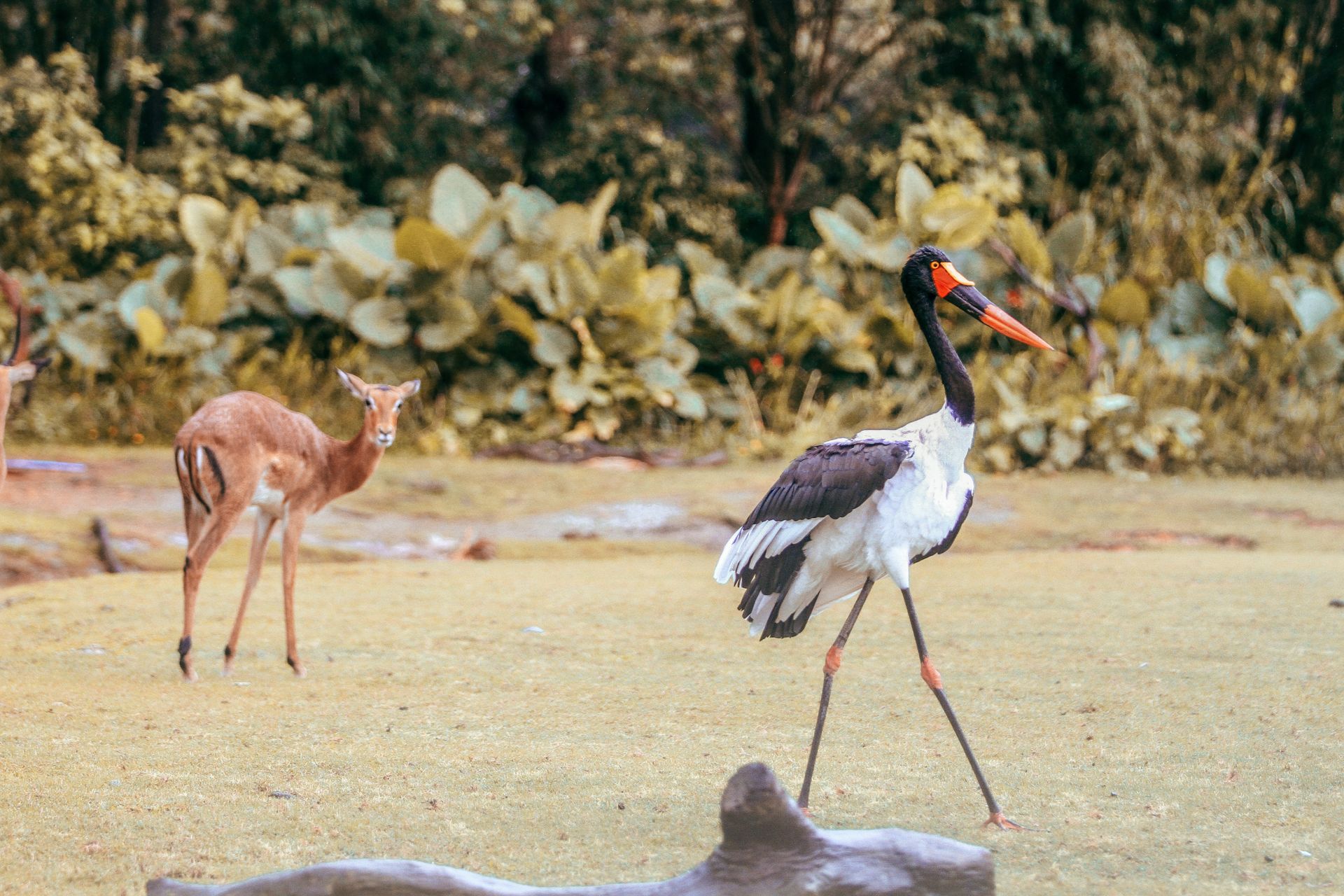
The Stork Billed Kingfisher is a fascinating bird species that's native to the tropical regions of Asia. They can be found in countries such as India, Sri Lanka, and Southeast Asia.
These birds are medium-sized, measuring around 23-26 cm in length. They have a distinctive stork-like bill, which is where they get their name from.
One of the most striking features of the Stork Billed Kingfisher is its bright blue and orange plumage, with a white belly and a black stripe running across its forehead.
Their diet consists mainly of fish, crustaceans, and small insects, which they catch while perched on a branch overhanging water.
Related reading: Micronesian Kingfisher
Taxonomy
The stork-billed kingfisher has a rich history in taxonomy, with the first formal description by Carl Linnaeus in 1766. He coined the binomial name Alcedo capensis, which was based on Mathurin Jacques Brisson's "Le martin-pescheur du Cap de Bonne Espérance".
Linnaeus's specific epithet capensis denotes the Cape of Good Hope, but the species was actually found in India, not Africa. The specimen was initially believed to be from the Cape of Good Hope region of South Africa, but it's now known to have come from near Chandannagar in West Bengal, India.
The current genus Pelargopsis was introduced by the German zoologist Constantin Gloger in 1841. This was a significant change in the classification of the stork-billed kingfisher.
Thirteen subspecies of the stork-billed kingfisher are recognized:
- P. c. capensis (Linnaeus, 1766) – Nepal through India to Sri Lanka
- P. c. osmastoni (Baker, ECS, 1934) – Andaman Islands
- P. c. intermedia Hume, 1874 – Nicobar Islands
- P. c. burmanica Sharpe, 1870 – Myanmar to Indochina and south to north Malay Peninsula
- P. c. malaccensis Sharpe, 1870 – central and south Malay Peninsula, Riau Archipelago and Lingga Islands
- P. c. cyanopteryx (Oberholser, 1909) – Sumatra, Bangka Island and Belitung Island
- P. c. simalurensis Richmond, 1903 – Simeulue Island (off the west coast of the island of Sumatra in Indonesia)
- P. c. sodalis Richmond, 1903 – Banyak, Nias, Batu and Mentawai Islands (off the west coast of Sumatra)
- P. c. innominata (van Oort, 1910) – Borneo
- P. c. javana (Boddaert, 1783) – Java
- P. c. floresiana Sharpe, 1870 – Bali to Flores (Lesser Sunda Islands)
- P. c. gouldi Sharpe, 1870 – north Philippines
- P. c. gigantea Walden, 1874 – central and south Philippines
Physical Characteristics
The Stork-billed kingfisher is a truly impressive bird, measuring 35 cm in length, making it one of the largest kingfisher species.
Its plumage is a vibrant mix of greens, blues, and browns, with a green back, blue wings and tail, and an olive-brown head.
The underparts and neck are a warm buff colour, while the very large bill and legs are a striking bright red.
Sexes are similar in appearance, with no noticeable differences in body shape or colour.
There are 13 races or subspecies of Stork-billed kingfisher, with P. c. gigantea of the Sulu Archipelago in the Philippines having a unique white head, neck, and underparts.
The Stork-billed kingfisher's flight is quite distinctive, with a laboured and flapping motion, but it's still able to fly in a direct path.
Here's a breakdown of the different genera of kingfishers, which might be helpful for bird enthusiasts:
Kingfisher Details
The stork-billed kingfisher is a large bird, measuring 35 cm in length. It has a distinctive appearance, with a green back, blue wings and tail, and olive-brown head.
This kingfisher is widely distributed in the tropical Indian subcontinent and Southeast Asia, from India to Indonesia. It's a resident bird, meaning it stays in its range throughout the year.
The stork-billed kingfisher has a very large bill and legs, which are bright red. Its underparts and neck are buff, and its flight is labored but direct.
There are 13 races or subspecies of the stork-billed kingfisher, differing mostly in plumage detail. One of these subspecies, P. c. gigantea, found in the Sulu Archipelago in the Philippines, has a white head, neck, and underparts.
This kingfisher is a skilled hunter, catching fish, frogs, crabs, rodents, and young birds. It also eats insects and insect larvae.
The stork-billed kingfisher breeds from January to September in India. Both sexes dig a nest-tunnel, up to 1 meter long, ending in a nest-chamber 23 cm in diameter and 13 cm high.
Here's an interesting read: Male Black Capped Chickadee
Here are the different names for the stork-billed kingfisher in various languages:
- Hindi: Bada kilkila, Badami kourilla, U.P.: Badami kourilla, Mirshikars: Tunnak, M.P: Bada kilkila, Ben: Gurial, Guj: Dhonkchanch kalkaliyo, Ta: Kukuluppan, Mal: Kakka ponman, Kandu taleya meenchulli, Sinh: Wattura anduwa, Maha pilihuduwa, Mar: Balakchoch Khandya/ Dhivar
The stork-billed kingfisher is found in various habitats, including lowland waterside habitats, primary rainforest, swamp-forest, and mangroves. It's also found in open areas like coconut plantations and paddy fields.
Conservation
The stork-billed kingfisher is a species that's adapted to living near water, often found in coastal areas and wetlands. It's not surprising then that it plays a crucial role in conservation efforts.
In fact, the stork-billed kingfisher has been known to feed on invasive species, helping to control their populations. This makes it a valuable ally in the fight against invasive species.
The stork-billed kingfisher's diet consists mainly of small fish, crustaceans, and insects, which means it's an important part of the aquatic food chain. This also makes it vulnerable to changes in its environment.
Conservation efforts are in place to protect the stork-billed kingfisher and its habitat. For example, the Malaysian government has established several protected areas to safeguard the species' breeding and feeding grounds.
The stork-billed kingfisher's unique characteristics, such as its brightly colored beak and distinctive calls, make it a popular species among birdwatchers and researchers. This has led to increased awareness and appreciation for the species, which in turn has contributed to conservation efforts.
Consider reading: Blue Eared Kingfisher
Habitat and Behavior
The Stork-billed kingfisher is found in a vast majority of Asia, covering countries such as India, Sri Lanka, Thailand, Indonesia, and the Philippines.
They generally inhabit lowland forests, as well as areas by the edges of rivers, streams, canals, and large lakes, making them well-suited for fishing.
These birds are fiercely territorial and have been known to chase away much bigger animals, including eagles.
A family of Stork-billed kingfishers typically consists of 6 members, who live together and work together to hunt for food.
They have a unique ability to hover in one spot over water, then swoop down to pluck fish from the water, making them skilled predators.
Habitat
The Stork-billed kingfisher is widely distributed across Asia, covering a vast majority of the continent, including countries like India, Sri Lanka, Thailand, Indonesia, and the Philippines.
They can be found in lowland forests, often by the edges of rivers, streams, canals, and large lakes, where they can easily access water to fish.
Their habitat preferences are quite specific, and they tend to avoid areas that are too dense or too dry.
Behaviour
Stork-billed kingfishers live in a family with an average of 6 members. They are fiercely territorial and have been known to chase away much bigger animals such as eagles.
To aid fishing, kingfishers have the ability to hover in one spot over the water, then swoop down to pluck fish from the water. This unique skill allows them to catch their prey with ease.
Their distinctive call is a series of three sharp "ke-ke-ke" sounds, which can be heard in their natural habitat. They primarily feed on freshwater fish and crustaceans, but will also eat frogs and small rodents.
Frequently Asked Questions
Is Stork billed Kingfisher rare?
The Stork-billed Kingfisher is widely distributed but sparsely found in its range, suggesting it may be a relatively rare bird species. Its sparse distribution hints at a limited population.
What do stork billed kingfishers eat?
Stork-billed kingfishers primarily feed on fish, frogs, crabs, rodents, and young birds. They also hunt in various nesting sites, including river banks, decaying trees, and tree termite nests.
Is the Stork billed kingfisher male or female?
There is no visual difference between male and female Stork-billed Kingfishers. Both sexes have the same bright red and large bill.
Featured Images: pexels.com