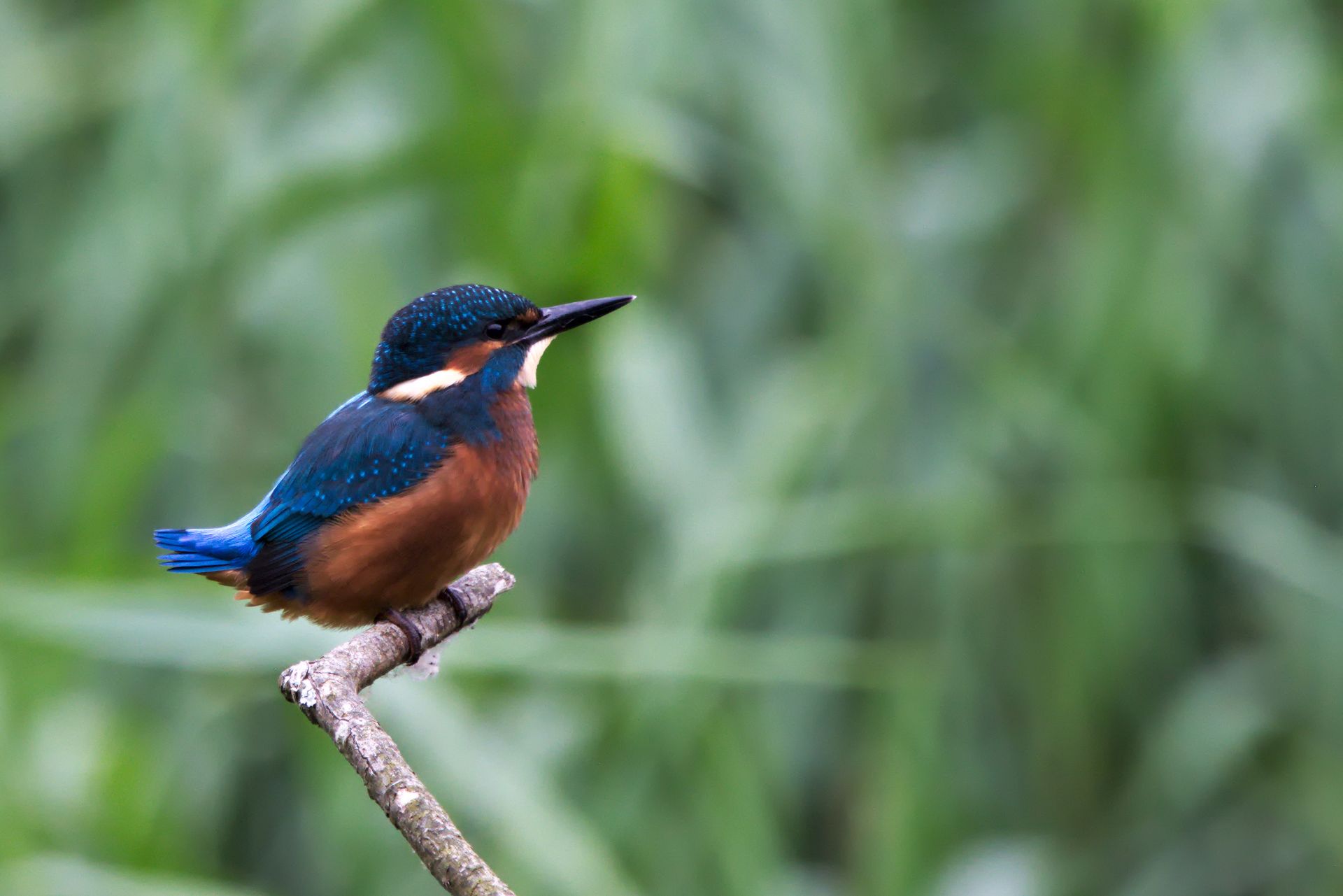
The Micronesian Kingfisher is a bird of striking beauty, with its glossy blue back and white belly. It's a rare sight to see one in the wild.
These birds are found in the Micronesia region, specifically in the islands of Guam and the Federated States of Micronesia. They inhabit tropical forests and are known to be solitary birds, only coming together for mating.
The Micronesian Kingfisher is a medium-sized bird, measuring about 23 centimeters in length.
Worth a look: Blue Eared Kingfisher
Conservation and Recovery
The Guam micronesian kingfisher's population on Guam has dwindled to just a few birds, with almost all remaining individuals being solitary males.
The drastic decline of forest bird populations on Guam is one of the most alarming and challenging endangered species problems of modern times.
Conservation efforts are underway, with the species included in the Endangered Native Forest Birds (for Guam and Rota of the Mariana Islands) Recovery Plan.
A captive breeding program set up by the Aquatic and Wildlife Resources Division, Guam Department of Agriculture and the American Association of Zoological Parks and Aquariums has been successful in breeding the species in mainland U.S. zoos.
The collared kingfisher (H. chloris) on Rota remains healthy, unlike the Guam micronesian kingfisher.
It is likely that the Guam micronesian kingfisher will be extirpated from the wild on Guam in the near future.
The nocturnal Boiga is believed to be taking the incubating female individuals off the nest at night, which is presumably why the remaining individuals on Guam are mostly solitary males.
Here's an interesting read: Stork Billed Kingfisher
Habitat
The Guam micronesian kingfisher is a bird that thrives in mature limestone forest and mixed woodland. It also makes itself at home in second growth stands and scrub forests on the northern plateau.
One of the unique features of this bird is its ability to perch on powerlines or telephone poles adjacent to forest areas, a habit that's quite rare among native birds. This adaptability is a testament to the species' resourcefulness.
To build its cavity nest, the kingfisher requires old, rotting trees like Pisonia grandis and Artocarpus mariannensis. These trees are soft and can survive for many years with broken branches, making them perfect nest cavity sites.
Micronesian Kingfisher
The Micronesian Kingfisher is a bird that's been affected by habitat destruction.
It's found on Palau, Pohnpei, and Guam, with three distinct subspecies.
The Guam endemic subspecies, Halcyon cinnamomina cinnamomina, is the one that's been extirpated from Guam.
The Micronesian Kingfisher was last seen in the wild in 1989 on Guam.
It's listed as endangered by the US Fish and Wildlife Service and the Government of Guam.
A captive breeding program was begun in 1983 to help bring the bird back.
The program has been successful, with the captive population reaching 100 birds in 2008.
However, the bird is still listed as extinct in the wild, with only 140 individuals remaining.
The main threats to the Micronesian Kingfisher are habitat destruction and predation by the introduced brown treesnake.
Habitat
The Guam micronesian king-fisher requires mature forest to thrive, specifically looking for old rotting trees like Pisonia grandis, Artocarpus mariannensis, and Cocos nucifera to build its cavity nest.
These trees, especially Pisonia grandis, provide the perfect environment for the species, with their soft wood allowing them to survive for many years despite broken branches.

The species can also be found in coastal strand vegetation with coconut palm, riparian habitat, and scrub forests of the northern plateau.
In fact, the Guam micronesian king-fisher is one of the few native birds that can be seen perching on powerlines or telephone poles adjacent to forest areas.
The presence of extremely rotten trees is crucial for captive breeding, as demonstrated by experience at several stateside zoos.
Frequently Asked Questions
What is the rarest type of kingfisher?
The Guam kingfisher, also known as the "sihek", is considered one of the rarest types of kingfishers in the world. Due to their elusive nature and breeding difficulties, they are highly sought after by bird enthusiasts and conservationists.
Featured Images: pexels.com