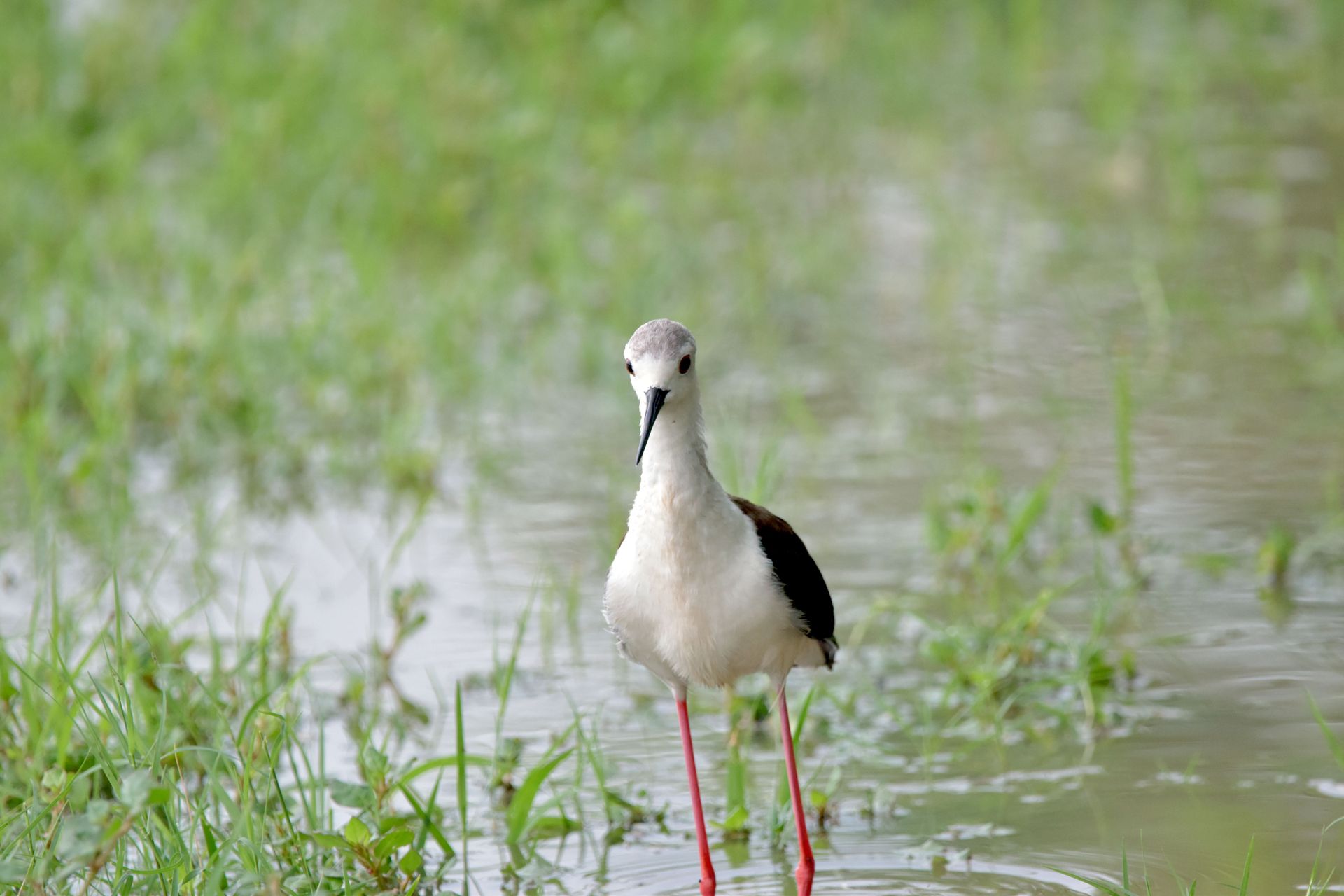
The Spoon Billed Sandpiper is a rare bird species that's found in the coastal regions of East Asia.
It's estimated that there are only around 400 individuals left in the wild, making it one of the rarest birds in the world.
This bird gets its name from the distinctive spoon-shaped bill it has, which is a unique feature among sandpipers.
The Spoon Billed Sandpiper is known to migrate long distances, traveling from its breeding grounds in Russia and China to its wintering grounds in Southeast Asia and Australia.
Physical Description
The Spoon-billed Sandpiper is a unique bird species that can be identified by its distinctive spatulated bill. They have a rusty orange color on their head and shoulders during the breeding season, with dark spotting on the breast leading to a white underbelly.
Females are slightly larger than males, weighing around 34 grams compared to the male's 29.5 grams. Their legs and bill remain black throughout the year.
The Spoon-billed Sandpiper's plumage changes with the seasons, losing its rufous color for a gray head and shoulders during the non-breeding season. This change in coloration is quite remarkable.
Here are some key physical characteristics of the Spoon-billed Sandpiper:
- Weight: 29 to 40 grams (1.02 to 1.41 oz)
- Length: 14 to 16 cm (5.51 to 6.30 in)
- Wingspan: 32 to 38 cm (12.60 to 14.96 in)
They can be found in areas with salty water, usually in coastal marshes and estuaries.
Distribution and Habitat
The spoon-billed sandpiper breeds in far northeastern Russia, specifically along the Bering Sea coast of the Chukotsk peninsula and southwards down the Kamchatka peninsula.
It requires specific habitat types, which are widely separated, and is now absent from the majority of its historical breeding range, including Belaya Spit, formerly the largest core breeding area known for the species.
During breeding season, spoon-billed sandpipers live in coastal tundra, often near large coastal lagoons or bays, and nest among crowberry plants on sparsely vegetated gravel spits or in more heavily vegetated lowland tundra dominated by sedges, moss, and dwarf willow.
They feed along lake shores, shallow ponds, and in wet tundra meadows.
In the summer, spoon-billed sandpipers reside in the tundras of arctic Russia, breeding in tundra grasslands, vegetated with mosses, willows, and crowberry plants.
They have a very specific breeding ground, requiring both crowberry vegetation and nearby lakes or marshes for feeding.
As a coastal species, spoon-billed sandpipers have never been recorded to breed further than 5km from the shoreline.
Here are the different habitats where spoon-billed sandpipers can be found:
- Tundra
- Savanna or grassland
- Lakes and ponds
- Temporary pools
- Coastal
- Brackish water
- Marsh
During migration and winter, spoon-billed sandpipers occupy coastal marine sites, especially mudflats on the outer reaches of tidal estuaries, where they can find small invertebrates to feed on.
They prefer coastal mudflats with low vegetation, sandy intertidal areas with a thin layer of mud, and shallow water pools, a sandy coast, and a soft layer of mud for feeding.
In the winter, the species inhabits coastal areas in southern Asia near the equator, where they can be found in mudflats, salt flats, river deltas, and tidal estuaries.
Ecology and Behavior
The spoon-billed sandpiper is a fascinating bird species that can be found in coastal areas of the tundra. They have a unique feeding style, moving their bill from side to side as they walk forward with their head down, allowing them to forage for food in the mud.
During the breeding season, these birds are most active during the day and are known to forage during low tide in shallow mudflats. They are also recognizable due to the side to side movement of their beaks through the mud.
Spoon-billed sandpipers are primarily solitary birds, but may feed alongside groups of other shorebirds. They are very site faithful, meaning they will never wander over 5 km from the shoreline as they migrate up to 5,000 miles a year.
Here are some key behaviors associated with the spoon-billed sandpiper:
- terricolous
- diurnal
- motile
- migratory
- solitary
- territorial
Their territory size is typically around 3 to 5 km^2.
Behavior
The Spoon-billed Sandpiper is a fascinating bird that's most active during the day, which is why they're considered a diurnal species. They're also very site faithful, meaning they tend to stick to the same general area.
Their feeding habits are quite unique, as they forage for food during low tide in shallow mudflats. You can spot them easily while they're foraging due to the side-to-side movement of their beaks through the mud.
These sandpipers are predominantly solitary birds, which means they don't have a large social group. However, they may feed alongside other shorebirds. They're not very social and don't have a distinguished territory outside of their breeding season.
One interesting fact about Spoon-billed Sandpipers is that they fly 5,000 miles a year, which is an impressive feat. They also tend to stay within a 5 km radius of the shoreline, as they're a terricolous species.
Here's a list of some key behaviors exhibited by Spoon-billed Sandpipers:
- Diurnal
- Motile
- Migratory
- Solitary
- Territorial
Their range territory size is relatively small, typically ranging from 3 to 5 km^2.
Key Achievements
The Spoon-billed Sandpiper Task Force has made significant strides in protecting this critically endangered species.
Advocacy work has raised the profile of the intertidal wetlands in the Yellow Sea, with China committing to no more reclamation in the area.

A notable achievement is the boost in the number of young spoon-billed sandpipers reared each year in the wild, thanks to headstarting efforts. This has increased by a quarter, with 236 birds released so far.
19 headstarted birds have returned to breed in Russia since 2014, and have been resighted over 200 times in the flyway, with approximately 26% of birds resighted at least once.
The team has also successfully tracked spoon-billed sandpiper migration for the first time using satellite tags.
A captive population has been established at WWT Slimbridge, with two chicks hatched and reared to adulthood, serving as a safeguard against extinction.
The Spoon-billed Sandpiper Task Force is working with villagers in Myanmar and Bangladesh to ease the pressure of trapping, and awareness-raising activities are introducing this incredible bird to children along the flyway.
Conservation Status
The Spoon-billed Sandpiper is critically endangered, with a population of fewer than 2500 mature individuals. Its numbers are decreasing rapidly, with a 26% annual decline.
Habitat loss and hunting are the main threats to its survival. The bird's staging and wintering areas are under threat from reclamation and hunting. Protected areas like Yancheng in China and Mai Po Marshes in Hong Kong are helping to conserve the species.
Conservation efforts are underway to save the Spoon-billed Sandpiper. A captive breeding program was started in 2011, but it has been unsuccessful so far. Only two chicks have survived to adulthood in the past 10 years.
The species was reclassified to Critically Endangered status in 2008 due to its rapid decline. It was previously classified as Endangered. The population was estimated at only 120-200 pairs in 2009-2010.
Here are some key conservation statuses for the Spoon-billed Sandpiper:
- IUCN Red List: Critically Endangered
- US Migratory Bird Act: Protected
- CITES: No special status
- State of Michigan List: No special status
Multimedia
The Spoon-billed Sandpiper is a bird like no other, and I'm excited to share some multimedia resources with you to learn more about this unique species.
Check out our Spoon-billed Sandpiper: Multimedia Resources page for a collection of videos and more.
During the breeding season, the Spoon-billed Sandpiper's distinctive bill is a striking black spatulate shape.
In its non-breeding season plumage, the bird's upperparts are mostly gray with a lightly streaked cap and back of the neck.
The Spoon-billed Sandpiper's underparts, throat, and forehead are white, often with a white streak over the eye.
This bird's legs are a striking black color.
The Spoon-billed Sandpiper's breast has varying amounts of dark spotting extending toward the belly, which is white.
During the breeding season, the bird is rich reddish brown, particularly around the head, breast, and back.
Spoon-billed Sandpipers are a mixture of white, black, and gray during the non-breeding season.
On a similar theme: Black Billed Magpie Diet
Similar Species
The Spoon-billed Sandpiper is a unique bird with a distinctive spatulate bill, which sets it apart from other shorebirds. This is why it's placed in its own genus, Eurynorhynchus.
In terms of physical characteristics, the Spoon-billed Sandpiper closely resembles other birds in the genus Calidris. This is a group of "peeps" that includes the Semipalmated Sandpiper, Dunlin, and Sanderling.
These similarities make it easy to see why the Spoon-billed Sandpiper is often confused with its Calidris cousins.
Vocalizations and Classification
The Spoon-billed Sandpiper makes many different sounds during the breeding season, both from the ground and during aerial display flights.
These vocalizations are likely similar to those of the sandpipers in the genus Calidris.
During winter and migration, the Spoon-billed Sandpiper's vocalizations are likely limited to a few simple calls.
Vocalizations
The Spoon-billed Sandpiper makes many different sounds during the breeding season.
These vocalizations can be heard both from the ground and during aerial display flights, similar to sandpipers in the genus Calidris.
The species is known to make a variety of sounds, but no complete studies of their vocalizations have been accomplished.
New recordings from the 2011 expedition will provide a good basis for future study of the Spoon-billed Sandpiper's vocalizations.
Northward spring migrants may occasionally utter calls related to breeding.
During winter and migration, vocalizations are likely limited to a few simple calls.
Classification
Classification plays a crucial role in understanding the spoon-billed sandpiper's place in the natural world.

The spoon-billed sandpiper belongs to the kingdom Animalia, which is home to a staggering 22861 pictures and 7109 specimens.
Let's break down the classification further to see how the spoon-billed sandpiper fits into the larger picture.
Here's a simplified breakdown of the spoon-billed sandpiper's classification:
- Kingdom: Animalia (animals)
- Phylum: Chordata (chordates)
- Subphylum: Vertebrata (vertebrates)
- Class: Aves (birds)
- Order: Charadriiformes (shorebirds and relatives)
- Family: Scolopacidae (sandpipers, snipes, and relatives)
- Genus: Eurynorhynchus (spoon-billed sandpipers)
- Species: Eurynorhynchus pygmeus (spoon-billed sandpiper)
This classification helps us understand the spoon-billed sandpiper's unique characteristics and behaviors.
Frequently Asked Questions
How many Spoon-Billed Sandpipers are left in the world?
There are approximately 680 Spoon-Billed Sandpipers left in the world, making them a critically endangered species.
Can spoon-billed sandpipers be kept in captivity?
Spoon-billed sandpipers are not typically kept in captivity, but a unique flock of captive Spoon-bills exists at a trust's outdoor reserve. This rare captive flock was established in 2011 with 23 individuals.
Featured Images: pexels.com