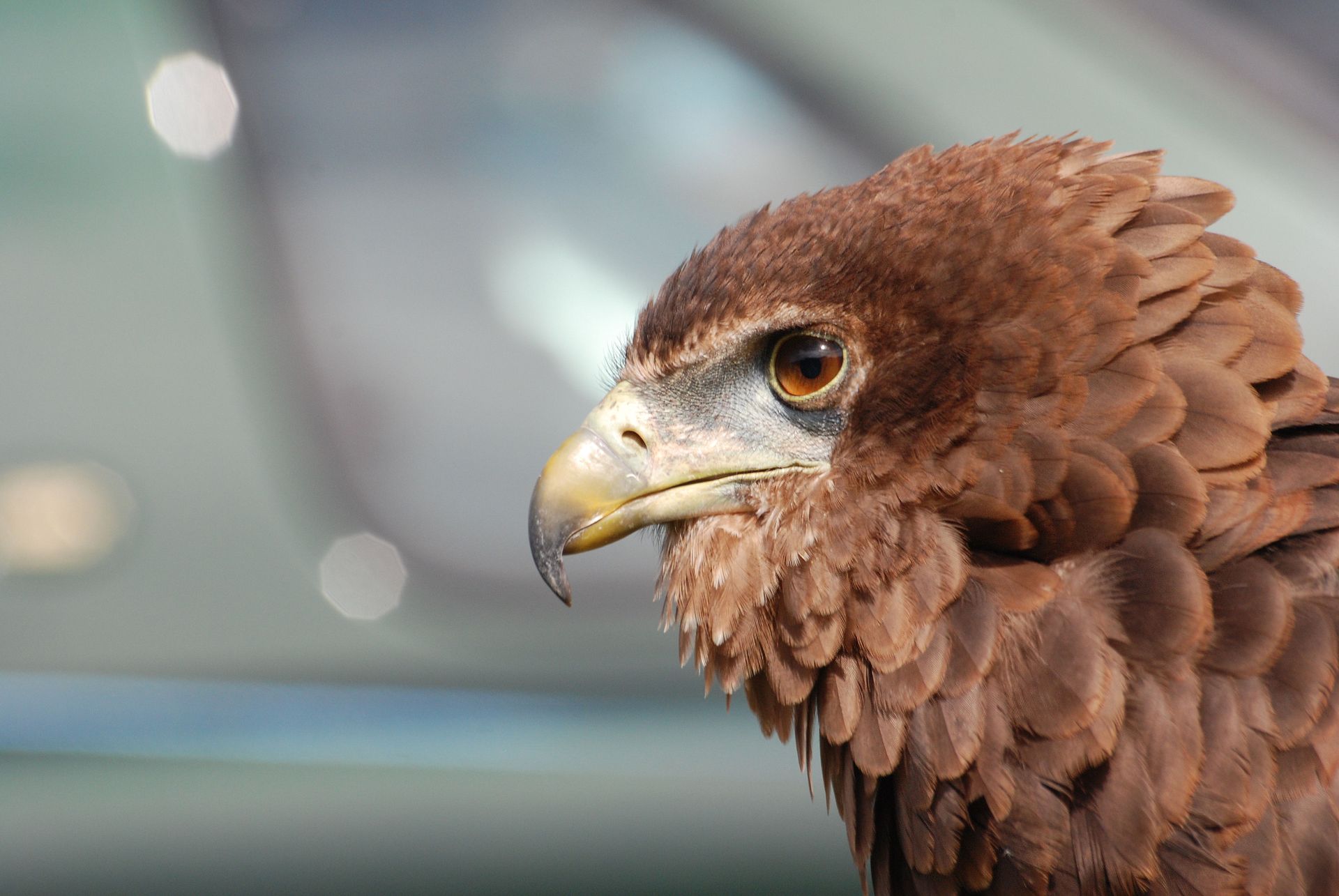
The Philippine Serpent Eagle is a majestic bird of prey that's native to the Philippines. It's a subspecies of the Crested Serpent Eagle, and is known for its striking appearance.
Its wingspan can reach up to 2.2 meters, making it a formidable hunter in the skies. The Philippine Serpent Eagle is a medium-sized eagle, weighing around 2.5 kilograms.
See what others are reading: Lesser Spotted Eagle
Physical Characteristics
The Philippine Serpent Eagle is a stunning bird with some distinctive physical characteristics. They are brown from above.
Their crown is black, and they have a short, bushy crest. The cheeks and throat are a mix of gray and gray-brown.
The underparts are a warm rufous color with white spots that merge into barring along the crissum. The tail is black with a white tip and a light brown central band.
They have a secondary basal band on their tail, and their primary feathers are also black. White spotting can be seen along the wing coverts.
Take a look at this: Haliaeetus Leucogaster
Habitat and Distribution
Spilornis holospilus can be found in a variety of habitats, including riparian forests, foothills, and open country.
These birds are adaptable and can thrive in areas with cultivated land and forest edges, typically up to 1,500 meters above sea level.
They are often spotted soaring above the forest, taking advantage of the wind currents to conserve energy.
Spilornis holospilus has a relatively large range, spanning across the islands of Luzon and Mindanao in the Philippines.
Adults tend to be sedentary, meaning they don't migrate to different areas, and are estimated to number around 10,000 individuals.
Here is a breakdown of their distribution:
Keep in mind that while they have a large range, their populations are still declining due to habitat loss and other threats.
Conservation Status
Spilornis holospilus is listed as Least Concern by BirdLife International, but its conservation status is a bit more complicated than that. Despite being capable of adapting to changing environments, the species is threatened by habitat loss.
The IUCN has also classified the species as Least Concern, but notes that populations are still declining due to habitat loss. Habitat loss is a major issue, caused by activities such as slash and burn farming, mining, illegal logging, and habitat conversion.
Spilornis holospilus can be found in multiple protected areas, including Pasonanca Natural Park, Bataan National Park, and Mount Apo. However, protection is lax and deforestation continues despite these protected areas.
Here are some of the main threats to Spilornis holospilus:
- Slash and burn farming
- Mining
- Illegal logging
- Habitat conversion
- Hunting and poaching for the illegal wildlife trade
Taxonomy and Classification
Spilornis holospilus, also known as the Philippine Serpent-Eagle, has a complex taxonomy. It is described as a monotypic species.
Some authorities treat Spilornis holospilus as a subspecies of Spilornis cheela, specifically Spilornis cheela holospilus. However, BirdLife International and Ferguson-Lees, James, and Christie, David A. (2001) categorize it as a full species.
The type locality for Spilornis holospilus is near Manila. This information is based on the original description by Vigors in 1831.
Avibase taxonomic concepts have recognized the Philippine Serpent-Eagle as a subspecies of Spilornis holospilus in various versions, from 2013 to 2024.
Suggestion: Greater Spotted Eagle
Philippine Serpent Eagle
The Philippine Serpent Eagle is an eagle found in the major islands of the Philippines.
It inhabits primary and secondary forest, and is often seen soaring over clearings and river valleys. The bird feeds on amphibians, reptiles, and other live prey.
It's distinguished from other species of serpent eagle by more well-defined spots on the underpants and wings.
Philippine Serpent Eagle
The Philippine Serpent Eagle is an eagle found in the major islands of the Philippines, often treated as a race of the Crested Serpent Eagle.
It's found in forest clearings, open woodlands, and sometimes in cultivated lands with scattered trees. This species is endemic to the Philippines and can be seen soaring over clearings and river valleys.
The Philippine Serpent Eagle feeds on amphibians, reptiles, and other live prey. It's distinguished from other species of serpent eagle by more well-defined spots on the underpants and wings.
In 2008, a Philippine Serpent Eagle was rescued in a forest in Barangay Laylaya, Besao, Mountain Province, with a right-wing gunshot wound.
Habitat and Conservation
The Philippine Serpent Eagle is found in a variety of habitats, including riparian forest, foothills, and open country. It's not uncommon to spot them soaring above the forest canopy.
They live in the islands of Luzon and Mindanao in the Philippines, ranging from 18.5°N to 6°N latitude. Adults are generally sedentary throughout their range.
The Philippine Serpent Eagle is adaptable to changing environments, but it's still threatened by habitat loss. This is despite being listed as Least Concern by BirdLife International.
They can be found in a range of elevations, from sea level to 2,500 meters above sea level. Tropical moist lowland forest, montane forest, and second growth habitats are all suitable for this species.
Unfortunately, habitat loss due to slash and burn farming, mining, and other human activities continues to threaten the Philippine Serpent Eagle population.
Habitat and Conservation
Spilornis holospilus can be found in a variety of habitats, including riparian forest, foothills, open country, and along forest edges, typically below 1,500 meters above sea level.
They are also known to soar above the forest, giving them a unique perspective on their surroundings.
These birds live on the islands of Luzon and Mindanao in the Philippines, with a range spanning from 18.5°N to 6°N.
Adult Spilornis holospilus are generally sedentary, meaning they don't migrate, and there are an estimated 10,000 individuals in the wild.
Despite being listed as Least Concern by BirdLife International, Spilornis holospilus are threatened by habitat loss, which is a major concern for their survival.
Habitat loss is a result of human activities such as slash and burn farming, mining, and illegal logging, which not only destroy their habitats but also lead to population decline.
The good news is that Spilornis holospilus are capable of adapting to changing environments, which is a testament to their resilience.
However, protection of their habitats is lax, and deforestation continues despite the presence of protected areas such as Pasonanca Natural Park and Bataan National Park.
Here are some of the protected areas where Spilornis holospilus can be found:
- Pasonanca Natural Park
- Bataan National Park
- Mount Banahaw
- Mount Kitanglad
- Mount Apo
- Northern Sierra Madre Natural Park
Frequently Asked Questions
Why is it called a serpent eagle?
The serpent eagle gets its name from its primary diet of snakes, including large and venomous species. Its unique feeding habits set it apart from other eagle species.
Featured Images: pexels.com