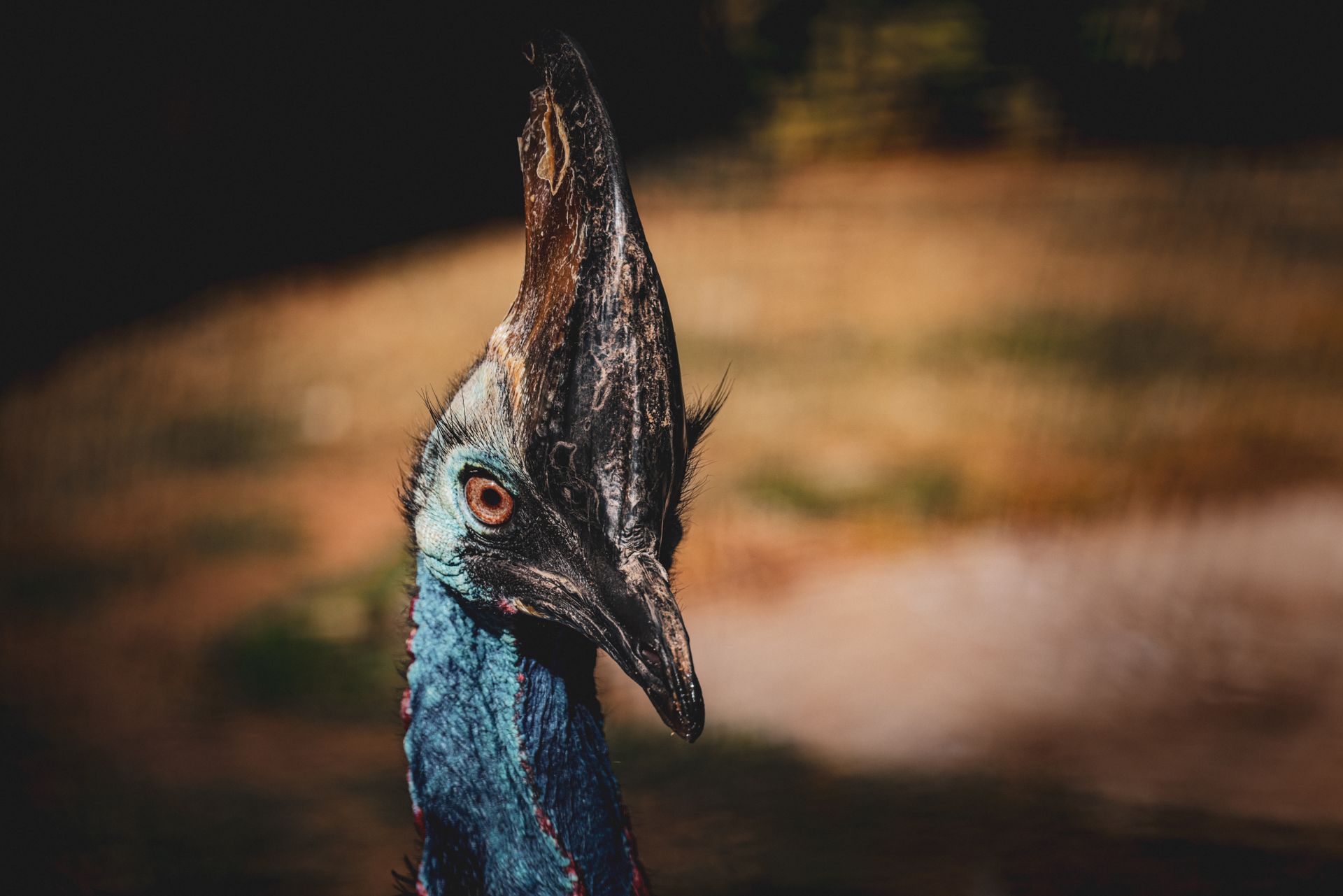
The southern cassowary is a large, flightless bird native to Australia and New Guinea.
They can grow up to 6 feet tall and weigh as much as 120 pounds.
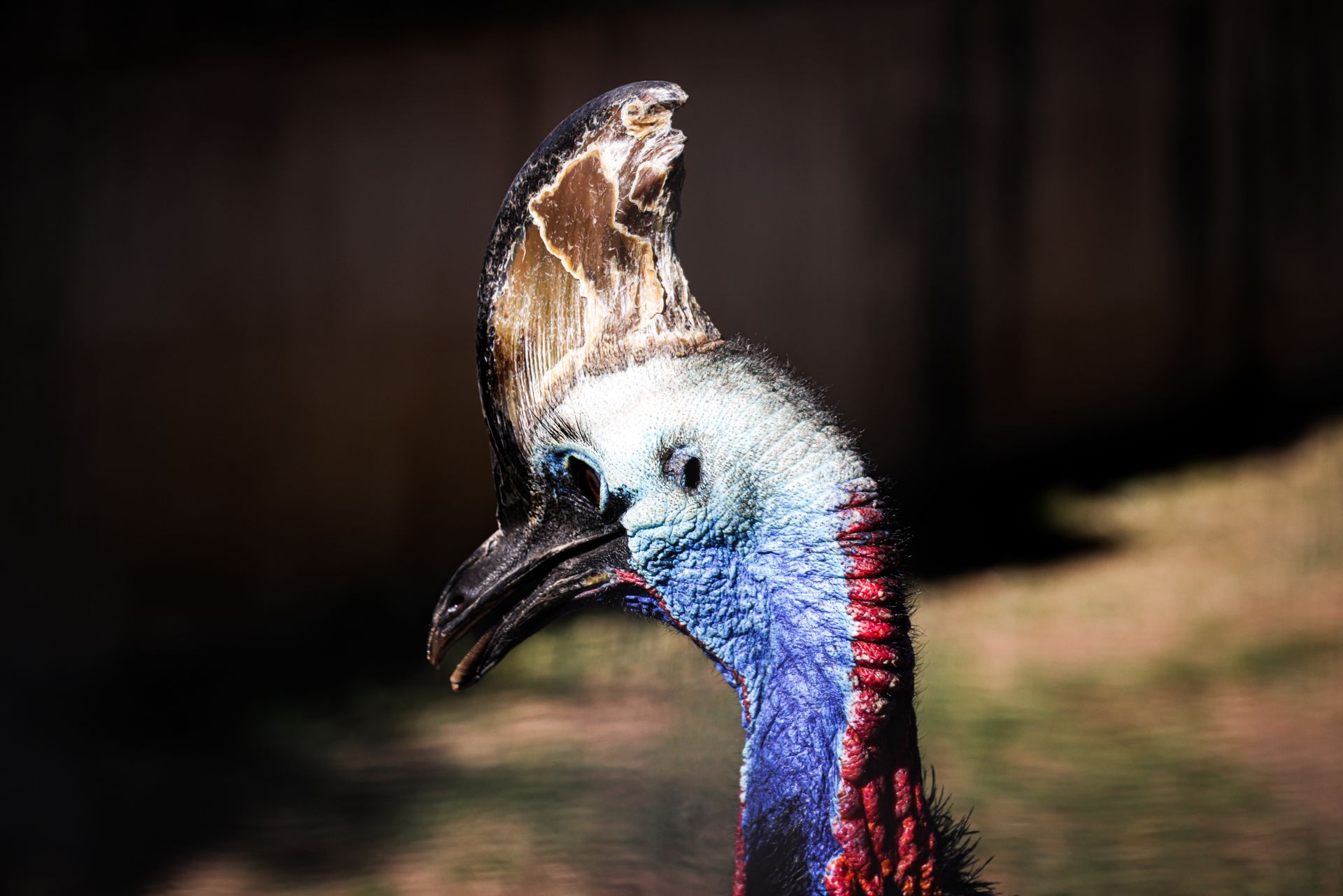
These birds have a distinctive casque, or crest, on their heads, which can be up to 7 inches tall.
This casque is thought to play a role in communication and mating.
Southern cassowaries are omnivores, feeding on a variety of plants, fruits, and small animals.
They have powerful legs and sharp claws, perfect for running and defending themselves.
In the wild, southern cassowaries can live for up to 40 years.
Classification
The southern cassowary is a member of the family Casuariidae, which is a group of large, flightless birds that also includes emus.
The genus Casuarius is the specific classification for the southern cassowary, and it is considered to be monotypic, meaning that it has no close relatives within the same genus.
The southern cassowary is most closely related to the kiwis, with both families diverging from a common ancestor approximately 40 million years ago.
Here's a list of some of the synonyms used to describe the southern cassowary:
- Struthio casuarius
- Casuarius casuarius altijugus
- Casuarius casuarius aruensis
- Casuarius australis
- Casuarius casuarius beccarii
- Casuarius bicarunculatus
- Casuarius bistriatus
- Cassowara eximia
- Casuarius casuarius chimaera
- Casuarius galeatus
- Casuarius casuarius hamiltoni
- Casuarius casuarius intensus
- Casuarius casuarius johnsonii
- Casuarius casuarius lateralis
- Casuarius casuarius salvadorii
- Casuarius casuarius sclaterii
- Casuarius casuarius tricarunculatus
- Casuarius casuarius violicollis
- Hippalectryo indicus
- Casuarius hagenbecki
Taxonomy
Taxonomy is a complex and sometimes confusing topic, but it's essential to understand the classification of species. The southern cassowary is a great example of this complexity.
Most authorities consider the southern cassowary a monotypic species, meaning it's a single species with no close relatives. However, several subspecies have been described over the years.
One of the challenges in confirming the validity of these subspecies is the lack of specimens and the fading of the bright skin on the head and neck, which is often used to distinguish between them. Locals have also traded live cassowaries for centuries, leading to the introduction of the birds to new regions.
The southern cassowary is most closely related to the kiwis, and both families diverged from a common ancestor around 40 million years ago.
Here's a list of some of the scientific names that have been used to describe the southern cassowary:
These names have all been considered taxonomic synonyms for the species, meaning they are no longer used to describe the southern cassowary.
Species Overview
The southern cassowary is a remarkable bird, known for its vibrant blue neck and long, drooping red wattles. If cornered, it can deliver a powerful kick strong enough to break bones.
The southern cassowary is a significant species to First Nations peoples, with different words used to refer to it in various regions. For example, it's called goondoi in Djiru Country and gumbugan in Mamu Country.
There are only three remaining populations of southern cassowaries, two in Cape York and one in the Wet Tropics. Outside Queensland, it's only found in Papua New Guinea and some surrounding islands.
In Cape York, the southern population lives in the vine forests of the McIlwraith and Iron ranges, while a northern population inhabits the less extensive vine forests north of Shelburne Bay.
Discover more: Australian Bird Cassowary
Physical Characteristics
The southern cassowary is a large and impressive bird, standing up to 2 meters tall and weighing up to 76kg in females and 55kg in males.
Its distinctive features include a high, greyish helmet or casque, a vivid blue neck, and long drooping red wattles. The bird's legs are well-muscled and have three toes each, with a large, dagger-shaped claw up to 120mm long.
Here are some key physical characteristics of the southern cassowary:
- Height: up to 2m
- Weight: females up to 76kg, males up to 55kg
- Casque: high, greyish helmet
- Neck and wattles: vivid blue and long drooping red
- Legs and toes: well-muscled with three toes each
- Claw: large, dagger-shaped up to 120mm long
Size
The size of this animal is quite impressive. They can grow up to 5.5 feet tall.
Males typically weigh around 121 pounds, while females can reach 167 pounds.
Their tall stature is quite noticeable, and they can make a lasting impression.
Description
The southern cassowary is a large, flightless bird that can grow up to 2m tall. It has a distinctive appearance, with a high, greyish helmet (casque) on its head.
One of the most striking features of the southern cassowary is its vivid blue neck and long, drooping red wattles. These wattles can reach up to 17.8 cm in length, hanging down around its throat.
The bird's plumage is stiff and bristly, with black feathers covering its body. In fact, the plumage is so coarse that it resembles hair.
The southern cassowary's feet are thick and powerful, equipped with a lethal dagger-like claw up to 12 cm long on the inner toe. This claw can be up to 120mm long, making it a formidable defense mechanism.
The bird's wings are relatively small, with wing stubs that carry a small number of long, modified quills. These quills curve around the bird's body, but do not provide much lift.
Here are some key statistics about the southern cassowary's size:
The southern cassowary is a large bird, with some individuals reaching up to 85 kg in weight. This makes it one of the heaviest birds on earth, tied with the Somali ostrich and the common ostrich.
Behavior and Habitat
Southern cassowaries are fascinating creatures, and understanding their behavior and habitat is essential to appreciating these amazing birds.
They are primarily solitary animals, inhabiting a home range or territory that changes depending on the season and food availability, which can vary between 0.52km² to 2.35km².
These birds are excellent foragers, spending about a third of their time searching for food, which includes fallen fruit, snails, and fungi, as well as small mammals, reptiles, and insects.
Their diet consists of over 238 species of plants, including many poisonous to humans, and they have a unique digestive system adapted to deal with these toxins.
In the wild, cassowaries are capable swimmers, often crossing rivers and swimming into the sea to escape danger.
Cassowaries are also known to be good swimmers and enjoy bathing in shallow water and mud wallows.
They have a keen sense of smell and can detect food from a distance, which helps them navigate their territory.
Their scat is a vital part of their ecosystem, containing seeds from the fruits they have swallowed whole, which helps to regenerate the forest.
In the wild, cassowaries can be found near streams where they drink water either standing or sitting.
Their tall helmet may indicate dominance and age, and it may also assist them in "hearing" the low vibrating sound made by other cassowaries.
Broaden your view: Eastern Wild Turkey Poults
Conservation and Threats
The southern cassowary is facing several threats in the wild. Habitat destruction and fragmentation are the main causes of their decline, with land clearing for farming and urban development greatly reducing their habitat.
Cyclones in 2006 and 2011 depleted their food sources, causing many birds to die from starvation. After cyclones, cassowaries venture closer to human settlements, making them more vulnerable to dog attacks and collisions with vehicles.
Road accidents are a large source of mortality for southern cassowaries. Feral animals, such as pigs, also prey on them, while diseases like tuberculosis affect their survival.
The Australian population of southern cassowaries is listed as Endangered under federal law, while the northern population is considered vulnerable. The species has been evaluated as Least Concern by the IUCN, but road-building, feral animals, and hunting are significant threats.
Here are some key statistics on the threats facing southern cassowaries:
- Habitat destruction and fragmentation are the main causes of their decline.
- Land clearing for farming and urban development has greatly reduced their habitat.
- Between 10,000 and 20,000 birds were estimated in a 2002 study, with between 1,500 and 2,500 in Australia.
- There were estimated to be around 5,000 individuals in Australia in June 2023.
- Road accidents are a large source of mortality for southern cassowaries.
Breeding and Ecology
The southern cassowary's breeding habits are quite unique. They're solitary birds, only pairing up during breeding season in late winter or spring.
The male builds a nest on the ground, which is a mattress of herbaceous plant material 5 to 10 centimeters thick and up to 100 centimeters wide. This allows moisture to drain away from the eggs.
The male cassowary takes on the responsibility of incubating the eggs and raising the chicks alone. A clutch of three or four eggs are laid, measuring 138 by 95 millimeters.
These eggs have a granulated surface and are initially bright pea-green in color, although they fade with age. The male's thunderous call during mating season is quite a distinctive sound.
In addition to their impressive breeding habits, southern cassowaries play a vital role in their ecosystem. They're rainforest gardeners, spreading the seeds of rainforest trees.
Some seeds are so large that no other animal can swallow and disperse them. The cassowary's digestive process helps these seeds germinate.
Their scats are large and often contain hundreds, if not thousands, of seeds. This ready-made fertilizer helps many plants grow.
The female's home range usually overlaps with that of several males, and they can mate with several males in one season.
Interesting Facts
The southern cassowary is a remarkable bird. It can sprint up to 30 miles per hour for short periods, making it a force to be reckoned with.
These birds are also great swimmers, and their casque, a distinctive feature on their heads, is made of a tough, elastic, foam-like material that's incredibly resilient.
They're part of a larger group called Struthioniformes, which includes emus, ostriches, rheas, kiwis, and tinamous, all sharing similar characteristics and traits.
Fun Facts
Cassowaries are great swimmers and can even dive into the water to escape predators!
The casque of a cassowary is made of a tough, elastic, foam-like material that helps protect their head.
Only the ostrich is heavier than the southern cassowary.
The southern cassowary can sprint up to 30 miles per hour (48 kilometers per hour) for short periods, which is impressive for such a large bird.
Cassowaries share their Order Struthioniformes with emus, ostriches, rheas, kiwis, and tinamous, which shows just how unique and fascinating these birds are.
Cassowary Day
Cassowary Day is celebrated on 26 September each year, a time to appreciate these ecologically and culturally important birds.
Habitat loss is a significant threat to cassowaries, making it crucial to protect their natural habitats.
Be cautious on roads that cassowaries cross, as they can be hit by cars, making slow and careful driving essential.
Don't approach cassowaries, as they are best enjoyed at a distance for both their safety and yours.
Not feeding cassowaries is also important, as it can harm them and alter their natural behavior.
Gardening and Safety
As we work to cultivate safe spaces for southern cassowaries, it's essential to remember that these birds can be dangerous if cornered. They're solitary birds, after all.
Their rainforest habitat is a delicate balance that requires our care and attention. The southern cassowary is a remarkable rainforest gardener, playing a crucial role in maintaining the ecosystem.
If you're lucky enough to encounter a southern cassowary in the wild, keep a safe distance – at least 10 meters (33 feet) away. This will help prevent any potential conflicts.
Look Great
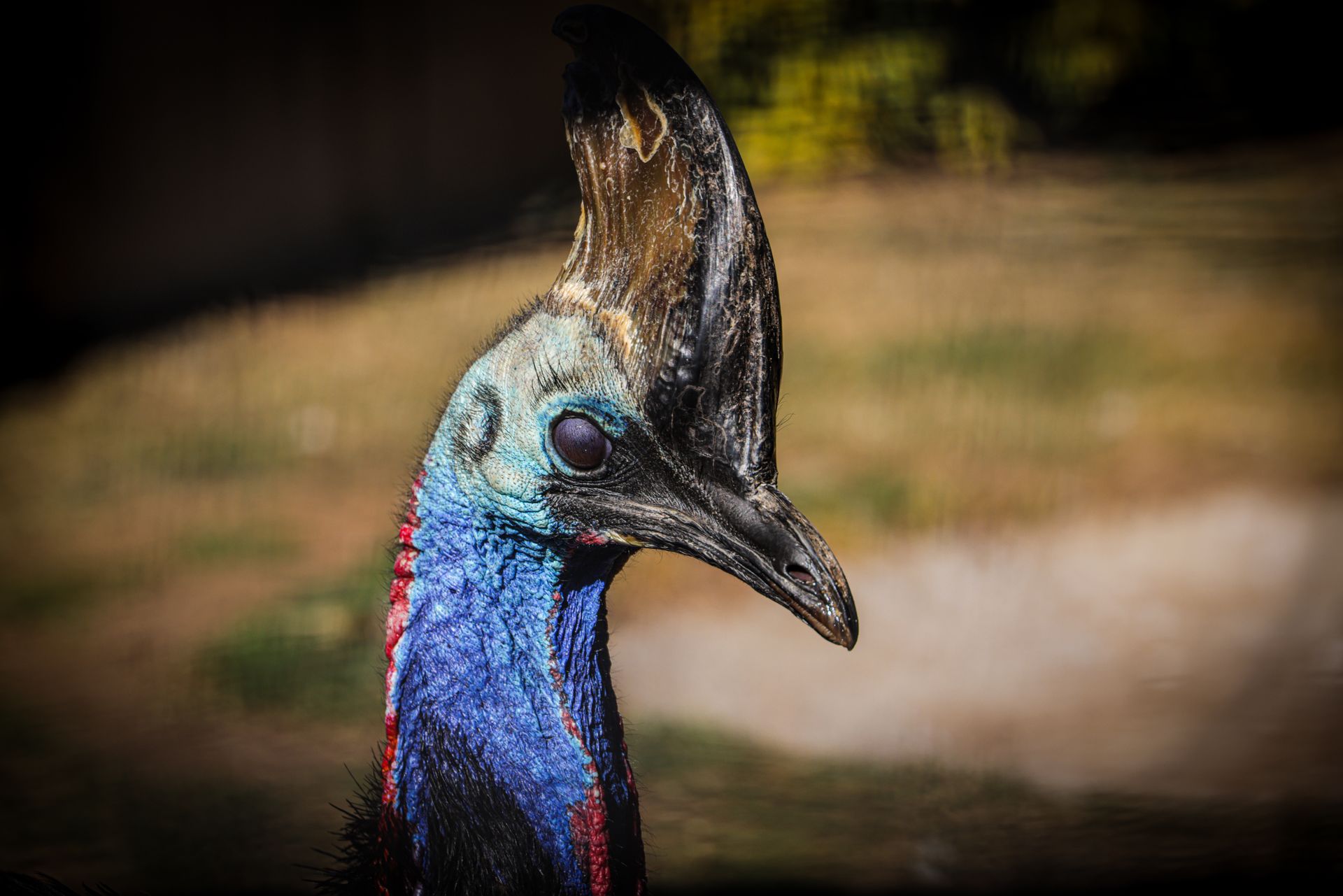
Cassowaries are quite the fashionistas of the bird world, with their glossy black feathers and vibrant blue neck and head.
They're also quite tall, standing at about 1.5-1.8 meters (5-6 feet) tall, which is impressive, especially when you consider they're found in the dense rainforests of northern Australia.
Their powerful feet and legs are perfect for navigating through thick vegetation, and that distinctive helmet-like structure on their head, called a casque, is quite a sight to behold.
The casque is made of keratin, the same stuff that makes up your hair and fingernails, and scientists are still trying to figure out exactly what it's used for, but one theory is that it might help keep them cool on hot days.
Cassowaries are also quite the eaters, with a long, strong beak that's perfect for snacking on forest fruits, which make up the bulk of their diet.
Recommended read: Dodo Raphus Cucullatus
Are Gardeners
Cassowaries are indeed gardeners, helping forests grow by dispersing fruit seeds in their poop as they move through the forest.
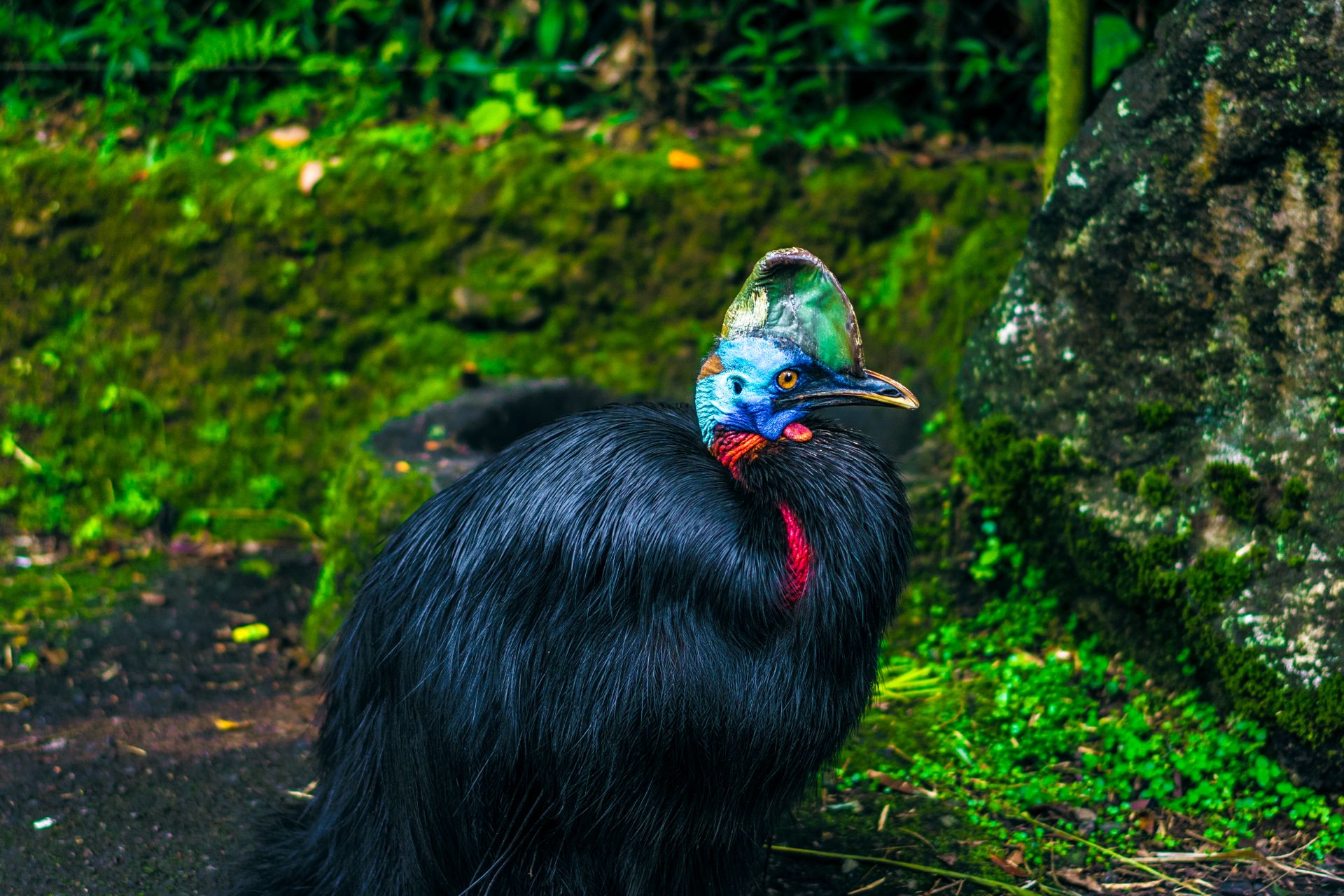
Their unique ability to eat and disperse large fruits makes them the only animals capable of doing so.
Cassowary activity encourages new plants to grow and fill gaps in the forest, showing us the importance of these birds in maintaining a healthy ecosystem.
By spreading seeds, cassowaries play a vital role in shaping the landscape and promoting biodiversity.
Their role as gardeners highlights the interconnectedness of all living creatures and the impact we can have on our environment.
Frequently Asked Questions
Can a southern cassowary fly?
No, southern cassowaries are flightless birds. They're actually known for their impressive jumping ability, reaching heights of up to 7 feet.
What is the predator of the southern cassowary?
The main predators of the southern cassowary are crocodiles, pythons, dingos, and quolls, but their impact is relatively minor. Pigs, however, pose a significant threat to the species.
Featured Images: pexels.com