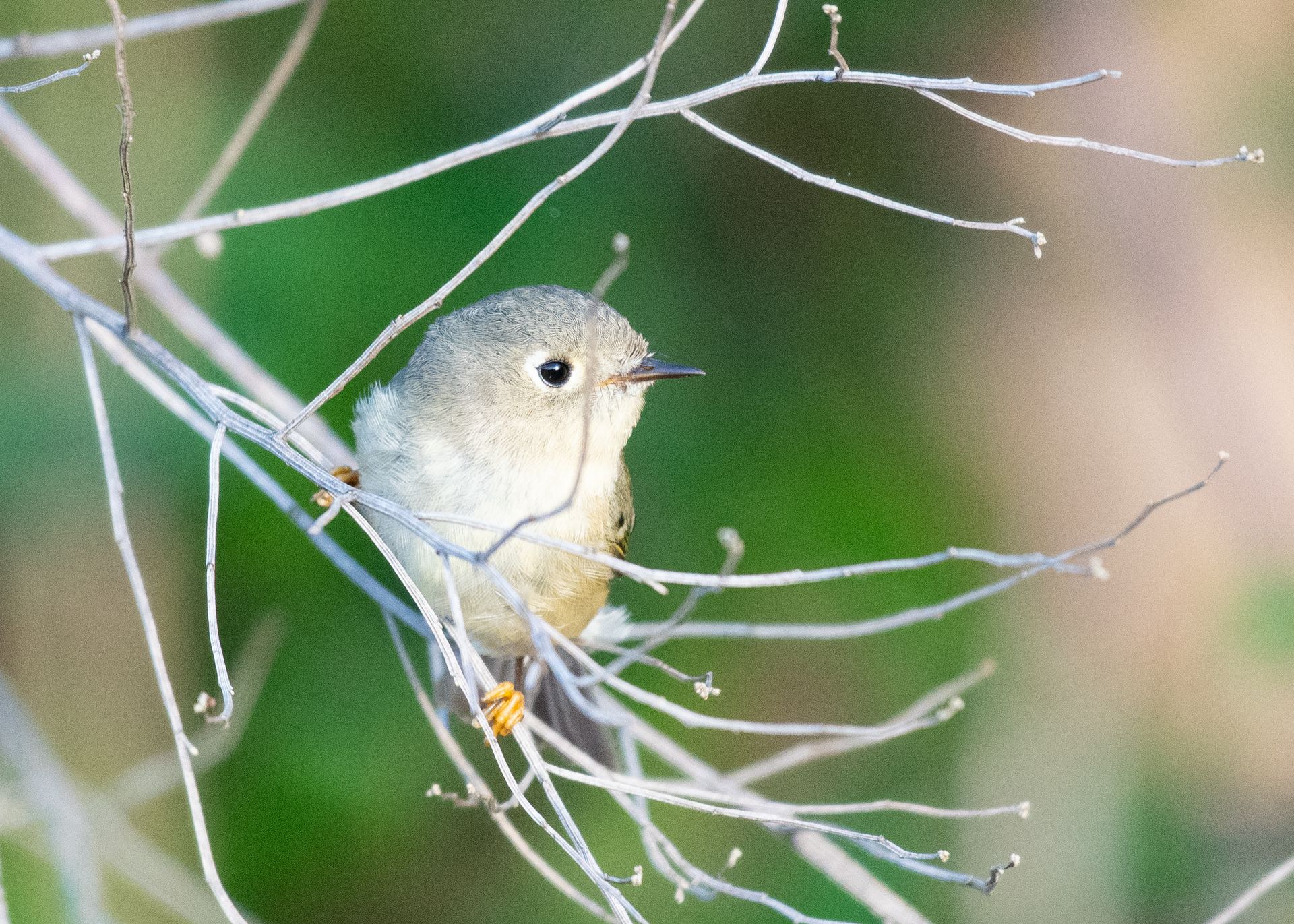
The Ruby Crowned Kinglet is a tiny bird that packs a big punch. They are one of the smallest birds in North America, weighing in at around 0.2 ounces.
These birds are found in coniferous forests, particularly in the western United States and Canada. They are known to migrate to higher elevations in the summer months.
Ruby Crowned Kinglets are social birds and are often seen in flocks. They are known for their bold and curious nature, often approaching humans for food.
Despite their small size, Ruby Crowned Kinglets are fierce singers, producing a loud and complex song that can be heard throughout the forest.
Basic Information
The ruby-crowned kinglet is a tiny bird, measuring 9 to 11 cm in length.
Its wingspan is quite impressive, ranging from 16 to 18 cm.
This bird's plumage is a mix of gray-green and olive-buff colors, with two white wingbars and a broken white eye ring.
You might enjoy: White Crowned Pigeon
The male ruby-crowned kinglet has a scarlet-red crown patch, although it's usually hidden by the surrounding feathers.
The female looks identical to the male, except for the lack of a crown patch.
The kinglet's face and head are relatively plain, with the crown patch being the main distinguishing feature.
Here's a comparison of the ruby-crowned kinglet's size and shape to its close relative, the golden-crowned kinglet:
The ruby-crowned kinglet is slightly larger and more elongated than the golden-crowned kinglet, with greener plumage.
This bird's flight is swift, jerky, and erratic, with rapid wing beats.
It's constantly active, moving along branches or through foliage with short hops.
Its characteristic wing-flicking is a key identification clue.
Distribution and Habitat
Ruby-crowned Kinglets breed in coniferous forests across Canada, Alaska, northern New England, and the western United States. They prefer coniferous forests for breeding.
Their breeding habitat is typically found at high elevations, where they nest in small forest openings or wetlands.
They nest in a well-concealed hanging cup suspended from a conifer branch and may lay as many as twelve eggs in a clutch.
During migration and in winter, they come down into the lowlands and can be found in a wide variety of forest and shrub habitats. Some birds are permanent residents in the west.
Their population is on the rise, mainly due to the discovery of less disturbed territory farther north. This allows more successful breeding.
Behavior and Nesting
Ruby-crowned Kinglets are monogamous birds, but they form new pair bonds each breeding season. This means they don't mate for life, unlike some other bird species.
Their nests are typically 40 or more feet from the ground, usually in conifers, and are well hidden and protected from above by an overhanging branch. The female builds the nest using a variety of materials, including moss, grass, lichen, bark strips, twigs, rootlets, needles, and spider webs.
The female Ruby-crowned Kinglet lays large clutches, with 9 to 10 eggs being the typical number in the Pacific Northwest. This is one of the largest clutches relative to size of any North American passerine.
Discover more: Male and Female Ruby Throated Hummingbird
Behaviour
Ruby-crowned kinglets are quite the feisty birds. They defend their nests fearlessly, mobbing intruders like cats, squirrels, or humans.
These birds have a clever way of drawing predators away from their nest. They perform a "broken-wing" act, which is a clever tactic to distract the predator.
In their daily lives, ruby-crowned kinglets forage actively in trees or shrubs, mostly eating small insects and spiders. They also enjoy some berries and tree sap.
You might catch them hovering over a branch while feeding or flying out to catch insects in flight. It's quite a sight to see!
Their red crest is raised when they're agitated or in display.
Nesting
Ruby-crowned Kinglets are monogamous but form new pair bonds each breeding season. They're quite devoted to each other, but they don't stick together year-round.
Their nests are usually 40 or more feet from the ground, which is quite high up. This placement helps keep them safe from predators.
Females build the nests, which are usually in conifers. They have a keen eye for finding the perfect spot to raise their young.
The typical Ruby-crowned Kinglet nest is deep and is suspended from two hanging twigs. It's a marvel of engineering, really.
Moss, grass, lichen, bark strips, twigs, rootlets, needles, and spider webs comprise its outer walls. It's a true masterpiece of natural craftsmanship.
Females incubate large clutches. In fact, Ruby-crowned Kinglets have the largest clutch relative to size of any North American passerine.
Clutches in the Pacific Northwest typically contain 9 to 10 eggs, sometimes as many as 12. That's a lot of eggs for such a small bird!
Incubation lasts for about two weeks. During this time the male brings food to the female on the nest.
The female broods the young for a few days after hatching, and then joins the male in bringing food to the young. It's a team effort, really.
The young leave the nest about 16 days after hatching. And the male continues to feed the young from the first brood for another 10 days.
Ruby-crowned Kinglets raise only one brood a year. They put all their energy into raising their young, and then they're done for the season.
On a similar theme: Ruby Crowned Kinglet Nest
Conservation and Migration
The Ruby-crowned Kinglet's conservation status is a topic of interest. Their populations fluctuate due to winter die-offs in cold years.
Ruby-crowned Kinglets are able to adapt to changing landscapes thanks to their ability to use various habitats outside of the breeding season. They've managed to thrive despite some habitat loss.
Unfortunately, logging and uncontrolled wildfires have shrunk their breeding range over time.
Conservation Status
The Ruby-crowned Kinglet's conservation status is a mixed bag. Their populations fluctuate because of winter die-offs in particularly cold years.
In Washington, the Breeding Bird Survey hasn't detected any significant, long-term population changes. This is a good sign, but it's essential to note that logging and uncontrolled wildfires have shrunk their breeding range.
Their ability to use a variety of habitats outside of the breeding season has allowed them to adapt to the changing landscape. This flexibility is crucial for their survival.
Migration Status
Ruby-crowned Kinglets migrate slightly earlier in the fall and later in the spring than Golden-crowned Kinglets. This difference in migration timing can be crucial for their survival.
They are less well adapted to cold temperatures, which means they need to find warmer places to spend the winter. This is why they typically winter farther south than Golden-crowned Kinglets.
The extent of their northern migration is often determined by temperature, with warmer temperatures allowing them to stay further north.
You might enjoy: Where Do Ruby Throated Hummingbirds Winter
Find This Bird
These little birds are fast-moving and quiet, often darting into view and disappearing into the foliage before you can get a good look. They're so quick, you might need to keep a sharp eye out for them.
One way to spot a Ruby-crowned Kinglet is to look for its characteristic habit of wing-flicking. This is a distinctive behavior that can give them away.
Their ruby crown is often kept hidden, so don't rely on seeing it to identify them. Instead, listen for the male's loud song, which can be a dead giveaway.
In much of the U.S., Ruby-crowned Kinglets are common during the winter or on migration, making them easy to spot.
Kinglet Information
The Ruby-crowned Kinglet is a tiny bird that's always on the move, foraging frantically through lower branches of shrubs and trees.
Its constant wing flicking is a key identification clue, so keep an eye out for that.
Smaller than a warbler or chickadee, this plain green-gray bird has a distinctive white eyering and a white bar on the wing.
Additional reading: White Crowned Sparrow
Featured Images: pexels.com