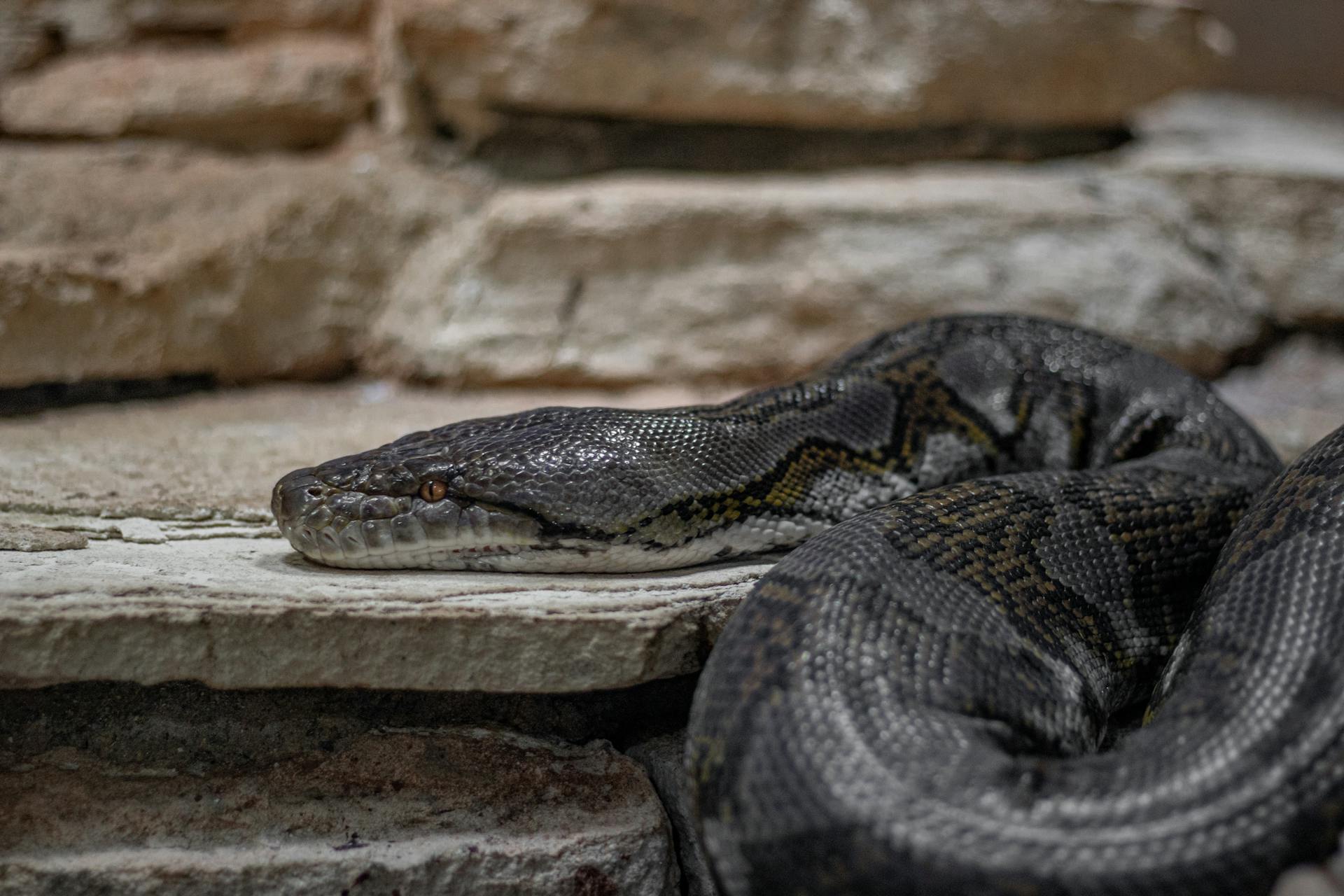
Reticulated pythons can make fascinating pets for experienced snake owners. They are one of the largest species of snakes, reaching lengths of up to 25 feet.
Before considering a reticulated python as a pet, it's essential to understand their massive size requirements. They need a spacious enclosure that provides ample room for growth and movement.
Reticulated pythons are carnivores and require a diet rich in protein. They are constrictors, feeding on small mammals, birds, and reptiles in the wild.
A well-fed reticulated python can live up to 30 years in captivity, making long-term commitment a must.
Physical Characteristics
Reticulated pythons are truly massive creatures, growing up to 33 feet in length, with the record length being 33 feet. They can weigh as much as 250 pounds or more, with fully-grown females being the largest.
On average, males reach between 10 and 14 feet in length, while females grow to at least 16 feet and can exceed 20 feet. They grow quickly, exceeding 12 feet in just two years under optimal feeding regimens.
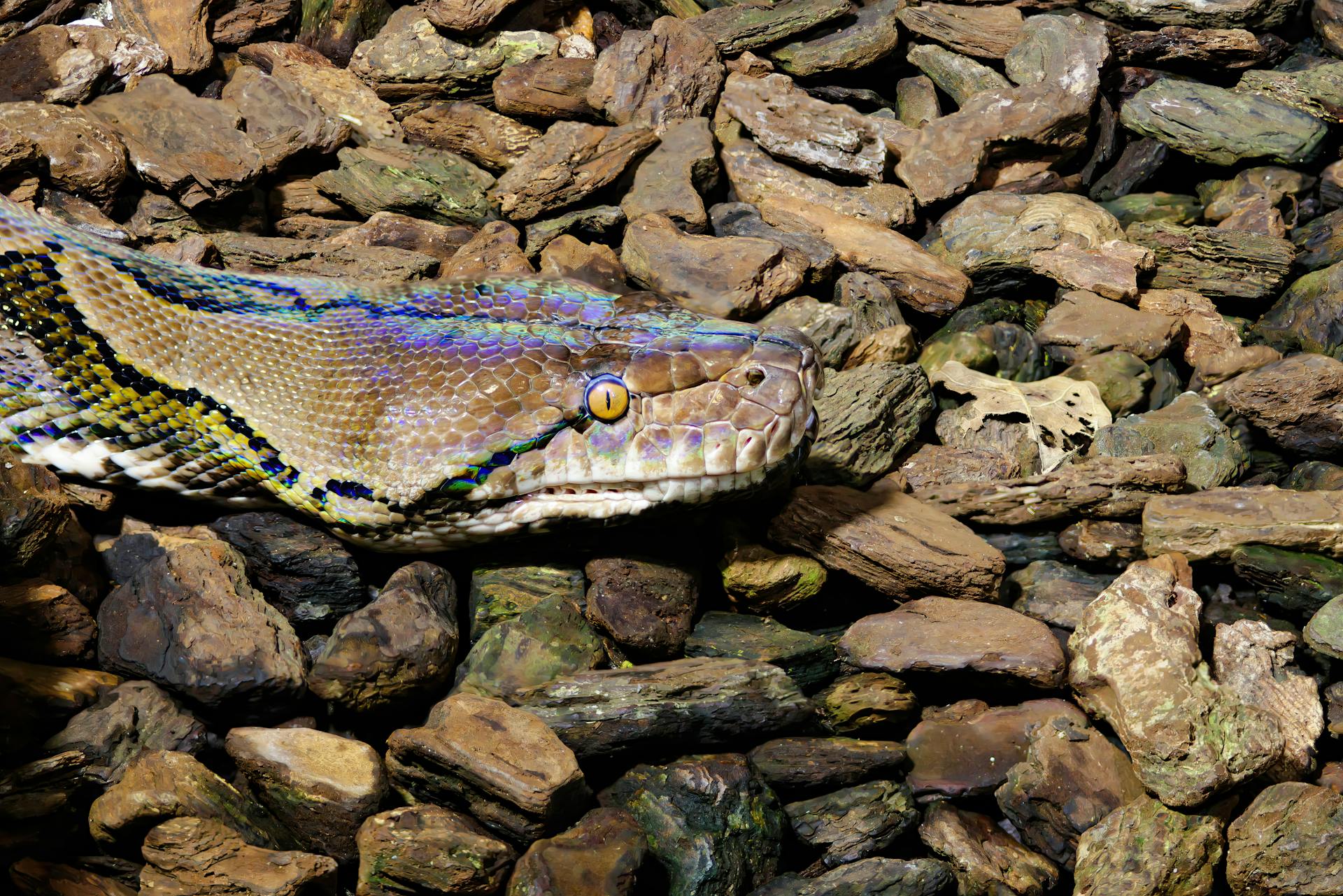
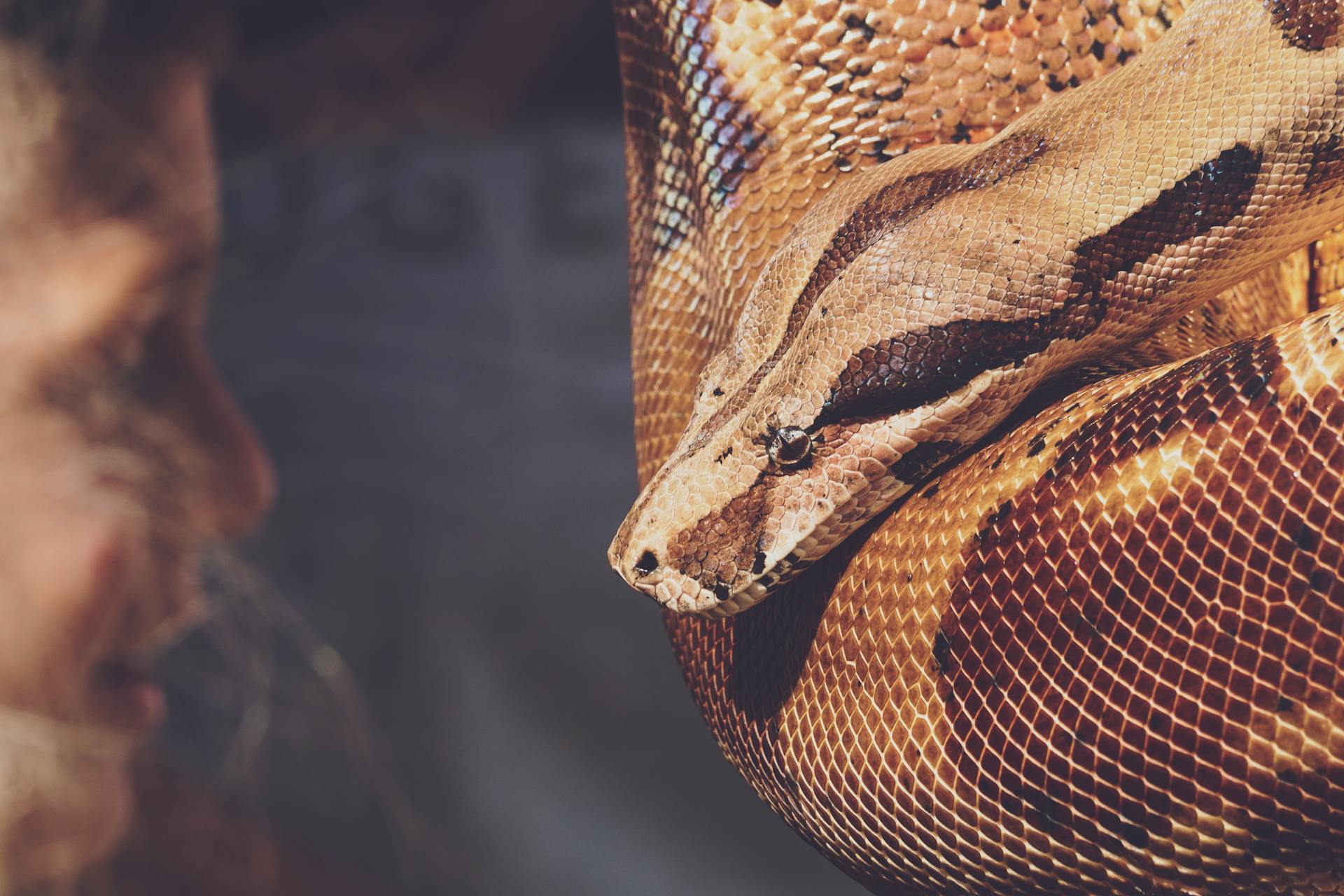
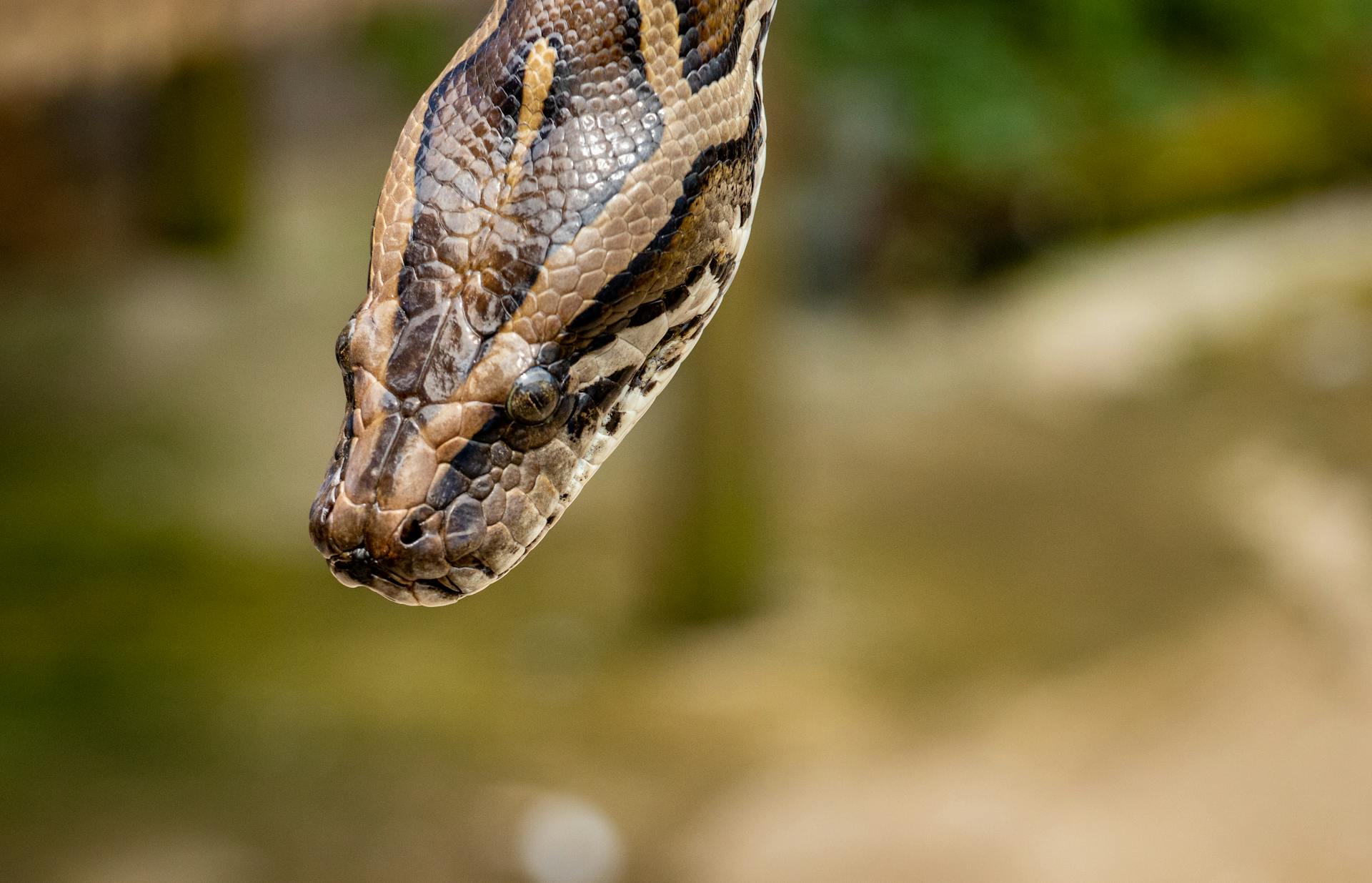
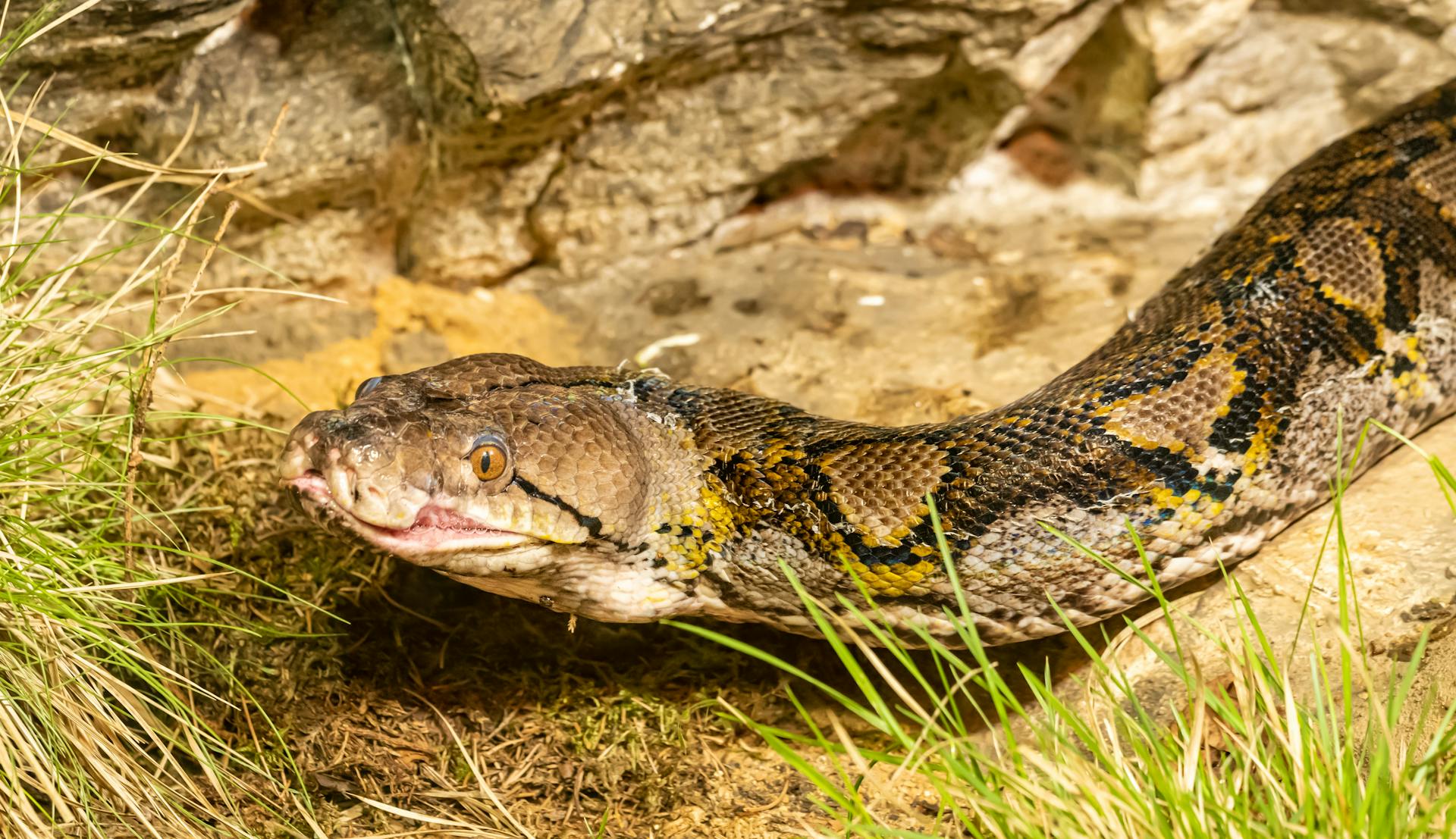
Their complex color pattern is marked by a diamond or saddle pattern and a black stripe running from the head to the tail, giving them a netlike appearance, hence their name reticulated.
Size
Reticulated pythons are truly massive snakes, with lengths ranging from 6 feet for dwarf males to 20+ feet for large females.
Males typically reach between 10 and 14 feet in length.
Females, on the other hand, grow to at least 16 feet and can exceed 20 feet in length, with the record length being 33 feet.
Fully-grown female retics can weigh a whopping 250 pounds or more.
Reticulated pythons grow quickly, exceeding 12 feet in just two years under optimal feeding regimens.
Appearance
Reticulated pythons have a complex color pattern, marked by a diamond or saddle pattern and a black stripe running from the top of the head to the tip of the tail.
Their patterns resemble netting, thus the name reticulated, which means netlike.
In nature, reticulated pythons tend to be olive, dark green, black, white and gold.
They come in dozens of varieties, or morphs, that are beautiful enough to make up for their ill temperaments.
For more insights, see: Black Headed Python Size
Distribution and Habitat
Reticulated pythons can be found in a vast range of habitats, from rainforests to woodlands and grasslands.
Their native range spans across South and Southeast Asia, including countries like India, Bangladesh, and Thailand. They are also found in Indonesia and the Philippines.
These snakes are excellent swimmers and have been known to venture far out at sea, colonizing many small islands within their range. In fact, they've even been spotted in busy areas like Bangkok.
Reticulated pythons inhabit elevations ranging from sea level to over 4300 feet, making them adaptable to various environments. They are commonly found near rivers, streams, and lakes, and have even been known to enter the huts of villagers.
Their geographical location is a good key to establishing the subspecies, as each one has a distinct geographical range.
For more insights, see: Colubrine Sea Krait
Behavior and Care
Reticulated pythons are said to be some of the most intelligent snakes in existence. Their great intelligence allows for some degrees of recognition and responsiveness toward their owners.
They can be bite-prone, especially when being handled, so caution should always be exercised. Even experienced owners can be harmed by a free-roaming snake.
Some owners of reticulated pythons allow their giant snakes to roam freely around their homes, while others are relegated to room-sized enclosures. It is not recommended to allow them to have free access in a home in which there are children or animals.
Here are some color mutations recorded in the species:
- "albino"
- "tiger"
- "sunfire"
- "motley"
- "Aztec"
- "ocelot"
- "rainbow"
- "goldenchild"
Care Level
Reticulated pythons are still best left to the experts, though great strides have been made in domesticating an otherwise nasty animal.
Twenty years ago, nearly all reticulated pythons were wild-collected and imported from Asia, but these days, an increased number of reticulated pythons have been bred in captivity and raised from hatchlings.
These captive-bred reticulated pythons are long-lived snakes, living up to 20 years, making them a significant commitment for experienced keepers.
Some experienced keepers have reported that captive-bred reticulated pythons can become as tame as their Burmese python cousins, but it's essential to have previous experience with large constrictors to ensure safety to both animal and keeper.
- Keepers working with adults from mainland populations should have previous experience with large constrictors.
- Captive-bred reticulated pythons can be a good choice for experienced keepers.
While not venomous, large pythons can inflict serious injuries by biting, sometimes requiring stitches, so it's crucial to exercise caution when handling them.
Behavior
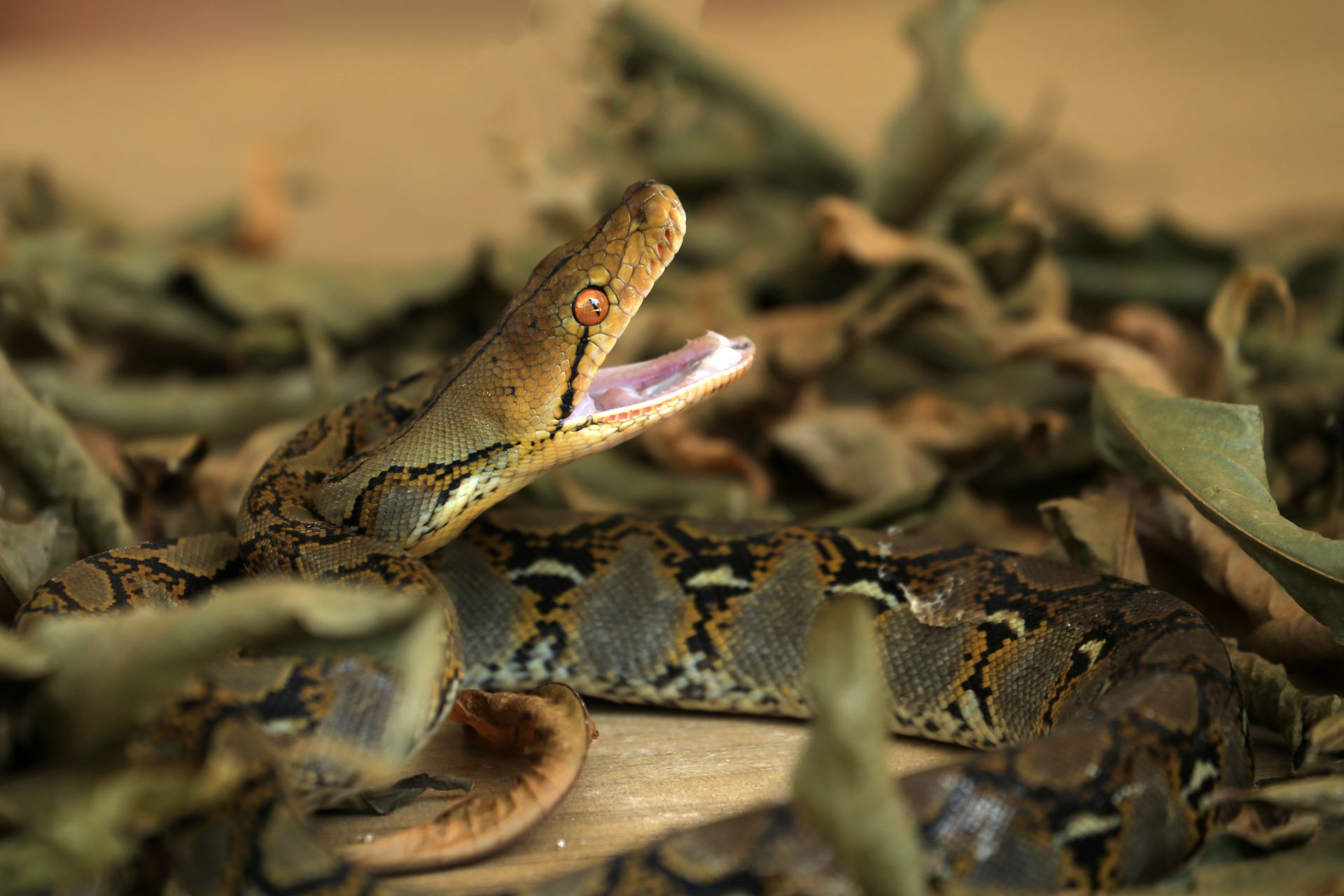
Reticulated pythons are known to be one of the most intelligent snake species, but their behavior can be tricky to generalize due to their wide distribution.
They can show recognition and responsiveness towards their owners, but caution should always be exercised, even with experienced handling, as they can be bite-prone.
Some owners allow their reticulated pythons to roam freely around their homes, but it's not recommended to do so in homes with children or animals.
Free roaming snakes can pose a risk to even experienced adults.
Health
When selecting a healthy reticulated python, it's essential to observe the snake in its natural enclosure before buying, if possible. Owning a healthy reticulated python begins with the selection.
Observing the snake in its natural enclosure can give you a better understanding of its overall health and behavior. This can help you make an informed decision when buying a reticulated python.
It's always recommended to buy from an established snake breeder with a good reputation in the reptile community. Buying from a reputable breeder can ensure you get a healthy and well-cared-for snake.
A short summary of reticulated python diseases and disorders is crucial for their care and management.
Safe Feeding Tips
Feeding your reticulated python safely is crucial to prevent injury to both you and your snake. Always have the prey animals within easy reach to avoid any accidents.
Having another adult present when feeding your giant snake is a good idea, especially if you have multiple snakes. This way, you can keep a watchful eye on the situation and be prepared to intervene if needed.
Feeding prekilled prey is always the safest route to go, as live prey can pose an injury risk to your snake. If you're feeding rabbits, you can ask your supplier to kill them when you purchase them.
Large snakes love to eat fowl, but it's best to reserve chicken as a last resort. Chicken can be used for fattening a retic that doesn't want to eat, or for putting extra weight on as part of prebreeding conditioning.
Here are some safe feeding habits to adopt:
- Only feed one snake per enclosure at a time.
- Use a snake hook, shield, wooden board, or other sturdy barrier as a buffer between you and the python when removing uneaten prey.
Popular Varieties
Reticulated pythons, also known as "retics" or "tics", don't have any officially recognized subspecies of their own.
They have a couple of dwarf subspecies: Python reticulatus jampeanus and Python reticulatus saputrai.
Snake breeders have produced several retic varieties, or morphs, but most of these morphs cannot be found in the wild.
Diet and Feeding
Reticulated pythons are voracious eaters and prefer live prey, but it's still advisable to avoid live feeding to prevent injury to your snake. You can warm the meal slightly beforehand to help your snake eat, but be sure to do it safely.
One safe method to warm prey is to dip the baggie it's stored in into heated water for about an hour. You can also warm frozen prey by placing the baggie in warm water for a couple of hours, with a dish or coffee mug on top of it to keep it submerged. Never warm prey in a microwave, as it will cook the meat rather than warm it.
To prevent obesity, don't power feed your retic for the first 3 or so years. As your snake gets older, cut back the feeding regimen as its growth naturally slows.
Here's a general feeding schedule for reticulated pythons:
- Hatchling to 4 feet (1.2 m): Feed one or two appropriately sized mice every 3-4 days.
- From 4 feet (1.2 m) to sexual maturity (10 feet [3 m] in females, 8 feet [2.4 m] in males): Feed one or two prey animals every 7 days.
- From sexual maturity (appx. 18 months) to three years old: Feed one or two rabbits or equally sized prey animals once every week.
- From three years on: Feed one to two rabbits or prey animals every ten to fourteen days, adjusting your schedule depending on the snake's overall appearance.
It's always best to have another adult present when feeding your giant snake, especially if it's larger than 6 feet (1.8 m) in length. This will help prevent injury to both you and the snake.
Environmental Setup
A proper enclosure is the foundation of a happy and healthy reticulated python. The enclosure should be specifically designed to house giant snakes and have a strong locking mechanism to prevent escape.
Hatchling and baby retics can thrive in a 10 or 20-gallon glass terrarium before moving to their permanent enclosure. This gives them room to grow and explore without feeling overwhelmed.
The enclosure of an adult reticulated python should be one and a half times the length of the snake. For most retics, an enclosure of 6 to 8 feet in length will be sufficient.
Reticulated pythons grow quickly initially, but after a few years their growth will taper off and then stop altogether. This means you won't need to upgrade their enclosure as frequently as you might think.
A secure hiding place is essential for a python's well-being. This can be made from large pieces of wood, hollowed out logs, or anything that gives the snake a bit of privacy from time to time.
Make sure the hiding spot is large enough for the snake to fit its body within. This will help prevent stress and promote a healthy immune system.
Regulations and Collection
Reticulated pythons are not native to Florida and are considered an invasive species due to their impacts on native wildlife.
They are not protected in Florida except by anti-cruelty law, which means they can be humanely killed on private property with the landowner's permission.
On 32 Commission-managed lands in south Florida, you can capture and humanely kill reticulated pythons year-round without a permit or hunting license.
Effective April 29, 2021, reticulated pythons were added to Florida's Prohibited species list, so it's essential to be aware of these regulations.
The United States Fish and Wildlife Service also lists reticulated pythons as an Injurious Species under the Lacey Act, preventing the importation of these constrictor snakes into the United States.
You might like: Lists of Reptiles of the United States
Regulatory Status
In Florida, reticulated pythons are considered an invasive species due to their impact on native wildlife. They're not native to the state.
Reticulated pythons can be humanely killed on private property with landowner permission. This rule applies to all nonnative reptile species in Florida.
A different take: Native Snakes of Britain
In fact, you can capture and humanely kill reticulated pythons year-round on 32 Commission-managed lands in south Florida. No permit or hunting license is required.
Reticulated pythons were added to Florida's Prohibited species list on April 29, 2021. This means there are specific rules in place regarding their handling and possession.
The United States Fish and Wildlife Service also lists reticulated pythons as an Injurious Species under the Lacey Act. This prevents the importation of these constrictor snakes into the United States.
Collection:
The reticulated python is a popular species among snake enthusiasts, and for good reason. It's the world's longest snake, and the third heaviest after the green anaconda and Burmese python.
Some reticulated pythons can grow to be quite pricey, with prices ranging from $275 to $8,500. For example, a male reticulated python sold for $275 in 2025, while a female reticulated python sold for $8,500 in 2023.
The prices of reticulated pythons can vary depending on their sex, age, and color morph. Some color morphs, like the albino morph, can be quite rare and expensive, with prices reaching up to $17,500.
Here's a breakdown of some of the reticulated pythons listed in the collection:
It's worth noting that some of these prices may be sale prices, and the original prices may have been higher. Additionally, some of these snakes may have been sold multiple times, with the same price listed each time.
Danger and Impacts
Reticulated pythons can compete with native species for food and habitat, which is a concern for their coexistence in the wild.
Their wide ranging diet includes federally listed species, such as burrowing owls and other birds of concern, as well as wading birds and mammals.
Reticulated pythons may also prey upon domestic pets and livestock, but their small numbers in Florida indicate a relatively low potential for impact.
Their preference for wet and warm habitats means they're unlikely to migrate much further north, which is a good thing for the local ecosystem.
The highly seasonal nature of their reproduction also limits their potential for damage, as they may go years without reproducing.
For another approach, see: Common Snapping Turtle Species
Danger to Humans
The dangers posed by this phenomenon are very real. Rising sea levels can lead to devastating flooding, displacing millions of people worldwide.
Coastal erosion is a major concern, with some areas losing up to 10 meters of land per year. This not only threatens the homes and livelihoods of coastal communities but also destroys valuable ecosystems.
The increased risk of disease and illness is a very real threat, especially for vulnerable populations such as the elderly and young children. Climate-related disasters can lead to the spread of waterborne diseases like cholera and typhoid fever.
Flooding can also contaminate water sources, making it difficult for people to access clean drinking water. This can lead to further health problems, including dehydration and waterborne illnesses.
As sea levels continue to rise, the risk of saltwater intrusion into freshwater sources increases, further exacerbating the problem.
For more insights, see: Coastal Carpet Python Size
Potential Impacts
Reticulated pythons compete with native species for food and habitat. They may consume federally listed species, such as burrowing owls and other birds of concern. Their wide-ranging diet also includes wading birds and mammals. The python's small numbers in Florida indicate a relatively low potential for impact. Reticulated pythons prefer wet and warm habitats, making them unlikely to migrate much further north.
Description and History
Reticulated pythons are one of the longest snake species in the world, with females generally reaching lengths of 13-16 feet and some rare examples exceeding 20 feet.
Their color pattern is quite striking, featuring a blotchy, net-like design with white, tan, brown, yellow, and red scales.
Typical specimens weigh about 30-40 pounds, although a female specimen has been reported to weigh as much as 300 pounds.
These pythons have a few distinctive characteristics, including a straight dark line down the middle of their skull and red-orange irises surrounding vertical pupils.
Suggestion: Red Tail Boa Constrictor Snake
Description
Reticulated pythons are one of the world's longest snake species, with females typically reaching lengths of 13-16 feet and some rare examples exceeding 20 feet.
These snakes have a unique appearance, with a blotchy, net-like color pattern covering their bodies consisting of white, tan, brown, yellow, and red scales.
Their skulls are angular, and their mouths contain high amounts of small backward-facing teeth for holding prey.
Red-orange irises surround their vertical pupils, and a straight dark line runs down the middle of their skull.
Reticulated pythons are generally lighter than other species of pythons, weighing around 30-40 pounds, with a maximum reported weight of 300 pounds for a female specimen.
Habitat and History
The reticulated python is native to Thailand but can be found across Asia. Many of the first reticulated pythons to be imported to the U.S. were from Thailand.
Reticulated pythons live throughout the Malaysian peninsula, Southeast Asia, and in the islands of the Philippines and Indonesia. They love to make their homes in rain forests, woodlands, and grasslands.
In the past, reticulated pythons were commonly found in even the busiest parts of Bangkok. They would often eat birds, cats, dogs, chickens, sheep, pigs, and other domestic animals.
The reticulated python is an excellent swimmer, which is how they ended up colonizing small islands in the Philippines and Indonesia. Prior to 1990, it was almost unheard of to keep or even want reticulated pythons as pets because they were so large and mean.
Today, thanks to many generations of captive breeding, reticulated pythons are one of the most popular snakes around.
If this caught your attention, see: Giant Tortoise in the Galapagos Islands
Frequently Asked Questions
Do reticulated pythons prey on humans?
Yes, reticulated pythons are known to prey on humans, particularly in areas where their natural diet overlaps with human populations. They can grow up to 20-25 feet long, making them a formidable predator.
What snake is bigger than reticulated python?
There is no snake bigger than the reticulated python in terms of length, but the green anaconda is heavier. However, the green anaconda is the heaviest snake in the world, weighing up to 227 kilograms.
Featured Images: pexels.com