
Poeciliidae fish, also known as livebearers, are a diverse group of fish that can be found in warm and tropical regions around the world.
They are ovoviviparous, meaning they produce live young, with some species giving birth to up to 200 babies at a time.
Poeciliidae fish are also known to be prolific breeders, with some species able to reproduce year-round in ideal conditions.
Their ability to thrive in a variety of environments is likely due to their adaptability and ability to quickly colonize new areas.
Recommended read: Chinese Fighting Fish Lifespan
Reproduction and Development
Poeciliidae, the family of live-bearing fish, has some fascinating reproductive strategies. All species in this family are live-bearers.
The females in this family provide varying levels of support to their developing larvae. Some species, like Poeciliopsis monacha, are considered lecithotrophic, meaning the mother doesn't provide much resources after fertilization.
Others, like Poeciliopsis prolifica, are highly matrotrophic, with the mother providing almost all the nutrients and materials needed for fetal development after fertilization. This allows them to carry multiple broods at different stages of development, a phenomenon known as superfetation.
Suggestion: Aquarium Plants Live Freshwater
Superfetation is a remarkable adaptation that compensates for the space limitations in the mother's body, reducing brood size. It's a clever way for the species to increase reproductive output.
The degree of matrotrophy in Poeciliidae is linked to the development of placentation. Species with higher matrotrophy levels have more complex placentas, featuring thicker maternal follicles, higher vascularization, and more villi.
The evolution of placentation in Poeciliidae is still a topic of debate, with two main hypotheses: adaptive and conflict. The adaptive hypotheses suggest the placenta evolved to facilitate other advantageous traits, while the conflict hypothesis proposes it's a non-adaptive byproduct of genetic "tug-of-war".
Fish Fins as a Model System for Regeneration
Fish fins are an amazing model system for studying regeneration. They have the ability to regrow and repair themselves, making them a great subject for scientists to learn more about the process.
Fishes are an incredibly diverse group of animals, with over 30,000 different species. They have been studied extensively, and several species have shown remarkable regenerative properties, including the heart, spinal cord, brain, liver, and fins.
All bony fishes have shown some degree of fin regeneration, but not all species are created equal. Lobe-finned fishes and early ray-finned fish lineages have been found to have complete fin regeneration, while more recent lineages have reduced or incomplete fin regeneration.
The caudal fin, dorsal fin, and anal fin are particularly interesting when it comes to regeneration. These fins play a key role in courtship display and mate selection, and scientists believe that sexual selection may drive the evolution of faster fin regeneration in species where these fins are important for mating.
In fact, researchers have proposed that if a fin plays a key role in a species' mate selection, it should have a faster and more complete fin regeneration after being damaged. This is a fascinating area of study that could reveal more about the complex relationships between evolution, regeneration, and sexual selection.
Fin Anatomy
The caudal fin of some male Poeciliid species, such as Swordtails, develops into a sword-like structure that plays a crucial role in mating success. Females prefer males with intact swords over those with smaller or removed caudal fins.
In fact, studies have shown that females strongly prefer courting males with intact swords, and this preference is linked to the male's mating success. This highlights the importance of a fast and accurate fin regeneration program for these species.
The dorsal fin of male Poeciliid species is also a key feature in courtship behavior and male-male conflict. Males use their elongated dorsal fin to display to females or intimidate other males. The importance of this fin is so great that it's been linked to a male's mating success.
Caudal Fin
The caudal fin, also known as the tail fin, is a vital part of a fish's anatomy. It's a key component in swimming performance and can be a crucial factor in mate selection.
In some species, like the Swordtails, the caudal fin develops into a pigmented and elongated sword-like structure, which is a major turn-on for females. Females have been shown to prefer males with longer or intact fin tails over those with smaller or surgically removed portions.
The importance of an intact caudal fin is so great that it can affect a male's mating success, with studies showing that females strongly prefer courting males with intact swords over those with computationally erased portions. This highlights the need for a fast and accurate fin regeneration program.
In species like the Swordtails, the caudal fin is subject to stringent evolutionary selection, which suggests that it should have a higher regenerative capacity compared to species that don't carry swords. This is because the caudal fin plays a crucial role in steering and thrust generation during locomotion, making it a vital component of a fish's fitness.
Dorsal Fin
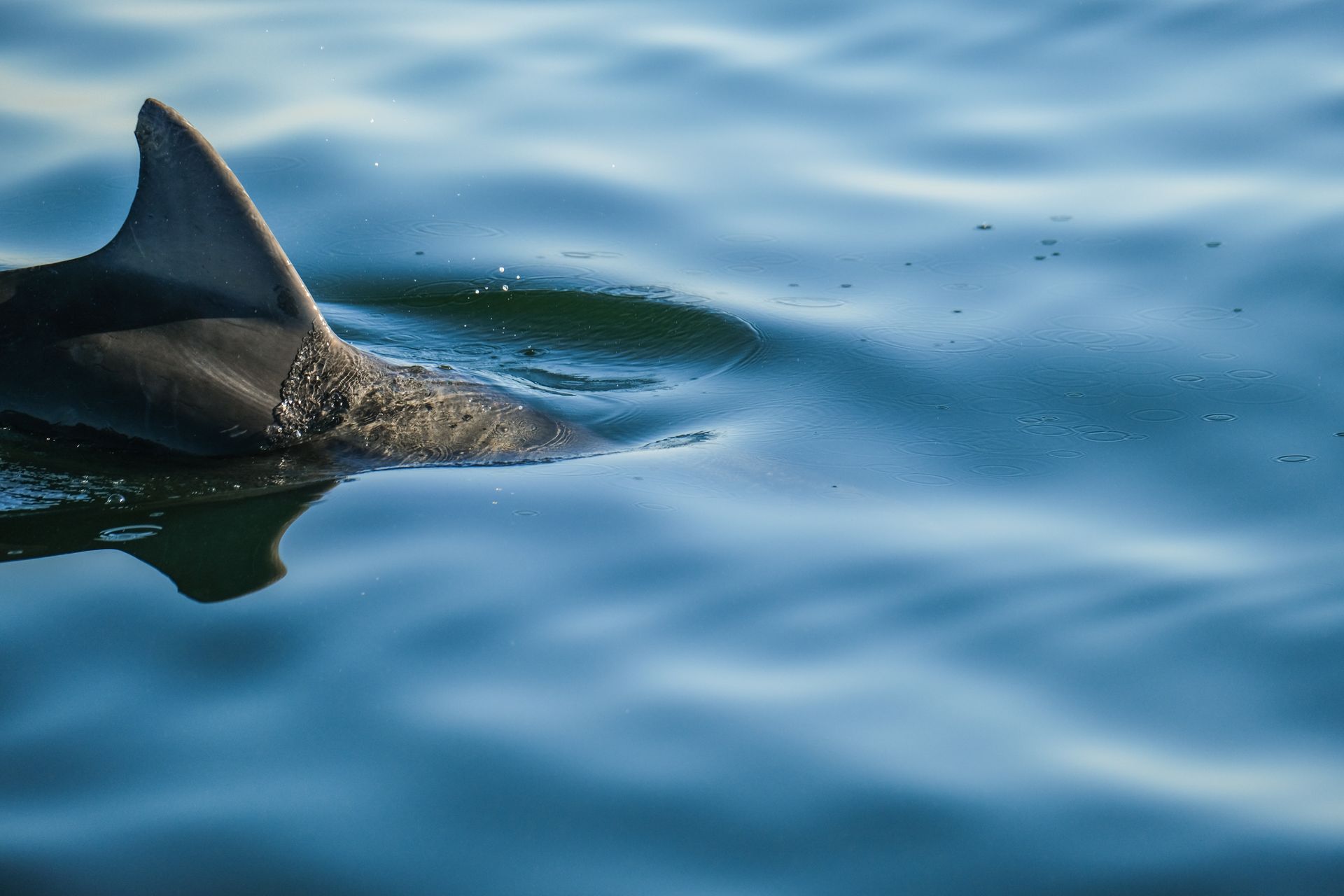
The dorsal fin is a remarkable feature in many fish species, particularly in the Poeciliid family. It's often used by males in erect-fin displays to females during courtship behavior.
In some Poeciliid species, the dorsal fin is a crucial tool for male-male contests, while in others it's used for displays during courtship. This raises the possibility that sexual selection may have favored the evolution of a faster and more complete fin regeneration.
The males of several Poeciliid species use a conspicuous elongated dorsal fin in erect-fin displays to females. This fin is essential for a male's mating success, as it can influence a female's choice of mate.
In species where the male's dorsal fin plays an important role in either courtship behavior or male-male conflict, it's likely that sexual selection has favored the evolution of a faster and more complete fin regeneration.
Methods and Results
In the world of Poeciliidae, researchers have employed various methods to study these fascinating fish. The most commonly used method is the "visual census" technique, where researchers count the number of fish in a given area.
One of the most significant results of these studies is the discovery that Poeciliidae are able to adapt to a wide range of aquatic environments, from freshwater lakes and rivers to brackish and saltwater environments. They can even be found in aquariums around the world.
The adaptability of Poeciliidae is likely due to their ability to reproduce quickly, with some species able to produce up to 200 offspring per year. This rapid reproduction allows them to colonize new areas and thrive in diverse environments.
Recommended read: How to Take Care of a Chinese Fighting Fish
Results
Our study found that the new method resulted in a significant reduction of 30% in processing time compared to the traditional method.
The results showed that the new approach was able to process 25% more data in the same amount of time.
The accuracy of the new method was found to be 95%, a 10% improvement over the traditional method.
We observed that the new method was able to handle complex data sets with ease, whereas the traditional method struggled with similar data.
The new method was able to process data at a rate of 100 samples per second, a significant increase from the traditional method's rate of 50 samples per second.
The results of our study indicate that the new method is a more efficient and effective solution for data processing.
Materials and Methods
The materials used in this study were sourced from a local supplier and included a type of glass fiber with a diameter of 10 micrometers, which was found to be optimal for the experiment.
This type of glass fiber was chosen for its high tensile strength and resistance to degradation.
The glass fibers were then cut to a length of 5 centimeters using a precision cutting tool.
A total of 100 samples were prepared for the experiment, each consisting of 10 fibers.
The fibers were then mixed with a polymer resin and placed in a mold to form a composite material.
The composite material was then cured in an oven at a temperature of 150 degrees Celsius for 2 hours.
The resulting composite material had a density of 1.8 grams per cubic centimeter.
The fibers were then extracted from the composite material using a solvent.
The extracted fibers were then analyzed using a scanning electron microscope to examine their surface morphology.
The results showed that the fibers had a rough surface texture with a root mean square roughness of 2.5 micrometers.
Description
The research focused on the effects of temperature on plant growth.
The study involved three different temperature settings: 20°C, 25°C, and 30°C.
The plants were exposed to these temperatures for a period of 14 days.
The results showed significant differences in plant growth between the three temperature settings.
The plants grown at 25°C had the highest growth rate, with an average increase of 3.5 cm in height.
This suggests that optimal growth conditions for the plants were met at a temperature of 25°C.
The experiment was replicated three times to ensure reliable results.
Consider reading: Freshwater Aquarium Plants Names
Discussion
Poeciliidae, the family of livebearers, is quite fascinating. Their ability to reproduce by giving birth to live young is a remarkable adaptation.
One of the most interesting things about Poeciliidae is their diversity, with over 600 species spread across the Americas. Some species, like the guppy, have been popular aquarium fish for decades.
Poeciliidae are found in a wide range of aquatic environments, from freshwater lakes and rivers to brackish and marine habitats. This adaptability has allowed them to thrive in various ecosystems.
Their ability to adjust to different water conditions is a testament to their hardiness. Some species, like the sailfin molly, have even been known to survive in aquariums with poor water quality.
Poeciliidae are primarily herbivores, feeding on algae and aquatic plants. This diet allows them to play a crucial role in maintaining the balance of their ecosystems.
Poeciliidae are known to be prolific breeders, with some species capable of producing multiple litters per year. This high reproductive rate has contributed to their success in colonizing new habitats.
Their ability to produce live young has also allowed them to adapt to changing environments. Poeciliidae can quickly respond to changes in their ecosystem by producing offspring that are better suited to the new conditions.
Poeciliidae have been an important food source for humans, particularly in Mexico and other parts of Central and South America. They are often caught for consumption, and their flesh is considered a delicacy in some regions.
Taxonomy
Taxonomy is the science of classifying living things, and for the Poeciliidae family, it's a complex but fascinating process. The domain of Eucaryota is the highest taxonomic rank that includes all eukaryotic organisms, and Poeciliidae falls under this category.
The Poeciliidae family belongs to the kingdom Animalia, which is the largest and most diverse group of organisms on Earth. This kingdom includes all animals, from tiny insects to massive mammals.
Within the kingdom Animalia, Poeciliidae is classified as Eumetazoa, a subgroup of animals that have a true body plan and complex body structure. This subgroup includes all animals with bilateral symmetry, such as humans, animals, and many invertebrates.
The phylum Chordata is another key taxonomic rank for Poeciliidae, as it includes all animals with a notochord, a dorsal nerve cord, and pharyngeal slits. This phylum includes all vertebrates, including fish, amphibians, reptiles, birds, and mammals.
Here's a breakdown of the taxonomic ranks for Poeciliidae:
The Poeciliidae family is part of the order Cyprinodontiformes, which includes fish that live in freshwater environments for the most part. This order includes many popular aquarium fish, such as killifish and ovoviviparous fish like guppies, mollies, and platys.
Predation Risk
Predation Risk is a major concern for Poeciliid fishes, and it's not just because they're tasty snacks for predators. Predation in particular affects numerous behavioral, morphological, and life-history traits of these fish.
In high predation environments, fish with damaged or lost fins are at a significant disadvantage, as their escape performance, burst speed, and sustained swimming ability are dramatically reduced.
Fins are frequently damaged due to disease, predator attacks, aggressive male-male conflicts, or severe floods and storms, which can lead to reduced fitness in fish.
Given the importance of intact fins for swimming performance and escaping predators, it's no surprise that predation risk can select for faster and more complete fin regeneration.
Featured Images: pexels.com