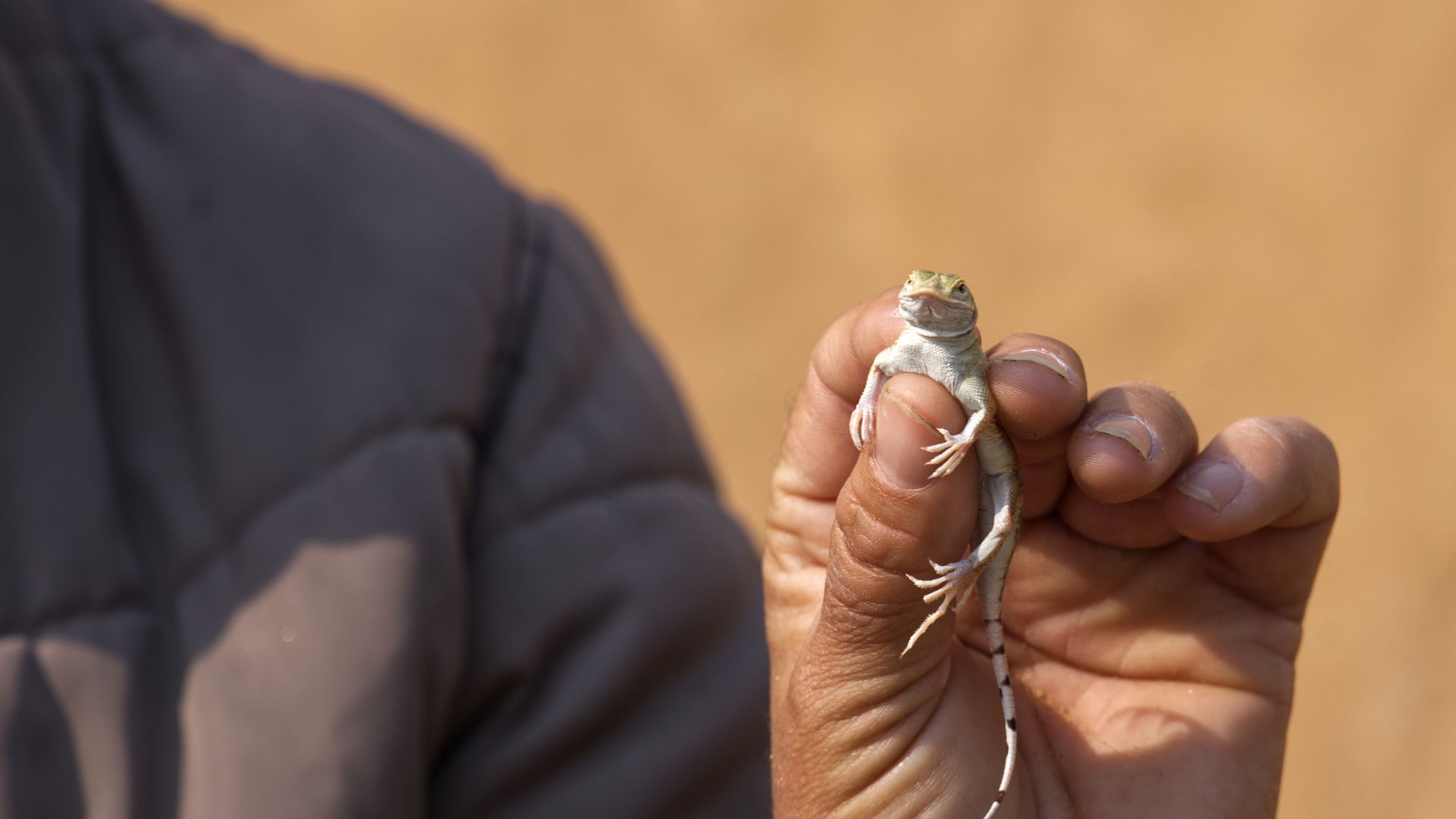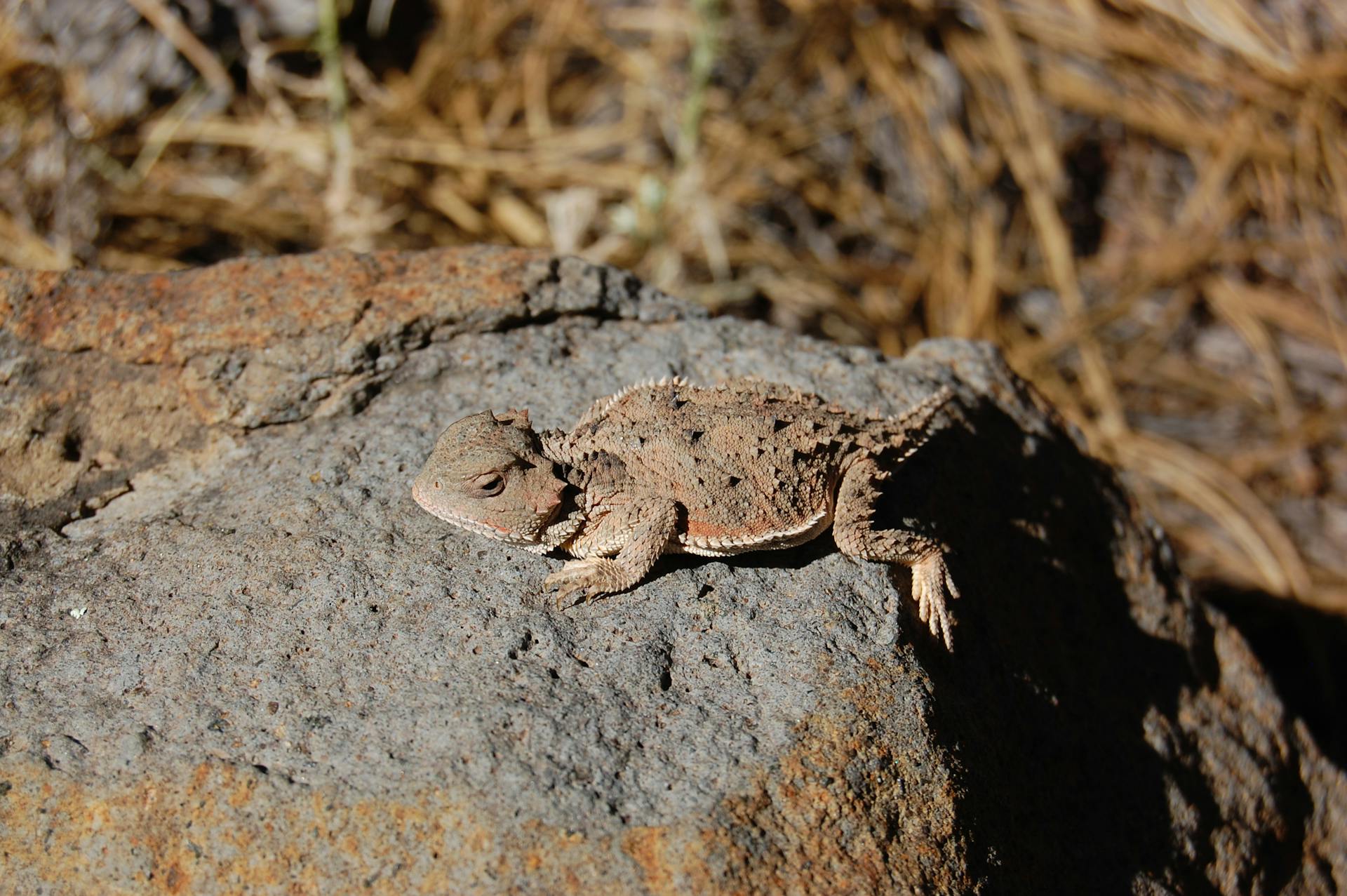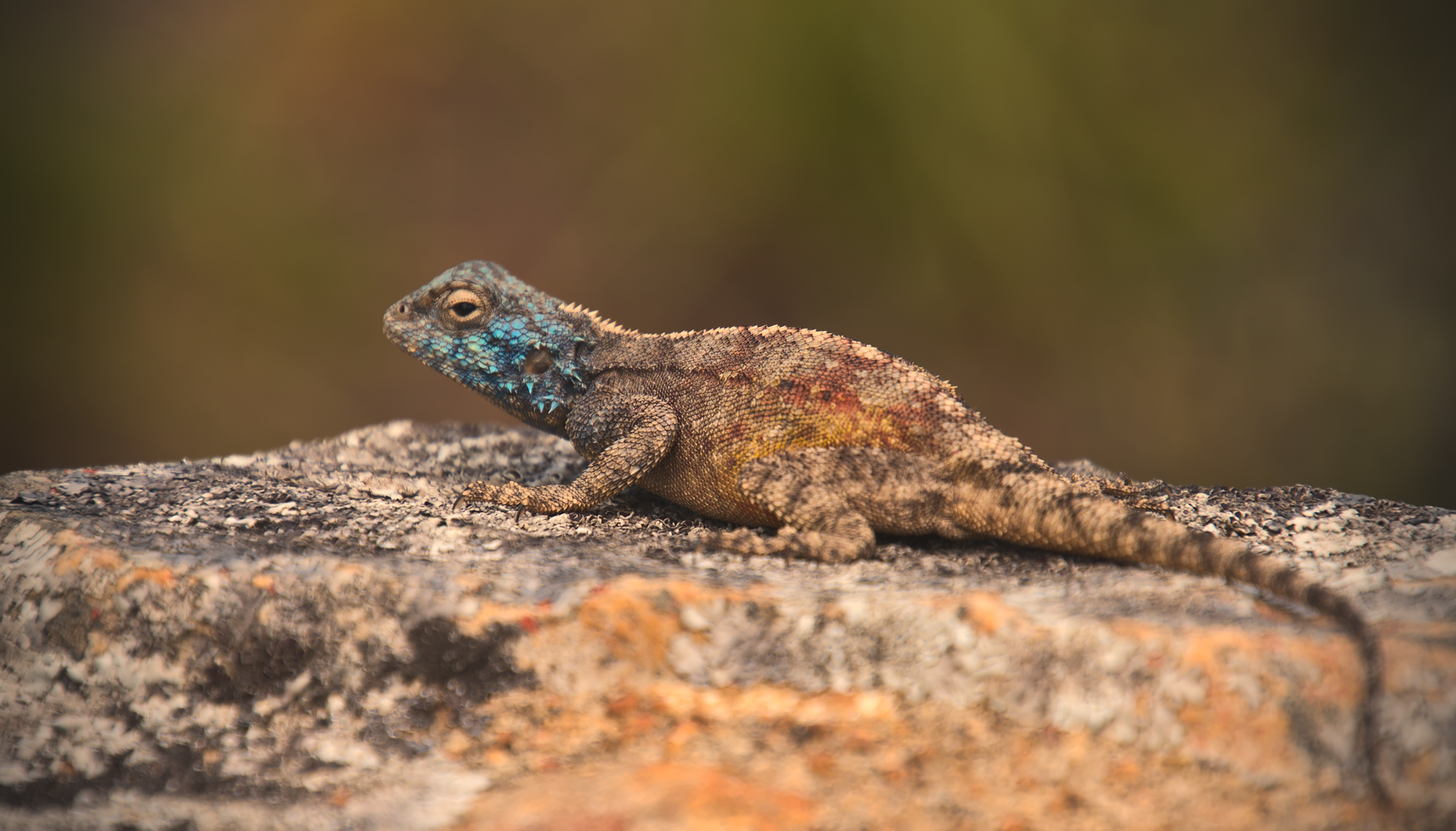
Phrynosoma cornutum, also known as the Texas horned lizard, is a species of lizard that is native to the southwestern United States and northern Mexico.
Its conservation status is a topic of concern, as it is listed as a species of special concern by the U.S. Fish and Wildlife Service.
The main threat to this species is habitat loss due to urbanization and agriculture.
Habitat loss is a significant threat to Phrynosoma cornutum, as they require specific habitats to survive, including sandy or rocky areas with low vegetation.
Their populations have declined significantly over the years due to this loss of habitat, making conservation efforts crucial to their survival.
A different take: Phrynosoma Platyrhinos
Biology
Texas horned lizards' development is a fascinating process. Their white eggs incubate for approximately 40 to 61 days before hatching.
These eggs are quite small, measuring 16 mm long, 10 mm in diameter, and weighing 1 gm on average. Milne and Milne's (1950) study found that eggs were laid in groups of 10-11 with layers of sand in between the layers.
The sex of Texas horned lizards is determined by the temperature of their burrow during development, a process known as temperature sex determination. This means that the temperature of the burrow can influence whether a hatchling is male or female.
Texas horned lizards exhibit indeterminate growth, meaning they can grow throughout their lifetimes. This is typical of reptiles living in a temperate environment.
Here are some key facts about the development of Texas horned lizards:
- Incubation period: 40-61 days
- Egg size: 16 mm long, 10 mm in diameter, 1 gm weight
- Sex determination: Temperature sex determination
- Growth pattern: Indeterminate growth
Physical Description
Texas horned lizards are quite the sight to behold, with their distinctive physical features that help them thrive in their desert and prairie habitats. Their bodies are covered in horny scales, which provide protection from predators.
The largest horns crown their heads, with two forming the brow and more protruding from the jawline and up to the temporal portion of the skull. Two rows of spikes line the lateral portions of their torso, separating the larger spikes of the dorsal side from the scaly underbelly.
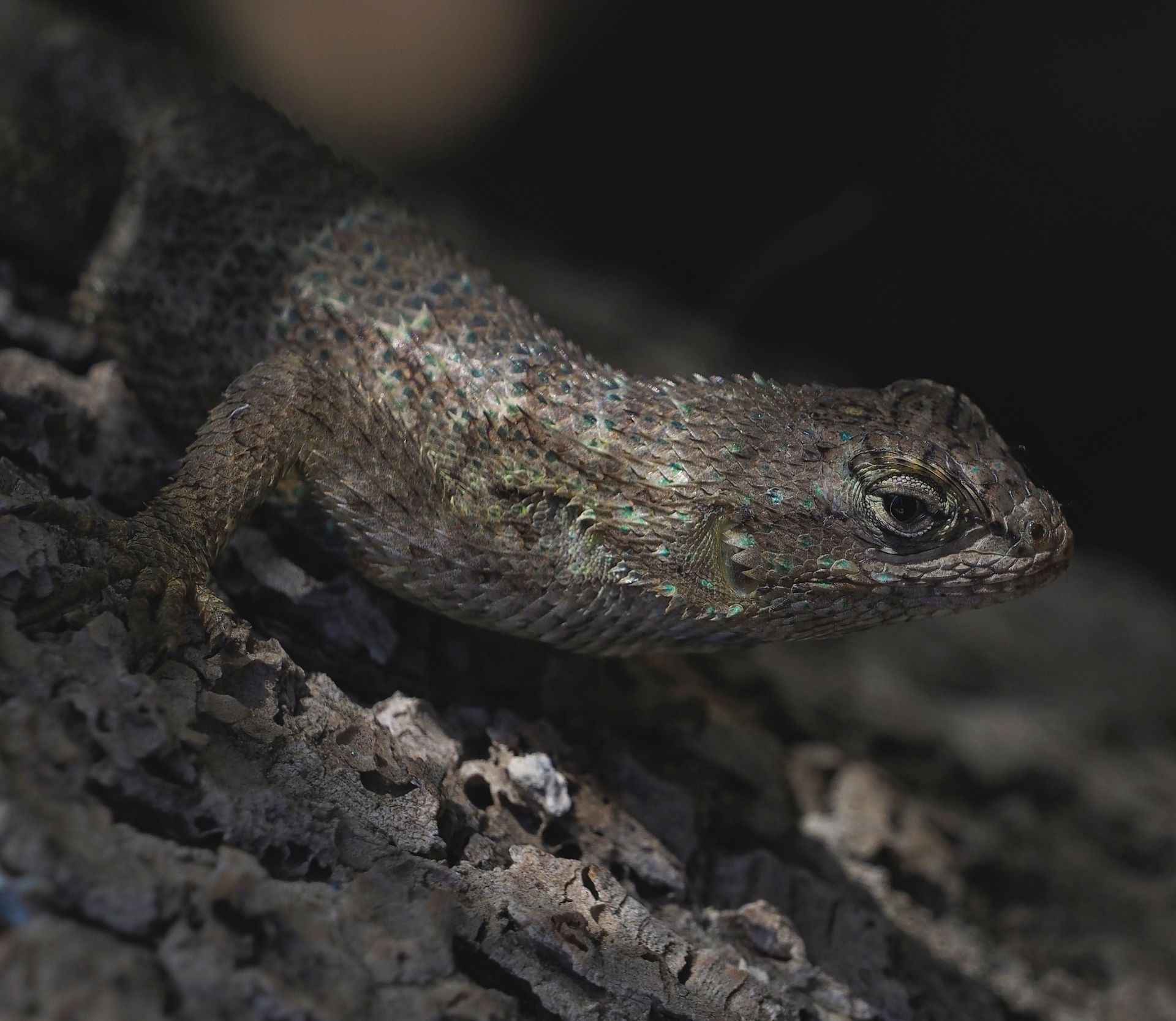
Female Texas horned lizards are larger than males, growing up to 144 mm in length, while males reach a maximum length of 94 mm. Their mass ranges from 25 to 90 g, or approximately 0.88 to 3.17 oz.
These lizards can also inflate themselves with air, making their spikes protrude and making it more difficult for predators to consume them. They can even flatten their bodies to hide.
Dark bars run down the eyes to the tips of the horns, with more upon the head and across the legs. Some individuals have a darker brown or red coloration on the two largest horns on the back of the head.
Here are the different physical features of Texas horned lizards:
- ectothermic
- bilateral symmetry
Interestingly, hatchlings have a dark brown coloration, which may fade into a lighter coloration upon reaching adulthood.
Development
Texas horned lizards' development is a remarkable process. Their white eggs develop for approximately 44 days within the female before being deposited in a burrow.
The eggs incubate for an additional 40 to 61 days before hatching, which is a significant amount of time. Milne and Milne's study found that their clutch of 23 eggs on average measured 16 mm long, 10 mm in diameter, and each egg weighed 1 gm.
The young Texas horned lizards reach adulthood after two years, when their snout-vent length averages 69 mm. This is a notable milestone in their development.
Interestingly, Texas horned lizards do not possess sex chromosomes, which means their sex is determined by the temperature of their burrow during development. This is a unique characteristic of the Iguanidae family.
Here are some key facts about Texas horned lizards' development:
- Development time: 44 days within the female, plus 40-61 days incubation
- Average egg size: 16 mm long, 10 mm in diameter, 1 gm weight
- Adulthood: reached after 2 years, with an average snout-vent length of 69 mm
- Sex determination: temperature-dependent, without sex chromosomes
Habitat and Distribution
Texas horned lizards reside in arid or semi-arid regions with access to open ground and some scattered vegetative cover. These areas include prairies, dunes, deserts, and the edge habitat of playas, which are flat desert basins that are normally dry but may become shallow lakes after rainfall.
They can be found at elevations from 106 m to 1,330 m above sea level. In the mornings and evenings, they bask and hunt for insects on open ground, while in the hot afternoon sun they take shelter under rocks, in rodent burrows, or in crevasses to avoid predation.
Texas horned lizards hibernate from October until late March by burying themselves under soil, litterfall, and foliage. Their burrows average a depth of 140 mm and tend to face the south or south-west, where sunlight exposure is highest during the winter.
Here are the different types of habitats where you can find Texas horned lizards:
- Habitat Regions: temperate, terrestrial
- Terrestrial Biomes: desert or dune, savanna or grassland
Geographic Range
Texas horned lizards have a wide geographic range, spanning across the United States and Mexico.
They can be found as far north as southeast Colorado, Kansas, and southwest Missouri, and as far south as the Mexican states of northeast Sonora, Chihuahua, Durango, Zacatecas, San Luis Potosí, and Tamaulipas.
Additional reading: Lists of Reptiles of the United States
Their range extends as far east as Louisiana and Arkansas, and as far west as southeastern Arizona and New Mexico.
Texas horned lizards are commonly found throughout Oklahoma and Texas, including the barrier islands along the Texas coast.
They have been introduced to 19 states outside their native range in the United States, with locations including the District of Columbia, Florida, Wyoming, Arizona, and Michigan.
See what others are reading: Venomous Lizards in Arizona
Habitat
Texas horned lizards call arid or semi-arid regions home, where they can be found on open ground, prairies, dunes, and deserts. They also inhabit the edge habitats of playas, which are flat desert basins that can become shallow lakes after rainfall.
These areas include bajadas, slopes of fertile soil found along the foot of a mountain. Texas horned lizards have been spotted at elevations ranging from 106 m to 1,330 m above sea level.
In the mornings and evenings, you can find Texas horned lizards basking and hunting for insects on open ground. They seek shelter under rocks, in rodent burrows, under woody vegetation, or in crevasses during the hot afternoon sun to avoid predators.
Here are the habitat regions and terrestrial biomes where Texas horned lizards can be found:
- Habitat Regions: temperate, terrestrial
- Terrestrial Biomes: desert or dune, savanna or grassland
Behavior
Phrynosoma cornutum, also known as the Texas horned lizard, is primarily a diurnal species.
It spends most of its time foraging for food, which consists mainly of ants and beetles.
This species is known to be active during the warmer months of the year.
In general, Phrynosoma cornutum is a solitary animal, only coming together with others during the mating season.
Intriguing read: Phrynosoma Hernandesi
Home Range
Texas horned lizards have a home range that can vary greatly, from as small as 291 m^2 to as large as 14,690 m^2.
The size of their home range tends to decrease as the seasons change, with the largest ranges found in June and substantially smaller ranges by the time they hibernate.
Males tend to have larger home ranges than females, likely to ensure access to potential mates.
In fact, within a group of Texas horned lizards of the same body size, males utilized larger home ranges than females.
Subdominant males also have larger home ranges compared to dominant males, which helps them avoid confrontations with dominant males.
However, it's worth noting that Texas horned lizards do not actively defend a territory within their home range.
Here's an interesting read: Desert Horned Lizard
Predation
Texas horned lizards have some clever defense mechanisms to protect themselves from predators. They know to flee from ambush predators like western diamondback rattlesnakes, and to stand their ground against chasing predators like Sonoran whipsnakes or coachwhips.
Standing their ground means remaining motionless until the predator passes by. If noticed, they may engage in a defensive posture by flattening their torso, lowering the tail, and facing the threat with their mouths agape.
If the threat approaches, they will hiss and lunge to defend themselves. This behavior is a clear warning to predators that they're not an easy meal.
Texas horned lizards can also squirt blood from their eyes, which they spray at predators. In fact, one individual studied by Burleson ejected blood from its left eye at a distance of nearly 1 meter.
The horns of horned lizards are also thought to be used to defend against predators. The horn of this species has been found puncturing the throats of all listed species except greater roadrunners.
Here's a list of some of the known predators of Texas horned lizards:
- Canids
- Western diamond-backed rattlesnakes (Crotalus atrox)
- Sidewinders (Crotalus cerastes)
- Sonoran whipsnakes (Masticophis bilineatus)
- Coachwhips (Masticophis flagellum)
- Prairie falcons (Falco mexicanus)
- American kestrels (Falco sparverius)
- Loggerhead shrikes (Lanius ludovicianus)
- Red-shouldered hawks (Buteo lineatus)
- Greater roadrunners (Geococcyx californianus)
Conservation
Conservation efforts are underway to protect the Texas horned lizard, but it's a complex issue. The species has no special status on the US Federal List, CITES, and State of Michigan List.
In Texas, the main threats to their survival are urbanization, collection as pets, and the loss of their main food source, harvester ants. Harvester ants make up 69% of their diet.
The use of pesticides not only harms harvester ants but also directly causes illness in Texas horned lizards. This is a significant concern, as these lizards are highly specialized and cannot survive on other food sources.
The Texas Wildlife and Parks Department recommends against taking Texas horned lizards as pets, as they often die after a few months in captivity. Releasing them onto private property is also discouraged.
Here are some conservation statuses of the Texas horned lizard:
- IUCN Red List: Least Concern
- US Federal List: No special status
- CITES: No special status
- State of Michigan List: No special status
In Oklahoma, Texas horned lizards are classified as "species of special concern", and their collection and harm are considered unlawful. This is a step in the right direction, but more needs to be done to protect this species.
You might enjoy: Common Snapping Turtle Species
Frequently Asked Questions
What is the common name for Phrynosoma cornutum?
The common name for Phrynosoma cornutum is the Texas horned lizard.
Featured Images: pexels.com